Meta cutting 600 AI jobs even as it continues to hire more for its superintelligence lab

posted in: All news | 0

MENLO PARK, Calif. (AP) — Meta Platforms is cutting roughly 600 artificial intelligence jobs even as it continues to hire more workers for its superintelligence lab, the company confirmed on Wednesday.

Related Articles


$1B Rosemount aerospace complex, University of St. Thomas semiconductor hub receive state funding


Reddit sues AI company Perplexity and others for ‘industrial-scale’ scraping of user comments


YouTube steps up its shopping game with help from influencers


Gold prices have tumbled from recent records. What’s behind the losses?


AI can help the environment, even though it uses tremendous energy. Here are 5 ways how

Axios first reported the cuts, which will affect Meta’s Fundamental AI Research, or FAIR unit, as well as product-related AI and AI infrastructure units.

Its newer TBD Lab unit won’t be affected. Citing a memo sent to workers by chief AI officer Alexandr Wang, Axios said the company is encouraging employees affected to apply for other jobs at Meta, with most expected to find other roles. The Menlo Park, California-based company is also still recruiting and hiring for TBD Lab, which is developing Meta’s latest large language models. Large language models are the technology behind OpenAI’s ChatGPT, Google’s Gemini — and Meta’s Llama.

Meta has taken a different approach to AI than many of its rivals, releasing its flagship Llama system for free as an open-source product that enables people to use and modify some of its key components. Meta says more than a billion people use its AI products each month, but it’s also widely seen as lagging behind competitors such as OpenAI and Google in encouraging consumer use of large language models, also known as LLMs.

Beyond Meat shares briefly sizzle on Walmart deal and meme stock interest

posted in: All news | 0

By DEE-ANN DURBIN

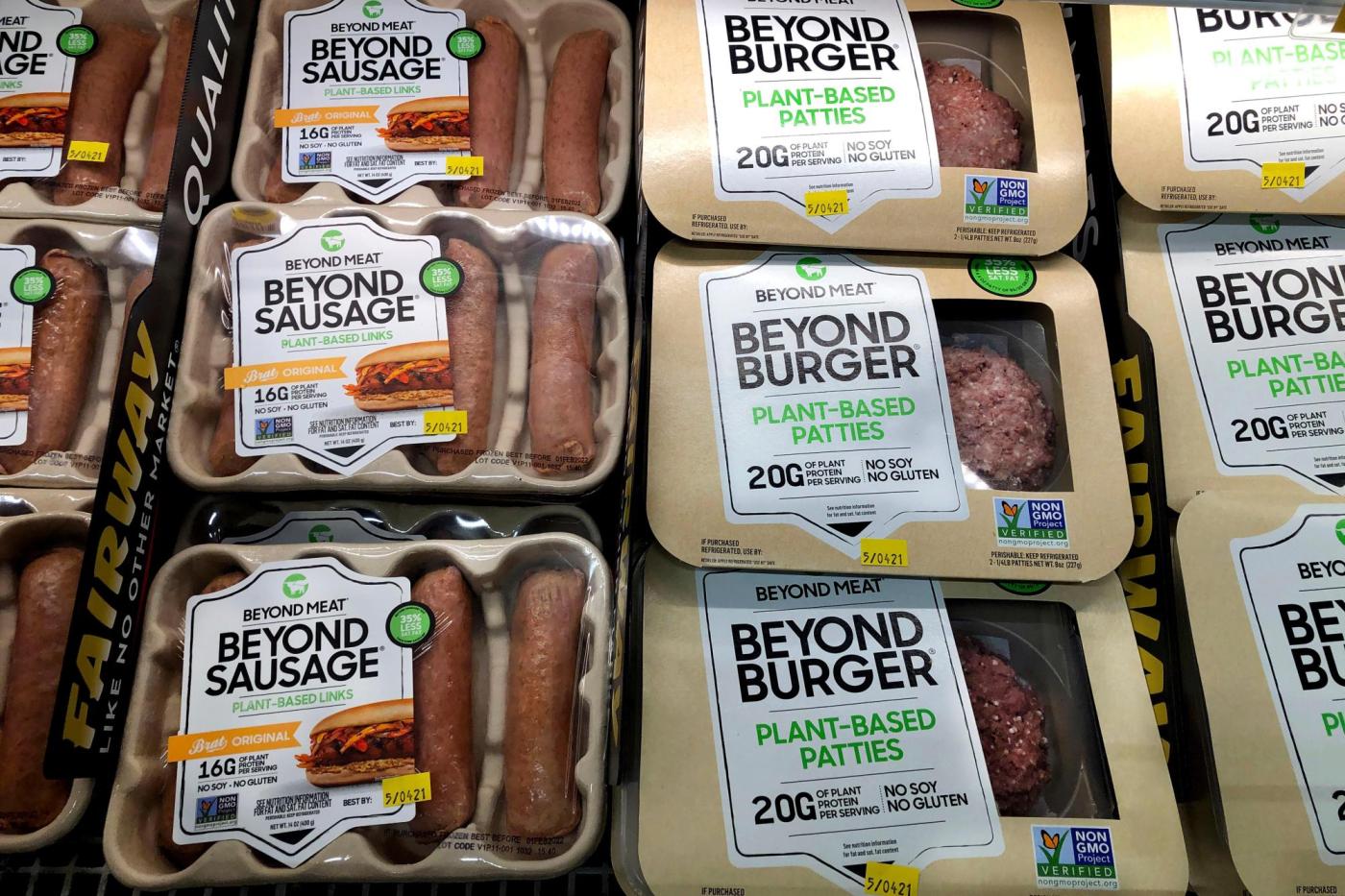
Beyond Meat’s shares briefly sizzled Wednesday before heading back down again.

Related Articles


$1B Rosemount aerospace complex, University of St. Thomas semiconductor hub receive state funding


Reddit sues AI company Perplexity and others for ‘industrial-scale’ scraping of user comments


YouTube steps up its shopping game with help from influencers


Gold prices have tumbled from recent records. What’s behind the losses?


AI can help the environment, even though it uses tremendous energy. Here are 5 ways how

The plant-based meat company’s shares more than doubled early Wednesday before closing at $3.58 per share, which was down 1%. Still, it was a surprising comeback for a stock that was trading at an all-time low of 50 cents per share late last week.

Investors cheered Beyond Meat’s announcement Tuesday that it’s increasing the availability of some of its products at U.S. Walmart stores. Beyond Meat said that its chicken pieces, Korean BBQ-style steak and burger six-packs will now be easier to find in more than 2,000 Walmart stores.

Beyond Meat also launched a direct-to-consumer website this week, which will try to build buzz by offering limited releases of new products.

But perhaps the biggest driver of interest in Beyond Meat is Roundhill Investments, which added Beyond Meat to its Meme Stock ETF, or exchange-traded fund, on Monday. The fund consists solely of meme stocks, which are stocks that gain popularity and trading volume based on social media hype rather than a company’s financial performance.

Investors have been sporadically turning to meme stocks throughout 2025 in an effort to find bargains amid a very pricey stock market. The stocks are often the target of “short sellers,” or investors betting against the stock.

Beyond Meat was the darling of the plant-based meat industry when it went public on the Nasdaq stock exchange in 2019.

But in recent years the El Segundo, California-based company has been struggling with weak demand for its burgers, sausages, tenders and other products. Beyond Meat’s net revenue was down 15% in the first six months of this year.

Beyond Meat’s stock price cratered last week after the company announced the expiration of lock-up restrictions on some of its 326 million shares of new stock as part of a plan to help it reduce its debt load and extend the time until its debt matures. The lock-up had prevented shareholders from selling the stock but now they were free to do so.

John M. Crisp: How do you know when you’ve become an autocracy?

posted in: All news | 0

Schemes of national governance are complicated and subject to generalization, but for the sake of argument, let’s put “democracy” at one end of a spectrum and “autocracy” at the other and consider the bright line that separates them?

There isn’t one.

In fact, since 1997 the Center for Systemic Peace has maintained a 21-point scale that takes into account various political variables — elections, the role of the military, economic inequality, political violence and so on — in order to describe where countries stand on the scale between democracy and autocracy.

On the autocracy end, at -10, are the countries that you would expect: North Korea, Saudi Arabia, Bahrain, obvious autocracies all.

At +10 are the apparent democracies: Switzerland, New Zealand, Canada and, until recently, the United States.

In the middle, between -5 and +5, are what political scientists call partial democracies, hybrid regimes or anocracies. They embody elements of both autocracy and democracy, and the point where one clearly shades into the other is elusive.

In her ominously entitled book, “How Civil Wars Start,” published in 2023, political scientist Barbara F. Walter describes the erosion of America’s standing on this 21-point scale during President Donald Trump’s first term, which began with the U.S. at +10.

Shortly after Trump’s inauguration in 2017, America’s score fell to a +8 based on Trump’s efforts to purge government figures he deemed disloyal and to punish opponents. He refused to disclose his tax returns, and he pardoned friends who were guilty of crimes.

By 2019 Trump was refusing to cooperate with Congress, especially in connection with his impeachment. He sued to block subpoenas and refused to turn over information needed for congressional oversight. The polity scale score dropped to +7.

The pandemic and the George Floyd protests encouraged Trump’s tendencies to absorb power into the executive branch. And then there was January 6, an indisputable, if inept, effort to overturn an election.

By the end of Trump’s term, the U.S.’s score had dropped to +5, making America, according to Walter, an anocracy, rather than a democracy, for the first time in more than 200 years.

I searched in vain for the U.S.’s current score, but Trump’s first nine months in office can’t have been good for it. It’s easy to see why Trump’s critics worry that we’re headed for genuine autocracy.

Of course, few countries aspire to autocracy. About the only countries that are honest about this are places such as Saudi Arabia, which unashamedly calls itself a Kingdom. China, on the other hand, is officially the People’s Republic of China. North Korea, fooling no one, is the Democratic People’s Republic of Korea. Even Iran, a thoroughgoing theocracy, calls itself the Islamic Republic of Iran.

But we have (or had) a real republic, and it would be a shame, despite its imperfections, to let it slip away.

Because, as the analysis above suggests, autocracy always comes gradually. Where’s the point when we are no longer a republic, or even an anocracy, but have become an autocracy?

Is it when the president openly orders his Department of Justice to prosecute his political enemies? Is it when he sends federalized troops under flimsy pretenses into states and cities governed by Democrats? Is it when he uses military force against a sovereign nation (Venezuela, for example) without bothering to consult Congress or ask for a declaration of war?

Or does autocracy begin with less dramatic measures, like when Trump started calling the Gulf of Mexico the Gulf of America and required others to do the same? Or when he renamed American military installations to honor the Confederate officers (despite the cover story) who fought to preserve slavery because… well, because he could?

Or does autocracy begin when something clicks in the mind of the wannabe authoritarian and he realizes that he can do nearly anything he wants with impunity?

I thought of this last week when Trump threatened to relocate World Cup matches scheduled to be played in Boston next year because Boston’s mayor is “radical left.”

Maybe autocracy starts with something as trivial as this. Or maybe it starts the moment our country loses the will to say no to Trump.

John M. Crisp, an op-ed columnist for Tribune News Service, lives in Texas and can be reached at jcrispcolumns@gmail.com.

Allison Schrager: The era of the illiquid millionaire is here

posted in: All news | 0

Being a millionaire isn’t what it used to be. This isn’t a lament, it’s a fact: As Bloomberg News reported recently, almost one-fifth of U.S. households have a net worth of more than $1 million. Fully one-third of them have gained that status since 2017.

There is, however, an important caveat to this data, which is through 2023: Most of that wealth is on paper. America may be entering the Era of the Illiquid Millionaire. Compared to the alternative — the illiquid non-millionaire — it is a nice problem to have. But it also is redefining what it means to be rich, with profound implications for both society and public policy.

Americans’ wealth is the result in part of a soaring stock market (up more than sevenfold from the bottom in 2009) and increasing real estate values (up 125% since 2009). Many Americans benefited from these markets because of deliberate policy choices that encouraged investment in them. In 1989, only 32% of Americans owned any equity; by 2022, about 60% did.

The big change first came from the increased popularity of tax deferred retirement accounts, which are the way most Americans save.

Since the 1980s, retirement accounts have displaced other forms of saving and are now how most Americans invest in markets. But these accounts make Americans feel richer than they are.

First, they are illiquid — that is, investors can’t get their money without paying a penalty (or borrowing against it) until they are 59. Also, most of the time they still owe income tax on the money — and the rate will probably be much higher than the capital gains tax rate on post-tax assets. Even if retirement assets are reported just like other kinds of financial assets, they are often worth less.

The other big source of wealth is housing, which makes up about 40% of the net worth of a typical American household. Policy also encourages homeownership: with tax incentives, subsidies for the mortgage market, and efforts to keep interest rates low. (Policy has also restricted supply, contributing to rising home values, which incentivizes homeownership.) But a house, too, is illiquid. Selling a home involves substantial transaction costs, and people who sell their house have to find somewhere else to live. The housing market can be brutal, with high prices and higher mortgage rates.

It all adds up to an illusion in which we tell ourselves: We are rich! I fall for it myself. I am doing things I never did before, such as looking at my brokerage account when the market is up and checking real-estate listings for similar apartments. It feels good, and even though I know better, it is easy to forget that I am actually about 35% less wealthy than it appears.(That’s about what it would cost me to convert my assets into cash and pay my tax liability when I am old enough to withdraw my money, which I can’t now. If I liquidate today, I am about 50% less wealthy than my account says I am.)

In some ways this wealth means America’s policy choices encouraging retirement saving and home ownership have been successful. These policies force people to save for the future, giving them a more comfortable retirement that is less reliant on public benefits.

On the federal level at least, the momentum is to encourage even more illiquidity for retirement investors — such as the White House’s plan to allow private equity in 401(k)s, which is a very bad idea. These proposals tend to come when asset prices are high, less so when prices fall.

But there are downsides. The illusion of wealth can encourage people to take on more debt — and unsurprisingly, home-equity loans and loans against 401(k)s have become more common. And while retirement accounts may mean more money for the future, they also increase vulnerability to economic shocks today.

And if a price correction in the market makes all these rich-on-paper Americans feel much poorer and cut back on spending, watch out. Wealth effects can be significant, even when investors are looking at an account they can’t touch for decades.

That’s what makes this story far more consequential than a cliché profile of a high-earning but cash-poor millionaire straight out of a Tom Wolfe novel. When almost 20% of the population is worth $1 million or more, $1 million truly does not mean what it used to. If your net worth is a million dollars, you’re certainly not poor. But you’re not as rich as you might think.

Allison Schrager is a Bloomberg Opinion columnist covering economics. A senior fellow at the Manhattan Institute, she is author of “An Economist Walks Into a Brothel: And Other Unexpected Places to Understand Risk.”