CHICAGO — Before I moved to Chicago, years ago, whenever I found myself here in the city, I would carve out time and head to Wicker Park, trudge to the second floor of the Flatiron Arts Building and enter the House of Monsters, which was owned by a guy named Barry Kaufman who always seemed buried alive beneath latex vampire masks and imported Godzillas and dioramas of giant spiders and every back issue of Famous Monsters of Filmland, their old covers lined up like a demonic yearbook.
The old uneven floors creaked.
The clogged aisles screamed fire hazard.
It was the kind of place I would dream about when I was 10, but never did exist.
Not until it did exist, like some dark manifestation from the back pages of Famous Monsters, which were dank and ugly and peddled bootleg Darth Vaders and rubber werewolf masks and Super 8 reels of “Mysterious Dr. Satan” and X-ray eyeglasses. House of Monsters hung around for 11 years and folded its Wicker Park shop in 2007 but continues online, still operated by Kaufman, who once saw the future of horror-themed businesses and knew it was horrible.
Slowly, steadily, like a zombie pulling itself out of fresh earth, a small but quite lively patchwork of horror-and-gothic-themed shopfronts and cafes and restaurants and bars have been replicating across America. Call it a byproduct of the anxious early 21st century, call it capitalizing year-round on what Spirit Halloween only offers for 60 days, but right now, on Long Island, there’s a Haunted House of Hamburgers. Los Angeles offers an entire stretch of Burbank seemingly dedicated to horror shops. In eastern Indiana, you’ll find Famous Monster Pizza. When Orlando’s cheerfulness is driving you batty, the Post Mortem Horror Boo-Tique in nearby Kissimmee is like Ann Taylor for Wednesdays. Need a good book? The Twisted Spine, New York City’s first horror bookstore, just opened. In Arkansas, grab a Chicago Mothman hot dog at The Witching Hour food truck — or if you prefer a hamburger, they come “slaughtered” (chopped cheese) or “smothered” (melted cheese).
“I do hear from a lot of people these days that ‘Oh, we couldn’t have done a horror store without House of Monsters,’” Kaufman said, “but all of this feels inevitable. The interest was there, it just took people to recognize that the horror community wanted places to gather. But because of social media, because of horror franchises being so widespread, because of a perfect storm of reasons, these are basically mainstream spaces today.”
Horror as a lifestyle, in other words, is now an option.
And Illinois, in particular, leads the way.
(Save the “hellhole” cracks for TikTok, thank you.)
Morning on the Moors
Your day begins like every other.
You climb out of your crypt, vaguely revived, allergic to the sun. Good news: Chicago offers plenty of variety for the nearly undead. On the South Side, at the end of a quiet Bridgeport cul-de-sac is Jackalope Coffee & Tea, which only sounds pleasant. It is, in fact, disgustingly charming, if you’re cool with “Night of the Living Dead” posters, man-size aliens and one whole room largely painted black, set off with a tapestry of a Victorian woman haunted by a vaporous skull. In the center of the room is the perfect round table to host a seance. By the front door is a box labeled “Menstruatin‘ With Satan,” full of personal care items for free, sponsored by the Satanic Temple of Illinois.
Skulls adorn the curtains. As a nod to the neighborhood’s Latino influence, “The Shining” twins are painted onto a wall, refashioned as Día de los Muertos skeletons. Like many horror-themed year-round businesses, nothing about Jackalope comes off as indifferent or routine; a visitor is rewarded for peering close into every nook and cranny.
It opened 13 years ago as something of a response to the end of the moody, gothic punk scene that co-owner January Overton, now 48, once sought in Lakeview — namely the infamous Punkin’ Donuts era of Belmont Avenue and Clark Street. She and her husband, John Almonte, have been veterans of Chicago’s punk and metal scenes for years.
“I grew up in Bridgeport and wanted that aesthetic here,” Overton said. “Except, not so much dark as fun.”
And so, on a peaceful morning, The Slits’ “Typical Girls,” and a canon of punk classics, blast away while customers peck at laptops.
“I wasn’t sure about any of this at first,” she said. “Now it’s an extension of our home.”
A similar spirit animates The Brewed coffeehouse in Avondale, which is lined with display cases of horror memorabilia culled from personal collections of its owners. A “Dark Shadows” board game. A commemorative “Creature from the Black Lagoon” plate. Woven into the decor are nods to John Carpenter’s “They Live” and Jordan Peele’s “Get Out.” A skeleton nonchalantly occupies a stool among the living. The very name, The Brewed, is a clever take on David Cronenberg’s “The Brood.”
“We had an inkling this could work,” said Jason Deuchler, co-owner with Nick Mayor and Jen Lemasters. “What we didn’t know is how much this would be embraced.”
At least a a thousand customers attended a Halloween market on a recent Sunday, the line for coffee curling long past the shop’s antique tube TV, which plays either a clip of the spooky girl from “The Ring” or the malicious Halloween commercial from “Halloween III.”
“I think there’s room for more (horror coffeehouses) like this,” he said, “and you know, one person’s passion so easily can become a parody, but right now, with the way our daily lives can seem to be reflected by horror, I think we’re in a good place for more.”
The last thing Julia Goodmann, co-owner with Lisa Harriman, of Loaves + Witches coffeehouse in Edgewater wants is a parody of the dark arts. They are self-described “witchy” owners, practicing witches, “very much aligned spiritually with the occult,” Goodmann said. The look is elegant, black and white, with only a handful of clear references to witches.
But the gothic sensibility is undeniable.
“Some of my family thought we were going for kitschy witchy,” she said, “like Disney caricatures, with ‘Hocus Pocus’ cauldrons or something. And we were thinking witchy as in earth forward, nature, warm, inviting. Still, having witches here and there is fun.”
Anushka Sen, an assistant professor of English, reads at a table at Loaves and Witches on Oct. 16, 2025, in Chicago. Hanging on the wall behind her is a collection of bones and dried flowered made by an artist named Horisora. The bones have intentions written on them often as part of spiritual rituals. Loaves and Witches is a witch-owned, coffee house in Edgewater (Stacey Wescott/Chicago Tribune)
They offer a Coven Cold Brew and a Hex Your Ex Coffee Cake, but the most outwardly frightening element are the images on their bags of coffee, which, like the coffee at Jackalope, comes from Parker Slade and his horror-themed Lakeview roasting business, Hexe Coffee. On the bag of his Brazilian and Peruvian blend, there’s an eyeball impaled on a knife; on the front of another bag of beans, a horde of demons and ghosts scream out of a man’s skull.
“I have definitely heard from at least one big grocery chain that ‘No, no, look, absolutely not! You can not put stuff like that on the side of a coffee bag,’” said Slade, who started Hexe in 2016 while he was roasting coffee at home and binging murder podcasts.
About six years ago, he got around the understandable hesitation for ghoulishly-branded coffee by opening a Hexe coffeehouse on Diversey Parkway. On a recent Saturday morning, like many mornings here, it had a line out the front door of parents and strollers and elderly couples and tech bros, a sharp contrast to Hexe’s dark industrial aesthetic.
An employee walks past a wall featuring a witches broom and a bulletin board entitled “The Coven” at Loaves and Witches on Oct.16, 2025, in Chicago. (Stacey Wescott/Chicago Tribune)
A taxidermied tarantula beside the bar. Paintings of skulls and flowers. Antlers. On the wall behind one toilet, in a Ye Olde New England font, it read: “What Fresh Hell is This?”
And yet, that’s Steely Dan playing softly in the background.
“People always tell me that it’s so ‘cute’ in here,” Slade said. “And I get so angry at that. ‘Cute’ is really not what I was going for. And that’s when I will throw some Slayer on.”
Little Afternoon Shops of Horror
Before you’ve even stepped across its threshold, Ghoulish Mortals in St. Charles beckons. Tentacles (inflatable) uncurl out of the second story of its old brick storefront. The flower boxes out front are full of black (metal) flowers that glower. The wavering theme to Disney’s “Haunted Mansion” ride drifts across the sidewalk. You step inside only to trigger a motion sensor that, on most days, sets off the creeeak of a heavy castle door.
Inflatable tentacles poke out of the windows of Ghoulish Mortals, a horror themed store in St. Charles, on Oct. 16, 2025. The store sells monster as well as horror items and art in their various themed sections. (Dominic Di Palermo/Chicago Tribune)
Ghoulish Mortals comes on like a direct descendant of House of Monsters, though its wares are a mix of collectible horror movie tchotchkes and art prints, many by local artists. (“Creeptastic products” is how they put it.) “Is this all there is?” a woman asked me the other day, beside a shrine to “Creature From the Black Lagoon.” We were only in the first room, and like any good scary building, the place just goes on and on — past an H.P. Lovecraft alcove, a replica of the Christmas-lights living room in “Stranger Things,” and an Audrey II from “Little Shop of Horrors” big enough to selfie yourself in its jaws.
It’s the kind of place you browse without buying — what am I going to do with an cannibalistic-looking Elmo doll? Or a Bigfoot patch? Or the sweetest little crocheted goat demon doll? And, indeed, for a while, said Dove Thiselton, who owns Ghoulish Mortals with husband Warwick Price, “there wasn’t a vacation for years, we were sad and broke. Though now” — after seven years in St. Charles — “we’re making money.”
Dawn Dominguez, of Minooka, left, takes a picture of her friend Laurie Schneider, of Wilmington, who posed for a photo with a life-sized Michael Myers figure, from the movie “Halloween” in the basement of Ghoulish Mortals in St. Charles, on Oct. 16, 2025. (Dominic Di Palermo/Chicago Tribune)
What comes across is the simple nerdy joy of sharing a monster — or a love of the genre itself. The Horror House, across the street from The Brewed, will sell you a “Friday the 13th” T-shirt or a Pennywise fanny pack or sunglasses that appear to be soaked in blood, but the meat of the store is Frankenstein dolls, Dracula puppets, retro Halloween decor that, come on, nobody who shops here takes down after Oct. 31.
Personally, I’m less enthusiastic about the enamel Charles Manson pin that you can buy from Graveface Records & Curiosities in Bucktown, or a John Wayne Gacy shirt, but their taxidermied squirrels flipping the bird? What it lacks in classic horror it makes up for in fever dream. (To complete the vibe, they also sell cult horror film soundtracks.)
Bucket O’ Blood Books & Records in Avondale — its eye-popping psychedelic eyeball sign on Elston Avenue a neighborhood fixture after more than a decade — is not named for the 1959 Roger Corman horror comedy, but ancient slang for an unsavory business. It wears its name proudly, like a reminder that scary things were not always embraced so warmly. As you enter, the front is given over to horror literature, diced into countless categories — medical, indigenous, witchy, extreme.
“To be honest, this store came out of a personal need of my partner and I,” said Jennifer McKee, co-owner. “We were frustrated at not being able to find small press horror, out-of-print sci-fi, marginalized voices. And in the time since? We’ve grown and expanded. It was a personal project, it was never ‘Oh, this thing will become a trend a decade later.’”
Children of the Night
At Wolfden Brewing in Bloomingdale, I walked to the bar and asked where to find the ghosts. If one can roll their eyes loudly, the woman to my right managed. The bartender smiled. They get this a lot. Wolfden isn’t a horror business per se; its wolf motifs stop short of full moons and man-beasts. But Wolfden isn’t shy about being a local pub that happens to be haunted — they tout themselves as the most haunted brewery in Illinois. They offer occasional ghost hunting tours of the grounds. The bartender told me to grab a table upstairs — “that’s where customers tend to feel something ghostly around here.”
It was dead silent — a stray bit of light seeped from behind a partially closed door.
Probably nothing.
And yet, Katie Wolf, who owns Wolfden with her husband Krys, said when they bought the 1851 building in 2017 and heard stories of ghosts, they thought it was nothing, too. Until plates started to fly. During trivia night, something growled into the microphone.
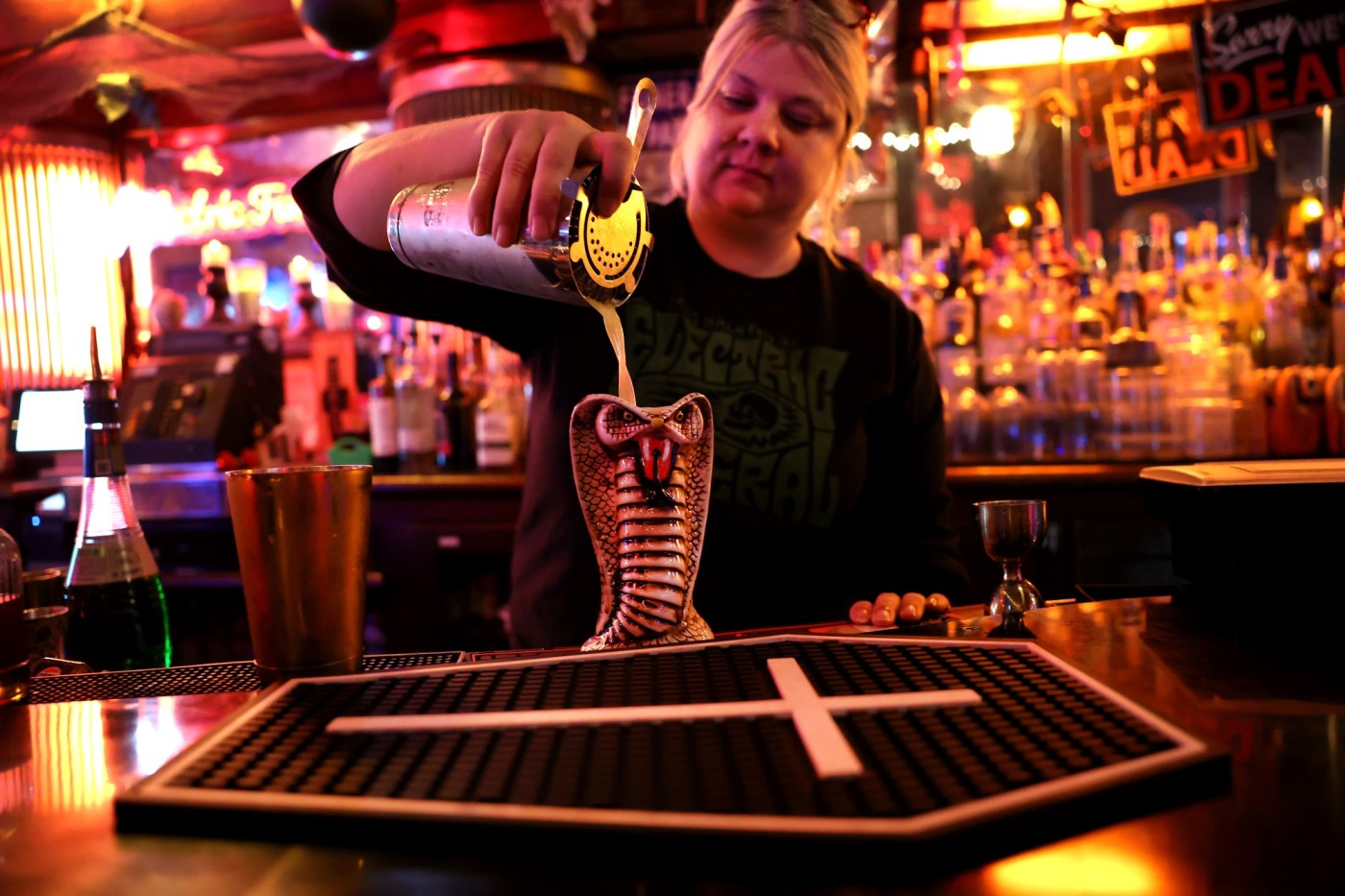
Should that make you want to hightail it out there and toward a stiff drink at a non-haunted place, might I suggest Electric Funeral in Bridgeport, owned by Overton and Almonte of Jackalope. The facade is jet black. When you enter, you will probably notice the two-headed goat breathing fog, and the full-sized coffins and a skeleton bartender (and a live bartender).
“We get normies who come in and gape like it’s a Rainforest Cafe,” Overton said.
Fog-producing goat decorations are seen above the entrance to the horror-themed Electric Funeral bar in Chicago’s Bridgeport neighborhood on Wednesday, Oct. 15, 2025. (Chris Sweda/Chicago Tribune)
Those folks might want to avoid the “Carrie”-minded blood drop planned for Halloween night at The Final Girl in Kenosha, Wisconsin, a small horror-themed neighborhood bar that opened last year, down the street from The Final Inning bar and The Tipsy Bear bar. You can catch the Packers on Sunday here, albeit beneath a mural of Jamie Lee Curtis and Michael Myers and a neon sign that reads “Hello Sidney,” a nod to “Scream.”
“I have to explain the name of the bar all the time,” said owner Chelsea Vecchione, “that it’s a reference to the horror trope of a last girl standing, but it’s also, to me, a reference to how my focus is on beer and Wisconsin but I work in a male-dominated area and I am a queer person who never felt my voice was heard — I am like a final girl, a survivor.”
I stopped by the other day. As I ate the Ripley’s Facehuggers (wings) with Pig’s Blood (Korean BBQ sauce), the door burst open. A boisterous couple walked in and stared at the horror all around us.
“Whoa, this place is nuts!” the man announced.
The bartender shrugged and took their orders. He’d seen scarier.
cborrelli@chicagotribune.com