Fall is reading season.
In the following months, publishers both big and small will release some of their most anticipated titles, perfectly timed for readers who want to dig into a book in a park, their backyard, or a coffeehouse with a hot drink in hand. (We won’t judge you for ordering something pumpkin-spice flavored.)
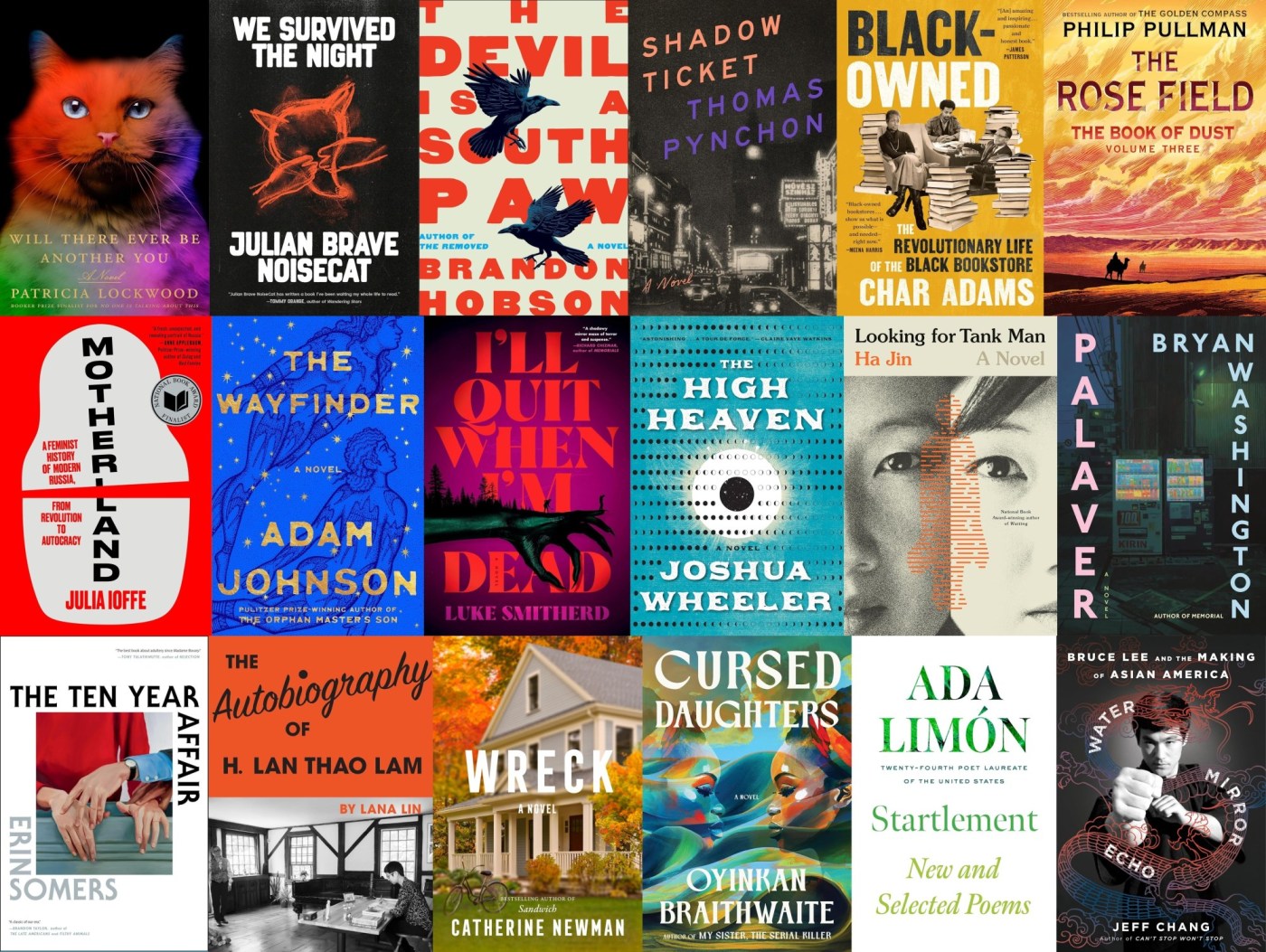
You’re bound to find something intriguing in this list of 34 new or forthcoming books, from novels to nonfiction to poetry to titles that resist easy classification. Look for these exciting books at your library or your favorite local independent bookstore.
“Will There Ever Be Another You”
Author: Patricia Lockwood
What It’s About: Author Lockwood won commercial success and critical praise for her 2017 memoir “Priestdaddy” and 2021 novel “No One Is Talking About This.” Her latest novel, marked with her trademark dark humor, tells the story of a young woman who becomes undone after falling ill with a disease that has affected the way she thinks.
Publication Date: out now
—
“Water Mirror Echo: Bruce Lee and the Making of Asian America”
Author: Jeff Chang
What It’s About: Chang, whose “Can’t Stop Won’t Stop: A History of the Hip-Hop Generation” still resonates with readers, takes a look at the life of the martial-arts icon who died at 32 in 1973. More than just a biography, the book considers how Lee’s influence still resonates.
Publication Date: out now
—
“Startlement: New and Selected Poems”
Author: Ada Limón
What It’s About: Limón, who grew up in Sonoma, served as the U.S. Poet Laureate from 2022 until this year; one of her projects involved bringing poetry to national parks, while another saw one of her poems heading into space. Her latest book, focused on mystery and wonder, collects new poems as well as ones from her previous books, including the National Book Critics Circle Award-winning “The Carrying.”
Publication Date: out now
—
“The Autobiography of H. Lan Thao Lam”
Author: Lana Lin
What It’s About: Experimental filmmaker Lin, inspired by Gertrude Stein’s “The Autobiography of Alice B. Toklas,” tells the story of her life and that of her partner, the artist Lam. The book, published by Dorothy, a Publishing Project, has been longlisted for the National Book Award.
Publication Date: out now
—
“Near Flesh”
Author: Katherine Dunn
What It’s About: Dunn is a literary icon, thanks to her cult-favorite 1989 novel “Geek Love,” which continues to startle and delight readers. Her latest book, published more than 9 years after her death, is composed of 19 short stories that showcase the lives and disappointments of women.
Publication Date: out now
—
“The High Heaven”
Author: Joshua Wheeler
What It’s About: The debut novel from USC graduate Wheeler tells the story of Izzy Gently, who grew up in a New Mexico cult, and now finds herself in Texas and Louisiana trying to overcome her troubled past.
Publication Date: out now
—
“Shadow Ticket”
Author: Thomas Pynchon
What It’s About: Don’t expect a book tour for this one — one of America’s most famous authors is also the most reclusive (save for two appearances on “The Simpsons,” where he was portrayed with a paper bag over his head). The latest from the author, whose 1990 novel “Vineland” also inspired Paul Thomas Anderson‘s new film, “One Battle After Another,” follows a private detective named Hicks McTaggart who goes in search of a missing cheese heiress in 1932.
Publication Date: out now
—
“Offline Humans: How to Stop Scrolling and Reconnect with the Real World”
Author: Natalie Alzate
What It’s About: Alzate, better known to her fans as Natalie’s Outlet, is a content creator with an unusual message for someone who made her fame on the internet: People should spend less time online. Her new book invites readers to do just that, providing creative prompts, exercises, and other ways for people to cut the digital cord.
Publication Date: out now
—
“We Survived the Night”
Author: Julian Brave NoiseCat
What It’s About: Oakland-raised journalist, filmmaker and powwow dancer NoiseCat, a member of the Canim Lake Band Tsq̓éscen̓, earned an Oscar nomination for his documentary “Sugarcane.” His first book is both a memoir of his childhood and a journalistic effort to undo the erasure of the Native peoples of North America.
Publication Date: Oct. 14
—
“I’ll Quit When I’m Dead”
Author: Luke Smitherd
What It’s About: Smitherd, who lives in both Los Angeles and Coventry, England, returns with a horror novel that follows two people: Madison, who joins an all-female boot camp to break her breakup-related junk-food habit, and Johnny, who goes to a remote cottage to detox from pain pills. There’s something sinister lurking in both places, though.
Publication Date: Oct. 14
—
“Intemperance”
Author: Sonora Jha
What It’s About: Jha won critical praise for her 2023 novel, “The Laughter.” Her latest book follows a 55-year-old professor in Seattle who decides to hold a swayamvar — a contest in which men compete for her hand in marriage. Her decision to hold the competition attracts attention, both positive and negative.
Publication Date: Oct. 14
—
“All That We See or Seem”
Author: Ken Liu
What It’s About: Liu is known for his fantasy novels as well as for his translations of Chinese novels into English, such as Liu Cixin’s “The Three-Body Problem.” His new book, the first in a planned sci-fi series, follows Julia Z, a hacker and artificial-intelligence expert who goes in search of a missing “dream artist.”
Publication Date: Oct. 14
—
“The Wayfinder”
Author: Adam Johnson
What It’s About: Pulitzer Prize-winning author Johnson’s latest novel is a sprawling epic that follows Kōrero, a young woman who lives on a Tongan island struggling with poverty and hunger, but who becomes the queen of her people.
Publication Date: Oct. 14
—
“Looking for Tank Man”
Author: Ha Jin
What It’s About: The latest novel from National Book Award-winning author Jin tells the story of a Harvard student who learns for the first time about the 1989 Tiananmen Square massacre — the discussion of which is heavily censored in China — and decides to research the topic for her dissertation.
Publication Date: Oct. 21
—
“The Ten Year Affair”
Author: Erin Somers
What It’s About: Somers (“Stay Up With Hugo Best”) is one of the funniest and sharpest writers working today. Her new novel follows Cora and Sam, two young married parents who meet at a baby group. In one timeline, the two engage in a long tryst; in another, they choose to remain with their spouses.
Publication Date: Oct. 21
—
“Motherland: A Feminist History of Modern Russia, From Revolution to Autocracy”
Author: Julia Ioffe
What It’s About: Moscow-born journalist Ioffe has long been an expert on Russia. Her first book, longlisted for the National Book Award, blends history and memoir to tell the story of the women of the country, whose rights have been scaled back during the presidency of Vladimir Putin.
Publication Date: Oct. 21
—
“The Rose Field”
Author: Philip Pullman
What It’s About: Pullman delighted young readers with his His Dark Materials trilogy of fantasy novels, and followed that up with another three-part series, The Book of Dust, an expansion of the original books. He brings the new trilogy to an end with this novel, which continues the epic story of his beloved characters Lyra and Malcolm.
Publication Date: Oct. 23
—
“The Devil Is a Southpaw”
Author: Brandon Hobson
What It’s About: Cherokee author Hobson was a National Book Award finalist for his 2018 novel “Where the Dead Sit Talking.” His latest follows two boys who were jailed together in a juvenile detention facility in the late 1980s; one, a writer, harbors jealousy of the other, a talented artist.
Publication Date: Oct. 28
—
“Wreck”
Author: Catherine Newman
What It’s About: Newman introduced readers to Rocky, a woman contending with her aging parents and grown children during a summer vacation to Cape Cod, in the hilarious 2024 novel “Sandwich.” Her latest is a follow-up to that book, with Rocky and her family back home in Western Massachusetts; Rocky becomes obsessed with a local train accident and a stubborn rash that won’t seem to go away.
Publication Date: Oct. 28
—
“The Uncool”
Author: Cameron Crowe
What It’s About: Crowe was a reporter for Rolling Stone from a young age, an experience he drew upon for his 2000 film “Almost Famous.” In his new memoir, he tells the real story of his teenage career in journalism, which led to his screenplay for the now-legendary 1982 film, “Fast Times at Ridgemont High.”
Publication Date: Oct. 28
—
“Tom’s Crossing”
Author: Mark Z. Danielewski
What It’s About: Danielewski’s debut novel, “House of Leaves,” has been a cult classic for 25 years, with fans enchanted by his creative use of typographic trickery. His latest novel, which spans over 1,200 pages, tells the story of two Utah friends who try to rescue two horses set to be slaughtered by a prominent member of their community.
Publication Date: Oct. 28
—
“Palaver”
Author: Bryan Washington
What It’s About: Washington is one of the country’s most respected authors, and he’s only 32. His latest book, following the short story collection “Lot” and the novels “Memorial” and “Family Meal,” follows a gay man living in Tokyo who is visited by his estranged mother. The novel has been longlisted for the National Book Award.
Publication Date: Nov. 4
—
“Bread of Angels”
Author: Patti Smith
What It’s About: Punk rock icon Patti Smith wowed the literary world with her 2010 memoir “Just Kids,” about her friendship with photographer Robert Mapplethorpe; the book was a bestseller and won the National Book Award. Her new memoir covers more of her life, from her childhood, music career, and her years spent raising her children.
Publication Date: Nov. 4
—
“Book of Lives: A Memoir of Sorts”
Author: Margaret Atwood
What It’s About: Atwood, author of novels including “The Handmaid’s Tale” and its Booker Prize-winning sequel, “The Testaments,” is Canada’s most legendary living author. But she’s never told the story of her life — until now. Her memoir shares tales of her childhood in Ontario and Quebec, her long partnership with fellow novelist Graeme Gibson, and, of course, the creation of some of her best-known books.
Publication Date: Nov. 4
—
“Flat Earth”
Author: Anika Jade Levy
What It’s About: The debut novel from the Forever Magazine co-founder follows two women: Avery, a New York graduate student who works for a conservative dating app, and Frances, a lauded documentary filmmaker; her success results in complicated feelings for the floundering Avery.
Publication Date: Nov. 4.
—
“Cursed Daughters”
Author: Oyinkan Braithwaite
What It’s About: Braithwaite stunned readers with her darkly comic 2018 thriller, “My Sister, the Serial Killer.” Her newest novel Eniiyi, a girl whose family believes is the reincarnation of her mother’s cousin — and thus the inheritor of a longstanding family curse.
Publication Date: Nov. 4
—
“Black-Owned: The Revolutionary Life of the Black Bookstore”
Author: Char Adams
What It’s About: Former NBC News and People magazine reporter Adams writes about the past and present of Black-owned bookstores in the U.S., from the first one in New York in 1834, to the ones that came after, including Los Angeles’ own Eso Won Books and Octavia’s Bookshelf.
Publication Date: Nov. 4
—
“Lucky Girl”
Author: Allie Tagle-Dokus
What It’s About: High school teacher Tagle-Dokus makes her literary debut with this novel about Lucy Gardiner, a 12-year-old girl who is cast on a dance-themed reality show. As the years go by, she realizes that the fame she once craved might not be all it’s cracked up to be.
Publication Date: Nov. 11
—
“Without Consent: A Landmark Trial and the Decades-Long Struggle to Make Spousal Rape a Crime”
Author: Sarah Weinman
What It’s About: Weinman is one of the country’s most acclaimed writers of crime nonfiction; her books “The Real Lolita” and “Scoundrel” both received rave reviews from critics. Her latest book is the account of Greta Rideout, who in 1978 accused her husband of raping her; he became the first person in the U.S. to be charged with spousal rape. Weinman also writes about other similar cases that ensued.
Publication Date: Nov. 11
—
“This Year: 365 Songs Annotated: A Book of Days”
Author: John Darnielle
What It’s About: Darnielle is best known as the singer-songwriter for the indie-folk band the Mountain Goats, but he’s also the author of three previous novels, most recently “Devil House.” His new book collects hundreds of his lyrics and comes with extensive notes about the songs by the acclaimed musician.
Publication Date: Dec. 2
—
“Casanova 20: Or, Hot World”
Author: Davey Davis
What It’s About: Davis’ previous two novels, “The Earthquake Room” and “X,” were bold and stunningly original portraits of lives on the edge. Their latest novel follows two best friends: Adrian, living in New York, whose beauty gains him constant attention, and Mark, who returns to his family home in California and learns that he is dying from a mysterious disease.
Publication Date: Dec. 2
—
“Television”
Author: Lauren Rothery
What It’s About: Filmmaker and music video director Rothery makes her fiction debut with this novel that takes a look at Hollywood from the perspectives of a movie star; his best friend and sometimes lover; and a would-be director desperate to get a break.
Publication Date: Dec. 2
—
“The Award”
Author: Matthew Pearl
What It’s About: The latest novel from “The Dante Club” and “The Last Dickens” author Pearl is a literary thriller that follows David Trent, who wins a prize for his new novel, drawing the interest (and envy) of his neighbor, an ill-tempered literary lion who previously refused to recognize David’s existence.
Publication Date: Dec. 2
—
“Googoosh: A Sinful Voice”
Author: Googoosh with Tara Dehlavi
What It’s About: Singer and actress Googoosh was Iran’s biggest celebrity until the 1979 Iranian Revolution, which resulted in the banning of women singing. She stayed silent for 21 years before moving out of Iran and making a comeback. She tells the remarkable story of her life and career in this autobiography.
Publication Date: Dec. 2
Literary calendar for week of Oct. 12
Readers and writers: Don’t miss these two novels, including a Minnesotan’s debut
Hungarian writer László Krasznahorkai wins the Nobel Prize in literature
Poking around the scary, horrible, disgusting, excellent cauldron of new horror lit
Literary calendar for week of Oct. 5