When immigration agents detained Douglas Menjivar in June, it wasn’t his first time.
Menjivar, a 50-year-old master mechanic originally from El Salvador, had lived in the United States for most of the last twenty years. A decade prior, he’d spent 2013 to 2015 in immigrant detention, including at the Houston-area Joe Corley Detention Center, which is operated by the for-profit prison contractor GEO Group. What he endured there changed the course of his life.
While Menijivar was held at the Corley facility facing possible deportation, another detainee sexually assaulted him twice with the help of an accomplice, he said in an official complaint and in interviews with the Texas Observer and other media. The duo targeted him after he confronted them for raping an 18-year-old. Upon seeing the traumatized teen sobbing, Menjivar, who had been sleeping on a top bunk, offered to trade places, believing the culprits would not attack a grown man. But the two jumped him as he slept: One held Menjivar down, shoving a pillow in his face, while the other assaulted him.
After another attack in the shower, he slipped and fell while fleeing his assailants, causing him to pass out and lose a significant amount of blood from a gash in his head. Upon regaining consciousness in the detention center infirmary after the attack, an Immigration and Customs Enforcement (ICE) supervisor mocked him, calling him “stupid,” he said. He was left with a two-inch scar on his scalp that remains visible.
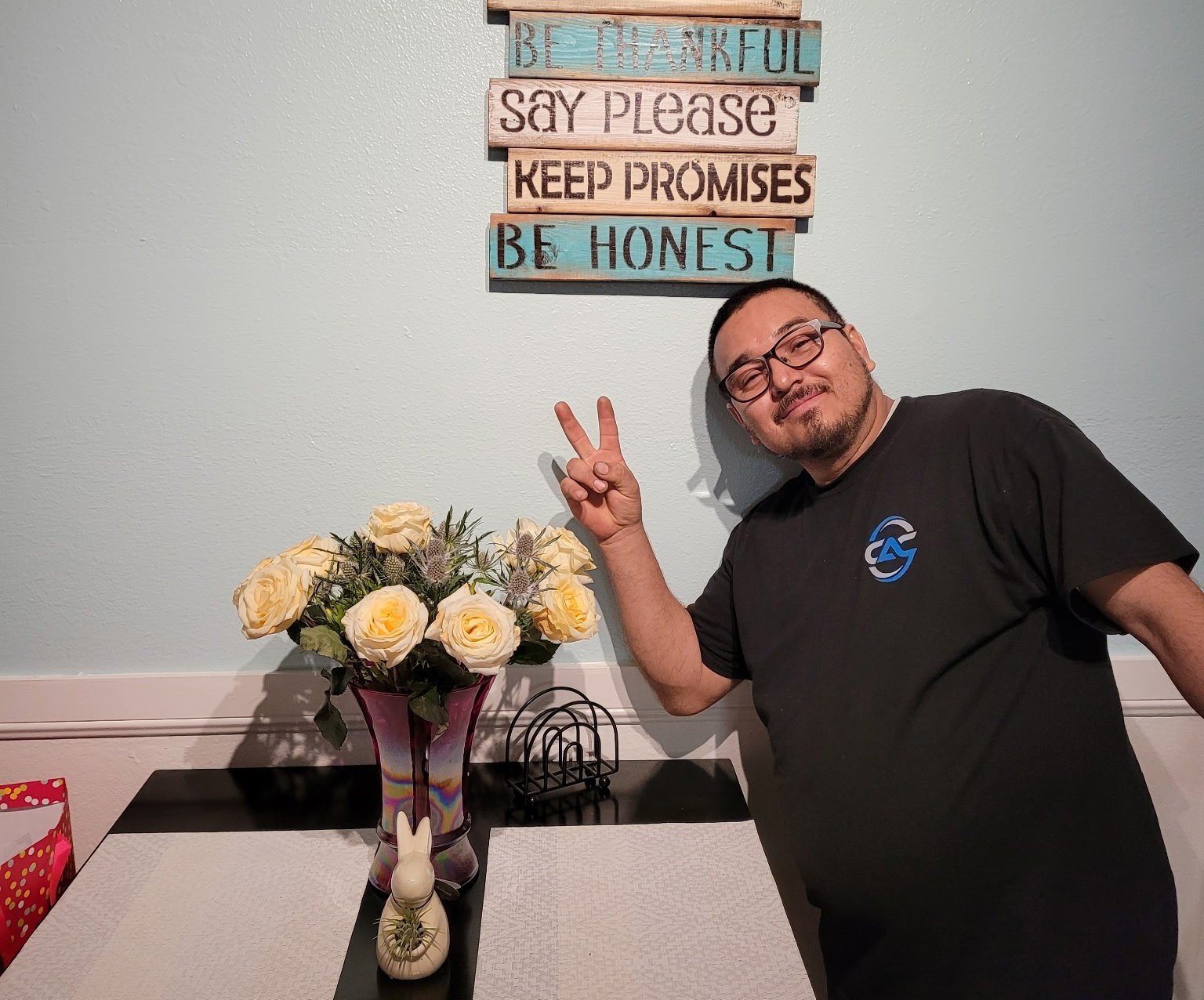
Douglas Menjivar
Later, Menjivar informed advocates, who pressured ICE to review the case and release him. In March 2015, then-U.S. Representative Sheila Jackson Lee wrote to the ICE Houston field office director, advocating for Menjivar’s release. In response, ICE authorities did something unexpected: Within a couple weeks, they released him, though he still had an active removal order. ICE generally may use prosecutorial discretion to defer deportation on a case-by-case basis, but under the second Trump administration such discretion has largely disappeared, according to experts including Menjivar’s lawyer, Ava Benach.
After his release, Menjivar poured his pain into advocacy, hoping that other immigrants would not have to endure what he had. Despite living in legal limbo, Menjivar contributed to a nationwide civil rights complaint that advocates filed against the Department of Homeland Security (DHS) in 2017. Community Initiatives for Visiting Immigrants in Confinement (CIVIC), the group that lodged the complaint, alleged that from 2010 to 2016 the DHS Office of the Inspector General, the department’s watchdog, took insufficient action to investigate sexual assault claims. (CIVIC has since changed its name to Freedom for Immigrants.)
Menjivar also joined Texas activists opposing the expansion of immigrant incarceration, participating in marches to protest plans for yet another for-profit detention center that was ultimately built near Corley.
For the decade after his release, he held a temporary work permit, and he married an American citizen in 2017. But he was unable to obtain a green card, routinely reporting to ICE until June 10, when agents arrested him after he dutifully arrived for his appointment. That day, they took him to the new Montgomery County ICE facility—the same center he had protested.
Locked up again, Menjivar wasn’t focused on the trauma he’d suffered, his activism, or his looming deportation to El Salvador, the country he’d fled in 2013 after working undercover for police. Instead, he focused on his wife, Monica Logan, who needed surgeries as part of treatment for breast cancer and a chronic skin condition.
Menjivar had been her sole caretaker, since her other relatives lived out of state. Now, there was no one to help.
Before they married, he’d promised God to care for Logan, and, “if necessary, give my life for her,” Menjivar told the Observer in a video call from the detention center. But, behind bars, he couldn’t even drive her to the hospital.
Menjivar entered Texas in 2004 by crossing without authorization. He was arrested by Border Patrol agents, he said, and received an immigration court date. Menjivar found work as a mechanic on the East Coast, but he did not appear for court (he told the Observer he lost his way in the New York public transportation system), and he received a deportation order in absentia in March 2005. He kept living in the country as an undocumented immigrant; he developed no criminal record.
The day before New Year’s Eve in 2009, Menjivar returned from New Jersey to El Salvador to care for his sick father and stayed for nearly three years. While there, he worked undercover with police to investigate corrupt officials tied to organized crime, Menjivar said in an Observer interview and a 2013 reasonable fear interview with DHS. However, he quickly learned that the police had not protected his identity. Fearing for his life, he crossed the Texas-Mexico border again in 2013 seeking safe haven and was detained. An immigration judge reinstated his prior removal order, and he was locked up for the next two years.
Menjivar attempted to pursue “withholding of removal,” a form of legal relief sought by people ineligible for asylum that protects them from deportation but does not directly lead to a green card. But he ultimately lost his case. He attempted to fight the denial, but he was hindered by ineffective assistance from a lawyer who had failed to present important evidence and missed a filing deadline on appeal, the Board of Immigration Appeals (BIA) later found. That attorney, Afton Izen, was suspended from practicing law in 2018 and disbarred in 2021 after other clients complained that she failed to complete paperwork and communicate about their cases, according to State Bar of Texas records. (Izen died shortly after being disbarred.)
During his first stint in detention, Menjivar befriended a Houston immigrant rights activist named Hope Sanford while helping to lead a hunger strike. After ICE used its discretion to release him, she hosted him in her home as he waited to obtain a work permit.
In 2016, Menjivar met Logan. They lived in the same apartment complex and became friends while chatting in the parking lot. Within a week, he told her: “You’re going to be my wife,” and she laughed. In July 2017, they married in Sanford’s backyard.
Monica Logan and Menjivar at their wedding
After marrying a citizen, he made several attempts to become a legal permanent resident.
As a stepping stone, he sought a U-visa, which is reserved for crime victims, based on the assaults in detention. However, since ICE and GEO Group’s staff never documented the attacks, immigration authorities said he lacked proof to establish that the crimes had occurred. He presented evidence of related injuries: The violent assaults left permanent damage to his body and a venereal disease, according to interviews and medical records, yet neither local police nor ICE would sign off on a U-visa application.
In 2024, the Biden administration announced a program that would have allowed some 500,000 undocumented spouses of U.S citizens to become lawful permanent residents, according to DHS estimates. Menjivar applied, but he appeared to be ineligible since he’d crossed the border a second time without authorization after he’d already been given a final order of removal, according to Benach and a federal website outlining the policy. That slim possibility disappeared after Texas, along with 15 other states, sued to block its implementation and a federal court ruled the program illegal last November.
His lawyer explored other avenues, and she finally had some success: In September 2024, the BIA reopened his withholding of removal case.
Menjivar kept reporting to ICE for check-ins: sometimes once a year, sometimes every three months. Sanford, who’s in her 70s and considers him her adopted son, had a bad feeling about the June 10th check in—his second one since Trump’s election.
Despite the national immigration crackdown, Menjivar and his wife were optimists and made plans for his 50th birthday, which would be two days later. They’d celebrate at a Tex-Mex restaurant where they were regulars. Logan had already bought his gifts: new chanclas, two new shirts, two pairs of shorts, and two pairs of jeans. But he never got to wear them.
Instead, agents detained him, despite his reopened case. The following day, Benach said she filed a habeas corpus petition and an emergency temporary restraining order to challenge his deportation.
On June 12, his birthday, Logan visited Menjivar. She couldn’t even bring him the card she’d made. They could only speak through a phone, divided by a thick pane of glass. It was one of few times she’d ever seen him cry.
During Menjivar’s second stint in immigration lockup, the guards referred to detainees by the number of their assigned bunk bed. Menjivar was now number 76. “Here, they treat us like rats,” he said by video call in September. (ICE denied the Observer an in-person interview, citing “operational security reasons.”)
While inside, Menjivar befriended younger immigrants and tried to help them. Fredy Chub Choc, an 18-year old asylum-seeker from Guatemala, had been placed in the men’s unit despite being a trans woman. Menjivar stood up to others who threatened or insulted her, she told the Observer.
But Menjivar was dealing with his own mental and physical health issues. He was depressed. And, on a prison diet heavy on rice and beans, without access to the specific diabetes medication he’d been taking, he gained nearly 40 pounds.
Every fall, around the anniversary of his assaults, he experiences nightmares, sometimes throwing punches in his sleep. But this year, his wife was not there to comfort him. He typically managed to sleep only an hour or two, even when he paid other detainees to guard his bed. In September, he said he tried to take his own life, and guards transferred him to solitary confinement for three days. He attempted another hunger strike, but staff threatened to force feed him, he said.
Reached by email, an ICE spokesperson told the Observer that he would provide comment for this story, but he never did so.
“I personally invite any U.S. citizen, or any person who says this is easy [or] that they treat us well, come to a detention center. Stay here … without seeing your family, without seeing your wife, without seeing your kids, without seeing the freedom that this country mentions,” Menjivar told the Observer a few days after leaving solitary confinement, his voice occasionally trembling as he fought tears.
Menjivar and Logan
Despite his own pain and the possibility of deportation, Menjivar’s main worry was his wife. With her caretaker detained—and his requests for parole and bond denied—Logan kept postponing surgeries.
Considering everything, Menjivar and Logan made a difficult decision. They asked his lawyer to drop the reopened immigration court case. Together, they decided to leave the country where Menjivar had spent about two decades, and where his wife had lived her entire life. They asked an immigration judge to allow him to voluntarily leave for Spain, where Menjivar has two adult daughters from a previous relationship and four grandchildren.
Once the judge approved their plan, Logan prepared her husband’s suitcase, packing new birthday clothes. She had returned the originals and bought the same items two sizes up, to account for his weight gain.
Logan had left the suitcase at the detention center a few days in advance. But, as he prepared to leave, ICE instead gave Menjivar the filthy pair of jeans he’d worn on the day of his arrest—soiled with urine from the hours he’d spent that day forbidden from going to the restroom. When he finally saw Logan at the George Bush Intercontinental Airport, he was trembling, though his head was held high. She fought back tears as the ICE agents watched them until they boarded. He had the suitcase, but it had been zip-tied shut; for the 30 hours to Madrid, he wore those jeans.
During the flight, they gripped each other’s hands. Logan finally let slide a few tears, of joy and rage alike.
Logan calls her husband “a prisoner of the anti-immigrant war.” Still, she has hope. “We’re going to overcome,” she said in a later video call from Madrid, sitting next to Menjivar in a hotel bed. “We’re going to rise above this.”
The post Trump’s ICE Arrested a Whistleblower Who Exposed Sexual Assault in Detention. Now, He’s Left the Country. appeared first on The Texas Observer.