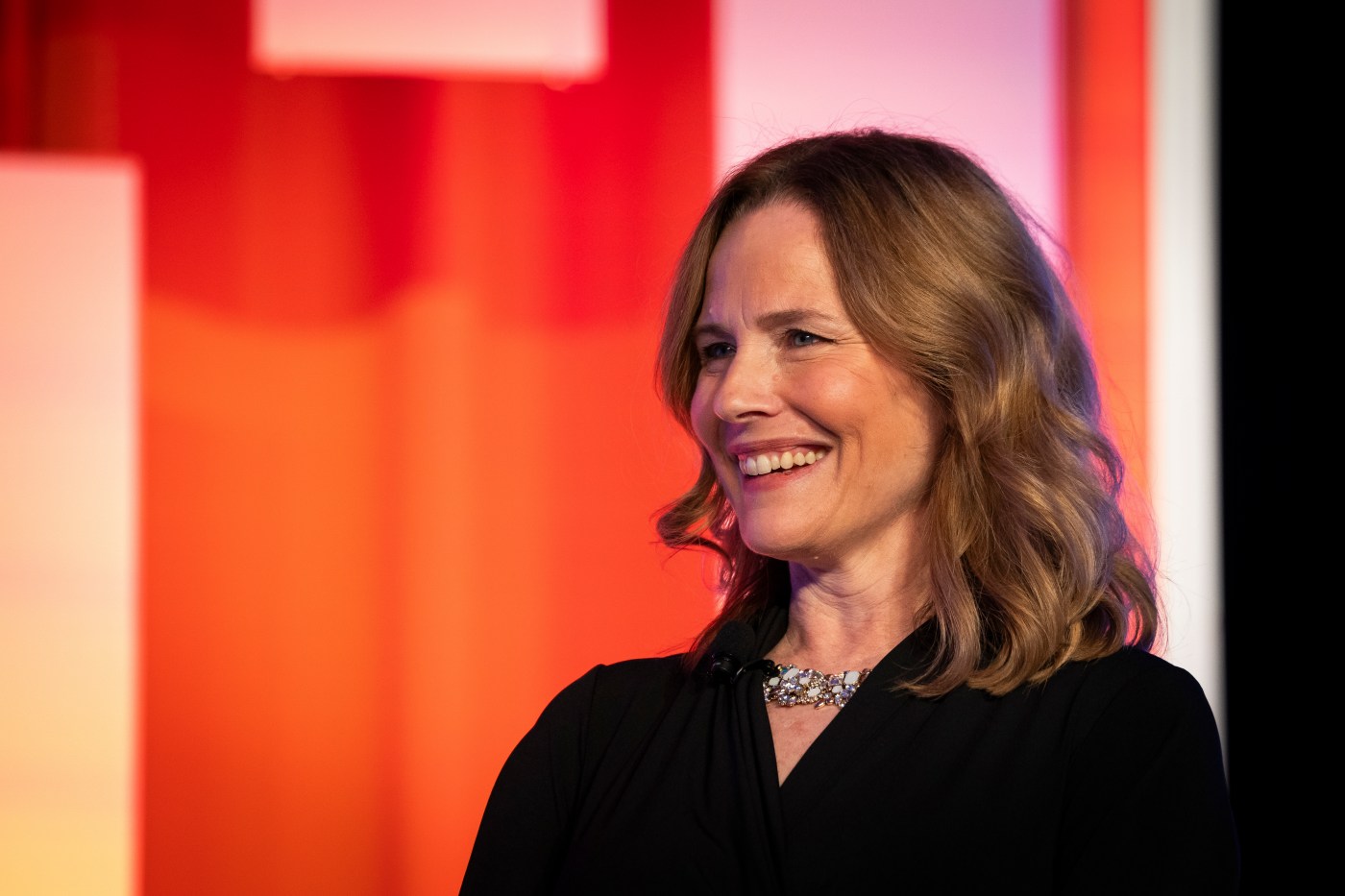
There’s a roster of cases before the Supreme Court that could reshape the entire Trump presidency and redefine executive power. Justice Amy Coney Barrett, my guest last week on my Times Opinion podcast, “Interesting Times,” is likely to be the decisive vote in some of these cases.
Unfortunately but predictably, that means that she couldn’t or wouldn’t respond to my most direct questions about the Trump administration.
But my goal was to push Barrett on a question that she can answer, one that she addresses at length in her new book, “Listening to the Law.” I wanted to know whether her preferred legal theory, originalism, bends in response to prudential and political concerns.
Barrett believes strongly that it shouldn’t, that justices should rule without worrying about political pressures or considerations. But I tend to think real-world politics constantly tests and limits that ideal. So in our conversation, I’m trying to find those limits and the ways in which even justices devoted to the original meaning of the Constitution have to deal with the highly unusual pressures of right now.
Below is an excerpt of our conversation. The full interview can be found wherever you get your podcasts.
Q&A
Douthat: hen you were being nominated, The New York Times ran a story that described you as “a woman who is both unabashedly ambitious and deeply religious, who has excelled at the heights of a demanding profession,” even as she speaks openly about prioritizing her faith and family. I’m curious if you actually see yourself this way?
Barrett: I feel like the word “ambition” puts a focus on success or ambition for its own sake, which isn’t how I’ve ever conceived of my career.
My own mother had a large family — I’m one of seven — which is what I always wanted. And I wasn’t sure that I could do that and work at the same time, but I always have, since I had our first child.
Douthat: Do you think of yourself as a feminist — a conservative feminist?
Barrett: I don’t know; labels are so dangerous because they mean different things to different people. If being a feminist simply means having the view that women can do whatever it is they put their minds to and have opportunities open to them, then yes, I am.
But labels are risky.
Douthat: Labels are risky, especially when you are charged with the interpretation of the entire U.S. Constitution. Let’s talk about the law. You were a clerk for Justice Antonin Scalia, who is seen as one of the key intellectual progenitors of originalism. You are an originalist. What is originalism?
Barrett: Originalism, simply stated, is just the proposition that the Constitution should be interpreted consistently with the meaning that the words of the Constitution had at the time that it was ratified.
So where the meaning of those words can be discerned, it is decisive.
Douthat: Oh, well, that’s easy. That’s it.
Barrett: We can go home.
Barrett: I think one of the great advantages that originalism has had over rival schools of interpretation is that it sounds like basic common sense. What else would a justice do if not interpret what the words meant when they were ratified?
But it is a little bit more complicated than that in actual practice. You talk about the meaning of the words. You are not trying to interpret the intentions of the people who wrote the Constitution or wrote the statutory law, right?
Barrett: Right. We’re trying to interpret the meaning of words like “freedom of speech,” “establishment of religion,” “unreasonable search and seizure.” Our constitutional document is more than two centuries old, so we have accumulated all kinds of history — not just the original meaning but also all of the precedent, court decisions that have been decided in the interim since the Constitution was ratified.
So we’re not historians. We’re looking at the legal history behind certain words and phrases. That’s actually something that all judges do, not just originalists. Because there are various sources that all constitutional interpreters look to, and the question is: How do you weight them? History is a tool in everyone’s tool kit.
Douthat: We’re in an environment where many of the central questions the court is taking up in the second Trump administration have to do with executive power that are, if not novel, at least we could call them ambitious and aggressive. Is there a basic originalist view of executive power that exists above and around the particular controversies you’re likely to deal with this term?
Barrett: I would say that the unitary executive theory, which is the theory that Article II vests the executive power in the president, is one that has long been associated with originalism.
It’s one that Justice Scalia advocated: the idea that the president has to control the executive branch. There has been a lot of debate and some new originalist scholarship debating right now whether indeed it has sound originalist credentials. But yes, it is one that has traditionally been associated with originalists.
You can see this in debates during the Great Depression and FDR and the New Deal and the explosion of the administrative state. Back then, you had a debate about how much Congress could create administrative agencies that fell outside the president’s control.
There were some who said no, and others who favored the New Deal expansion of the administrative state who said Congress can take agencies and make them independent of the president’s control.
That’s essentially the debate that we’re seeing play out in some of the cases on the court’s docket now.
Douthat: We’re living through an era when it seems to a lot of observers that Congress is increasingly unwilling to or is at least unexcited by the exercise of its own powers. There’s a broad sense that Congress is doing less and the presidency is doing more.
Is that something that enters into judicial considerations when you’re thinking about the cases that you take, the scope of the rulings that you decide to make?
Barrett: There’s a lot in that question.
Douthat: Yes.
Barrett: I think this is actually a disconnect between what observers of the court expect to see and what the court can actually do — the press and the public live in a particular moment. The court has to take a longer view, and so the content of doctrine cannot turn on just the precise political moment.
This isn’t anything to do with being an originalist. I talk in the book about decisions that John Marshall made, including in the trial of Aaron Burr. Those cases got cited within the last couple of years on more than one occasion. So what we decide now would be cited seven, eight or nine presidents from now.
We have to be very careful that the content of the doctrine isn’t fashioned just for the moment, because one reason that the Constitution has been able to survive is that it isn’t contingent only on a particular period. I do think there is a lot of discretion. You asked: Does it affect the scope of decisions?
Yes, I think it can. The court does have a little bit more room in that regard in deciding the breadth of a decision.
Douthat: And whether to leave certain questions temporarily unanswered, maybe?
Barrett: That is not always possible. But yes, where it is possible, that is the kind of a thing where the court can decide. There is sometimes a range of discretion in deciding how broadly or narrowly to write a rule or a rule should be.
Douthat: This is one of the conceits about Chief Justice Roberts. A lot of people see him in his role as chief justice as someone who is supposed to be the steward of the court’s position. Roberts doesn’t have a lot of really committed admirers. I’ve developed a lot of sympathy for that kind of approach. I’m curious to what extent you think that enters into a chief justice’s calculations. Like, is the time ripe for a decision, for instance?
Barrett: So I certainly won’t be the Chief Justice Roberts interpreter. You pointed out that the chief justice has few admirers on either side. I think that is a tribute to him because an important part of this job is you have to be willing to be disliked.
I think it’s pretty clear that no decision that Chief Justice Roberts has made has been in an effort to build himself a following. He’s making decisions quite plainly, whatever the calculus may be — and I won’t offer a view on that — that he thinks are the right decisions for the country, the court, the Constitution and not with an eye toward building up a fan base. I think that’s commendable.
Douthat: The Trump administration has discovered ways to use executive power to gain advantages, even if in the end it loses the legal forays that it makes.
How should a court think about executive maneuvering and attempts to box the Supreme Court in or use the law in ways that are, in effect, disingenuous?
Barrett: I don’t think I can answer that one because it’s too difficult to extricate from current cases.
Douthat: OK. A very wise friend observed, when I was preparing for this interview, that it seems that the Trump White House has been extremely deferential to the Supreme Court and extremely critical of the lower courts, in terms of expansive hostile rhetoric to lower court rulings. To what extent does the Supreme Court have an obligation to see itself as a defender and protector of the entire judicial branch in conflicts with the executive?
Barrett: I don’t know that I really can answer that one, either, because that wades very much into current debates, which I probably can’t —
Douthat: OK, let’s make it general. When I was younger, almost all of the most stinging critiques of the Supreme Court came from the right.
And now there are still plenty of stinging critiques of the court from the right, but there’s also a substantial movement from the political left that raised possibilities of court packing, stripping the court of jurisdiction.
Is there an extent to which the Roberts approach becomes more important when the court is under threat or critique from both right and left? Or is it even more important in that kind of moment to maintain an intellectual independence, where you are insulating yourself entirely from any sense of political pressure?
Barrett: My own view?
Douthat: Your own view.
Barrett: My own view is: intellectual independence. I think you have to make a judgment. Once you open the door to letting outside pressures of any kind influence or dictate — especially dictate — your decisions, then it’s over. Therein lies madness. Because my oath requires fidelity to the Constitution and to decide these cases by my best lights.
I’m a judge. I’m a lawyer. I’m not a politician. It’s pretty difficult for me to say what public opinion is. I’m not a pollster. I don’t know what the consequences would be. So I don’t even think that judges are particularly well suited to try to guess at some of those things.
Douthat: Does that also apply to the long view that you were describing earlier, when you said: Look, we’re not making law just for the Trump era; we’re making law for the next 50 years? It doesn’t bring in any kind of concrete vision of what the future might actually look like?
Barrett: You do look forward, and you do take into account consequences of decisions. Those kinds of considerations are and always have been fair game and standard fare of constitutional decision-making. I took you to be asking about public reaction to the court in particular. Like, should the court be taking account of its own skin? Should the court be taking account of the backlash that it will suffer?
Douthat: But why are those two things separable? Why is it OK to say: It’s all right to think about how this decision plays out for the health of the Republic as a whole, but it’s not OK to worry about mass backlash against the judiciary specifically?
Barrett: I think maybe we’re talking about different things.
Thinking about the larger structural point is important. Thinking about how our institutions will be affected in the long term is important because we are making decisions, as I said before, not just looking at what happened in the past but looking forward into what will happen in the future.
I guess what I would resist is saying that a decision should be dictated by short-term consequences or short-term pain in the institution. Brown v. Board visited a lot of backlash on the court, but that was the right thing to do, obviously. It needed to do it, despite the short-term cost.
Douthat: One issue related to those kinds of short-term costs and long-term costs is the question of the Supreme Court’s own position in the balance of powers between the branches and its ability to get the other branches to heed its rulings.
The Supreme Court does not command the power of the purse, doesn’t command the military, doesn’t have police powers. What it has, in a sense, is prestige, public support, a historic constitutional role.
We’re in a moment when it’s very easy to imagine, from either the left or the right, some present or future president deciding to test the court, Andrew Jackson-style, saying: Interesting ruling, Justice Barrett. Good luck enforcing it.
How do you think about that potential challenge, as a member of the court?
Barrett: I think that you are absolutely right that just as the court must take account of the consequences on the institutional dynamics, say, between a current president and a future president, the balance of power between the executive branch and the legislative branch. Those same kinds of institutional concerns are ones that play a part in the court’s decisions and always have, because they also are reflected in concerns of the constitutional structure.
Douthat: OK, let me try that again: If a president defied the Supreme Court, what would you do?
Barrett: Well, as you say, the court lacks the power of the purse. We lack the power of the sword. We interpret the Constitution, we draw on precedents, we have these questions of structure, and we make the most with the tools that we have.
Ross Douthat writes for the New York Times.