Real World Economics: Senators wake up and smell the tariffs

posted in: All news | 0

Edward Lotterman

How do members of Congress differ from the beef our nation imports? All bones have been removed from most beef, but congressional representatives have only lost their spines.

Until this past week that joke held true.

But last week on Tuesday, five GOP senators — Susan Collins of Maine, Lisa Murkowski of Alaska, Rand Paul of Kentucky, Thom Tillis of North Carolina and Mitch McConnell of Kentucky — bravely split from their party, voting for a winning bill to overturn 50% tariffs on imports from Brazil.

Paul and Virginia Democrat Tim Kaine co-sponsored the bill. Minnesota senators Amy Klobuchar and Tina Smith both voted for it. Klobuchar, long a member of the Senate Agriculture, Nutrition, and Forestry committee, stood prominently at Kaine’s side in announcing the vote.

The next day, Wednesday, four of the GOP renegades, Collins, McConnell, Murkowski and Paul, again defied President Donald Trump, voting with Democrats gave a four-vote majority to a near-identical bill overturning Trump’s tariffs on Canada. And on Thursday, these four mavericks tipped the scale for a 51-47 vote to overturn all of Trump’s “reciprocal tariffs” worldwide.

In the short run, of course, these votes are merely symbolic.

With fewer renegades, the GOP majority in the House is stronger than in the Senate. All these tariffs will stand unless overturned by lawsuits pending in the courts. Yet these Senate votes show that tariffs, increasingly unpopular in the general public, are not a strict party-line issue. They are a beacon to other Republicans uneasy with increasing public dissatisfaction with import taxes.

It was a coincidence that these votes overlapped the Federal Reserve’s slight interest rate cut. However, some Fed board members expressed concern that tariff-induced inflation is not yet slain. Fed Chair Jerome Powell made it clear that further rate cuts, specifically at the Fed’s next meeting in December, are not a given.

Powell’s concerns, shared by the senators, are apparent to anyone at the check-out counter of their local supermarket. Trump rode into the Oval Office lambasting high consumer inflation under President Joe Biden. That pain was real. The Consumer Price Index for “all food eaten at home” was 22% higher on election day 2024 than four years earlier. Trump vowed to reverse that, “on day one!”

That hasn’t happened. Yes, as of September this groceries CPI category was only up 1.6% over last January when Trump was sworn in. But tariffs are starting to bite. If August and September increases persist, the jump in a year would be 5.5%.

Moreover, key foods rose more. Ground beef, the product most affected by imports, is up 14% since Trump put his hand on the Bible. Steaks and roasts are up 12.5%. And the CPI notated “Coffee, 100%, Ground Roast, All Sizes” is up 30% January to September. A necessity to many, coffee had risen an average 12% annually during the “Biden inflation.”

Such higher prices may explain why 50% tariffs on Brazil were the first issue teed up in the Senate. It’s no secret that coffee, much of this beef, and many other grocery store staples we take for granted, are imported.

Brazil is our largest single source of coffee. Some 35% of all we drink comes from there. This might not be as high as some think. But if you look at grocery-store brands bought by lower-income people who don’t frequent tony coffee shops, the percentage of Brazilian coffee is far higher. For people who live from one paycheck or SNAP deposit to another, the 30% coffee price increase from January to September isn’t minor. And 9% of that came in only two months after Trump’s July 29 announcement of 50% tariffs on all imports from Brazil.

Another item, one seldom mentioned, is orange juice. We are the world’s largest consumer of frozen OJ. But plant diseases are devastating U.S. orange production, making us the largest juice importer by far. Brazil is the world’s largest producer, and exporter, supplying 80% of the global total. Some 60% of our total comes from there. In the September CPI report, the price for “Orange Juice, Frozen Concentrate” is up 5.7% since January. However, its price has risen at an annual rate of 12.9% since the president announced the Brazil tariffs.

This is all a lot of data. What general lessons are involved?

The media, and some politicians, have focused on the simplistic but false dichotomy of who actually “pays the tariff” — exporting-nation producers or importing-nation consumers. It is far more complicated than that. In the real world, time needed for the costs — and benefits — to appear in the general economy vary greatly by specific product and the length of time for adjustments to take place. Producer-exporters are affected, as are consumer-importers. So are domestic producers, not only of the product itself, but of substitute ones.

The key question here is how badly we feel we need the product. Could we just do without it? Are there good substitutes? These determine exactly who loses, or gains, by how much, from new tariffs. Moreover, how quickly or slowly domestic production can be ramped up is key, if that is even possible. For imports like coffee, there generally are no U.S.-produced substitutes.

With current very high prices, U.S. beef production is increasing. But it takes time for new beef cows to be able to have calves. And, compared to chickens or hogs, cattle take a long time to reach slaughter weight. So adjustments to tariffs take time.

Similarly, bringing fruit trees to production takes years. But vegetables grow in weeks. Our country does have frost-free irrigated land in the southwest that once produced vegetables. This just was not competitive after production moved to Mexico. At some price, broccoli, green beans and the like could be produced again in relatively short order. But producers would be loath to invest money if the whim of a mercurial proto-dictator, or a Senate vote, or an activist judge, might abolish tariffs on competing cheaper imports overnight.

The same is true for seasonal vegetable production in areas with cold winters. In 1899, my grandfather came from the Netherlands to work in vegetable production on Maryland’s Eastern Shore. Before federally-subsidized irrigation in southern California, Maryland, Pennsylvania, Delaware and New Jersey produced large quantities of vegetables each summer.

Baltimore was the canning capital of the country. H.J. Heinz was in Pennsylvania for a reason. Canned tomatoes and sauce, beans, peas and other vegetables again could be grown and frozen or canned, despite urbanization. Minnesota could produce corn, pears and pickles. At the farm level, production could ramp up quickly. But new processing plants are expensive. They take time to be up and running. Who will sink such millions if flattery from some foreign leader might prompt tariff reductions that would leave new investment here high and dry?

Coffee is an interesting case because it seems a necessity for many. Growing coffee here is near impossible. We can stiff Brazil and buy from Vietnam or Kenya, outbidding their traditional customers. These might then pick up slack that we left in Brazil. That happened when our 2018 tariffs on imports from China sent that nation to Brazil for soybeans, lowering but not destroying our overall exports.

The upshot is that we are going to pay more for goods subjected to tariffs but the degree and timing of that will vary greatly from product to product. And the full results may not be settled for years. The one sure thing is that resources available to meet the needs of our nation and the world as a whole will be wasted. We collectively will be less well off than we need be.

Related Articles


Real World Economics: Argentina bailout is a new level of corruption


Real World Economics: ‘Creative destruction’ and Argentina’s debt crisis


Real World Economics: How farm payouts violate basic principles


Real World Economics: Ignorance of Social Security’s problems is not bliss


Real World Economics: How bad is it going to get?

St. Paul economist and writer Edward Lotterman can be reached at stpaul@edlotterman.com.

Movie review: ‘Anniversary’ a character study of creeping fascism

posted in: All news | 0

Polish director Jan Komasa might be best known in the United States for his 2019 Oscar-nominated film, “Corpus Christi,” but his biggest box office success was in Poland, for his 2014 film “Warsaw 44,” about the Warsaw Uprising, the bloody effort by the Polish resistance to expel the occupying German army from Warsaw toward the end of World War II.

Komasa knows authoritarianism, in its most flagrant, brutal forms, but his new film “Anniversary” imagines a scenario in which fascism doesn’t stomp in jackbooted, but creeps, pretty and ladylike, on kitten-heeled feet. It’s a thought experiment more than anything else, from a story by Komasa and Lori Rosene-Gambino, who wrote the screenplay.

“Anniversary” maps five years in the life — and obliteration — of an American family, a microcosm of a larger rapid political evolution that turns suburban utopia dystopian with a speed that could make your head spin.

Meet the Taylors: we’ll get to know them across reunions and celebrations starting with an anniversary party for Ellen (Diane Lane) and Paul (Kyle Chandler). She’s a professor at Georgetown, a public intellectual caught up in the university culture wars debate, he’s a chef, and they have four children upon whom they dote: Cynthia (Zoey Deutch), an environmental lawyer, Anna (Madeleine Brewer), a provocative comedian, high school science nerd Birdie (Mckenna Grace), and brother Josh (Dylan O’Brien), a nebbishy, struggling writer. The camera knits them all together in long shots, swirling around their idyllic backyard.

Diane Lane as Ellen and Kyle Chandler as Paul in “Anniversary.” (Owen Behan/Lionsgate/TNS)

Josh has brought home a new girlfriend, Liz (Phoebe Dynevor), who is carefully coiffed and poised; immaculately presented and mannered, though her perfection gives his sisters pause. After the introductions, she and Ellen have a quiet, awkward moment together. As one of Ellen’s former students, Liz wrote a thesis that scandalized the professor, which Ellen describes to her husband as having “radical anti-Democratic sentiments,” advocating for a single party system. The title? “The Change.”

While Liz says she “came here with the best of intentions,” and claims she and Josh were introduced by their shared agent, Ellen is suspicious, and rightly so. The enigmatic Liz is mild-mannered and quiet, but her ideas are anything but. As she hugs Ellen, she whispers, “I used to be afraid of you but I don’t think I am anymore.” That is never more clear when she sends Ellen a copy of her newly published book, “The Change,” dedicated to “the haters, the doubters, and the academic stranglers.”

Two years later, the Change is officially afoot. Liz is as celebrity, now working with a mysterious organization called the Cumberland Company. She and Josh are married, pregnant with twins, and he’s achieved a conservative glow-up. New flags are popping up in the Taylor’s well-heeled neighborhood, and things are shifting in ways that make Ellen uncomfortable, enraged even. But in the spirit of politeness and family unity, she acquiesces to Paul’s desire for a nice family Thanksgiving, despite their political differences.

Therein lies what might be “Anniversary’s” biggest warning: don’t let the fox into the henhouse, even if it seems rude not to. Ellen maintains an appropriately wary distance and skepticism of Liz, but Paul’s fatal flaw is his assumption of good faith. He hasn’t even read “The Change,” because frankly, he doesn’t want to know. But as Liz attaches herself to Josh like a parasite, perhaps in an attempt to enact revenge on her former professor, so too do the other Taylor children topple, as the nation changes under their feet.

Some might find “Anniversary” too vague about what, precisely, is Liz’s political stance that makes her so powerful, and so repugnant to Ellen? She has advocated for a “single party system” branded under the guise of “solidarity,” but the result is an autocratic surveillance state that suppresses free speech, upheld by a violent paramilitary police force. The film never gets into the specifics, perhaps because the only ideology of fascism is the concentration of power. “Anniversary” suggests the rhetoric doesn’t matter when we can turn on each other so easily, humanity and freedom crushed under such a state.

It is fascinating that recent cultural output that attempts to grapple with contemporary sociopolitical issues often feminizes the threat: take the #MeToo cancel culture fable “Tár,” or this year’s academia scandal film “After the Hunt.” “Anniversary” situates a nonthreatening woman as the vessel for such evil, even as Liz’s male host, Josh, starts to embody the most extreme outcomes of what she has set in motion.

“Anniversary” is a deeply nihilistic film that can’t be described as a cautionary tale — that horse has left the barn. Rather, it’s a hypothetical question as character study, an examination of how this happens, and an assertion that a system like this shows no mercy, not even to its most loyal subjects, despite what we want to believe.

‘Anniversary’

3 stars (out of 4)

MPA rating: R (for language throughout, some violent content, drug use and sexual references)

Running time: 1:51

How to watch: Now in theaters

Related Articles


Made in St. Paul: Stories of Native history, culture and basketball from TPT filmmaker Leya Hale


Top 13 horror movies of 2025: ‘Weapons’ claims top spot in loaded year


Top 13 horror movies of 2025: Do you agree with our No. 1 pick?


Current DJ’s ‘Troma Project’ celebrates 50 years of horror and hip hop


Movie review: Animated flick ‘Stitch Head’ a charming spookfest for kids

Readers and writers: Prose, poetry, murder, memoir, history

posted in: All news | 0

Memoirs in prose and poetry, murder on an airplane journey and the importance of Pembina, N.D., in our history. Something for everyone today.

“Before I Lie”: by Dralandra Larkins (Book Baby, $25)

(Courtesy of the author)

I’m Black, brilliant, beautiful, wise!/Anxious and ambitious./A mystic./I am not your statistic./Passionate and persistent./A dreamer, multi-gifted./A generational curse breaker./A builder./I am not a maybe./I am not negotiable. — from “Before I Lie.”

Dralandra Larkins is on the rise in the Twin Cities literary community with a debut collection and a spot on the cover of the September issue of Minnesota Women’s Press. Poet Danny Klecko, who has read with Larkins and watched her dynamic onstage presence, says she’s someone to watch.

In her debut collection, Larkins writes in-your-face autobiographical poetry and, prose, illustrated with big, bold artwork by Brian Alexander Serrano, to tell her story in poems such as “An ode to the Hood” (in Minneapolis where she grew up), “Black myths,” “Healing the Scar That Sings Back,” and traits she carries from her ancestors. Running through the collection is the story of how she found her authentic self as her hearing disability was corrected with hearing aids and by learning ASL.

She writes: “These stories don’t beg for approval or wait for applause.”

Larkins is an award-winning spoken-word poet whose words catch the cadence of real-life language, as well as an educator and a multi-genre writer. She characterizes her work as “moving between stage and performance,” weaving together rhythm, intimacy and vulnerability to create a haven for healing rooted in her background as a social worker.

“Before I Lie” is for every young Black girl who never had access to a mic to tell her story, Larkins says. For white readers it is an introduction into a Black woman’s life.

Larkins will be at the Nov. 8 Twin Cities Book Festival and will read Nov. 18 at Magers & Quinn, 3038 Hennepin Ave. S., Mpls., with the Loft Literary Center’s program manager Marianne Manzler and spoken-word guru Tish Jones.

“Wayfinding”: by Renee Gilmore (Trio House Press, $24.99)

(Courtesy of Trio House Press)

But, there was only one thing I found, quite by accident, that could reliably distract my agitated mood. As counterintuitive as it sounds, taking risks and engaging in daring or dangerous behavior, on a small or large scale, was the true antidote to my anxiety. –– from “Wayfinding”

The title of Renee Gilmore’s frank and sometimes heartbreaking memoir has two meanings. It refers to her family’s love of car travel and the car culture she learned from her dad. It also refers to the ways in which she healed after a hard childhood of abuse and, later, rape. This violence left her with undiagnosed PTSD, seeking solace in drink and bad company, and a sad first marriage. Eventually she found happiness with her current husband. Besides her own emotional troubles, Gilmore dealt with the mental difficulties of her daughter, whom she and her husband adopted out of the foster system.

Each section takes its title from map language, as in “Back Bearing,” a bearing that is the exact opposite of your destination or waypoint.

Gilmore is a neurodivergent (meaning her brain works differently), multi-genre writer, essayist and poet, with a master’s degree from Hamline University. She never gave up her love for travel, journeying to all seven continents. And she’s a fan of international F1 car racing and car shows. Her writing about cars is like a a hymn.

You can meet her at the Trio House Press booth at the Twin Cities Book Festival.

“Airplanes, Atlanta & an Assassin”: by Mary Seifert (Secret Staircase Books, $14.99)

If you think you’ve had troubles with connecting airplane flights, be glad you aren’t Katie Welk, who’s chaperoning her high school students to a competition in this 10th Katie & Maverick cozy mystery.

Katie and her friend Jane separate from the students during a layover and take a private plane that crashes. Katie’s kidnapped by a guy who’s not too bright but knows how to hold a gun on her. Soon Katie uncovers a web of secrets, stolen documents, corporate espionage and dangerous toxins, and she needs to untangle everything before a killer strikes again. Happily, she has the help of Maverick, her trained search-and-recue Labrador retriever. Who doesn’t love a cozy featuring a lovable Lab?

Seifert, who has a background in mathematics, says she “ties numbers and logic to the mayhem” in this readable, entertaining series.

“The Beaver, The Buffalo, The Border”: by Gerald M. Sande (Anepeminan Press, $24.)

What a treasure of history Sande has given us as he writes of his childhood in Pembina, a small town in the extreme northeast corner of North Dakota founded in 1801. It’s subtitled “A Century of Small Town Pioneering,” but it’s about more than a small town because the area was vital beginning in the 18th century when the fur trade flourished, with voyageurs sending their valuable furs to St. Paul. Its history is part of the great expansion to the West.

Those were the days of the powerful Hudson’s Bay Company, based in London, versus The North West Company founded in Canada. He discusses the 1818 fixing of the international boundary between the United States and British North America, the 1852 destructive Red River flood, the 1861 establishment of the Dakota Territory.

This narrative is filled with names familiar to Minnesotans: Norman Kittson, John Jacob Astor, Jay Cooke, Ignatius Donnelly, James J. Hill, Zebulon Pike, Alexander Ramsey, Henry Hastings Sibley and the Rev. Henry Whipple.

History buffs will love the connections this book has to the history of St. Paul, which was growing right along with Pembina.

Related Articles


Literary pick for week of Nov. 2: Twin Cities Book Festival comes to Union Depot


Literary calendar for week of Nov. 2


‘Take This Phone And Shove It!’ Author wants to help you (or your grandparents) beat phone phobia


Carnegie libraries, including three in the east metro, will each get $10,000


St. Paul author tells moving story of alcoholics’ chase for local softball glory

Other voices: Gerrymandering’s slippery slope

posted in: All news | 0

The gerrymandering doom spiral is gaining downward momentum, exactly as expected.

Virginia is poised to become the second state, after California, where Democrats will seek to unravel reforms that took redistricting out of the hands of partisans. That’s in response to similar Republican power grabs in other states — especially Texas, where the GOP kicked off the nationwide partisan warfare this summer in a shortsighted attempt to protect its slim House majority.

Democrats currently control six of Virginia’s 11 congressional seats, accurately reflecting the commonwealth’s evenly divided electorate. By calling a special session, Democrats hope to nab an additional two or three districts by aggressively redrawing the map in their favor.

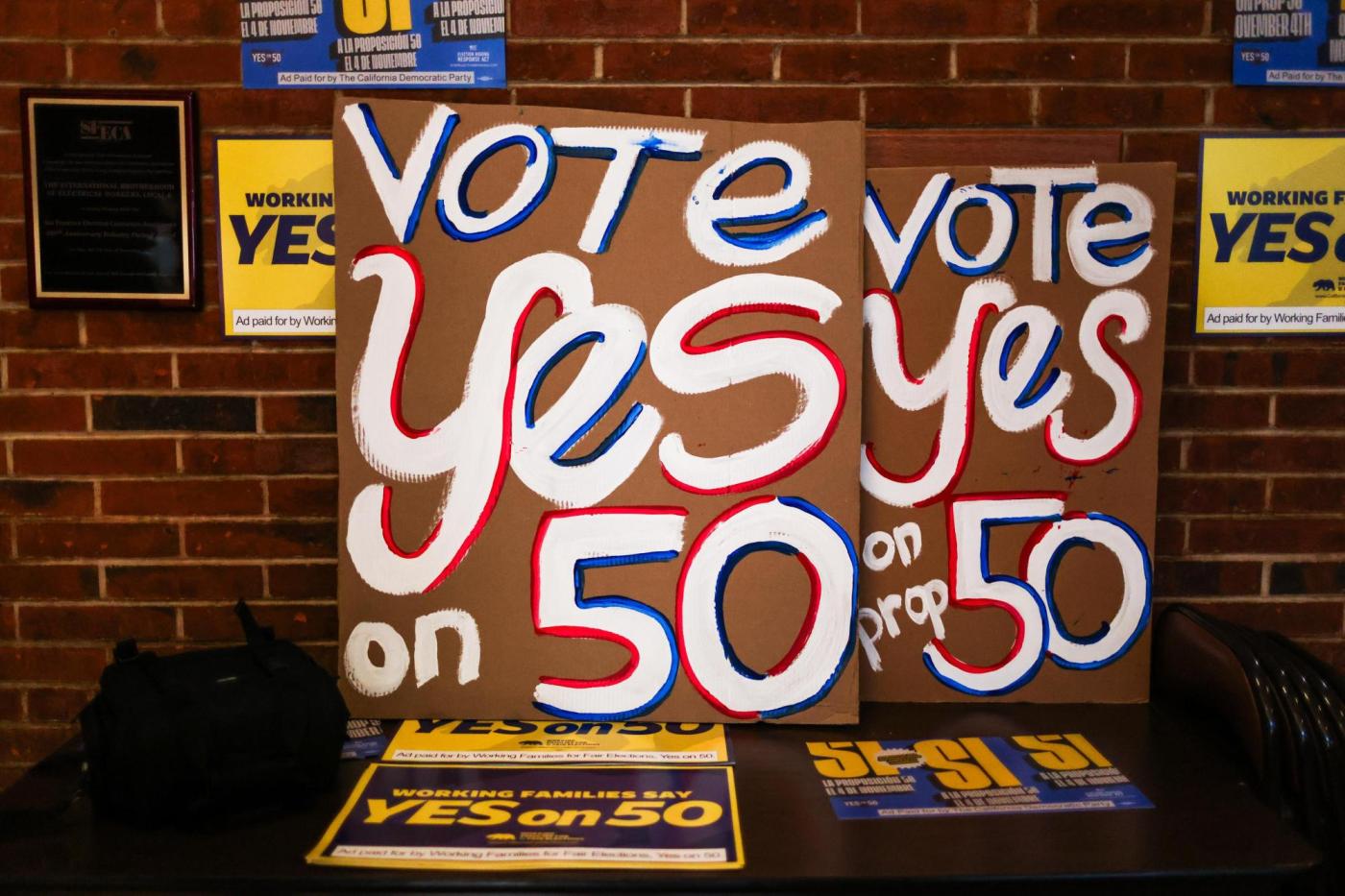
California’s redistricting effort will go before voters as a special ballot initiative on Nov. 4. Democrats there, who congratulate themselves as defenders of democracy, say the only acceptable response to Texas’s “election rigging” is to rig their own elections, too. Polls show that more than 60 percent of likely voters have embraced that backward logic, so Proposition 50 appears poised to pass.

Last month, North Carolina Republicans muscled through a map that they expect will help their party pick up one more seat in next year’s midterms. Missouri Republicans did the same a month earlier.

Despite the overly confident proclamations from partisan analysts about how such redistricting will change the balance of Congress, nobody knows how things will play next November. It was never certain that Texas’s efforts would win Republicans enough seats to stem the tide of a potential Democratic wave in the midterms. Nor has it ever been guaranteed that a Democratic wave would emerge, even if that’s the historical pattern. Anybody who has paid attention to the last decade of American politics should be wary of making firm predictions, especially amid a realignment in which young Hispanic and African American men have drifted toward Republicans.

As it looks now, Texas’s mid-decade gerrymandering could very well end up backfiring on the GOP; after all, California is far bluer than Texas is red. It could also end up as a wash, with broader political trends playing a more important role. It’s also very possible that there could a backlash to such raw displays of partisanship. This could boost Democrats statewide in the Lone Star State, where there may be a competitive gubernatorial or Senate race next year.

The guaranteed losers in all of these changes will be voters. By the time the midterms roll around a year from now, the country will have fewer competitive districts where politicians will have to work hard to win over Americans, especially independents. Credit goes to the Republican legislators of Indiana and Kansas who have admirably withstood intense pressure from national leaders to gerrymander their state’s map, at least so far. It’s a pity that so many others, including Democrats in Virginia, are willing to compromise their principles for perceived, short-term partisan advantage.

— The Washington Post

Related Articles


FDA restricts use of kids’ fluoride supplements citing emerging health risks


New Pentagon policy undercuts trans troops’ ability to ask to stay in the military, AP learns


Federal judge rules Trump can’t require citizenship proof on the federal voting form


Air traffic controller shortages lead to broader US flight delays as shutdown nears one-month mark


SNAP has provided grocery help for 60-plus years; here’s how it works