A plan to add flood walls and elevated park space is the most complicated and expensive link in the Lower Manhattan Coastal Resiliency portfolio: a chain of flood-proofing projects, devised in the wake of Hurricane Sandy, to protect the island’s tip from coastal flooding.
An evening view of the Financial District in Manhattan in February, 2023. (Adi Talwar/City Limits)
Picture a park stretching all the way from the Brooklyn Bridge to the Battery. It’s raised 15 to 18 feet above the current shoreline, and armed with nearly eight acres of green space, resilient ferry hubs, flood walls, deployable flood gates, and a multilevel esplanade projecting 90 to 200 feet into the East River.
If all goes well in the next decade, that’s what the waterfront along the South Street Seaport and Financial District could look like, once the neighborhood’s Climate Resilience Master Plan is complete. The challenge now is securing $5-7 billion to build it.
The FiDi-Seaport plan is the most complicated and expensive link in the Lower Manhattan Coastal Resiliency (LMCR) portfolio: a chain of flood-proofing projects, devised in the wake of Hurricane Sandy, to extend the shoreline and protect the island’s tip from coastal flooding due to sea level rise and storm surges.
Most of the other projects are partially or fully funded and will wrap up construction by 2031. The only outlier is the FiDi-Seaport plan, which is still in the design phase. Construction has yet to start, and it will take at least 10 years (if not longer) to finish once it does.
“[It’s] such a significant project, both in its location and its scale, that it raises issues we haven’t always had to grapple with on other projects,” said Jordan Salinger, the deputy director of adaptation strategies at the Mayor’s Office of Climate & Environmental Justice.
Funding, he added, must be addressed through “a creative solution between the federal government, state government, and the city.”
The need for the upgrades is clear, officials say. The New York City Economic Development Corporation (NYCEDC)—a public benefit organization spearheading the plan—projects that Lower Manhattan’s waterfront will experience frequent tidal flooding due to sea level rise by the 2040s.
The area has also seen significant population growth over the last decade, in part due to a slew of luxury housing projects and office-to-residential conversions, including those at 25 Water St., 55 Broad St., and One Wall St. Nearly 300,000 people also pass through the neighborhood while commuting to work each day.
The Seaport and the Financial District are some of the lowest-lying areas in Lower Manhattan, and they also suffered some of the worst water-logging during Hurricane Sandy. If the FiDi-Seaport plan isn’t implemented in time, NYCEDC estimates that future flooding could cause over $20 billion in direct and indirect damages to life, property, and businesses in New York City.
NYCEDC has proposed funding schemes for the project that combine grants from the U.S. Army Corps of Engineers (USACE), U.S. Department of Transportation (USDOT), the Federal Emergency Management Agency (FEMA), and funds from the city and state.
They’ve also been pitching the plan to residents. During Climate Week NYC in September, the EDC ran a pop-up exhibit at the South Street Seaport Museum, and organized community outreach events and educational tours.
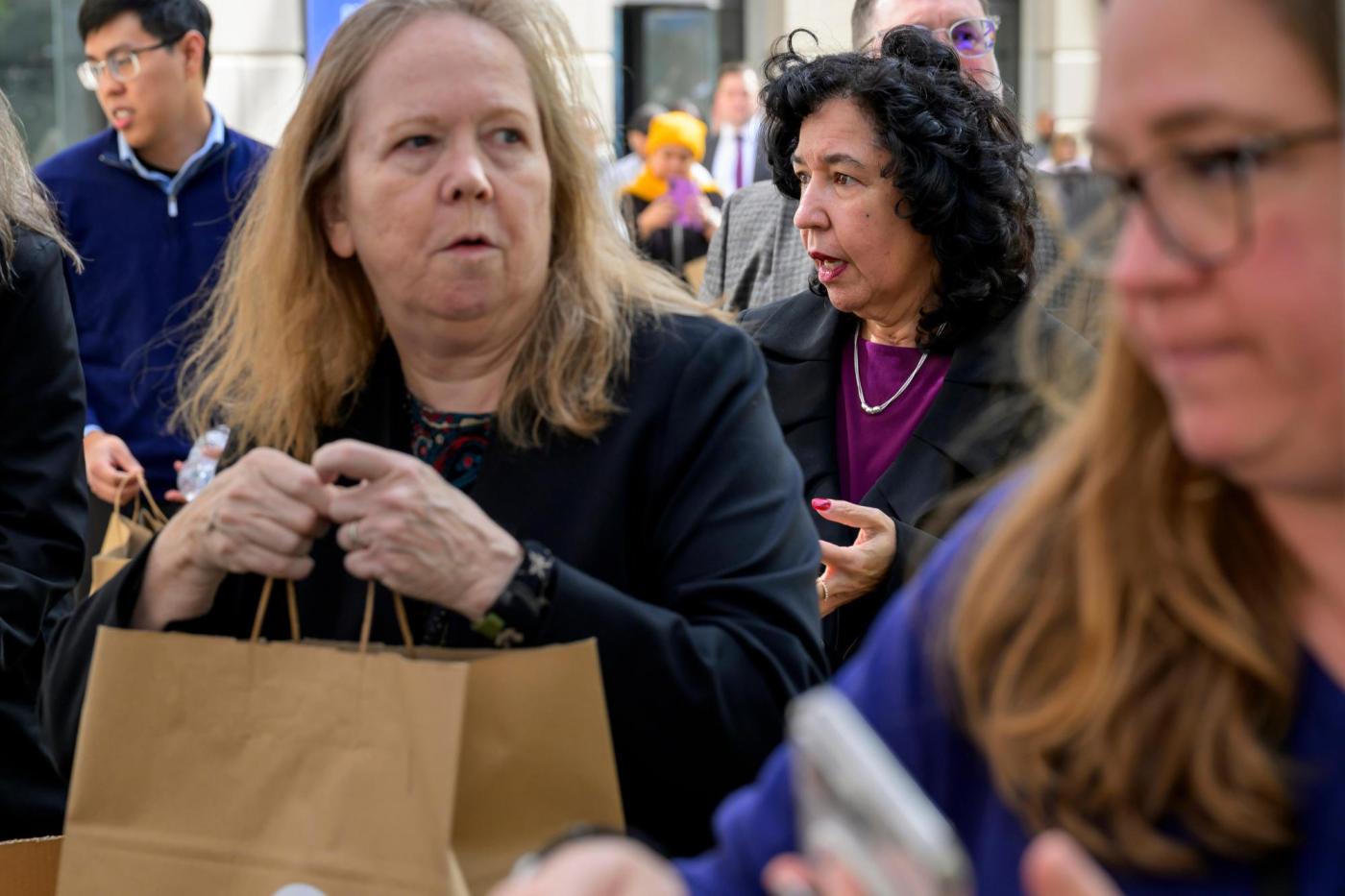
On Sept. 22, representatives from engineering firm Arcadis and Mathews Nielsen Landscape Architects (both consultants hired by NYCEDC) led a tour group on a 0.8-mile-long walk along the East River. The tour leaders told attendees NYCEDC hoped to secure up to 65 percent of the necessary funding from the U.S. Army Corps of Engineers (USACE).
Yet a week earlier in a Manhattan Community Board 1 meeting, a planner from the Army Corps’ New York District stated that it’s unlikely the project will receive USACE funding until at least 2028 or 2030. Even with funding, preliminary studies for projects of such magnitude can take multiple years, the planner said.
Tammy Meltzer, the chairperson of Manhattan Community Board 1, sees this window of time as an opportunity to iron out the project’s finer points. “I don’t think there’s room for panic. I think there’s room for careful planning,” she told City Limits. “I think we need to take stock of interim steps that can be done. We’re looking at this as a once in a lifetime opportunity.”
Future USACE funding for the FiDi-Seaport plan has to be allocated by Congress through the Water Resources Development Act. However, since coming into power, the Trump administration has repeatedly targeted climate infrastructure projects under the pretext of cutting “wasteful” spending.
Back in April, the Department of Homeland Security eliminated FEMA’s Building Resilient Infrastructure and Communities (BRIC) grant program, which provides funds for local governments seeking to mitigate damage due to natural disasters. New York State alone lost over $300 million in BRIC grants.
More recently, on Oct. 1, after the federal government shut down, U.S. Secretary of Transportation Sean Duffy announced that the USDOT would not distribute $18 billion in federal grants for the Second Avenue Subway and Hudson Tunnel projects in New York. Two weeks later, Russell Vought, the director of the Office of Management and Budget, threatened to withhold $11 billion for Army Corps projects in New York, San Francisco, Boston, and Baltimore. It’s still unclear which projects will be affected.
So while the federal government’s actions have dented hopes of securing construction funds, design work on the FiDi-Seaport project has also seen challenges.
During the 2025-2026 city budget cycle, the NYCEDC and Manhattan CB1 sought $15 million for an environmental review that would help secure Army Corps funding in the future. However, the executive budget released in May didn’t account for these funds, and design work was set to halt at the end of the year.
It took a last-minute push from NYCEDC, the Waterfront Alliance, and the Mayor’s Office of Climate & Environmental Justice to secure $7.5 million in the adopted city budget, which will keep design work on the project going until 2027.
“This project in particular had to stay alive,” said Tyler Taba, director of resilience at the Waterfront Alliance. “The FiDi-Seaport plan is the last connecting piece of the LMCR portfolio. Because engagement and design had already started on the project, leaving it in the middle unfunded would have been a huge missed opportunity for the city to close that gap.”
Historic storefronts along Fulton Street in the South Street Seaport, pictured here in 2015. (Credit: f11photo/Shutterstock.com)
There are other barriers to implementation. The restrictions on infrastructure development along the Seaport stem from the area’s protected city landmark status, the presence of an elevated parkway in the form of the FDR Drive, and a mishmash of subway lines underground. As a result, designers and engineers have little room to maneuver.
And the project has to go beyond just flood protection, stakeholders say.
“It’s not about the bottom line costs of flood control. It’s about the public waterfront and the experience we’re building for the next generation,” Alexis Taylor, NYCEDC’s vice president of climate resilience, said at a Manhattan CB1 meeting in August.
In the past year, officials completed two major flood-proofing projects in Manhattan, both of them parks. Segments of East River Park—part of a $1.45 billion resiliency project to protect the East River and the Lower East Side—opened in May after years of tense and difficult community engagement.
On the west side, Wagner Park, a $300 million project in Battery Park City (one of the least affected areas during Sandy), reopened at the end of July. Aside from flood-proof infrastructure to shield Manhattan against both sea level rise and another 100-year storm, the two revamped parks were designed as accessible public spaces.
The stakeholders behind the FiDi-Seaport plan have similar aspirations. “The city has set itself a number of goals,” said Matthijs Bouw, founder of One Architecture and Urbanism, and one of consultants on the plan. “They want this coastal resiliency infrastructure to be a multi-benefit infrastructure so that it enhances the waterfront as a piece of social infrastructure. And in order to deliver on that, it’s very important to get input from the community.”
So far, the community engagement process has revealed a variety of concerns and priorities.
“One of the things that we really desperately need is open recreation areas,” said Alice Blank, vice chair of Manhattan CB1. Meltzer told City Limits that she wants to ensure the project’s design would “connect the public to the water.”
Catherine McVay Hughes, who was chair of Community Board 1 during Hurricane Sandy, said she is curious about how the project would change the slope of the ground between the waterfront and FDR Drive. It is also vital, she added, to safeguard “the harbor which made New York City the financial capital. It’s very important to protect it because this is where New York City started.”
Some locals also fear parts of their neighborhood becoming construction sites for the next decade.
Between these issues and dealing with an uncooperative federal government, the project’s stakeholders have their work cut out for them. Even so, there’s no option but to keep moving forward, said Salinger.
“FiDi-Seaport is a generational effort that has already spanned multiple federal administrations, multiple governors, multiple city administrations,” he said.
“While it’s impossible to avoid partisanship in 2025, we have the science on our side, we have the community support, and we have the solution,” he added. “I think that’s all that we can control. Our focus is on delivering the right project at the right time.”
To reach the editor, contact Jeanmarie@citylimits.org
Want to republish this story? Find City Limits’ reprint policy here.
The post Funding Uncertainty Looms in FiDi-Seaport Climate Plan, Last Link in Lower Manhattan Flood Protection Projects appeared first on City Limits.