Double-decker downtown: At skyway shop Cedar Printing, paper is hotter than ever

posted in: All news | 0

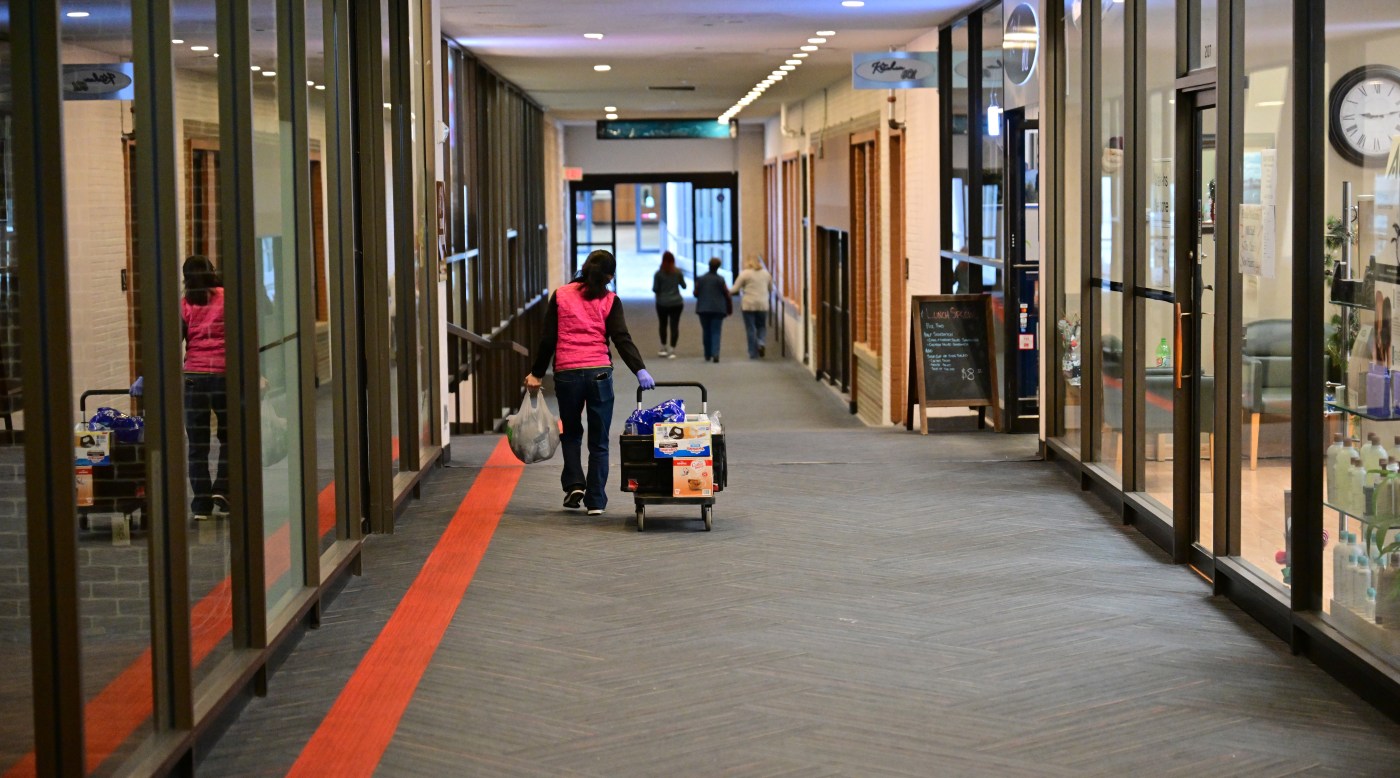
Especially in an increasingly digital age, printed materials often fall to the bottom of people’s to-do lists, said Tyler Hjeltness, the owner of Cedar Printing, a skyway print shop in Securian Financial’s 401 Building.

But then, suddenly, a major event or deadline or project presentation is a few days away, and you’ve forgotten to order your programs or marketing brochures or public signage.

“That’s part of our secret to success, is we cater to emergencies,” Hjeltness said. “Five to seven days is a typical lead time for a shop like ours, but we turn ‘em around tight, and we do it with a smile. It makes an impression on people when you can get the impossible done for them when at every other turn they’re told no.”

Hjeltness started working for Cedar Printing’s previous owner, Andy Flamm, in 2016 and bought the now-43-year-old business in 2019. Since then, Hjeltness has expanded the shop’s focus from primarily everyday business printing — think business cards, letterhead, invoices — to additionally incorporate more colorful marketing materials, wide-format banners and storefront graphics.

And interestingly, Hjeltness said he’s seeing a resurgence in how customers value printed objects, to the extent that the company is busier than ever. Currently, Hjeltness and his team are juggling about 60 active projects in various stages, from just-ordered to ready for pickup, and ranging in price from about $40 to several thousand.

“If you get a nice physical piece that somebody really obviously put some time and effort into, it seems to stand out,” he said. “There are things that digital media will never achieve. This is a cliche, but you can’t wrap a candy bar in a PDF.”

On an autumn Thursday afternoon, production manager Justin Kron completed final quality checks on an order of about 700 oversized postcards for a Minneapolis nonprofit. After they’re printed and cut to the right dimensions, he’ll apply a postage stamp to each one by hand.

“A lot of people want their stuff physically stamped because it shows someone cared enough to physically handle it,” Hjeltness said. “It wasn’t just a machine that just spit out a billion things and you’re just one in a billion.”

Meanwhile, print specialist Armand Clark kept an eye on a huge glossy banner for an upcoming event at the Minnesota Children’s Museum that was slowly emerging from a large-format printer. That morning, Minnesota Public Radio “Morning Edition” host Cathy Wurzer swung by to pick up an order. Recently, a renewable energy company based in Chicago hired Cedar Printing to produce and send a multi-state marketing push. Even the signage at the nearby Skyway Grill came out of Hjeltness’ shop.

“So we can be hyperlocal and also national,” Hjeltness said.

Running a print shop requires plenty of heavy, noisy machinery. The guillotine-style paper cutter in the corner weighs about as much as a sedan. An industrial paper folding machine is so loud when it’s running that Hjeltness keeps it in its own small room to reduce how disruptive it would be. So it’s not uncommon, he said, for print shops to be located in industrial parts of town or in out-of-the-way warehouses.

But for him, staying in the skyways is non-negotiable.

“I could technically run this out of a garage somewhere for cheaper rent, but no,” he said. “Being seen and being part of the community is what makes this enjoyable, honestly.”

More from Double-Decker Downtown

Read our deep dive into the past, present and future lives of the St. Paul skyways, and explore more profiles of skyway businesses:

After 43 years, Paul Hartquist’s personal service keeps skyway jewelry store shining
At Skyway Grill, owner Scott Johnson feeds everyone
Blue Hummingbird Woman brings native culture and wellness to the skyways
At skyway barbershop, Mr. B aims to empower through haircuts
Through clothing, skyway tailor Patricia Caldwell aims to beautify the world
Cycling Museum of Minnesota brings over a century of two-wheeled history to the skyway
Your guide to every lunch spot in the St. Paul skyways

Related Articles


I-94 to close next weekend both directions in downtown St. Paul for bridge work


Household cats encouraged to compete for royal titles at Saintly City Cat Club show


U.S. Bank Center mortgage acquired by St. Paul Downtown Development Corporation


MN Supreme Court reopens Keith Ellison’s wage theft case against Madison Equities


Crackdown on social service providers leaves some without housing assistance

Double-decker downtown: Cycling Museum of Minnesota brings over a century of two-wheeled history to the skyway

posted in: All news | 0

When Juston Anderson was growing up, the bus stop was right in front of his house. Kids from around the neighborhood would ride their bikes over, and while they waited for the bus, they’d tinker with the mechanics.

“When I learned how to ride a bike, it didn’t take me long to figure out that having a bike equals freedom,” Anderson said. “Later, I was going to school in Winona and I thought, when I graduate and get a job, I’m going to buy a historical bike. And then it just never stopped.”

Anderson amassed a significant enough personal collection that, in 2013, he exhibited some of his antique bikes at the State Fair. It caught the attention of the owners of Recovery Bike Shop in Minneapolis, who invited him to bring the exhibit to the second floor of their shop. Early the next year, the nonprofit Cycling Museum of Minnesota was officially born.

After a couple moves throughout the years, the museum opened an exhibition space in the St. Paul skyways, within Securian Financial’s 401 Building, with support from the Downtown Alliance’s Grow Downtown program. Because the museum is still a small, volunteer-run operation, the skyway exhibition space is currently open by appointment only.


A variety of historical bicycles are exhibited in the front window displays of the Cycling Museum of Minnesota in the St. Paul skyways on Nov. 4, 2025. (Jared Kaufman / Pioneer Press)

Today, the museum’s collection consists of more than 100 bicycles, including significant designs from the 19th and early 20th centuries. The collection also places a particular emphasis on Minnesota-made bikes and cycling artifacts, including vintage bike license plates and race medals.

Walking through the museum’s collection with Anderson, both his love of bicycles and his encyclopedic knowledge of cycling history immediately become clear.

The oldest bicycles in the collection are high-wheel bikes, sometimes called penny-farthings, from the 1880s. These bikes have what, to modern riders, appears to be a comically large front wheel, but Anderson explained its practical purpose: Because modern gear-and-chain drivetrain systems had not yet been invented, a larger wheel circumference meant more distance traveled with one pump of the pedal.

However, because of the way the seat was attached directly over the large wheel, it was unsettingly easy to accidentally take a “header,” or spin over the large front wheel and smash into the ground head-first, Anderson said. So when the modern bicycle design came around — with two equally sized wheels and a seat situated between them — it was aptly called a “safety bicycle.”

From there, he explained, various bells and whistles were added, literally and figuratively. Real noise-making devices were a crucial safety feature, so bikes would not spook nearby horses. Other add-ons that can be seen on bikes in the museum’s collection include acetylene gas headlamps, map cases, tool-carrying attachments and, for ladies’ bicycles, a skirt guard so the fabric would not become tangled in the wheel spokes.

The museum’s ethos, Anderson said, is preservation, not restoration. To illustrate this point, he noted some very faint ornate stenciled decoration along the frame of a bike from the early 20th century.

“When you strip it down, take off all the paint, you are getting rid of a lot of the history of the bike,” he said. “Any type of corrosion, we want to get that stopped. But if we were to restore this bike and repaint it, you would lose the original stenciling. I’m not into restoring bikes, because it just eliminates all the history that the bike had.”

“Every bike tells a story as it is,” he said.

Information about the museum, including contact information to set up a group tour of the exhibition space, can be found online at www.cmm.bike.

More from Double-Decker Downtown

Read our deep dive into the past, present and future lives of the St. Paul skyways, and explore more profiles of skyway businesses:

After 43 years, Paul Hartquist’s personal service keeps skyway jewelry store shining

At Skyway Grill, owner Scott Johnson feeds everyone

Blue Hummingbird Woman brings native culture and wellness to the skyways

Paper is hotter than ever at skyway print shop Cedar Printing

At skyway barbershop, Mr. B aims to empower through haircuts

Through clothing, skyway tailor Patricia Caldwell aims to beautify the world

Your guide to every lunch spot in the St. Paul skyways

Related Articles


I-94 to close next weekend both directions in downtown St. Paul for bridge work


Household cats encouraged to compete for royal titles at Saintly City Cat Club show


U.S. Bank Center mortgage acquired by St. Paul Downtown Development Corporation


MN Supreme Court reopens Keith Ellison’s wage theft case against Madison Equities


Crackdown on social service providers leaves some without housing assistance

Double-Decker Downtown: After 43 years, Paul Hartquist’s personal service keeps skyway jewelry store shining

posted in: All news | 0

When you’ve been in the jewelry business as long as Paul Hartquist has, you end up making a lot of couples’ engagement rings. And then engagement rings for the children of those couples.

And when you’ve been in the jewelry business as long as Paul Hartquist has — which, to be clear, is more than 43 years — you realize it’s not the rings themselves that are important but the people wearing them.

“It’s not so much doing the work, working on rings; I burned out on that long ago,” he said. “I’m helping people with jewelry that I met literally 40-plus years ago. …I’ve met a lot of wonderful people. Many of my customers have become friends.”

After apprenticing for seven years under Robert Moeller at his eponymous jewelry shop in Highland Park, Hartquist opened his own shop in what would become the Alliance Bank Center in 1989. When the building abruptly closed this spring, with tenants initially given just 48 hours to vacate, Hartquist hopped across the skyway to the Town Square building.

It was not ideal timing. Hartquist plans to retire at age 70, in a few years. He wasn’t interested in being forced to shutter his business before that point — especially not on such short notice — but he also doesn’t plan to be working for as many more years as it would take to reestablish himself sustainably elsewhere.

“It was a little chaotic and disturbing at first, but I landed on my feet,” he said. “If I was 10 or 20 years younger, I probably would have moved out into the suburbs.”

In Hartquist’s early days, the flow of people through the skyways was constant. But it’s been a steady decline since then, he said. Among his concerns: Too much street-level parking has been removed to make way for bike paths and the light rail. Some large companies have moved their headquarters out of downtown. Foot traffic is down substantially since the pandemic.

Hartquist is of two minds about the state of the skyway system today. On the one hand, his shop is tucked away at the end of a hallway, the final storefront before a “condemned” sign blocks what would’ve been the bridge to his old stomping grounds in the Alliance Bank building.

“Being here, it’s difficult for customers to access me,” he said. “They have to go out of their way; they have to want to see me.”

On the other hand, his business model is no longer one that relies on passersby. Decades ago, he said, women might stop in during their lunch hour and buy a necklace or a pair of earrings. But gold prices have jumped substantially over the years and people wear less jewelry than they once did, he said.

So now, he relies more on repeat customers and personal referrals than the daily walk-in business that sustains — or is unable to sustain — lunch counters and cafes around the skyways.

“Let’s say someone wants something done for a ring,” he said. “If they only come into work one day a week, well, that’s fine. They’ll come see me that one day. But if you’re in a food court, something like that, they need to sell food every day of the week in order to survive. So a lot of the vendors are suffering.”

More from Double-Decker Downtown

Read our deep dive into the past, present and future lives of the St. Paul skyways, and explore more profiles of skyway businesses:

At Skyway Grill, owner Scott Johnson feeds everyone

Blue Hummingbird Woman brings native culture and wellness to the skyways

Paper is hotter than ever at skyway print shop Cedar Printing

At skyway barbershop, Mr. B aims to empower through haircuts

Through clothing, skyway tailor Patricia Caldwell aims to beautify the world

Cycling Museum of Minnesota brings over a century of two-wheeled history to the skyway

Your guide to every lunch spot in the St. Paul skyways

Related Articles


I-94 to close next weekend both directions in downtown St. Paul for bridge work


Household cats encouraged to compete for royal titles at Saintly City Cat Club show


U.S. Bank Center mortgage acquired by St. Paul Downtown Development Corporation


MN Supreme Court reopens Keith Ellison’s wage theft case against Madison Equities


Crackdown on social service providers leaves some without housing assistance

Binyamin Appelbaum: Barring investors won’t fix the housing crisis

posted in: All news | 0

President Donald Trump relishes a handy scapegoat and, on Wednesday, he picked one to blame for the nation’s housing crisis: investors that are buying large numbers of single-family homes and operating them as rental properties.

Trump wrote on Truth Social that he was taking steps to prevent such purchases as part of a broader program to make homes affordable again. He said that “people live in homes, not corporations.” He said he’d provide more details in two weeks, when he visits Davos, a Swiss ski resort not known for its affordable housing.

But there’s no need to wait for the details. Landlords are not the cause of the nation’s housing crisis, and any plan that reduces investment in housing is only going to make matters worse.

The crisis is a simple problem with a complicated solution. The problem is that the United States does not have enough housing. The hard part is building more. It is certainly easier, and perhaps better politics, to talk about barring investors, or imposing rent controls, or kicking immigrants out of the country, but none of that is going to do the trick. The way to make housing more affordable is to build more housing.

Musical chairs and not enough chairs

Construction has never fully recovered from the 2008 financial crisis. Since then, the population has grown faster than the supply of new housing, and the result is a big game of musical chairs with not nearly enough chairs. While estimates vary, experts generally agree that we need millions of new housing units to close the gap. Up for Growth, a think tank focused on the shortage, puts the figure at 3.78 million.

Almost a year after taking office, Trump has yet to put forward any meaningful plans to increase housing construction. Instead he has offered a number of half-baked ideas, as in November, when he suggested on his social media platform that his administration might introduce a 50-year mortgage loan.

His threat to ban institutional investors is the latest example. As is so often the case, Trump isn’t proposing a real policy with actual details. He’s saying things he thinks people want to hear, even if they’re pulled from the policy playbook of the progressives he loves to hate.

Imagine it’s real

It is not even clear that Trump has the power to ban institutional buyers, nor that Congress would agree to pursue the idea. For the sake of this essay, however, let’s treat it as a real idea. Let’s pretend, for instance, that Trump means to endorse a bill introduced in 2022 by Rep. Adam Smith, D-Wash., imposing a 100% tax on purchases of single-family homes by any corporation with assets of $20 million or more.

The first thing to know is that such a proposal wouldn’t prevent most purchases of single-family homes for use as rental properties. In 2022, the Urban Institute estimated that institutional investors owned 574,000 single-family homes. That was less than 1% of the nation’s single-family homes — and less than 5% of single-family rentals. In other words, most rental houses are owned by small landlords.

A ban might have some benefits. Less competition from investors could push sellers to accept lower prices; buyers might be more likely to reside in the houses, rather than renting out the properties.

But it would punish renters. The rise of institutional investment in single-family houses is best understood as a postcrisis replacement for subprime mortgage lending. Tighter credit standards mean that millions of Americans can no longer obtain loans to purchase homes. Institutional landlords allow people to live in the same places but as renters.

Would it be better to expand lending? There may be an instinct to say yes. Americans generally regard homeownership as an end in itself, as a means of building wealth and as the basic building block of stable communities. But the housing crisis showed that homes purchased with subprime loans provided only the illusion of ownership. Borrowers did not build equity, nor did they establish enduring communities.

Fresh capital for homebuilders

The deep pockets of institutional investors aren’t just providing more options for renters. They’re also providing a fresh source of capital for homebuilders. Companies can sell excess inventory to rental companies, which allows them to build more aggressively. And, in some cases, they are building homes for rental companies. Last year, the homebuilder D.R. Horton completed a subdivision of 72 single-family houses outside Tallahassee, Florida, named the Cypress at Wesley Park. It rented the homes and then sold the whole thing to an investment firm called Topaz Capital Group.

Nobody would even blink if it was a 72-unit apartment building called the Cypress at Wesley Park.

Indeed, it’s important to remember that institutional ownership of homes is nothing new. Institutional landlords are a much larger and older presence in the apartment market. The nation’s largest owner of single-family rental houses, Invitation Homes, owned or managed about 110,000 properties as of September, which is a lot of houses. It’s also about one-tenth of the number of apartments owned or managed by the nation’s largest landlord, Greystar.

The apartment market does offer a cautionary tale. The Justice Department recently broke up an arrangement in which, it claimed, several of the largest apartment landlords, including Greystar, were collaborating through a third-party pricing service, RealPage, to raise rents. In a few metro areas, mostly in the Sun Belt, institutional investors have purchased enough single-family houses to potentially engage in similar shenanigans. It’s something for regulators to keep an eye on.

The question

But let’s get back to the big picture. Here’s a litmus test that you can use any time politicians say they have an idea to make housing more affordable: Will it result in more housing construction?

It only helps if the answer is yes.

Binyamin Appelbaum writes a column for the New York Times.

Related Articles


Bruce Yandle: Tax refunds are coming. Will they be vaporized by inflation?


Nolan Finley: Under Trump, U.S. is again the world’s policeman


Abby McCloskey: The GOP’s identity crisis is deepening by the day


Matt K. Lewis: Democrats could avoid a lot of trouble with a little ego management


Commentary: Nicolás Maduro is not just a corrupt leader. He’s also a direct threat to US security