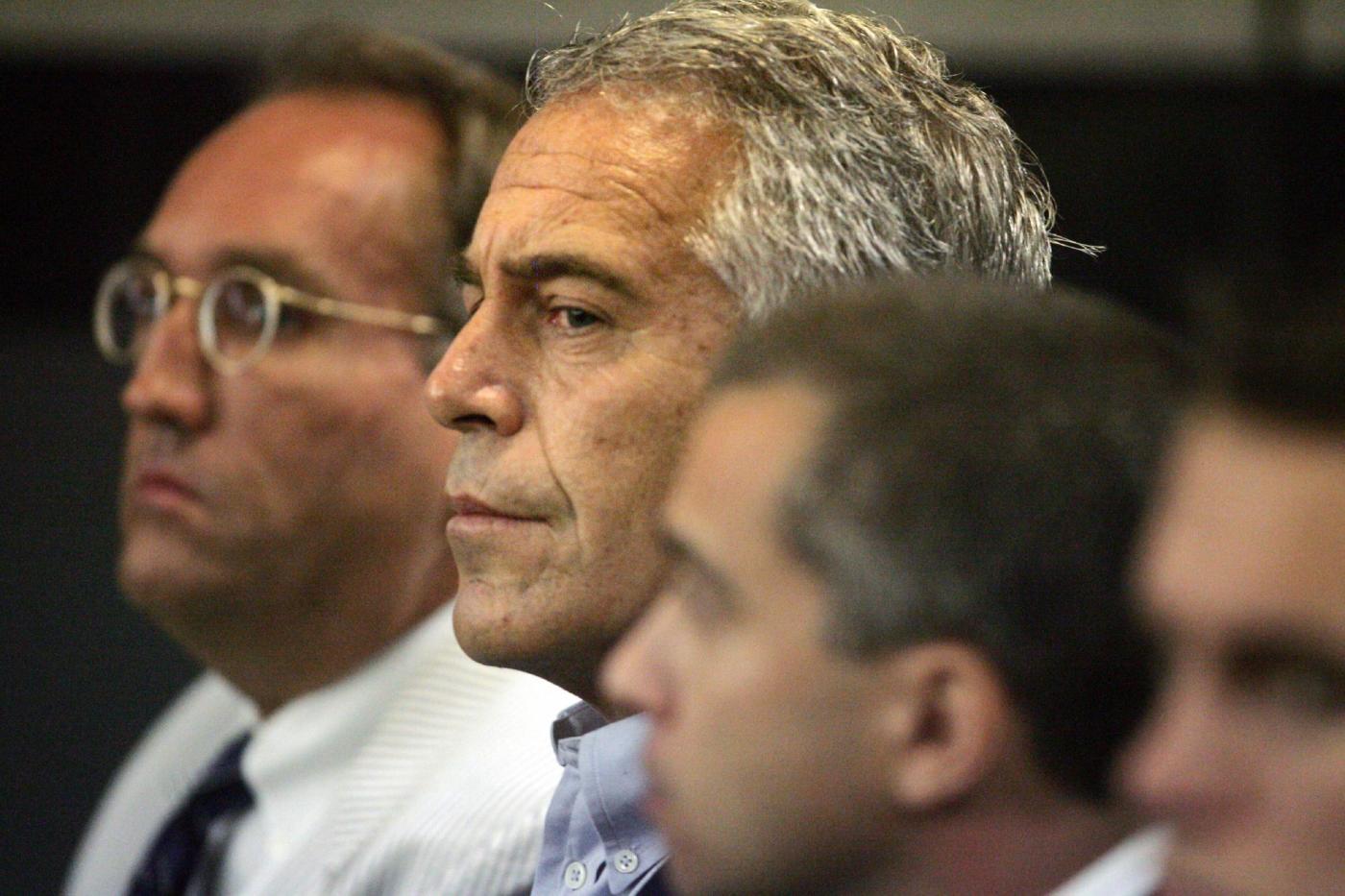
The fallout of Epstein’s crimes span the globe. Here’s a look at some of those paying the cost

posted in: All news | 0

By LAURIE KELLMAN, Associated Press

The fallout from Jeffrey Epstein’s transgressions spans oceans and continents, from the vulnerable girls he exploited to the privileged people and institutions that chose to associate with him, cover up his activities — or look away. No one has paid a higher cost than Epstein’s victims, who number more than 1,000, according to the Justice Department.

The world will soon have more information. President Donald Trump, friends with Epstein for years before he says they had a falling out in the early to mid-2000s, signed a bill late Wednesday forcing the Justice Department to make public many of its files on Epstein. The president’s reversal was a rare bow to the fact that his fight to quash the files was doomed in the Republican-led Congress, a development noted in foreign news outlets as a moment of exposure on the home front for the brash American president who had dominated geopolitics all year.

It’s worth noting that elected representatives of a nation bitterly divided on so much else at least could agree that the web of Epstein’s sex trafficking must be exposed. Yet even that has limits, because the legislation shields some of the case files from public view. Trump has insisted throughout that he has done nothing wrong and did not know of Epstein’s activities.

But even in death, Epstein bedevils not only the president but academics, government leaders, royalty, journalists and banks, across borders and parties. Public trust has suffered, too. Here’s a look at the escalating cost of the truth in the ongoing scandal.

Epstein friendship upends a pillar of academia

Economist Lawrence Summers has bounced back before after falling from the pinnacles of academia, government and punditry. That’s not likely for now, in the face of newly released emails showing that Summers stayed in touch with Epstein years after the disgraced financier pled guilty to soliciting prostitution from a minor.

This combo shows Jeffrey Epstein, left, and U.S. economist Larry Summers. (New York State Sex Offender Registry via AP/Michel Euler)

The letters reveal that Summers appeared to ask Epstein for advice about women — and Epstein dubbed himself Summers’ “wing man” — as late as 2019. That has cost the economist his positions with OpenAI, the Center for American Progress, a think tank, and the Budget Lab at Yale University. At first, Summers pledged to keep teaching classes at Harvard, captured in an eyebrow-raising video Wednesday in which he opened a class by noting his shame about the relationship with Epstein. Then he stepped away from that job, too, the university said.

The 70-year-old Summers, a former treasury secretary and onetime contender to lead the Federal Reserve, has had to give up responsibilities at Harvard before. In 2006, he stepped down as president of the elite school after a speech in which he suggested that women were less represented in math and science fields because of “intrinsic aptitude.”

This week, Harvard said it was conducting its own review. In 2020, the elite school reported that Epstein visited its Cambridge, Mass., campus more than 40 times after his 2008 plea deal. It said he was given his own office and unfettered access to a research center he helped establish. It also found that Harvard accepted more than $9 million from Epstein during the decade leading up to his conviction but barred him from making further donations after that point.

A former prince loses royal title, duties, castle home

A well-documented connection with Epstein has cost Andrew Mountbatten-Windsor his home on castle grounds and his title as prince of the realm.

FILE – Britain’s Prince Andrew speaks during a television interview at the Royal Chapel of All Saints at Royal Lodge in Windsor, April 11, 2021. (Steve Parsons/Pool Photo via AP, File)

Revelations about the king’s brother trickled forth for years and left little doubt that Mountbatten-Windsor, as Prince Andrew is now known, not only was involved in Epstein’s sex crimes against minors but stayed in touch with the disgraced financier after his conviction.

The evidence against Andrew grew increasingly hard to ignore even by his late mother, Queen Elizabeth II, who was said to consider Mountbatten-Windsor her favorite child and may have shielded him from the full consequences of his scandals.

That became impossible after Andrew gave a disastrous interview to the BBC in 2019. He was widely panned for failing to show empathy for Epstein’s victims and for offering unbelievable explanations for the friendship.

In her posthumous memoir, Virginia Giuffre said she was only 17 when she was trafficked to Andrew and that Epstein took a now-famous photograph that showed the then-prince with his hand around her waist.

FILE – Virginia Giuffre speaks during a news conference outside a Manhattan court in New York, Aug. 27, 2019. (AP Photo/Bebeto Matthews, File)

Andrew denied ever meeting Giuffre, did not recall the photo being taken and committed no crimes. But he did reach a settlement with her. Giuffre died by suicide in April.

“I can’t take any more of this,” a sender identified in Epstein’s contacts as “The Duke” wrote to him in 2011 of the scrutiny of their friendship, according to the partly redacted emails released by the House.

The flood of tawdry stories threatened to undermine support for the British monarchy at a time when Charles, 76 and in cancer treatment, is seeking ways to buttress the institution for his son, Prince William, to inherit.

Charles stripped Andrew of his title and forced him to move out of Royal Lodge, the 30-room mansion near Windsor Castle where Mountbatten-Windsor has lived for more than 20 years. Mountbatten-Windsor is banished to Sandringham, the king’s remote and private estate in the east of England.

Trump’s image of control took a hit

This time, the president failed to control a crisis of his own making — then claimed credit for resolving it.

In fact, Trump signed the bill to release files only after he’d lost a highly visible political fight, including with some of his fiercest MAGA defenders. That started a 30-day clock ticking for the release.

President Donald Trump speaks at the McDonald’s Impact Summit, Monday, Nov. 17, 2025, in Washington. (AP Photo/Alex Brandon)

But six years after Epstein’s death, his friendship with Trump continues to chip away at the president’s time, attention and support.

Trump increasingly began paying those costs in July, when the Justice Department abruptly reversed course and announced that no “further disclosure” of the Epstein files would be forthcoming. MAGA supporters, expecting Trump to make good on his campaign promise to release the files, edged toward rebellion.

Trump claimed he no longer wanted the support of such “stupid people” and “weaklings” — but that didn’t quiet them. He tried lashing out at reporters who asked about Epstein, but they kept doing so. A White House effort to lean on key Republicans supporting the files’ release didn’t work.

Major developments that Trump has trumpeted as achievements didn’t quiet the Epstein issue for long. Democrats made sure of that, releasing their choice Epstein emails on Nov. 12, the same day Congress and Trump ended a record 43-day government shutdown.

Related Articles


Probe says Iowa district ‘reasonably relied’ on consultant to vet superintendent arrested by ICE


Judge’s blistering opinion details use of force in Chicago-area immigration crackdown


Kashoggi’s widow and Democrats demand release of a call transcript with Trump and Saudi crown prince


A new crash test dummy that better resembles women gets key government endorsement


Officer acquitted in death of Ta’Kiya Young, a pregnant Black mother accused of shoplifting

The president thundered on social media that Epstein’s email claiming that Trump “knew about the girls” was a “hoax.” At another point, the president was forced to respond to a Wall Street Journal report that he’d written and signed a bawdy birthday note to Epstein that referred to secrets. Trump denied writing the note and filed a $10 billion defamation suit against the news outlet. Earlier this month, the president directed the Justice Department to investigate Democrats linked to Epstein.

Then, faced with the fact that all but one Republican in Congress would vote to release the FBI files, Trump abruptly backtracked.

“I DON’T CARE!” Trump wrote in a social media post. “All I do care about is that Republicans get BACK ON POINT.”

Flying without a Real ID? It could cost you $18 and a trip through a new screening process

posted in: All news | 0

By Karen Garcia, Los Angeles Times

Travelers who attempt to fly without a Real ID or a passport could be subject to a new airport security screening program that carries an $18 fee.

On Thursday, the TSA announced another option for travelers who have yet to get their Real ID or are flying without their passport: the modernized alternative identity-verification program.

The proposed program will use a new biometric kiosk system to verify identification before the traveler is permitted to pass through the TSA checkpoint, according to a notice posted on the Federal Register.

This option does not guarantee an individual will be granted access beyond the checkpoint and into the airport. To address the costs associated with the program, the TSA will require participants to pay an $18 fee, which then allows them to pass through airport security checkpoints for 10 days.

Related Articles


Travel: The islands of Indonesia offer unforgettable experiences


Portuguese island is a hiker’s paradise


See Al Pacino’s ‘Scarface’ shirt, Tom Hanks’ ‘Apollo 13’ spacesuit in new exhibit


National Geographic’s 25 best destinations to visit in 2026


Feeling right at home in Scotland

Biometrics uses physical characteristics to verify identity. The TSA already uses such methods for verifying digital IDS and for facial comparison.

Travelers who undergo the program screening may be subject to additional screening or experience delays.

It’s unclear if and when the new system and accompanying $18 fee will be implemented.

The TSA did not respond to The Times’ request for comment by the time of publication.

In a statement, the TSA said, “This notice serves as a next step in the process in REAL ID compliance, which was signed into law more than 20 years ago and finally implemented by Secretary [Kristi] Noem as of May 2025. TSA is working with stakeholders and partners to ensure both security and efficiency at our checkpoints. Additional guidance will be announced in the coming days.”

The newest program comes six months after TSA finally began enforcing its Real ID deadline, with mixed results. Since May 7, travelers who plan to board a domestic flight are required to show the federally compliant Real ID or another approved form of identification such as a passport to pass through airport security.

©2025 Los Angeles Times. Visit at latimes.com. Distributed by Tribune Content Agency, LLC.

Opinion: Development Without Displacement at Broadway Junction

posted in: All news | 0

“Our elected officials have a choice: be complicit in our displacement or successfully fight for these anti-displacement measures.”

A South West view of the Fulton Street and Van Sinderen Avenue intersection from one of Broadway Junction’s elevated platforms, pictured here in 2019.

The Broadway Junction area, which lies at the nexus of three communities—Bushwick, Ocean-Hill, Brownsville, and East New York—has been slated to receive nearly $1 billion in public and private investment. The public investment has the potential to be transformative in this disinvested area.  However, government officials must learn from the past and put protections for local residents in place to prevent speculation-induced displacement.  

In 2023, the city announced $500 million in investments to: bring long-overdue ADA  accessibility to the station, erect two new public plazas, make streetscape improvements, and relocate the Transit Police District 33 station. These investments come on top of the $21.6 million the city committed as part of the East New York Neighborhood Plan to renovate the adjacent Callahan-Kelly Playground, and the roughly $202 million in construction loans that the Leser Group took out to construct 2440 Fulton St., which now houses 1,100 NYC Department Social Services (DSS) employees across the street from the Broadway Junction station.

On top of this, the MTA has secured $2.75 billion as part of their 2025-2029 Capital Plan to construct the Interborough Express (IBX), a new light rail transit line that will run through Broadway Junction on Van Sinderen Avenue. Additionally, an estimated $48.5 million in  acquisition and construction loans were assumed by developer Jacob Landau to build 119 units of market rate housing at 2246 Fulton St., just two blocks from the Broadway Junction train station.

Two blocks down, a two-acre multi-building campus is proposed by  Brooklyn-based development firm Totem and is currently going through the Uniform Land Use Review (ULURP) process. These private development projects far exceed the amount in public investment that has been made by the city as part of the 2016 neighborhood rezoning approved by Mayor Bill de Blasio.  

Considering the flood of private dollars that will continue to inundate Broadway Junction, we are bracing ourselves for a wave of displacement. Property and land values will skyrocket,  rents and property taxes will increase, and the area will ultimately become inhabited by a new gentry, pushing out longtime predominantly Black, Latino and South Asian residents who have called this place home. However, there are critical steps the city and state can take to help prevent displacement. 

First, the city needs to increase funding for programs such as Partners in Preservation and the Homeowner Helpdesk to support tenant organizing and housing counseling.These were  programs that the city baselined and have consistently funded since the East New York  Neighborhood Plan of 2016.  

The city must also provide property tax reductions or subsidies to homeowners that live in 1-3 family homes within at least a mile radius of Broadway Junction. Cash-strapped homeowners should not face the consequences of being forced to sell their homes because they cannot  keep up with the pace of their growing taxes. East Brooklyn has consistently landed on the top of the tax lien sale—we should be undermining that trend, not exacerbating it. 

Likewise, the city and state needs to provide universal rent relief to renters that see rent  increases within a mile radius of Broadway Junction. The city currently provides rent relief  through the Senior Citizen Rent Increase Exemption (SCRIE) and the Disability Rent Increase Exemption (DRIE) programs, and it must design and offer similar programs for New Yorkers  within a rezoned area or area experiencing high levels of public and private investment like  Broadway Junction.  

Lastly, along with these developments, the sudden influx of private capital will drive up property values. This will cause some property owners to “cash-in” and sell their properties to investors who will push out longtime residents to maximize profits. Landlords will be incentivized to remove tenants through buy-outs or abusive tactics, as the area has seen in the lead-up and aftermath of the 2016 rezoning. For this reason, the city needs to expand funding for the Neighborhood Pillars Program to enable CLTs like the East New York Community Land Trust to acquire properties at scale (beyond what the program currently allows) and ensure permanent affordability. che City could even acquire these for-sale properties itself and transfer them to CLTs. 

Funding and expanding existing programs, as well as providing universal rent relief to renters and tax relief to homeowners in small homes, should be the anti-displacement policy at the top of the agenda for the city, especially as it relates to Broadway Junction. The days of the city simply providing legal counsel support for tenants within rezoned areas must end.

And to be clear, we are not anti-development or NIMBYs; as a CLT, we are for development that meets the needs of our community members, not development that displaces them. Our elected officials have a choice: be complicit in our displacement or successfully fight for these anti-displacement measures.  

Boris Santos is a public school teacher, East Brooklyn resident, and president of the East New York Community Land Trust. 

The post Opinion: Development Without Displacement at Broadway Junction appeared first on City Limits.

Probe says Iowa district ‘reasonably relied’ on consultant to vet superintendent arrested by ICE

posted in: All news | 0

By HANNAH FINGERHUT, Associated Press

DES MOINES, Iowa (AP) — Iowa’s largest school district released a report Friday claiming that it received an abbreviated background check and what was likely a forged transcript when it was hiring its former superintendent, who was charged in a federal indictment with falsely claiming to be a U.S. citizen on a federal form.

Des Moines Public Schools hired Ian Roberts in 2023 with the help of a national consulting firm, JG Consulting, which had initially recommended Roberts and four other candidates to the school board, according to the report from an investigator hired by the district.

The investigator, Des Moines-based attorney Melissa Schilling, concluded based on the contract and communications at the time that the school board reasonably relied on JG Consulting to vet Roberts or disclose limitations in their vetting process. The district is likely to cite the report in their ongoing lawsuit against the Texas-based consulting company, who has said the district is trying to shift blame.

A federal grand jury issued a two-count indictment against Roberts, who is originally from Guyana in South America and was arrested by federal agents on Sep. 26. Roberts resigned his position, is in federal custody and is awaiting trial, which is currently scheduled for March.

Schilling is a labor and employment lawyer who also co-leads her firm’s new crisis management practice, according to the firm’s announcement in July. Her work for the district was focused on the selection of JG Consulting for the superintendent search process and the school board’s awareness of discrepancies in Roberts’ records, according to the report.

The district declined to comment further or detail how much Schilling or her firm was paid to do the investigation.

Related Articles


Kashoggi’s widow and Democrats demand release of a call transcript with Trump and Saudi crown prince


A new crash test dummy that better resembles women gets key government endorsement


Officer acquitted in death of Ta’Kiya Young, a pregnant Black mother accused of shoplifting


Police say a man has been shot and killed after wielding a knife at St. Louis airport


More swings rock Wall Street, except stocks are jumping this time

Checking Roberts’ work authorization

Roberts had claimed to be a U.S. citizen on his work eligibility form, providing a driver’s license and Social Security card as supporting documentation. Schilling said Des Moines schools relied on the consulting firm to identify immigration issues since JG Consulting told the district that they were a registered agent with the government’s employment eligibility system, “E-Verify.”

E-Verify compares information entered by an employer from an employee’s documents with records available to the U.S. Department of Homeland Security and Social Security Administration. But the system has its flaws, recently highlighted in the case of a Maine police officer arrested by immigration authorities even though he was vetted using E-Verify.

Schilling said it was “unknown” whether the firm used E-Verify at the time.

JG Consulting disputes that it was their responsibility, according to a court filing. A spokesperson did not immediately comment on the report released Friday.

“The District had the legal duty and obligation to verify Roberts’ immigration status and work authorization as his employer, and it apparently failed to do so. JG Consulting legally could not, as the non-hiring entity, confirm Roberts’ immigration or work-authorization status,” the court document reads.

Des Moines Public Schools paid JG Consulting $35,000 for facilitating the superintendent search, according to the contract.

A limited background check

Schilling’s report said the background check provided to Des Moines Public Schools by JG Consulting, via a subcontracted third-party company, Baker-Eubanks, only looked at records for the past seven years despite federal law that allows more extensive disclosure for positions paid more than $75,000.

Schilling acknowledged in the report that many state laws prevent access to records, such as arrests or charges, if they did not result in a conviction.

Since his arrest, federal authorities have provided a list of criminal charges in Roberts’ record, including drug possession and intent to sell in 1996 in New York, where state law could have prevented full disclosure of such charges. Officials did not specify the outcome of that charge.

Still, Schilling said a 2012 conviction for reckless driving in Maryland likely would have been disclosed in the background check if it had looked beyond seven years.

The background check did identify — and Roberts did address — a 2022 weapons charge in Pennsylvania, where he was convicted of a minor infraction for unlawfully possessing a loaded hunting rifle in a vehicle. Schilling wrote that JG Consulting called the conviction a “blemish” when they recommended Roberts to the board.

Roberts has also been charged with unlawfully possessing a firearm while being in the country illegally. Officials said he had four firearms, including one found wrapped in a towel in the school-issued vehicle he was driving when he was arrested.

In his application, Roberts had to say whether he was ever charged with a misdemeanor, felony or major traffic violation, such as driving under the influence, according to JG Consulting’s profile for the job. It is not clear how Roberts responded at the time.

A transcript that was likely forged

Roberts falsely claimed on his application that he obtained a doctorate in urban educational leadership from Morgan State University in 2007, according to documents The Associated Press obtained through a public records request.

Schilling confirmed that board members were provided that resume by JG Consulting during the hiring process, though Roberts himself brought paper copies of a different resume — where he indicated he completed “abd,” or all but dissertation — to his in-person interview with the school board.

Although Roberts was enrolled in that doctorate program from 2002 to 2007, the school’s public relations office confirmed in an email that he didn’t receive that degree. It declined to say which degree requirements he hadn’t met, and it would not provide a copy of his transcript to the AP or to Schilling.

Schilling wrote that she was “fairly confident” that the transcript Roberts provided in his application was forged. She wrote that the background check flagged the discrepancy but interviews with board members indicate the issue was not raised by JG Consulting.

JG Consulting has said the district was aware that he had not obtained a doctorate from that university.

In the court filing, the firm said the district was attempting to shift blame for its “hiring and employment shortcomings,” it said. “The District cannot shift blame for its failures and oversights because it knew of Roberts’ criminal issues and resume problems but still decided to hire him.”