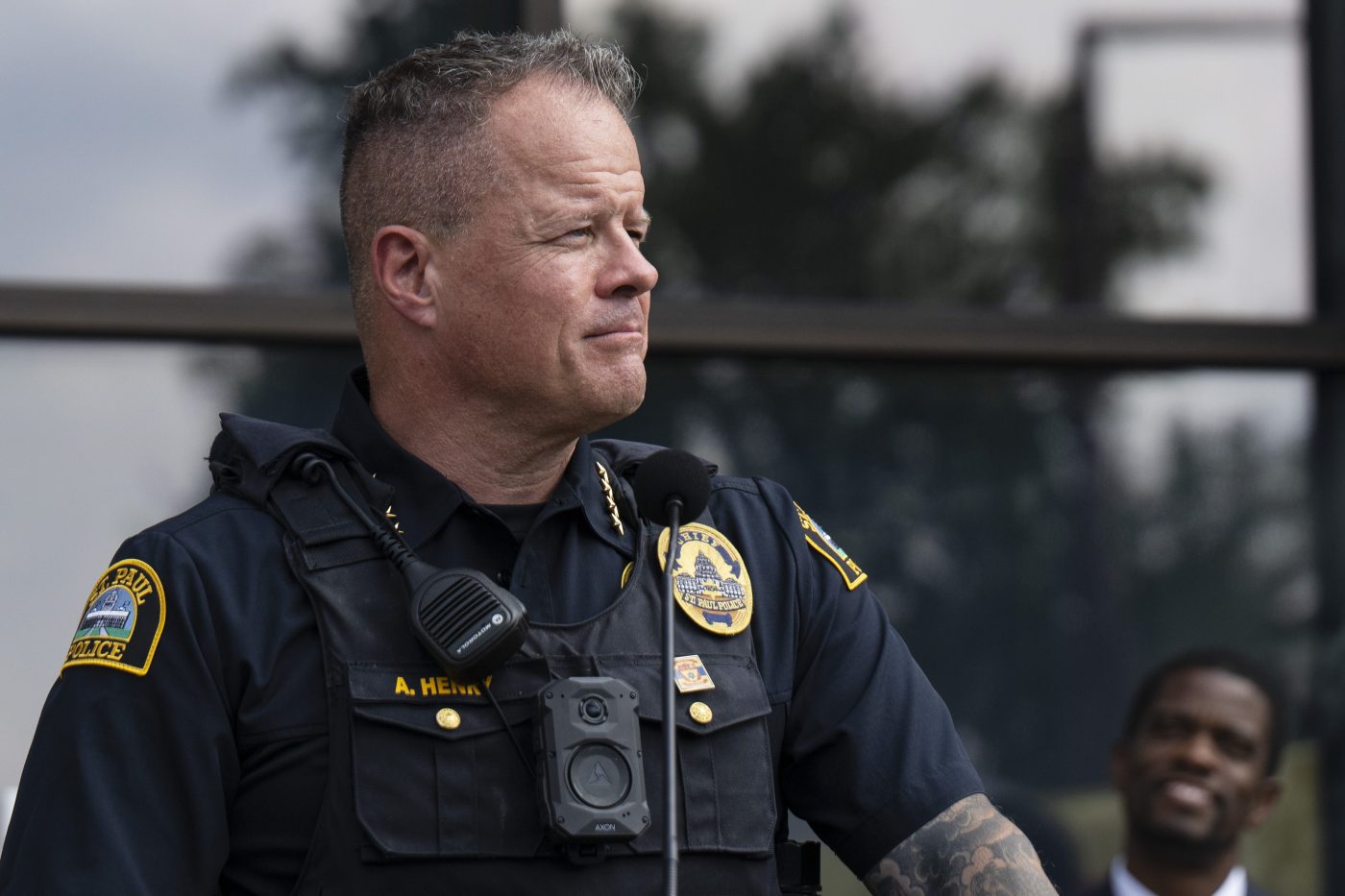
St. Paul Police Chief Axel Henry speaks at a news conference announcing an arrest in the murder of Michael Brasel, who was shot by a teen Brasel caught rummaging through his wife’s car. Henry has completed half his six-year term as chief of police and seen murder rates fall significantly in the past year. (John Autey / Pioneer Press)
Axel Henry became St. Paul’s police chief when the murder rate was high for the city and the department was understaffed.
Halfway into his six-year term, violence is down more significantly than what’s been seen nationally. Henry credits a major part of that to the department’s new focused effort on solving nonfatal shootings.
Hiring still hasn’t kept up with the pace of retirements and departures, though the police department has recently held academies twice a year to try to address that.
Henry, a St. Paul officer since 1998, followed in the footsteps of his predecessors by rising through the department’s ranks. Before he was appointed chief by Mayor Melvin Carter, he was commander of the narcotics and human trafficking unit.
The St. Paul city charter says police chiefs serve six-year terms, so new mayors often inherit a current police chief. State Rep. Kaohly Her, elected mayor this month over Carter, said she and Henry have “had a great working relationship.”
When federal agents descended on a St. Paul warehouse this week during an immigration raid, in which they arrested 14 workers, people were scrambling for information. St. Paul police officers were not involved in the operation.
“I appreciated the clear, direct communication this week around immigration action,” Her said in a statement about Henry. “His steady hand ensured we were operating on facts, not assumptions.”
For patrol officers, Henry’s time as chief has meant they’re feeling “more supported,” said Mark Ross, St. Paul Police Federation president.
Ross and Henry both say more still needs to be done to increase hiring. The department has recently held academies — how the department brings officers on board — twice a year instead of annually to try to keep prospective officers from getting recruited away by another law enforcement agency while waiting for St. Paul.
Henry sat down with the Pioneer Press for an interview about his first three years as chief and what he still wants to accomplish. This interview has been edited for space and clarity.
Q: What’s been the reality of what you wanted to do and what you’ve been able to?
A: I’m very proud of what we’ve been able to do around gun violence. Of course, it’s not just reducing it for the moment. You have to reduce it again the next year and the next year.
The number of murders really does drive a lot of perceptions. If you’re doing all the other public safety things right, your murder number goes down. (There had been 11 homicides in St. Paul this year as of Friday; there were 29 in the city during the same period last year. The department continues to have a high rate of solving homicides.)
But some of what I thought we were going to be able to tackle, like a lot of the issues with quality of life downtown, have not gone the way I thought they would. That’s not all on the police department, but I’m a part of that equation.
Q: How have you approached violent crime?
A: One of the things the mayor asked me about right away was, “How do we get this murder rate down?” If you look at the 20-year average, these last six years of murders of 30 or more a year were way too high, but they became the norm.
I always tell people: The data doesn’t tell you what to do. It tells you where to look, and that tells you how to find the solution to a problem.
The mayor said, “How quickly do you think you could bring that down?” I said, “The murder number isn’t a number you can just push down. You have to push down on a bunch of other things.”
Maplewood gunman sentenced for shooting at car while kids cowered nearby
Metro Transit looking for a new police chief
Stillwater prison 2.0: The DOC is testing ‘earned living units’ prior to 2029 closure
ICE says they arrested 14 for immigration violations at St. Paul warehouse
Jury convicts 2nd man in Coon Rapids triple murder
If you do a better job on domestic violence calls, it drives it down. If you get more guns off the street, if you deal with group violence so they’re not fighting as much, that brings it down. You do a better job of comprehensive investigations and solving nonfatal shootings.
The mayor said, “How long do you think it would take for that to actually happen?” I said, “I know what other levers to push, or at least I believe I do, and if I’m right, it’ll take about 24 to 36 months.” We’re literally right there.
(The department’s nonfatal shooting unit started in January 2024. There were 63 nonfatal shootings in St. Paul as of Monday, compared with 95 in the same timeframe last year. The clearance rate for such cases was 37 in 2023 and increased to 69 percent last year.)
One of the things that I think really is marbled into every piece of our success is morale.
Q: What’s the link between success and morale?
A: I always joke with (previous St. Paul police chief) Todd Axtell that he gets a heavyweight belt. Within the first weeks of his term, Philando Castile happened (he was fatally shot by a St. Anthony police officer in Falcon Heights). Then COVID, and George Floyd.
St. Paul Police Chief Axel Henry speaks during a dedication ceremony renaming the St. Paul Police Department Eastern District station in honor of slain St. Paul police officer Ron Ryan Jr. on Aug. 26, 2024. Ryan and fellow officer Tim Jones, along with Jones’ K9 partner Laser, were killed in the line of duty on Aug. 26, 1994. Mayor Melvin Carter is at right. Henry was promoted to chief at a time he described as a “dark period in law enforcement.” (John Autey / Pioneer Press)
We were coming out of a dark period in law enforcement when I became chief. I think the cops, understandably so, were feeling like they were hated.
That was part of the reason why I told the mayor when I applied for this job that I think the city needs a factory floor chief now: Someone that’s way more connected to the police officers. They deserve a leader internally. We focus so much on this job as a leadership position out in the community, but at the end of the day, you’re still in charge of leading the department.
The message of “service with purpose” and “what you do matters” has been the drum that I’ve been beating since before I was the chief.
Q: Some police chiefs I’ve talked to keep a photo in their drawer or their wallet of a victim in an unsolved case that weighs on them. Do you have anything like that?
A: I have something like that, too (pointing toward his bookcase, where a small piece of paper is taped, with a name he wrote on it — Bao Yang). That happened before I was the chief.
She had a restraining order and her ex-boyfriend set off all the alarm bells. She finally got away from her abusive partner and he shot and killed her in her front yard. She was a nurse and doing wonderful things.
I always look at her name and it reminds me why we’re out here and that, if you do it right, you can prevent these things from happening.
Q: You’ve talked about decreasing retaliatory violence. How have you done that?
A: If a young person gets killed in gun violence, then it’s like a cliche that someone’s going to show up at the funeral and shoot it up. If it’s predictable, it’s preventable.
Forever, before I was the chief, we would go out there in unmarked cars and try to watch and make sure that those things weren’t happening. We caught someone running on the West Side during a memorial for the student that was killed at Harding (High School). That’s another case that is going to be stuck in my mind forever.
The person we caught during the memorial had an extended magazine and a gun with a switch, and the mayor said, “How did you guys catch him so fast?” I said, “Cops were out there. Not in marked cars. We can’t do that because the community gets mad at us.”
The mayor said, “Would you be willing to put marked cars out there?” Now, if we have a funeral that was due to gun violence, you’ll see cops out there in marked cars, in uniform, and it’s been a deterrence.
Q: What’s an example of change that’s taken longer than you expected?
A: The ordinance issue is probably my highest frustration. There are some ordinances we have that are clearly antiquated and are just no longer enforceable, and the city doesn’t enforce them, so they shouldn’t be on the books anymore.
I think the community can come together and decide, “What are the problems that ail us that we have an issue with? There’s probably a legal way to enforce that.” We should either write a new ordinance or tweak the one we have to make sure that it’s addressing the problems.
We should be doing that, particularly downtown, on some of these lower-level issues that really drive a lot of the bigger problems that we have. And for sure, they drive the perception of safety in the city.
We can all be empathetic towards the plight of the folks that are unsheltered, the drug problem and the mental illness issues people are dealing with. But we can’t do that at the expense of our businesses that have been leaving and now we’ve got buildings that are vacant downtown, and that’s really the financial tax engine for our city.
Q: The department was below staff when you came in. Has it rebounded?
A: We’ve been in the middle of a big retirement boom and we haven’t been able to get enough people in the academies to make up the difference. (Authorized strength is currently 616 officers. There are 559 officers with 537 able to work, and the remainder on military, disability or other leave.)
This year, we’ll potentially be up between academy graduates and retirements. This is a classic example of how this is an aircraft carrier, not a jet ski. You can’t turn it around at a moment’s notice.
Part of what I figured out very quickly as the chief was it wasn’t enough to talk about recruitment and retention. You had to add development in there. You’ve got to be getting your people opportunities to go to the best trainings, to develop your own trainings.
Q: How have you done that?
A: An example is the International Association of Chiefs of Police conference. It’s normal for the chief and deputy chiefs to go. The first year, I asked, “Who’s been there?” And five people raised their hand. Then, “Who here wants to go?” And every other hand went up. I thought, instead of me going every year, we’ll let other people go.
One of the first questions I asked was, “When was the last time St. Paul hosted a command school?” It was 2005. We’re hosting one now (Northwestern University in Evanston, Ill., put on the intensive leadership program at the St. Paul police training facility and graduation was Friday). We were able to send four people because we received two spots for hosting.
Q: You said you’ve talked to Mayor-elect Her?
A: I’ve known her because she’s been a state representative. I will tell you, she brought me egg rolls today (Wednesday). I’ve never had anybody do that.
She said, “I know yesterday (when there was an ICE raid) was a tough day, and you got your phone blown up by all kinds of people with, ‘What’s going on?’ even though your department wasn’t there.” That was such a nice, thoughtful thing. The staff here, they were blown away by it.
She has been nothing but supportive of me. The first conversation we had, I was clear in saying, “I’m never going to argue with you publicly if we have a disagreement,” which was the same with Mayor Carter. She has said very openly that she doesn’t want to surround herself with “Yes” people.
Another thing I told the current mayor when I applied for this job was, “I will never lie to you, which means I can make you a second promise.” He said, “What’s that?” I said, “You won’t always like what I tell you.”
Ice safety is important any time, but especially right after freeze-up
Stillwater prison 2.0: The DOC is testing ‘earned living units’ prior to 2029 closure
ICE says they arrested 14 for immigration violations at St. Paul warehouse
Two arrested after glue found in locks at St. Anthony Starbucks
Immigrant group confirms 2 were detained at St. Paul business, checking for more
Q: What else do you want people to know about you and the department?
A: There’s an old joke in my line of work that the two things that cops hate are change and the way things are.
I tell this to people all the time: I will never really know if I did a good job until after I’m gone because if the whole thing falls apart or they reverse every decision I ever made, then you’re going to think, “Apparently that was all terrible.”
It is intimidating to take on this job because St. Paul has done many things so well that it’s almost easier if someone hands you a broken-down jalopy and says, “Fix it,” but we’re not that.