By LAURIE KELLMAN, SAM McNEIL and AAMER MADHANI
LONDON (AP) — President Donald Trump’s efforts to broker an end to the Russia-Ukraine war closely mirrors the tactics he used to end two years of fighting between Israel and Hamas: bold terms that favor one side, deadlines for the combatants and vague outlines for what comes next. The details — enforcing the terms, guaranteeing security, who pays for rebuilding — matter less.
Trump administration says lower prices for 15 Medicare drugs will save taxpayers billions
New prosecutor won’t pursue charges against Trump and others in Georgia election interference case
Trump’s Ukraine peace plan ignites diplomatic flurry but major hurdles lie ahead
Report: US envoy coached Putin aide on how Russian leader should pitch Trump on Ukraine peace plan
Federal judge says immigration officers in Colorado can only arrest those at risk of fleeing
“You know what the deadline is to me? When it’s over.” Trump told reporters aboard Air Force One Tuesday.
The formula has worked so far in the tense Middle East, though its long-term viability remains in question. Trump got his moment to claim credit for “peace” in the region from the podium of the Israeli parliament. Even there, he made clear that next on his priority list was resolving the largest armed conflict in Europe since World War II.
“Maybe we set out like a 20-point peace proposal, just like we did in Gaza,” U.S. special envoy Steve Witkoff told Yuri Ushakov, Russian President Vladimir Putin’s foreign policy adviser in a phone call the day after Trump’s speech, on Oct. 14. A recording of that call leaked to Bloomberg News.
They did just that, issuing a 28-point plan heavily tilted toward Russia’s interests that set off alarms in Europe, which had not been consulted. Trump insisted Ukraine had until Nov. 27 — Thanksgiving in the U.S. — to accept it.
But by Tuesday, Trump had eased off the hard deadline. It seemed clear, even to Trump, that the Israel-Gaza model doesn’t fully apply in Russia and Ukraine as long as Putin refuses to be flattered, pushed or otherwise moved to take the first step of a ceasefire, as Israel and Hamas consented for different reasons on Oct. 9. Making the point, Putin launched waves of bombings on Ukraine Tuesday and Wednesday even as American negotiators renewed Trump’s push to end the war.
“I thought (a Russia-Ukraine deal) would have been an easier one, but I think we’re making progress,” Trump said during the annual White House turkey pardon to mark the Thanksgiving holiday. Hours later, he told reporters that the 28-point plan actually “was not a plan, just a concept.”
FILE – Rescue workers clear the rubble of a residential building which was heavily damaged by a Russian strike on Ternopil, Ukraine, Nov. 19, 2025. (AP Photo/Vlad Kravchuk, file)
The president’s goal may not be a formal, long-lasting peace treaty, one expert said.
“Trump’s approach emphasizes the proclamation of a ceasefire, not its observance,” Mariia Zolkina, a political analyst at the Kyiv-based Ilko Kucheriv Democratic Initiatives Foundation, wrote on Liga.net, a Ukrainian news outlet, adding: “Donald Trump is not interested in whether the ceasefire will be sustainable.”
Trump’s approach toward ‘peace’ bears similarities to the tactics and style he used in the Israel-Gaza talks
Fresh off the Gaza deal and coveting the Nobel Peace Prize, Trump named his next priority before he’d even left the Israeli Knesset.
“If you don’t mind, Steve, let’s focus on Russia first, All right?” Trump said, turning to Witkoff.
Where the Gaza ceasefire agreement had 20 points, the Russia-Ukraine proposal would start with 28 items and include more detail on who would pay for reconstruction. They envision “peace” boards headed by the president to lead and administer the aftermath. Both lack detail on incentives for complying and enforcement. And both depend on a ceasefire.
Fabian Zuleeg, chief executive of the Brussels-based European Policy Centre think tank, said the proposals for Gaza and Ukraine show a kind of “naivete by believing that by intervening at that level, by imposing your will on something like this, that you will reach some form of long-term conclusion.”
He said both proposals reflect Trump’s political and personal self-interest.
FILE – People wearing hats that read “Trump The Peace President” inside the Knesset as President Donald Trump prepares to deliver remarks, Oct. 13, 2025, in Jerusalem. (Kenny Holston/The New York Times via AP, Pool)
“In the end, the focus is solely on what Trump thinks he will get out of this in terms of reputation and money,” Zuleeg said.
Each Trump administration plan to end the wars heavily favor one side.
The Trump plan for Gaza leans to Israeli terms. It makes disarming Hamas a central condition for any progress in rebuilding the devastated territory. It also lays out no strict timetable for a full Israeli troop withdrawal, making it conditional on deployment of an international security force.
FILE – President Donald Trump greets Israeli Prime Minister Benjamin Netanyahu at the West Wing of the White House, Monday, Sept. 29, 2025, in Washington. (AP Photo/Alex Brandon, file)
For Russia and Ukraine, Witkoff looked to open peace plan talks with terms skewing toward Russia. He quietly hosted Kirill Dmitriev, a close ally of Putin’s, for talks in south Florida to help launch the plan that opened talks in Geneva, according to a senior administration official and a U.S. official familiar with the matter who were not authorized to comment publicly and spoke on the condition of anonymity. The White House insists that the plan was U.S.-authored with input from both the Ukrainians and Russians.
But that’s where the similarities end. The differences are buy-in — and Putin
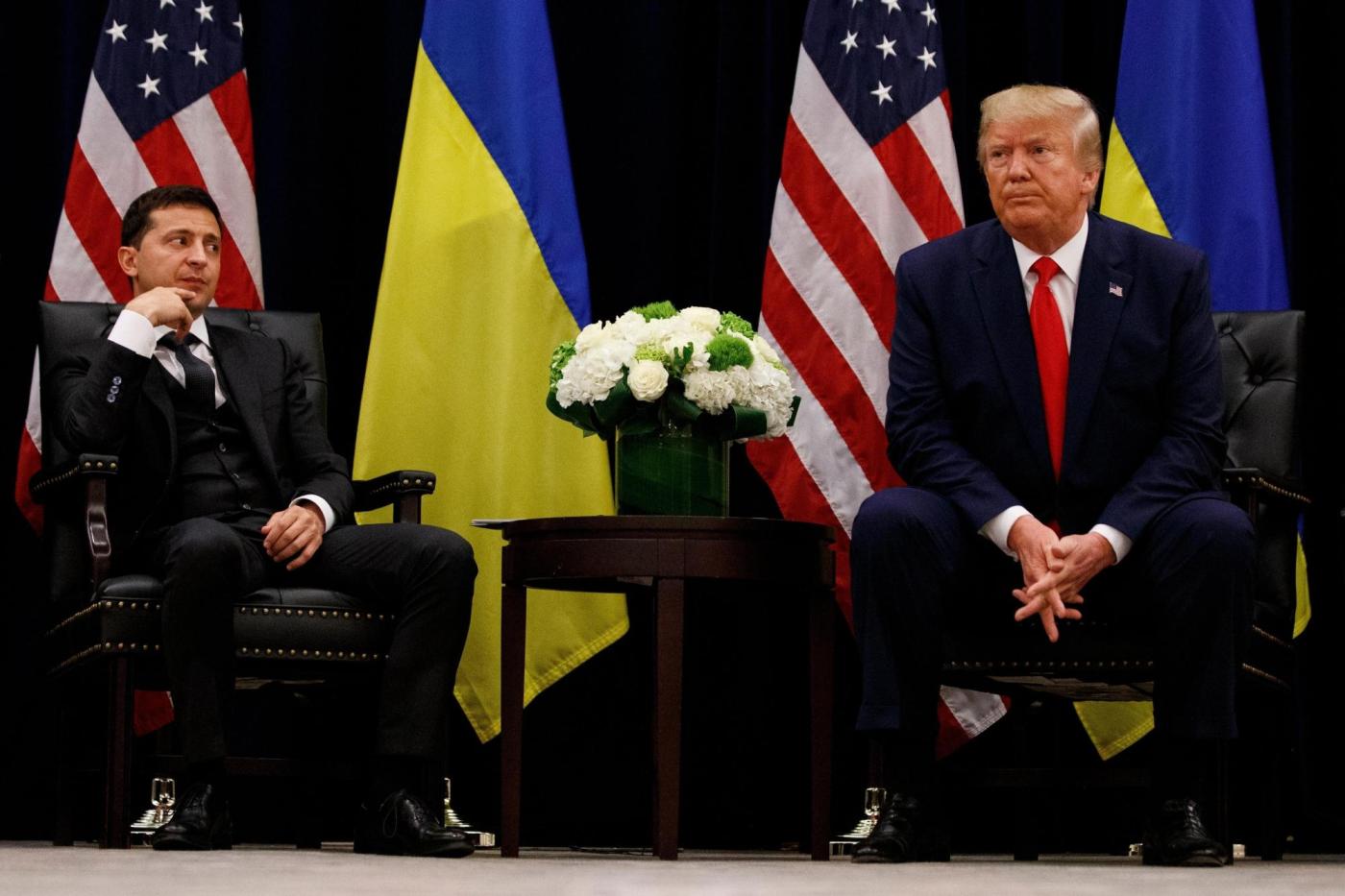
The draft that was formally presented to Ukrainian President Volodymyr Zelenskyy decidedly favored the Russians, with no European input. In contrast, the Gaza ceasefire talks got buy-in from Egypt, Qatari, Jordanian, Saudi and other regional powers.
The 28-point Russia-Ukraine plan called for Ukraine to give up land in the industrial Donbas region that the Russians currently don’t control and dramatically shrink the size of its military. It also effectively gave Russia oversight of both NATO and EU expansion. The draft has narrowed by a few points since it was first presented, and Trump is sending his envoys on a bit of shuttle diplomacy to “sell it,” as he said. He said Witkoff will visit Moscow next week — perhaps joined by his son-in-law, Jared Kushner, who was also involved in the Gaza plan. Army Secretary Dan Driscoll will meet with the Ukranians.
European leaders worried that Trump is leaving them out of high-level discussions and vulnerable to Russian aggression.
FILE – Firefighters put out the fire after a drone hit a multi-storey residential building during Russia’s night drone attack in Kyiv, Ukraine, Nov. 25, 2025. (AP Photo/Efrem Lukatsky, file)
“He appears perfectly ready to sacrifice Ukraine’s security and Europe’s in the process,” Hannah Neumann, a German member of the European Parliament, said of Trump on Tuesday.
Israeli Prime Minister Benjamin Netanyahu resisted Trump’s pressure to agree to a ceasefire, for a time. But Putin refuses to concede anything on Ukraine.
He’s appeared to be considering the matter, notably when Trump rolled out a red carpet for the Russian leader at a summer summit in Alaska — an old front line of the Cold War. Trump left without an agreement from Putin to end the bloodshed. The Russian leader walked off with long-sought recognition on the world stage.
To the horror of Ukraine and the vexation of Trump, Putin has stood firm.
FILE – A man hugs his children as they react to the death of their mother killed by a Russian airstrike in Kharkiv, Ukraine, Nov. 23, 2025. (AP Photo/Andrii Marienko)
As the envoys flew home from Geneva last week without any agreement, the White House scrambled to explain. One U.S. official argued that the 28-page plan, which calls on Ukraine to cede the Donbas region and bar Ukraine from joining NATO, represents considerable concessions from Putin because he would be agreeing to give up on his claim, once and for all, that all of Ukraine should be part of Russia.
Putin, the official noted, has long grumbled that the West doesn’t respect Russia’s position in the global world order. The official added that the Trump White House in its approach is not affirming Putin’s position but trying to reflect the Russian perspective is given its due in the emerging peace plan.
It’s not for the administration to judge Putin’s positions, the official said, but it does have “to understand them if we want to get to a deal.”
McNeil reported from Brussels and Madhani from Washington. Associated Press writer Lee Keath in Cairo contributed.