
Today in History: December 8, John Lennon shot to death

posted in: All news | 0

Today is Monday, Dec. 8, the 342nd day of 2025. There are 23 days left in the year.

Today in history:

On Dec. 8, 1980, rock star and former Beatle John Lennon was shot to death outside his New York City apartment building by Mark David Chapman.

Also on this date:

In 1941, the United States entered World War II as Congress declared war against Imperial Japan a day after the attack on Pearl Harbor.

Related Articles


Congress gears up to pass $900 billion defense policy bill


Trump wants Venezuela’s leader to go. Here’s who could replace him.


Today in History: December 7, Apollo 17 blasts off


Today in History: December 6, 13th Amendment ratified, abolishing slavery


Former DEA agent charged with agreeing to launder millions of dollars for Mexican drug cartel

In 1987, President Ronald Reagan and Soviet leader Mikhail S. Gorbachev signed a treaty at the White House calling for the destruction of intermediate-range missiles.

In 2012, Texas A&M quarterback Johnny Manziel became the first freshman to win the Heisman Trophy.

In 2014, the U.S. and NATO ceremonially ended their combat mission in Afghanistan, 13 years after the Sept. 11 terror attacks sparked their invasion of the country to topple the Taliban-led government.

In 2016, John Glenn, whose 1962 flight as the first U.S. astronaut to orbit the Earth made him an American hero and propelled him to a long career in the U.S. Senate, died in Columbus, Ohio, at 95.

In 2017, Japanese pitching and hitting star Shohei Ohtani announced that he would sign with the Los Angeles Angels.

In 2022, Russia freed WNBA star Brittney Griner in a high-profile prisoner exchange with the U.S. that released Russian arms dealer Viktor Bout. Griner had been detained for nearly 10 months.

In 2024, insurgents completed their occupation of the Syrian capital of Damascus as a half-century of Assad family rule swiftly crumbled. Russian state media reported that President Bashar Assad was in Moscow after fleeing the rebel advance.

Today’s Birthdays:

Flutist James Galway is 86.
Author Bill Bryson is 74.
Actor Kim Basinger (BAY’-sing-ur) is 72.
Commentator and columnist Ann Coulter is 64.
Actor Wendell Pierce is 63.
Actor Teri Hatcher is 61.
Basketball Hall of Famer Teresa Weatherspoon is 60.
Baseball Hall of Famer Mike Mussina is 57.
Actor Dominic Monaghan is 49.
NASCAR driver Ryan Newman is 48.
Singer Nicki Minaj is 43.
Country singer Sam Hunt is 41.
Actor AnnaSophia Robb is 32.
Congress Gears Up to Pass $900 Billion Defense Policy Bill

posted in: All news | 0

WASHINGTON — The House is expected to take up legislation this week that would authorize about $900 billion for the military, providing an increase over the White House’s annual budget request.

The bicameral version of the bill released Sunday includes $8 billion more than what the Trump administration had requested and what the House allotted in a version of the bill that it passed earlier this year. The additional funding in the legislation marked a modest but rare divergence for Republican lawmakers from President Donald Trump, after a year of largely ceding authority as he made dramatic cuts to the government.

Both chambers are racing to pass the annual defense policy bill before the end of the year and deliver it to the president’s desk.

One overarching goal of the bill, which authorizes spending for the 2026 fiscal year, is to streamline how the Defense Department meets its needs through research, contracting and manufacturing.

The bill would authorize an overhaul of how the department buys weapons. It also seeks to shore up the network of public and private organizations that provide a range of materials, products and services to the military.

Rep. Mike Rogers, R-Ala., the House Armed Services Committee chair, said in a statement that the legislation was focused on “building out critical warfighting capabilities.”

“I’m eager to send this to President Trump’s desk so we can give our military the tools they need to remain the most ready, capable, and lethal force in the world,” he added.

Troops across the military will receive a 3.8% annual pay raise under the bill.

The legislation also seeks to codify more than a dozen of Trump’s executive orders, including those aimed at accelerating U.S. manufacturing of military drones, transforming the country’s air and missile defense system into a “Golden Dome” to intercept foreign attacks, and authorizing the use of active-duty troops to patrol the southern border.

The final bill includes some House Republican provisions about gender in the military that echo the Trump administration’s efforts to end “woke” ideology, including a ban on transgender women participating in women’s athletic programs at U.S. service academies.

The bill, however, does not rename the Defense Department the “Department of War,” as Trump and his defense secretary have called it. Instead, the legislation sticks with the already codified “Department of Defense” and “secretary of defense” throughout the roughly 3,000-page bill.

The legislation would also roll back Biden-era climate policies, including by restricting the Defense Department’s use of electric or hybrid vehicles.

Aid for Ukraine is included in the bill, with a reauthorization of $400 million in security assistance annually through the 2027 fiscal year for the country as it faces a worsening position in its war with Russia.

Negotiators also included in the final text new guardrails on U.S. investments in certain technology in China. The language is a bipartisan attempt to stem the flow of American capital into China’s development of, among other sectors, artificial intelligence and military tech.

The bill would also repeal authorizations for the use of military force from 1991 and 2002. There was strong bipartisan support to eliminate the Iraq and Persian Gulf War-era authorizations that presidents for decades, in both parties, have used to justify overseas military operations.

A permanent repeal of U.S. sanctions on Syria is also included in the latest version of the bill, building on steps Trump has taken. Lawmakers say the repeal is necessary if Syria is going to recover from the civil war that ravaged the country for more than a decade.

Both the House and Senate versions of the bill that passed earlier this year would have approved expanding health insurance coverage for in vitro fertilization for service members and their family members. The provision was removed by Speaker Mike Johnson at the eleventh hour last year, but its sponsors had hoped that Trump’s pledge to improve access to IVF would pressure Republicans to support the proposal this year.

The Defense Department only covers fertility treatment for those who can prove a difficulty in becoming pregnant is because of “a serious or severe illness or injury while on active duty,” leaving those who cannot to pay out of pocket for the expensive procedure.

His office said in a statement that Johnson has “clearly and repeatedly stated he is supportive of access to IVF when sufficient pro-life protections are in place.”

Rep. Sara Jacobs, D-Calif., one of the sponsors of the IVF proposal, said in a statement that Johnson had put his “personal beliefs” over the needs of service members, and that she was disappointed that the president had “failed to do anything” to change the speaker’s position.

This article originally appeared in The New York Times.

U.S. Deports Second Planeload of Iranians, Officials Say

posted in: All news | 0

The Trump administration deported a planeload of Iranian citizens on a chartered plane to Iran on Sunday, according to two Iranian officials familiar with the details, in just the second time the United States has ever done so.

The plane — carrying about 50 Iranian citizens, as well as deportees from Arab countries and Russia — departed from an airport in Mesa, Arizona, and will make stops in Egypt and Kuwait, said the two Iranian officials, who asked for anonymity because they were not authorized to speak publicly.

The U.S.-chartered deportation flight to Iran was the second of its kind, after the first took off in September, after months of negotiations between Tehran and Washington.

Iran and the United States have not had diplomatic relations since the Islamic Revolution in 1979, and for decades the United States has provided refuge to Iranian dissidents, religious and ethnic minorities; members of the LGBTQ+ community; and others fleeing persecution in their homeland.

But as part of the Trump administration’s pursuit of mass deportations, it reached a deal with Tehran to coordinate the return of Iranian citizens facing deportation — currently estimated at about 2,000 people — and send them on chartered planes to Tehran. In the past, the United States deported Iranians individually on commercial planes.

The identities of Sunday’s deportees and their individual circumstances — including whether they had voluntarily accepted deportation or had been forced onto the plane — were not immediately clear. One of the Iranian officials familiar with the list of Iranians on the flight said they had entered the United States through the southern border, lingered in detention facilities for months and had their asylum requests denied.

The Department of Homeland Security did not comment on the flight. A U.S. official, who asked not to be identified to discuss the issue, confirmed the flight had taken off Sunday and described it as a routine deportation flight that included nationals from other countries, not just Iran.

One of the Iranian officials, who has worked closely with U.S. officials on the transfer, said that Arab and Russian nationals would get off the plane when it landed in Cairo and that the Iranians would then travel on to Kuwait, where they would transfer to a chartered Kuwait Airways airplane for the final leg to Tehran.

Mojtaba Shasti Karimi, director of consular services for Iran’s Foreign Ministry, told local news media Sunday that Iran was expecting to receive about 55 deportees from the United States in the coming days.

Shasti Karimi said that those in the group had expressed their willingness to return home to Iran because of “the racist and anti-immigration policies,” of the U.S. government and said Tehran had received reports of “inhumane” treatment of Iranians held in Immigration and Customs Enforcement custody.

As news reports of the possible flight began to circulate over the weekend, however, an Iranian-American U.S. lawmaker, Rep. Yassamin Ansari, D-Ariz., warned on social media that the flight could include “vulnerable individuals who could face persecution” if returned to Iran.

The Trump administration has said it plans to carry out the largest deportation in the country’s history, targeting immigrants lacking legal status and those who had illegally crossed the U.S. border. The administration has also said that it would severely reduce the number of asylum cases it grants and limit them to white migrants from South Africa or English-speaking Europeans.

Iranians are among the citizens of 19 countries targeted in President Donald Trump’s travel ban. Their — and many others’ — legal pathways to immigration have also been restricted following new limits Trump announced after the shooting of two National Guard members in Washington last month. The suspect in the shooting, which killed one soldier, is an immigrant from Afghanistan.

The first flight of Iranian deportees departed in September and landed in Tehran in early October, by way of Qatar, and at least eight of 45 people on the flight said they had resisted deportation, begging to not be sent to Iran because they feared for their lives. Two deportees on the flight to Tehran recounted their ordeals in detail, saying they had been beaten by immigration officials in the United States and in Qatar and dragged onto the plane.

Upon landing in Tehran in October, deportees said they were terrified, as they were questioned at the airport and made to fill out forms explaining why they had left Iran and sought asylum in America. Several of the deportees said they had been called in for interrogation by the intelligence wing of the Revolutionary Guard.

The United States and Qatar both denied allegations of violence against the deportees or forcing them on the flights to Iran.

This article originally appeared in The New York Times.

Thailand launches airstrikes along border with Cambodia as tensions reignite

posted in: All news | 0

By JINTAMAS SAKSORNCHAI and SOPHENG CHEANG

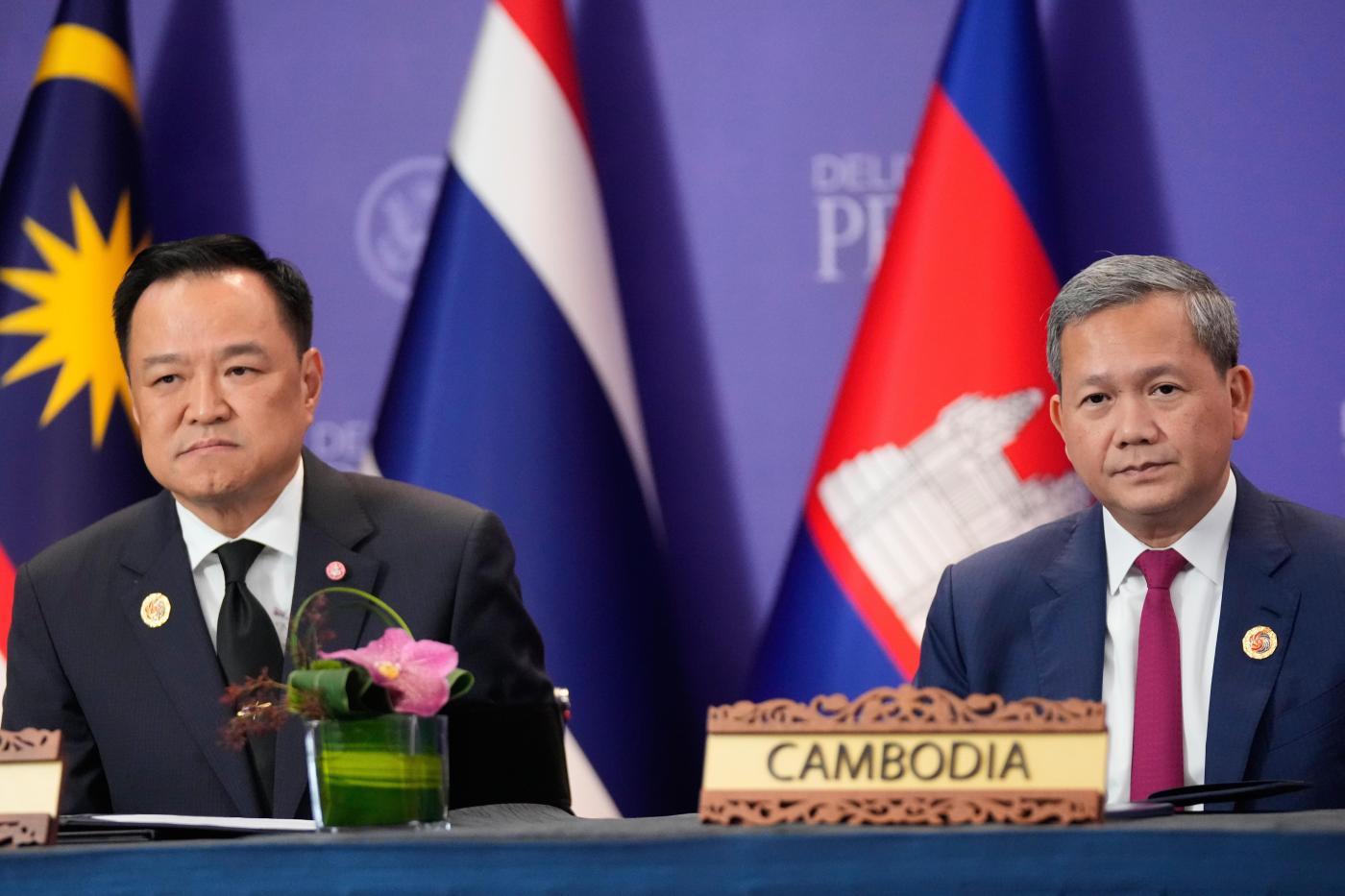
BANGKOK (AP) — Thailand launched airstrikes along the disputed border with Cambodia on Monday as both sides accused the other of breaking a ceasefire that halted fighting earlier this year.

Longstanding border disputes erupted into five days of combat in July that killed dozens of soldiers and civilians. U.S. President Donald Trump pushed the Southeast Asian neighbors to sign a truce agreement in October, but tensions have continued to simmer.

The Thai ministry of defense said that more than 35,000 people have left areas near the border for shelters and more are believed to have fled to stay with relatives elsewhere, while Cambodia’s Information Minister Neth Pheaktra said that residents of several villages near the border have been evacuated.

Thai Prime Minister Anutin Charnvirakul said in a televised speech that military operations would be carried out as necessary to defend the country and protect public safety.

“Thailand has never wished for violence. I’d like to reiterate that Thailand has never initiated a fight or an invasion, but will never tolerate a violation of its sovereignty,” he said.

Fighting follows exchange of fire on Sunday

The ceasefire was strained in early November after Thai troops were injured by land mines, leading Thailand to announce that it would indefinitely suspend implementation of the agreement. Both sides continue to trade accusations over responsibility, even as they are supposed to be cooperating in getting rid of the mines.

Trump said in mid-November that he’d intervened to preserve the ceasefire as tensions simmered between the two countries.

But another brief episode of fighting took place along the border Sunday, after which both sides said the other fired first. The Thai army said Cambodian fire injured two Thai soldiers and Thai troops retaliated, resulting in an exchange of fire that lasted around 20 minutes. Cambodia said that the Thai side fired first and that its own troops did not retaliate.

On Monday, Thai army spokesperson Maj. Gen. Winthai Suvaree said the Cambodian troops fired first into Thai territory in multiple areas. He said one Thai soldier was killed and four other soldiers were wounded, and civilians were being evacuated from the affected areas.

Thailand used aircraft “to strike military targets in several areas to suppress Cambodian supporting fire attacks,” he said.

Cambodian Defense Ministry spokesperson Maly Socheata said the Thai military attacked the Cambodian troops first on Monday, and that Cambodia did not retaliate during the initial attacks.

“Cambodia urges that Thailand immediately stop all hostile activities that threaten peace and stability in the region,” she said.

The prime minister of regional neighbor Malaysia, Anwar Ibrahim, called for restraint in a statment posted to social media and said that his country is ready to supports efforts to avert further fighting.

“Our region cannot afford to see long-standing disputes slip into cycles of confrontation,” he wrote.

Centuries of rivalry lie beneath territorial dispute

Thailand and Cambodia have a history of enmity going back centuries, when they were warring empires.

Their modern territorial claims stem largely from a 1907 map drawn when Cambodia was under French colonial rule, which Thailand has argued is inaccurate.

The International Court of Justice in 1962 awarded sovereignty to Cambodia over an area that included the 1,000-year-old Preah Vihear temple, which still rankles many Thais.

The ceasefire does not spell out a path to resolve the underlying basis of the dispute, the longstanding differences over where the border should run.

___

Sopheng Cheang reported from Phnom Penh, Cambodia. Associated Press writer Eileen Ng in Kuala Lumpur, Malaysia contributed to this report.