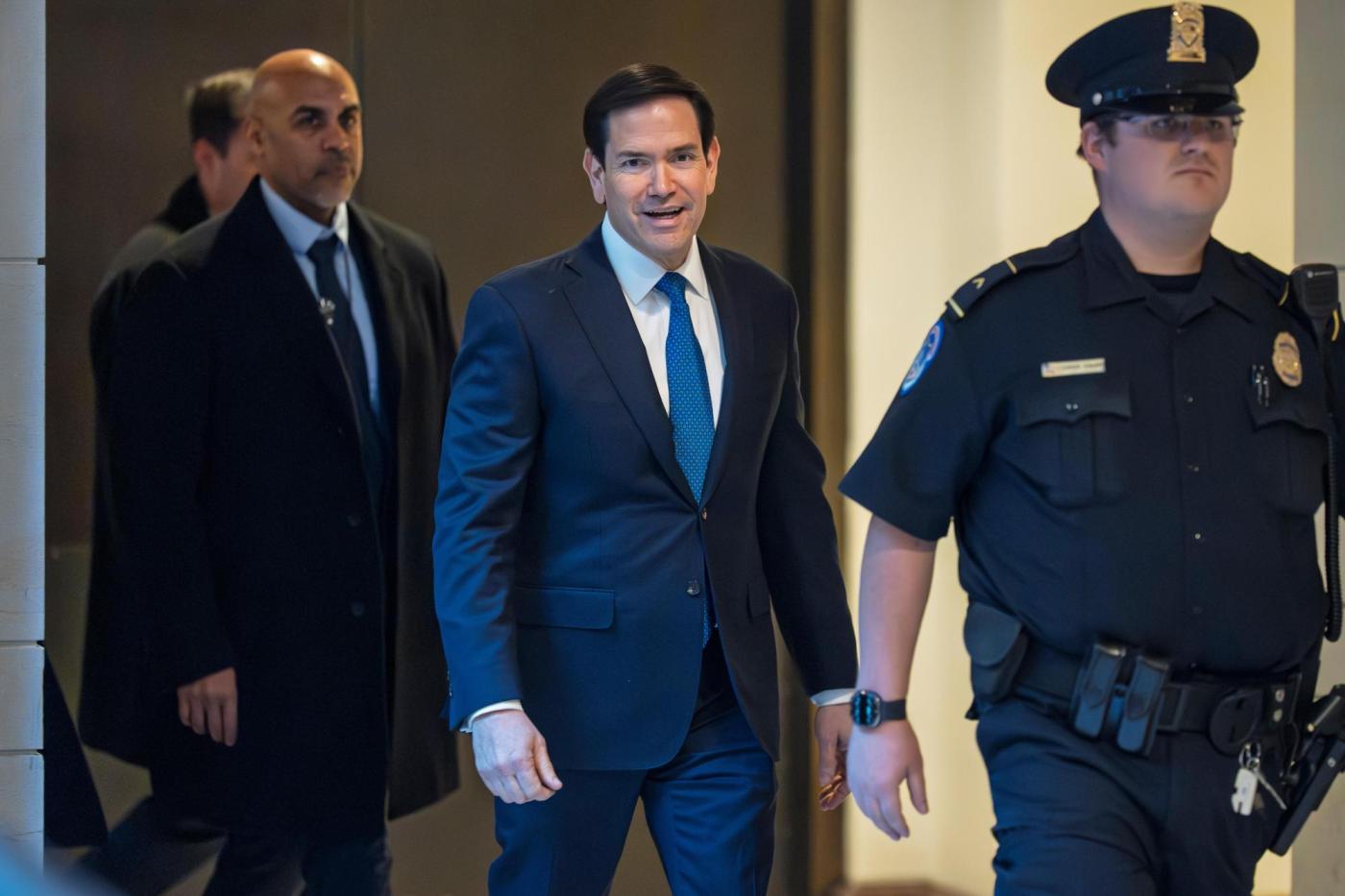
WASHINGTON (AP) — Secretary of State Marco Rubio has ordered diplomatic correspondence to stop using the Calibri font and return to the more traditional Times New Roman effective Wednesday, reversing a Biden administration shift to the less formal typeface that he called wasteful, confusing and unbefitting the dignity of U.S. government documents.
Related Articles
While scientists race to study spread of measles in US, Kennedy unravels hard-won gains
Georgia election board rejects rule change on using hand-marked paper ballots
Georgia Democrat Eric Gisler claims upset state House win in historically Republican district
Elon Musk says DOGE was only ‘somewhat successful’ and he wouldn’t do it again
WTF? Embracing profanity is one thing both political parties seem to agree on
“Typography shapes how official documents are perceived in terms of cohesion, professionalism and formality,” Rubio said in a cable sent to all U.S. embassies and consulates abroad Tuesday.
In it, he said the 2023 shift to the sans serif Calibri font emerged from misguided diversity, equity and inclusion policies pursued by his predecessor, Antony Blinken. Rubio ordered an immediate return to Times New Roman, which had been among the standard fonts mandated by previous administrations.
“The switch was promised to mitigate accessibility issues for individuals with disabilities,” the cable said, asserting that it did not achieve that goal and had cost the department $145,000 but did not offer any evidence.
Since taking over the State Department in January, Rubio has systematically dismantled DEI programs in line with President Donald Trump’s broader instructions to all federal agencies. The Trump administration says the goal is to return to purely merit-based standards.
Rubio has abolished offices and initiatives that had been created to promote and foster diversity and inclusion, including in Washington and at overseas embassies and consulates, and also ended foreign assistance funding for DEI projects abroad.
“Although switching to Calibri was not among the department’s most illegal, immoral, radical or wasteful instances of DEI it was nonetheless cosmetic,” according to Rubio’s cable obtained by The Associated Press and first reported by The New York Times.
“Switching to Calibri achieved nothing except the degradation of the department’s correspondence,” he said, adding that it also clashed with the typeface in the State Department letterhead.
According to a separate memo sent to department employees, the return to Times New Roman takes effect Wednesday and all templates for official documents are to be updated to remove the offending Calibri font.
The only exceptions are documents prepared for international treaties and for presidential appointments, which are required to use Courier New 12-point font, the memo said.
LONDON (AP) — Scientists in Britain say ancient humans may have learned to make fire far earlier than previously believed, after uncovering evidence that deliberate fire-setting took place in what is now eastern England around 400,000 years ago.
The findings, described in the journal Nature, push back the earliest known date for controlled fire-making by roughly 350,000 years. Until now, the oldest confirmed evidence had come from Neanderthal sites in what is now northern France dating to about 50,000 years ago.
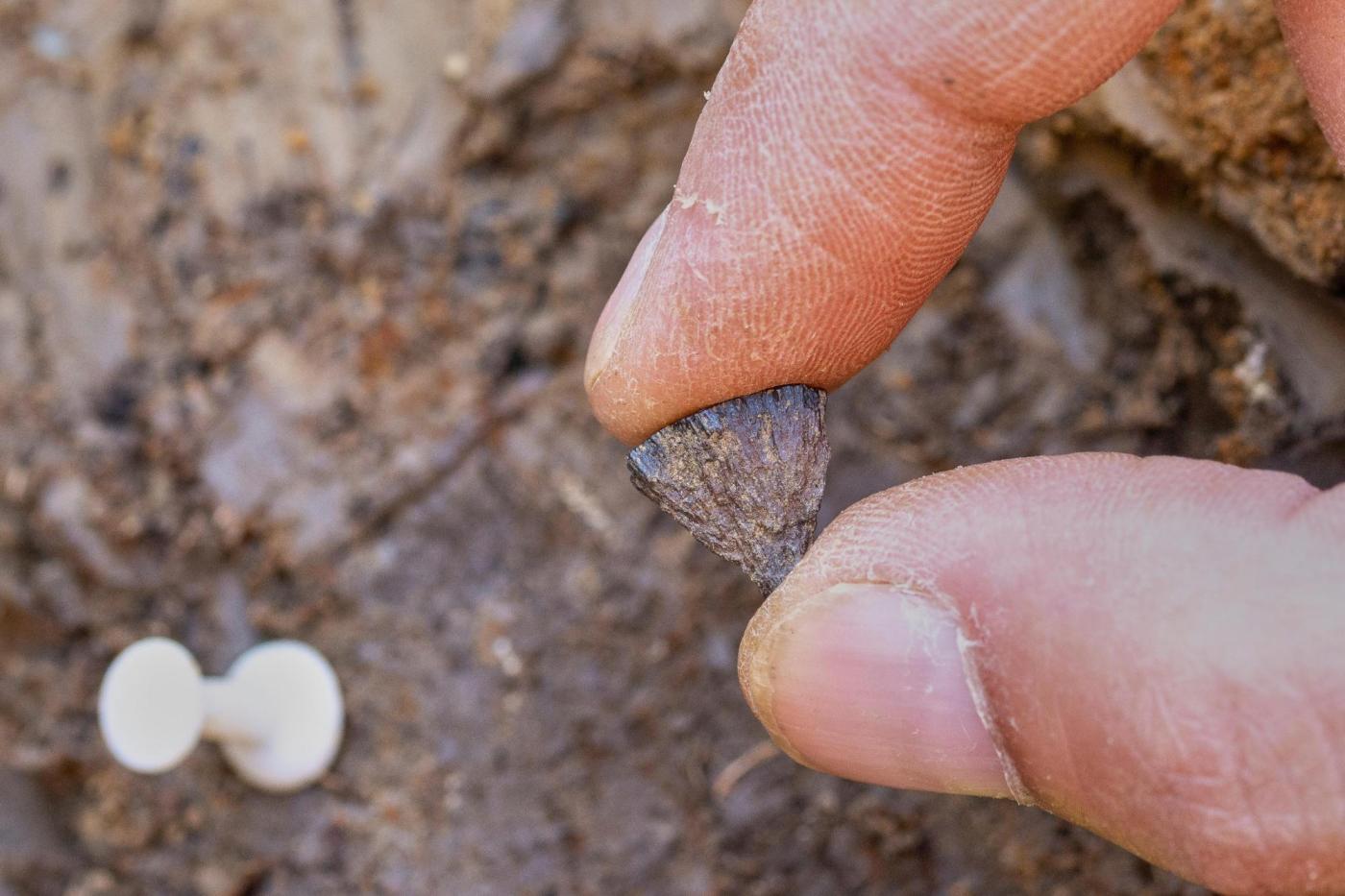
The discovery was made at Barnham, a Paleolithic site in Suffolk that has been excavated for decades. A team led by the British Museum identified a patch of baked clay, flint hand axes fractured by intense heat and two fragments of iron pyrite, a mineral that produces sparks when struck against flint.
Researchers spent four years analyzing to rule out natural wildfires. Geochemical tests showed temperatures had exceeded 700 degrees Celsius (1,292 Fahrenheit), with evidence of repeated burning in the same location.
Excavation site of 400,000 year old pond sediments at Barnham, Suffofk, England. (Credit Jordan Mansfield/Pathways to Ancient Britain Project via AP)
That pattern, they say, is consistent with a constructed hearth rather than a lightning strike.
Rob Davis, a Paleolithic archaeologist at the British Museum, said the combination of high temperatures, controlled burning and pyrite fragments shows “how they were actually making the fire and the fact they were making it.”
Iron pyrite does not occur naturally at Barnham. Its presence suggests the people who lived there deliberately collected it because they understood its properties and could use it to ignite tinder.
Deliberate fire-making is rarely preserved in the archaeological record. Ash is easily dispersed, charcoal decays and heat-altered sediments can be eroded.
At Barnham, however, the burned deposits were sealed within ancient pond sediments, allowing scientists to reconstruct how early people used the site.
Researchers say the implications for human evolution are substantial.
Related Articles
How to watch one of the year’s best meteor showers, the Geminids
New FDA-approved glasses can slow nearsightedness in kids
How to watch the last supermoon of the year
Telescope in Chile captures stunning new picture of a cosmic butterfly
Scientists capture the crackling sounds of what they believe is lightning on Mars
Fire allowed early populations to survive colder environments, deter predators and cook food. Cooking breaks down toxins in roots and tubers and kills pathogens in meat, improving digestion and releasing more energy to support larger brains.
Chris Stringer, a human evolution specialist at the Natural History Museum, said fossils from Britain and Spain suggest the inhabitants of Barnham were early Neanderthals whose cranial features and DNA point to growing cognitive and technological sophistication.
Fire also enabled new forms of social life. Evening gatherings around a hearth would have provided time for planning, storytelling and strengthening group relationships, which are behaviors often associated with the development of language and more organized societies.
Archaeologists say the Barnham site fits a wider pattern across Britain and continental Europe between 500,000 and 400,000 years ago, when brain size in early humans began to approach modern levels and when evidence for increasingly complex behavior becomes more visible.
Nick Ashton, curator of Paleolithic collections at the British Museum, described it as “the most exciting discovery of my long 40-year career.”
For archaeologists, the find helps address a long-standing question: When humans stopped relying on lightning strikes and wildfires and instead learned to create flame wherever and whenever they needed it.
BANGKOK (AP) — Paramount Skydance says the Chinese gaming and social media giant Tencent Holdings withdrew from its bid to buy Warner Bros Discovery to avert a possible national security review.
Paramount’s revised filing with the U.S. Securities and Exchange Commission of its takeover bid said the Chinese company had dropped its $1 billion financing commitment out of concern, since it would be a “non-U.S. equity financing source,” that its bid might be subject to a review by the Committee on Foreign Investment in the United States, known as CFIUS. That was even though approval by CFIUS or by the Federal Communications Commission was not a condition of the bid.
The SEC filing, dated Monday, said that foreign sovereign wealth funds of Saudi Arabia, Abu Dhabi and Qatar, which are providing $24 billion for Paramount’s bid, had agreed to give up a right to participate in Warner Bros’ management to avoid the additional scrutiny.
On Monday, Paramount launched a hostile $77.9 billion takeover offer for Warner Bros. Discovery, competing with rival bidder Netflix to buy the company behind HBO, CNN and a famed movie studio.
Big deals that involve foreign companies are sometimes subject to national security reviews by CFIUS, a U.S. government group chaired by the Treasury Secretary that studies mergers for national-security reasons. It has the power to force companies to change ownership structures or divest completely from the U.S.
Under former President Joe Biden as well as President Donald Trump, the Treasury Department has sought to strengthen its powers as national security concerns related to foreign investment have increased.
Tencent is among dozens of Chinese companies that the U.S. Defense Department has included in a list of companies it said have ties to China’s military. Tencent, whose shares are listed in Hong Kong, denies that.
Related Articles
Wall Street is quiet as it waits for the Federal Reserve’s announcement in the afternoon
Shocked by your electric bill? 3 reasons costs are rising
Federal Reserve likely to cut rates, may signal just one more reduction next year
OpenAI names Slack CEO Dresser as first chief of revenue as ChatGPT maker aims to make a profit
Cracker Barrel lowers revenue forecast as traffic falls after logo blowup
Based in the southern technology and financial hub of Shenzhen, Tencent owns the League of Legends developer Riot Games and has ties with other big U.S. entertainment brands. It also has a streaming deal with the National Basketball Association.
It is the world’s largest equity investor in online games and a major entertainment and social media company, operating the WeChat messaging and payments service in popular China and with Chinese emigrants abroad. Tencent has a market capitalization of over $700 billion, according to Hong Kong’s stock exchange.
WASHINGTON (AP) — As he shook President Barack Obama’s hand and pulled him in for what he thought was a private aside, Vice President Joe Biden delivered an explicit message: “This is a big f——— deal.” The remark, overheard on live microphones at a 2010 ceremony for the Affordable Care Act, caused a sensation because open profanity from a national leader was unusual at the time.
More than 15 years later, vulgarity is now in vogue.
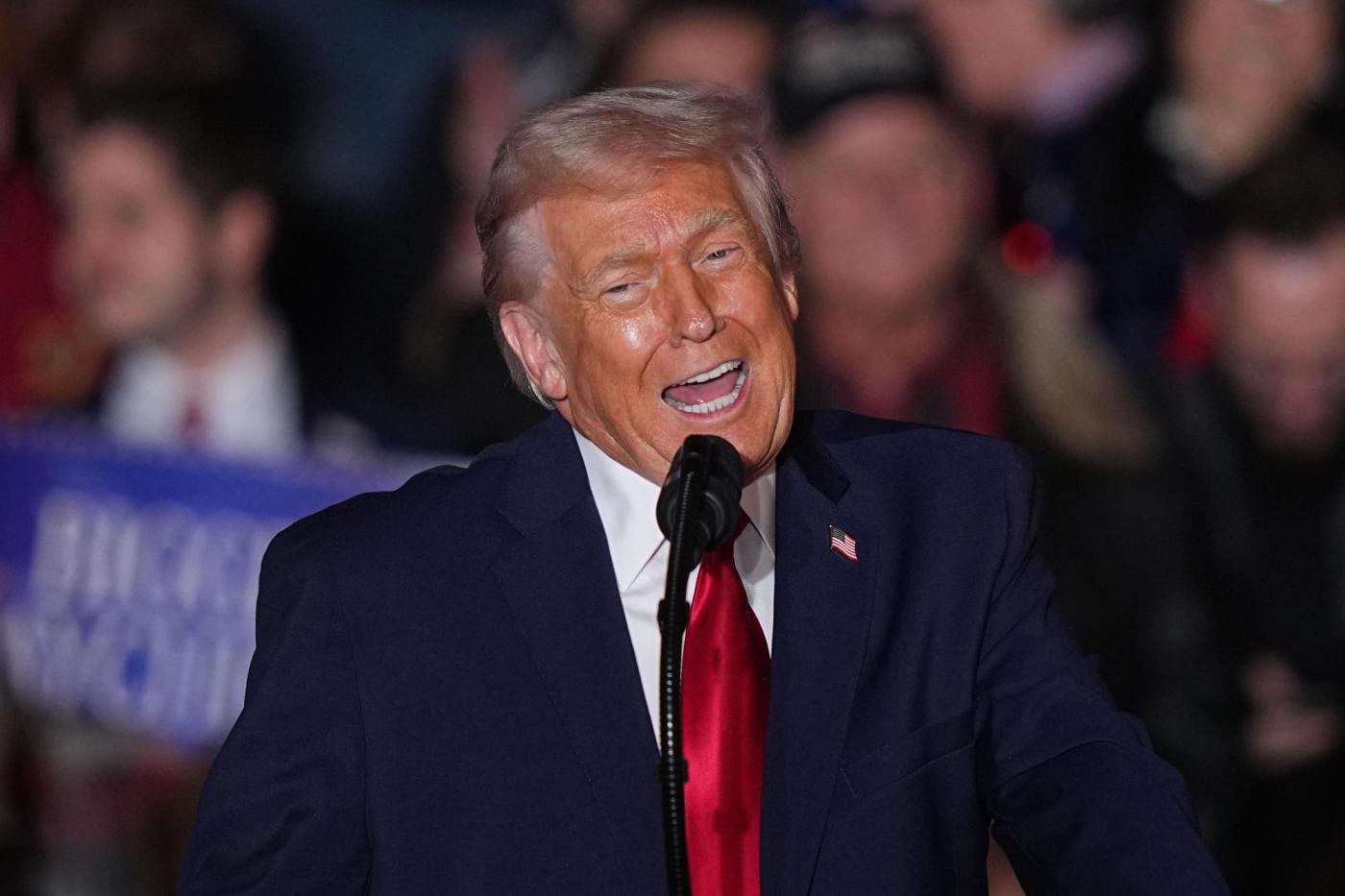
During a political rally Tuesday night in Pennsylvania that was intended to focus on tackling inflation, President Donald Trump used profanity at least four times. At one point, he even admitted to disparaging Haiti and African nations as “ shithole countries ” during a private 2018 meeting, a comment he denied at the time. And before a bank of cameras during a lengthy Cabinet meeting last week, the Republican president referred to alleged drug smugglers as “sons of b——-s.”
While the Biden incident was accidental, the frequency, sharpness and public nature of Trump’s comments are intentional. They build on his project to combat what he sees as pervasive political correctness. Leaders in both parties are seemingly in a race now to the verbal gutter.
Vice President JD Vance arrives before the lighting of the National Christmas Tree on the Ellipse, Thursday, Dec. 4, 2025, near the White House in Washington. (AP Photo/Julia Demaree Nikhinson)
FILE – President Joe Biden speaks about the economy at Prince George’s Community College, Center for the Performing Arts, Sept. 14, 2023, in Largo, Md. (AP Photo/Alex Brandon, File)
Senate Minority Leader Chuck Schumer, of N.Y., speaks to reporters on Capitol Hill, Wednesday, Dec. 3, 2025, in Washington. (AP Photo/Mark Schiefelbein)
Rep. Jasmine Crockett, D-Texas, speaks to reporters after announcing her run in the Democratic primary for U.S. Senate, Monday, Dec. 8, 2025, in Dallas. (AP Photo/LM Otero)
1 of 4
Vice President JD Vance arrives before the lighting of the National Christmas Tree on the Ellipse, Thursday, Dec. 4, 2025, near the White House in Washington. (AP Photo/Julia Demaree Nikhinson)
Vice President JD Vance called a podcast host a “dips—t” in September. In Thanksgiving remarks before troops, Vance joked that anyone who said they liked turkey was “full of s—-.” After one National Guard member was killed in a shooting in Washington last month and a second was critically injured, top Trump aide Steven Cheung told a reporter on social media to “shut the f—- up” when she wrote that the deployment of troops in the nation’s capital was “for political show.”
Among Democrats, former Vice President Kamala Harris earned a roar of approval from her audience in September when she condemned the Trump administration by saying “these mother———- are crazy.” After Trump called for the execution of several Democratic members of Congress last month, Sen. Chris Murphy, D-Conn., said it was time for people with influence to “pick a f——— side.” Senate Democratic leader Chuck Schumer of New York said the administration cannot “f—- around” with the release of the Jeffrey Epstein files. Democratic Rep. Jasmine Crockett, who on Monday announced her Senate campaign in Texas, did not hold back earlier this year when asked what she would tell Elon Musk if given the chance: “F—- off.”
The volley of vulgarities underscore an ever-coarsening political environment that often plays out on social media or other digital platforms where the posts or video clips that evoke the strongest emotions are rewarded with the most engagement.
“If you want to be angry at someone, be angry at the social media companies,” Utah Gov. Spencer Cox, a Republican, said Tuesday night at Washington National Cathedral, where he spoke at an event focused on political civility. “It’s not a fair fight. They’ve hijacked our brains. They understand these dopamine hits. Outrage sells.”
Cox, whose national profile rose after calling for civility in the wake of conservative activist Charlie Kirk’s assassination in his state, approved an overhaul of social media laws meant to protect children. A federal judge has temporarily blocked the state law.
Tough political talk is nothing new
Tough talk is nothing new in politics, but leaders long avoided flaunting it.
Recordings from Democrat Lyndon B. Johnson’s administration, for instance, revealed a crude, profane side of his personality that was largely kept private. Republican Richard Nixon bemoaned the fact that the foul language he used in the Oval Office was captured on tape. “Since neither I nor most other Presidents had ever used profanity in public, millions were shocked,” Nixon wrote in his book “In the Arena.”
Related Articles
Trump floats autopen investigation into Biden’s Fed nominees
EPA eliminates mention of fossil fuels in website on warming’s causes. Scientists call it misleading
What are parents to do as doctors clash with Trump administration over vaccines?
DOJ ends monitoring of illegal dumping in Houston in retreat from environmental justice
Wisconsin judge refuses to step aside as requested by former Trump attorney
“Politicians have always sworn, just behind closed doors,” said Benjamin Bergen, a professor at the University of California-San Diego’s Department of Cognitive Science and the author of “What the F: What swearing reveals about our language, our brains, and ourselves.” “The big change is in the past 10 years or so, it’s been much more public.”
As both parties prepare for the 2026 midterm elections and the 2028 presidential campaign, the question is whether this language will become increasingly mainstream. Republicans who simply try to imitate Trump’s brash style do not always succeed with voters. Democrats who turn to vulgarities risk appearing inauthentic if their words feel forced.
For some, it is just a distraction.
“It’s not necessary,” said GOP Rep. Don Bacon of Nebraska, who is retiring next year after winning five elections in one of the most competitive House districts. “If that’s what it takes to get your point across, you’re not a good communicator.”
There are risks of overusing profanity
There also is a risk that if such language becomes overused, its utility as a way to shock and connect with audiences could be dulled. Comedian Jerry Seinfeld has talked about this problem, noting that he used swear words in his early routines but dropped them as his career progressed because he felt profanity yielded only cheap laughs.
“I felt like well I just got a laugh because I said f—- in there,” he said in a 2020 interview on the WTF podcast with fellow comedian Marc Maron. “You didn’t find the gold.”
White House spokesperson Liz Huston said Trump “doesn’t care about being politically correct, he cares about Making America Great Again. The American people love how authentic, transparent, and effective the President is.”
But for Trump, the words that have generated the most controversy are often less centered in traditional profanity than slurs that can be interpreted as hurtful. The final weeks of his 2016 campaign were rocked when a tape emerged of him discussing grabbing women by their genitals, language he minimized as “locker room talk.” His “shithole” remark in 2018 was widely condemned as racist.
More recently, Trump called a female journalist “piggy,” comments that his press secretary, Karoline Leavitt, defended as evidence of a president who is “very frank and honest.” Trump’s use of a slur about disabled people prompted an Indiana Republican whose child has Down syndrome to come out in opposition to the president’s push to redraw the state’s congressional districts.
On rare occasions, politicians express contrition for their choice of words. In an interview with The Atlantic published last week, Gov. Josh Shapiro, D-Pa., dismissed Harris’ depiction of him in her book about last year’s presidential campaign by saying she was “trying to sell books and cover her a—.”
He seemed to catch himself quickly.
“I shouldn’t say ‘cover her a—,” he said. “I think that’s not appropriate.”