Over the course of 12 years at the helm of Texas state government, Greg Abbott became arguably the most powerful governor—de jure and de facto—in the history of Texas. His rule grew progressively unbalanced and unchecked by the GOP-run Legislature which increasingly followed his lead, through fear or favor, or the GOP-run judiciary, which was increasingly stocked with Abbott apparatchiks.
Much of his power accumulated through longevity and hegemony, which also allowed for an aggressive and unprecedented use of the Texas governor’s executive powers—governing via disaster proclamations that granted him unilateral executive authority over a large swath of state policy over a long period of time. This became most pronounced during the COVID-19 pandemic and continued through his border disaster proclamations, the basis on which he built his Operation Lone Star state immigration dragnet.
In total, his actions amounted to a transformation of the historically weak Texas governorship, which through intentional constitutional design is less empowered than in many other states. Those constraints are achieved through, among other mechanisms, staggered appointment terms, an independent lieutenant governor (long considered, though the sentiment is now outmoded, the actual most powerful statewide official), and a decentralized executive branch with a number of other elected statewide positions. Abbott used a variety of methods, including his simple staying power, to break out of his constitutional cage—and his Democratic successor now inherits an office whose overreach she’s harshly criticized but whose power, to the extent it remains tappable, may be politically irresistible.
“Not only is this the most extensive [use of executive authority], it’s also the most unchecked. He’s used these powers in a very aggressive way,” Randall Erben, a governmental law professor at the University of Texas at Austin who closely follows state executive powers and who once served as Abbott’s legislative director, told me for an in-depth profile I did on Abbott’s executive power grabs in 2021.
His powers continued to expand since that time. In seeking an unprecedented fourth term—which would have given him a tenure old enough to drive—Abbott was on the verge of attaining an even higher level of gubernatorial power. His control and micromanagement of the state agencies was total, and his willingness to preempt, circumvent, or otherwise dictate to the Texas Legislature was well established.
That dominion, however, was rudely ripped away by the Texas electorate last Tuesday who instead gave the governorship to a liberal Austin state Representative named Gina Hinojosa, whose insurgent campaign was laser-focused on the casual corruption and political overreach of Abbott’s government.
“The Republicans have been in too long, and they started to turn into a party of big government,” Erben told me after the election. “They were getting into your doctor’s office, getting into your house, and were telling businesses what they could and couldn’t do.”
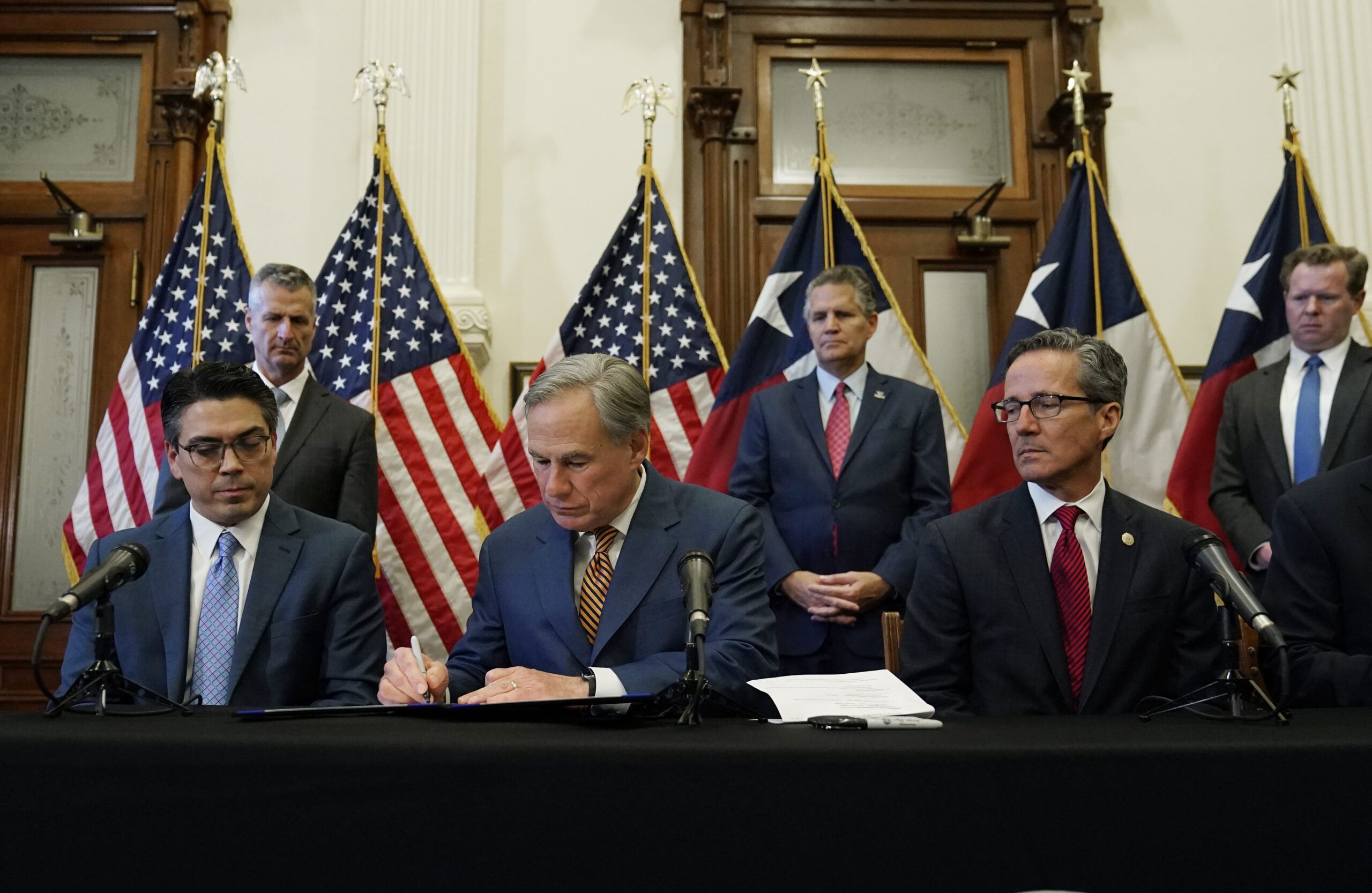
Abbott (center) in 2021 (AP Photo/Eric Gay)
Not long ago, Abbott and his advisors were trawling for generational legacy items—to put on the mantle next to private school vouchers—to tackle in his fourth term, including a harebrained scheme to abolish school property taxes. His data center pause, carried out via executive action, was meant to delay the permitting process until after the elections. Hinojosa, who campaigned on a full moratorium, could order agencies to extend the pause until the Legislature enacts permanent regulation.
Abbott’s defeat and imminent departure will leave a gaping hole in Texas politics—but the power of his governorship will continue to be felt for years, including through his numerous board appointees whose terms will continue for years into the next administration, and his playbook of governing by executive order, a tactic which Hinojosa has signaled she may emulate.
Hinojosa will begin the task of navigating her own realm of power as a governor who will have, in many ways, a more diminished authority. While her electoral mandate is strong and ability to wield the bully pulpit is still fresh, it’ll take years to stock her appointments throughout all the state agencies, and she’ll have to navigate tumultuous waters to get her priorities through a divided Legislature.
With her historic victory—becoming the state’s first Hispanic governor and first woman and Democratic top executive in three decades—many observers are now wondering just what a Hinojosa administration will look like, what she can (or will) do right away and over the long term. And, importantly, will she be able to retain some of the same muscular power that Abbott built in the office, or will much of it atrophy by circumstance, reverting to the governorship’s rather weak status quo?
With a new Democratic governor, a newly Democratic state House, and a state Senate as the only remaining bastion of GOP control, the next several months will bring about a wholesale recalibration of the balance of powers in Texas government.
One aspect of Abbott’s swollen power cannot be immediately replicated: longevity. His dozen-year reign maximized his appointment powers for hundreds of state boards, agencies, and universities, which are defused through staggered terms. Over time, he was responsible for almost every single agency commissioner, university regent, and all the other assorted gubernatorial appointees across state government.
Second, he benefited from political hegemony—a GOP-run Legislature and GOP monopoly on statewide offices—that accompanied him from the outset of his tenure. Those legislators who still defied him, for instance the rural GOP state reps who blocked private school vouchers in 2023, were finally taken out to the woodshed in what turned out to be the twilight of his tenure.
Lastly, Abbott pushed the reach of his executive authority to unprecedented levels through his aggressive use of expansive, seemingly perpetual emergency orders which, through the state’s Disaster Act, grant the governor unilateral power.
With that came a rather brazen new brand of pay-to-play disaster politics in which vendors who won no-bid contracts under his emergency orders—during the pandemic and through Operation Lone Star—became major donors.
Hinojosa was one of the most outspoken critics of this abuse of executive power, zeroing in specifically on what she saw as wasteful no-bid contracts to favored vendors at the Texas Education Agency—but also through Operation Lone Star.
“This is a corrupted use of the governor’s emergency powers,” Hinojosa told the Texas Observer for an investigation into Abbott’s cultivation of political contributions from major Operation Lone Star contractors. Through his perpetual disaster declarations, “Texas has become a pay-to-play [state] if you want these big government contracts because we don’t have fair bidding requirements. Now we see these political donors getting rich off taxpayer money with no accountability. Abbott acts as if he’s king, and he’s rewarding his patrons.”
As a candidate for governor, Hinojosa promised to bring in a newly transparent and accountable brand of state government leadership that would no longer rely on fiat and would not use the levers of power to award and cultivate campaign donors and political allies.
Hinojosa will be able to swiftly appoint replacements at some agencies—such as the Texas Education Agency, where she promised to fire Commissioner Mike Morath, whose term conveniently expires in January, immediately. In other cases—such as the Public Safety Commission, which oversees the state police agency, where the earliest term expiration is in 2028; or the pardons and parole board, where only three of seven are up next year—her direct appointment influence will be relatively muted for some years. (That could change if Abbott appointees opt to resign.) These appointments also require confirmation from the state Senate, which will be in GOP hands for at least two more years, though the governor can make interim appointments that hold between sessions.
With a Governor Hinojosa, there is the possibility of some political struggles between agencies that remain controlled by Abbott appointees and the governor’s office that could play out on a number of issues. Or, there could be relative stability.
“Agencies are not going to continue conduct that the governor, once she takes office, she is unhappy with. I just don’t buy that. You’d be causing a real crisis,” Erben said.
On the flip-side, Hinojosa will have to be somewhat restrained: “It’s not like you’re saying, I’m just going to fix this right now and I’m going to put all my people in charge. It doesn’t work that way. There’s going to be a lot of persuasion. And I’ve known Gina Hinojosa a long time. She’s a smart, savvy politician,” Erben added. “She’s also going to have to pick her fights.”
As of today, there are eight active disaster proclamations issued by Abbott that grant his executive orders the power of law—one pertaining to border security (Operation Lone Star), two for floods, one for fire, one for severe storms, one for drought, one related to diesel fuel prices, and one for the Screwworm outbreak. The state has been under some sort of ongoing disaster order since at least 2020. Despite border crossings having almost entirely halted, that proclamation remains in effect and has been renewed 69 times.
Those orders must be renewed every 30 days. Upon becoming governor, Hinojosa can either let those expire or terminate them as she sees fit. She can—and has said she will—issue her own disaster orders, a sign that she’s willing to some extent to follow Abbott’s executive playbook to enact her own agenda.
During her campaign, Hinojosa said in a statement to the Texas Tribune that she pledged to issue a disaster proclamation related to high costs on day one of her gubernatorial administration—and to issue two executive orders: one to suspend the state’s gas and diesel fuel tax and the second to freeze electricity rates for all ratepayers.
Over the course of the past several years, some Republicans have tried meagerly to rein in the governor’s executive authority—and most specifically the governor’s disaster powers, with proposals to require legislative approval for ongoing emergencies. But they didn’t really push that hard, and they didn’t find any success. Why anger the most powerful leader of your own party, who was wielding that power to largely carry out favorable priorities?
Chief antagonizer in the Texas House, GOP state Representative Brian Harrison, who has filed bills to limit the governor’s power in past sessions, is now leading an almost-surely doomed push to get Abbott to call a special session and get the current GOP Legislature to curb executive powers before Hinojosa takes office.
But Abbott has set a precedent—and with a divided Legislature could come an empowered new governor.
“The precedent that’s being set is that any time in the future, when a governor believes that we have a problem and policymakers in Washington are not addressing the problem and policymakers at the local level are not, or are frustrating the governor’s preferences,” Dale Carpenter, a constitutional law professor at Southern Methodist University, told me back in 2021, “he can declare a disaster and set up a different set of policies and direct spending to accomplish those policy objectives.”
The post Gina Hinojosa Won’t Be Able to Govern like Greg Abbott. Should She Try? appeared first on The Texas Observer.
Leave a Reply