In September, tech industry executives in freshly pressed suits watched as about 50 locals protested outside the downtown Austin Marriott hotel, where the suits had gathered for an annual conference focused on the artificial intelligence data center build-out.
With chants of “We need clean water, data centers make us hotter,” the protest was emblematic of one of the most pressing issues industry leaders had gathered there to address: the problem of what they called the “Not in My Backyard” backlash to the data center boom.
But it wasn’t just data center developers who were worried about the backlash. Leaders of the state’s nascent nuclear energy sector also expressed alarm over how popular opposition to AI and the disruptive infrastructure that fuels it might impact the public’s perception of the state’s distinct but related nuclear renaissance.
One panel moderator asked nuclear industry leaders what they were getting right and wrong about commercialization of new reactor designs in today’s political context, specifically alluding to the protest outside the hotel.
Brian Gitt, head of business development at the nuclear startup Oklo, a publicly traded, California-based company focused on bringing novel microreactors to market, skirted the matter of community relations in his answer, focusing instead on regulation and licensing. Gitt avoided the issue again when the Texas Observer approached him afterward, offering a connection with the firm’s official spokesperson rather than answer questions related to Oklo’s controversial piloting of an experimental reactor in one rural Texas community’s backyard.
Oklo quietly hit a key milestone in its business plan on August 6, conducting the first startup of its “Groves” microreactor—one among a fleet of innovative models for cleanly generating steam (and thus, power) through nuclear fission—in Caldwell County, the heart of Texas barbecue country. Oklo’s reactor, consisting of a cylindrical metal core small enough to fit in a shipping container and buried belowground, is situated at the site of a technology hub dubbed by its tech-bro founders “Proto-Town,” a ranch near Lockhart designed to host space for everything from reverse osmosis water desalination to next-generation air conditioners. It’s part of an ongoing Silicon Valley invasion of once-quiet patches of Central Texas beyond the outskirts of Austin.
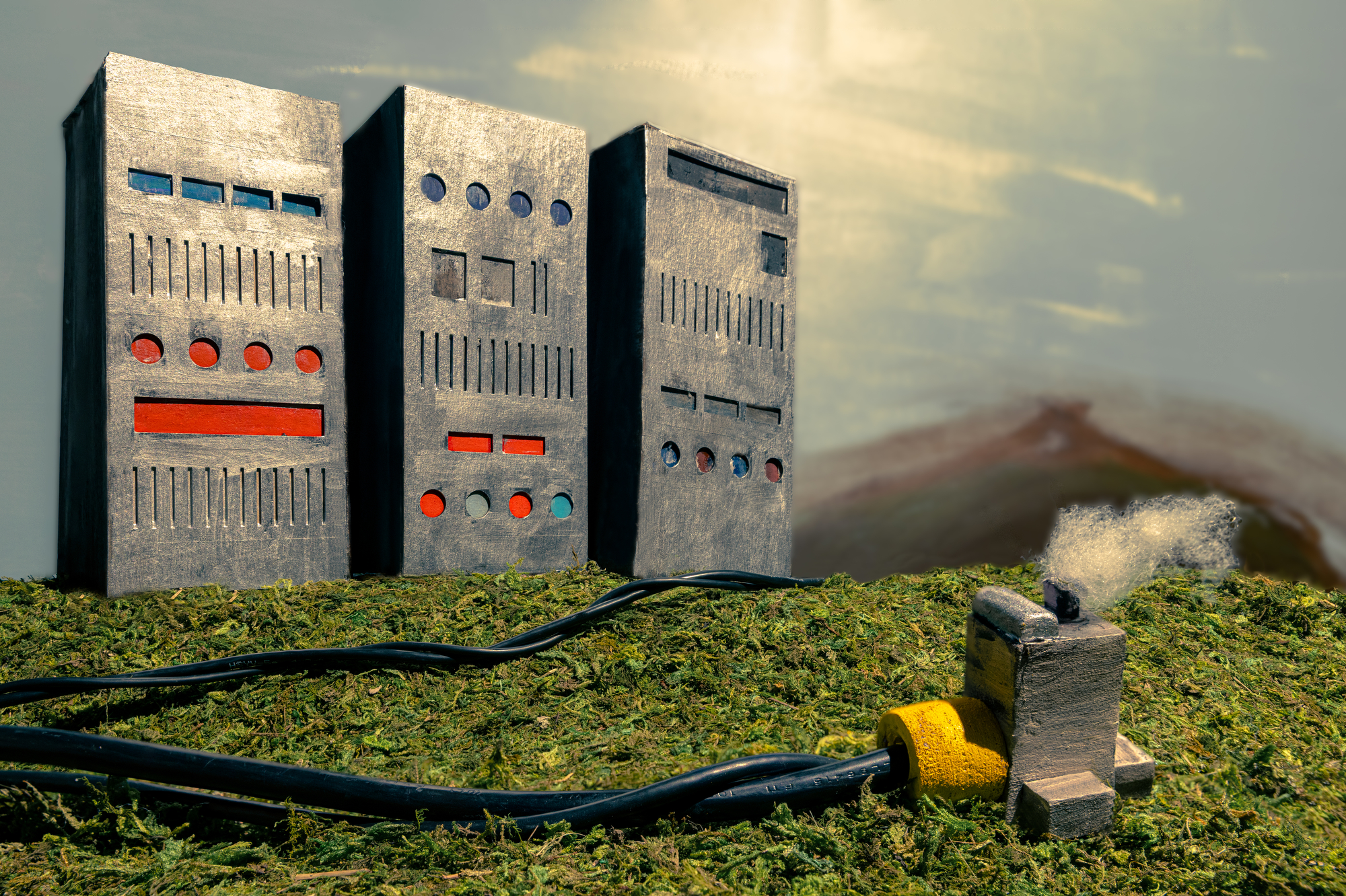
(Illustrations by Dave Maupin)
The Oklo microreactor at Proto-Town exemplifies the kind of slimmer, shippable design that nuclear startups are hoping will be market-ready by 2030. Promoters say that smaller, standardized power generators like these not only offer billions in savings over the hulking, Homer Simpson-style nuke plants of yore but also reduce risks of a catastrophic meltdown by using cutting-edge fuels and cooling techniques.
After decades of stigma, these startups—responding to increased interest in the technology’s ability to provide 24-7 carbon-free power—have followed the AI data center boom to Texas. The state’s grid operator projects data centers could quadruple the state’s energy demand by 2032, and Governor Greg Abbott’s August directive to audit new data center grid connection requests may slow, but not halt, that growth. Nuclear startups are hoping to fill a significant portion of the new demand: Deloitte estimates that nuclear firms could meet as much as 10 percent of new data center demand nationally by 2035.
While Groves isn’t powering any of Caldwell’s four proposed data center developments, its test run lays the groundwork for future commercial reactors, and it proves to tech giants like Google that Oklo can provide rapidly dispatchable power for energy-hungry server farms by demonstrating how quickly the firm can achieve “criticality,” or initial start up.
Oklo’s reactor is one of about a dozen that received a federal green light under a new U.S. Department of Energy (DOE) program designed to fast-track just these kinds of pilot tests. President Donald Trump authorized the program in a series of executive orders designed to speed up nuclear licensing and approvals to meet data centers’ enormous energy demands.
Those May 2025 orders slashed Nuclear Regulatory Commission (NRC) staff, initiated a rewrite of at least 27 NRC rules, and broadened the DOE’s role. Previously, the DOE’s regulatory authority had been limited to nuclear weapons-related research reactors on military bases. While the NRC will continue to license and approve commercial reactors, Trump’s orders created a DOE fast track for experimental designs under pared-down regulations.
Abbott has jumped on Trump’s nuclear bandwagon—a turnaround from his 2020 opposition to one firm’s bid to store spent nuclear fuel rods in West Texas. Just three years later, Abbott established a working group to study microreactor development. The group recommended creating a nonregulatory agency to support the industry in November 2025, and the Texas Advanced Nuclear Energy Office began distributing $350 million in public grants this fall.
Now, as startups rush to prove their models to investors in rural counties like Caldwell, the firms are generating some of the same grassroots resistance that sparked Abbott’s statewide data center audit as well as city-level bans and short-lived county-level moratoriums against the centers in places like San Marcos and Hill County.
That much is apparent to the industry itself. As Constellation Energy’s Bob Kinscherf put it during the panel featuring Oklo’s Gitt, “It’s hard enough to get a data center sited, then say, ‘Oh, by the way, there’s going to be a nuclear reactor there too.’”
That’s very much the case in Caldwell. Lockhart resident and local data center opponent Bonnie Marshall started Lockhart Nuke Watch in May to watchdog Groves. She began meeting with Oklo representatives and county officials to raise concerns about the microreactor’s lack of what she considers an adequate containment structure, as well as the firm’s plan to store radioactive spent fuel on-site before transferring it elsewhere. She wants Oklo to train the county’s local volunteer firefighters, pay for the necessary specialized equipment, and hold a town hall about public safety.
“My purpose is not to be anti-nuclear or even anti-Oklo. My purpose is just that they’ve been so secret,” Marshall told the Observer.
According to records obtained by the Observer, Oklo’s emergency plan for Groves states that no significant planning is needed for a radioactive leak, largely due to the fact that its test runs are generating only about 100 watts of power—around that of a light bulb. While the plan designates a radiation safety officer and indicates that local first responders would participate in on-site evacuation drills, it doesn’t explain whether those drills include containment efforts or whether the facility itself is prepared with hazmat suits.
Oklo spokesperson Bonita Chester told the Observer that “if abnormal radiological conditions were detected, personnel would secure the affected area, protect workers, assess conditions, and make the required notifications.” She also confirmed to the Observer that while the facility has personal protective equipment and anti-contamination clothing, hazmat suits “are not identified as necessary for the anticipated on-site response.” While Chester said the firm has met with residents and businesses and visited schools and nonprofits in Caldwell, she declined to confirm whether the firm has already held drills or if it would hold a meeting to address public safety concerns.
Nuclear watchdogs have raised other concerns about Oklo’s fast-tracked tests. Nuclear Information & Resource Service (NIRS) Executive Director Tim Judson pointed out that Groves’ August 2025 DOE green light came three years after the NRC denied a separate Oklo application for a license to operate a microreactor at the Idaho National Laboratory, on the basis that the firm hadn’t provided enough safety information. Despite NIRS’ concerns, Oklo’s Idaho project was approved by the DOE in August 2025.
In an April interview, Judson characterized nuclear startups’ claims of inherent safety as largely baseless. While microreactor impact radiuses may be small, Judson warned that radioactive contamination can drift with the wind. Moreover, microreactors rely on uranium fuel often mined on or near national monuments and Indigenous lands and produce radioactive waste. Many do not have any reinforced containment structure beyond the metal vessels enclosing their reactor cores and the surrounding housing, and none have been tested under the real-world disaster conditions they’re likely to face.
He also pointed to a radioactive release in 1986 at a smaller prototype reactor in Germany after fuel lodged in its suction hopper. That event was largely overshadowed by the Chernobyl meltdown that same year—a catastrophe that killed 20 people, poisoned thousands, and forced the relocation of 200,000 people from what is now a radioactive exclusion zone in Ukraine. It was Chernobyl, together with the earlier 1979 Three Mile Island accident, that turned Americans against nuclear power for generations.
After Three Mile Island, new commercial nuclear plants in the United States ground to a halt for a decade, picking up briefly in the late ’80s before another two-decade lull. Amid growing demand for an always-on, carbon-free source of energy in the face of worsening climate impacts, interest in nuclear energy slowly picked up again, though meltdowns at a nuclear plant in Fukushima, Japan, in 2011 forced the evacuations of 100,000 people and once again gave the fuel source a black mark.
In need of a rebrand, industry leaders began to promote microreactors—comparatively small devices incapable of turning, say, Austin into another Chernobyl. Trump’s executive orders turbocharged the shift: With just three commercial reactors coming online in the United States in the past decade, the NRC now expects to review more than 30 new license requests from microreactor startups—the equivalent of light speed for the industry.
“There’s also a way in which [microreactors play] into the cultural wars around renewable energy—for Republicans to be able to say they’ve got an alternative that isn’t [wind and solar],” Judson said. “The irony of which is that, as you know, in Texas, renewable energy is growing by leaps and bounds.”
Politics aside, nuclear power could play a role in addressing the climate crisis, strategically replacing fracked gas power plants until solar, wind, and battery storage can meet demand and provide a form of backup power in case of shortages. But, rather than partnering with independent regulators to demonstrate to a new generation of Americans that its technology is safe, the industry has so far advocated for gutting federal regulation to rapidly sell its model to AI data centers—an association that not only further jeopardizes the industry’s credibility but inflames the very climate crisis nuclear startups say they hope to mitigate.
On an overcast day in mid-June, I climbed into Diane Wilson’s white pickup parked outside the civic center of her 1,200-person coastal hometown, Seadrift, to visit the site of a proposed nuclear project a few miles northwest. Blue and red lights flashed behind us as we headed up State Highway 185. Wilson pulled over to the shoulder.
Her face obscured by a ball cap and sunglasses, Police Chief Cheyenne Beaver told Wilson, 78, she was being stopped for an expired registration. Beaver requested proof of insurance, and when Wilson went for her phone, she discovered she’d accidentally left it back at the civic center, telling Beaver she’d intended to invite her to the nuclear safety “People’s Conference” that Wilson had just hosted there. Beaver ran Wilson’s plates, found her insurance up-to-date, and let her off with a warning.
That might be in part due to who Wilson is. The activist and former shrimp boat captain, whose silver curls frame a resolute face, is known around the world for her decades-long campaign against a Taiwanese petrochemical company. In 2019, the firm buckled under Wilson’s Clean Water Act suit, settling with her for $50 million and agreeing to stop releasing waste from its Texas plant after Wilson and her organization collected more than 30 million of its plastic pellets, or “nurdles,” in local waters. She later won one of the most prestigious awards for environmental activism, the Goldman Environmental Prize, in 2023. Locally, she’s long been known as an eccentric crusader for environmental justice—an “Unreasonable Woman,” as her 2006 memoir title declares.
When we arrived at Dow Chemical’s 4,700-acre Seadrift facility, Wilson hopped out to show me the open field where one of North America’s largest chemical manufacturers, in partnership with the Maryland-based startup X-energy, hopes to build four 80-megawatt nuclear energy reactors to power its plastic-producing chemical complex. An idled train snaked along both the field and the road, obscuring most of the site where Dow’s new nuclear plant will be—if Wilson’s challenge to its NRC construction permit fails, that is.
Back in March, I reached Wilson as she camped out in a ditch beside the train tracks on the 16th day of a monthlong hunger strike, train blasts disrupting our connection every few minutes. In June, she showed me the spot where she’d camped out, leaving just twice to attempt to hand-deliver her “No Nukes, No Nurdles” demands to Dow, spending a night in Calhoun County Jail after her second attempt.
Dow, through its subsidiary Union Carbide, announced it had selected this site for its nuclear plant in May 2023—one day after Calhoun County granted the company a 10-year tax abatement in exchange for $4 million in onetime fees. (Based on the plant’s estimated cost, the tax abatement appears to generate a savings of as much as $82 million over the 10-year period.) While the project’s construction application is currently under NRC review, X-energy has already received $80 million in public subsidies through a separate DOE initiative.
Flush with $200,000 in Goldman Prize money, Wilson hired Austin-based attorney Marisa Perales to represent Wilson’s nonprofit, San Antonio Bay Estuarine Waterkeeper, in a legal intervention to try to stop the reactors. Their August 2025 intervention became the first such challenge to a modern microreactor in the United States.
The nonprofit’s safety argument relies on an affidavit submitted by nuclear physicist Edwin Lyman, who argues that the proposed design is unproven in the event of a catastrophe.
Before Wilson and I headed out to Dow’s Seadrift facility to see the planned nuclear site, she and about 30 others at the civic center listened intently as Lyman presented on the company’s so-called pebble-bed design, as part of the nuclear safety conference.
Lyman, speaking remotely from Washington, D.C., described the reactor as akin to a gumball machine in which 220,000 graphite “pebbles” the size of billiard balls are constantly bouncing around. The balls contain as many as 19,000 tiny particles of radioactive uranium fuel, and their collisions are what create the fission reaction that generates energy. Spent pebbles are discharged from the bottom of the reactor, and new ones are loaded into the top.
X-energy CEO J. Clay Sell has claimed this design is meltdown-proof because the balls’ coating will withstand temperatures up to 3,000 degrees Fahrenheit. The DOE calls it “the most robust nuclear fuel on earth.” Sell and dozens of nuclear developers are hoping to cut costs by relying on these “self-containing” pebbles to do the same work that reinforced lead and concrete containment barriers do for large reactors.
But Lyman contends that, since there’s no way to individually test the billions of balls that would need to be produced, mass manufacturing could render a significant portion defective. Moreover, earthquakes, fires, and floods could compromise a reactor’s cooling system, effectively melting the pebbles and releasing toxic radiation.
Administrative law judges from the NRC rejected Waterkeepers’ claims in June about the project—which has been handled by a Dow subsidiary, Long Mott Energy LLC—including striking the nonprofit’s contention about inadequate containment on a technicality. The group filed an administrative appeal.
Wilson points to Winter Storm Uri in 2021, which caused an automatic shutdown about 65 miles northeast of Seadrift at the South Texas Project, one of the state’s two large nuclear plants, both of which began construction in the mid-’70s. As that storm showed, freak events driven by climate change could threaten reactors in ways the firm can’t necessarily predict.
Wilson also simply doesn’t trust Dow or Union Carbide, which became a Dow subsidiary in 2001. A decade before that acquisition, an explosion at Union Carbide’s chemical facility in Seadrift—the same site where the reactors are planned—killed one worker and injured 26 others, leading the firm to pay the Occupational Safety and Health Administration a $1.5 million fine. Seven years prior to that, a company in which Union Carbide held majority ownership was responsible for the worst industrial accident in the history of the globe: a horrific gas leak that killed up to 16,000 people in Bhopal, India.
Neither Dow, X-energy, nor the firms’ attorneys responded to the Observer’s requests for comment about the ongoing intervention or concerns regarding the firms’ safety records.
Wilson opposes Dow’s reactors not only because of safety risks but because they would power the very plastic and chemical pollution that she has fought for years. Like other environmental justice activists who convened at the June safety conference, she opposes both AI data centers and nuclear energy in any form. Wilson and her allies argue that nuclear reactors are actively displacing forms of renewable energy that they do want to see.
John Daniel was there when Wilson was arrested outside Dow’s office in March. A 65-year-old retired plant worker, Daniel said he left Dow’s Freeport plant after the firm froze his pension following 22 years as a technician. He and his two sons grow corn and run cattle on 450 acres just a mile away from Dow’s proposed reactor site, and he told the Observer the reactors have pushed out other clean energy projects in the area.
Daniel said he signed a five-year contract in 2021 to lease a portion of his land for a $100 million battery storage operation crucial to making solar and wind energy available when the sun isn’t shining and the wind isn’t blowing—the very “reliability” factor both Republicans and Democrats have pointed at to revive the nuclear industry. But once the Calhoun County reactor plans became known, local electric utilities began restricting other energy projects that would place additional burdens on the local grid, and Daniel lost a project that would have earned him and his family $150,000 a year. “They’re just punting green energy down the road,” he told the Observer.
At the June conference in Seadrift, Joseph Napolitano stood to share his thoughts about local residents’ struggle against another nuclear reactor project, planned roughly 20 miles north at the Port of Victoria—this one linked directly to a local data center development.
“This is a real tipping point time in America, right? Because people are fed up with what’s going on. The AI data centers are galvanizing bipartisan [opposition],” he told Wilson and four others on a panel.
As of late September, Victoria County commissioners were weighing whether to grant Maryland-based startup Blue Energy a tax abatement for its $6.5 billion nuclear power plant. The 2.5-gigawatt plant, which will sell power to the Denver-based firm Crusoe’s 1,600-acre AI data center in neighboring Calhoun County, plans to use desalinated water from a deepwater aquifer and send whatever power may be left over back to the grid.
Napolitano is working with Wilson to slow a governmental permit application to the Army Corps of Engineers for dredging a section of the Victoria Barge Canal, which would benefit the Blue Energy project by allowing more and larger vessels to transport materials the project needs directly to its shipyard.
He’s banded together with other locals to canvass neighborhoods close to the reactor development in the 1,900-person town of Bloomington, created email lists, and held meetings to urge residents to pressure their commissioners to reject Blue Energy’s bid for a tax break.
While the company’s design isn’t novel, the startup is touting a fast-paced gas-to-nuclear approach consisting of a fracked gas power plant that the firm hopes to replace with five nuclear microreactors built in subsequent phases.
Despite its plans to transition, Blue Energy’s abatement application notes that its gas turbine will “continue to operate” after its first nuclear reactor comes online, and its gas supplier’s contracts run through 2031—locking in those greenhouse gas emissions for at least another five years.
Blue Energy spokesperson Eben Burnham-Snyder told the Observer that while the NRC has granted the project a partial license for its non-nuclear components, the firm is still in the pre-application phase. He noted that a local emergency preparedness and response plan will be required under the process and the company planned to hold an “open house” where local residents could ask questions.
Speaking to an audience of industry insiders at a Houston summit in March, Blue Energy CEO Jake Jurewicz stressed that his goal is a carbon-free source of energy. “There’s probably nothing more existential right now to the [AI] hyperscalers and to our global economy than finding a way to provide a firm-capacity, long-term, zero-carbon resource that can meet our growing energy demands as an economy,” he said.
Oklo also has at least two contracts with fracked gas companies. Both Oklo and Blue Energy’s gas contracts show how the ostensibly clean nuclear energy industry is, in practice, still relying on fossil fuels. Judson of the NIRS criticized that practice as “greenwashing.”
He and other critics say that by rushing to power the AI hyperscalers’ data center build-out, the industry is forsaking the chance to develop cleaner models that might compete with fracked gas as an alternative bridge to a carbon-free future and win over an already-skeptical public.
Napolitano’s opposition to Blue Energy’s project is emblematic of how next-generation nuclear startups are squandering trust, in part by tying themselves so closely to the data center boom. After all, it’s Crusoe’s data center, not Blue Energy’s nuclear plant, that Napolitano says he’s focused on defeating—not just because of concerns about its water and energy consumption but also about the kinds of mass surveillance tools the data center might enable. (Data centers empower tools such as controversial Flock license plate readers.)
“We don’t have a stance on being for or against this form of energy,” he told the Observer. “Our strategy is to slow down the Blue Energy development or stop it, because without Blue Energy and the power they provide, they’re not going to be able to build the AI data center.”
Back in Caldwell County, Marshall’s push for a community town hall with Oklo officials was just ramping up when she was blindsided by the discovery of a second nuclear energy-related site nearby.
Austin-based Aalo Atomic’s testing site, just 11 miles northeast of Oklo’s Groves reactor, required no federal approval from the DOE or NRC, since the firm wasn’t building a reactor there. It just planned to test a reactor coolant—liquid sodium metal—for use at its microreactor pilot site at Texas A&M University’s campus in Bryan.
Marshall soon linked up with nearby residents, including Mary Lynn Seay and Stephanie Johnson, who, after learning that liquid sodium metal explodes on contact with air or water, similarly wanted Aalo to host a town hall with the community about the potential dangers.
In late July, I met Aalo spokesperson Jared Hoffman for a walk-through of the firm’s separate Austin factory site, where he explained that a “closed-loop system” would keep the coolant testing process safe.
During the tour, I asked him to respond to critics concerned about the Trump administration’s rapid rewrite of NRC rules. In his view, the former NRC process was onerously slow and burdensome for the industry—perhaps the main reason, in addition to the public’s memory of decades-old disasters, that the development of nuclear reactors stalled out for so many years.
“The nuclear industry’s been regulated at 5 miles per hour,” he said. “They’re raising it to, like, 8 miles per hour, and people are like, ‘How dare you guys?’”
Down in Caldwell, Seay discovered Aalo lacked permits for a commercial well and septic system at its testing site. She called code enforcement, but when I visited on July 10, weeks after the county ordered Aalo to halt construction, workers were still boring a water well.
But that soon changed. In August, Hoffman confirmed to the Observer that the company had abandoned the testing site altogether following the resistance from residents.
Johnson holds one of her chickens on her farm in July. (Jordan Vonderhaar/Texas Observer)
This pattern of pushback appears to be repeating itself across the state, delaying or imperiling projects the world may very well need. As long as firms like Aalo and Oklo remain more committed to their data center buyers than to directly addressing the concerns of the rural communities they’re moving into, the data center backlash could become the nuclear industry’s twin fate.
Present-day Texas is far from a clean energy future, and solar and wind alone might not be enough to get us there. After half a century of stigma, the nuclear industry has a newfound opportunity to help, but will it sacrifice its chance at the altar of a climate-warming AI revolution that Texans have largely rejected?
Editor’s Note: This story was supported by a grant from the Fund for Investigative Journalism.
The post The AI Boom Goes Nuclear appeared first on The Texas Observer.
Leave a Reply