The first thing you see when you walk in is a dark wooden dresser covered with a white lace cloth, dozens of family photographs lying among marigold flowers, a rosary, an old pair of glasses, and a small statue of the Virgin of Guadalupe. Some photos are black-and-white; others have faded with time. They are layers of memory built up across generations. This is how Casa de Cultura: The Living Archive begins, the residency of photographer Violeta Álvarez at the Fresh Arts gallery inside Winter Street Studios, a large art complex in Houston.
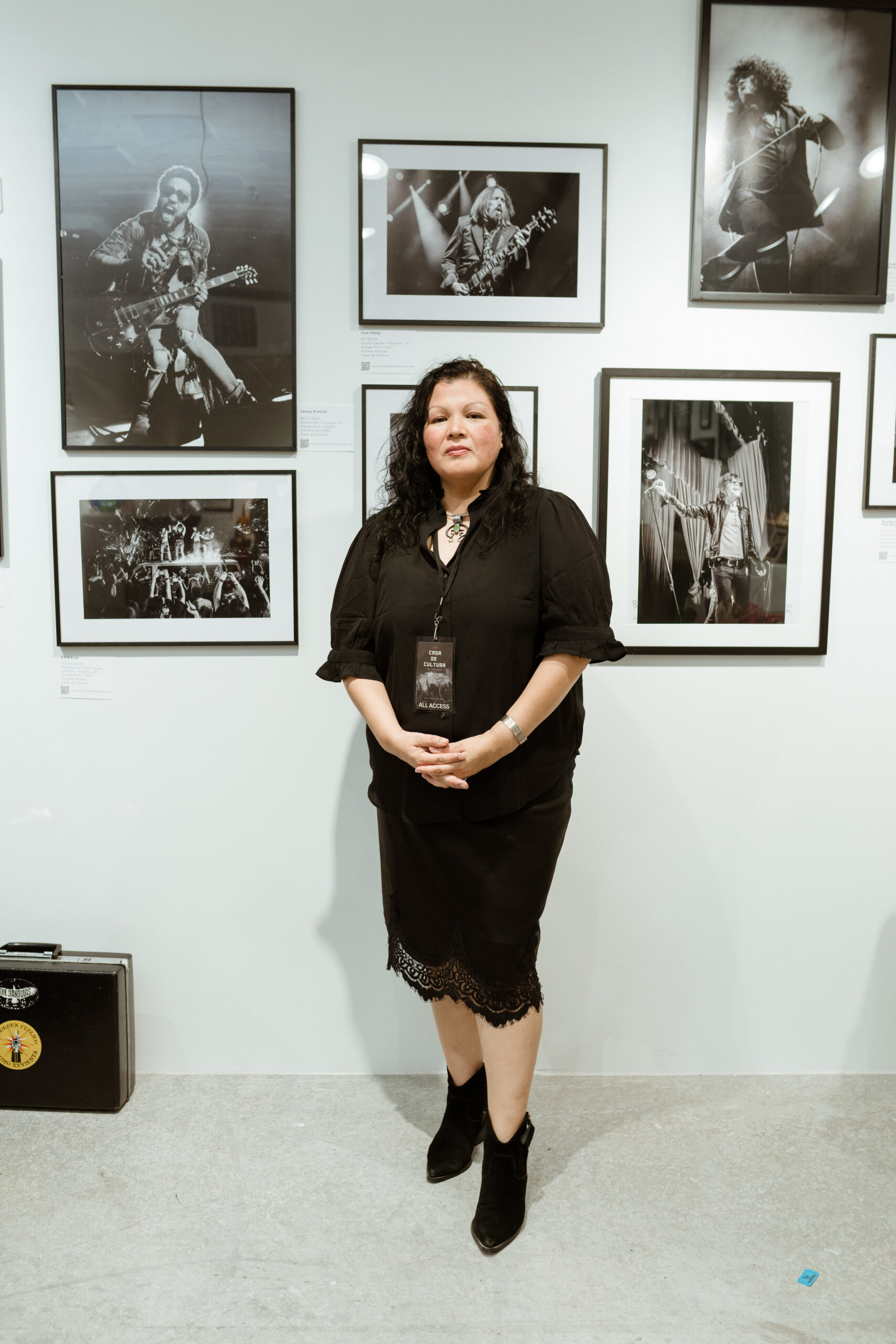
Álvarez has built her career around music photography. Her work has appeared in Rolling Stone and Pitchfork. Portraits of Bad Bunny and Willie Nelson hang in her studio. But this time she’s turned the camera inward, toward her own roots. Born in Texas to Mexican parents, Álvarez set out to explore the experiences that connect immigrant families, starting with her own family’s story.
(Violeta Álvarez)
The residency, which occupied the gallery for eight weeks in July and August, is built around two central exhibitions: Luz y Sombra (Light and Shadow), dedicated to her music photography, and Con Sangre y Corazón (With Blood and Heart), a series of portraits made during live sessions open to the community.
But the real heart of the project lies in what people left behind. Álvarez invited visitors to bring something that mattered to them to include in their portrait sessions, and a standing sign at the community shrine welcomes anyone to add a photo of a loved one who has passed away. A father’s hat, a childhood picture, a statue that belonged to someone’s mother.
“Some people never stepped in front of the camera. Instead, they brought personal items and shared their stories that way,” Álvarez says.
This has become a living archive of migration within the city.
Álvarez was 6 when her mother gave her her first camera, a Kodak 110. She says her mother came to the United States fleeing oppression and violence: “She wasn’t born here, but she belongs, just like anyone who comes to this country does.” For years, Álvarez’s mother worked as a house cleaner, while undocumented.
Meanwhile, young Violeta spent her days at the library searching for Latino role models, someone who looked like her behind the camera. She answers my questions in a loose, code-switching Spanish-English, sentences starting in one language and finishing in the other. “I always wanted to photograph our culture, you know? I wanted to go look for our history. But there wasn’t anyone like me—people of color, especially women—taking those kind of photos.”
She started photographing music performances as a teenager, but she carried that absence of a visual lineage with her for years, long before Casa de Cultura.
Álvarez says the idea for a project like this stayed with her for “her whole life,” but the project took shape during Trump’s first term, when she saw a “Mass Deportation” sign on TV during a Republican conference. “That made me very nervous,” she says. But she didn’t know how to channel it. She began applying for grants and residencies in 2018. Ironically, amid what many now call a migration crisis, this was the first time one of her proposals had been accepted.
Petite and dressed head to toe in black, Álvarez has almond-shaped eyes and an unassuming warmth. During the exhibition’s first month, she arrived at the gallery around 11 a.m. to set up the studio before the photo sessions, which she held on Saturdays and Sundays. People came in while visitors were touring the exhibition, so taking portraits itself became part of the public experience.
The day I visited, she was constantly in motion—greeting visitors, posing for a photo here, pulling out her phone there to capture people taking in the exhibit, imagery she said she uses for her Instagram.
When someone didn’t know what to do in front of the camera, Álvarez says she worked with them at their own pace: She’d ask them to dance or try a pose, and show them the photo right away so they could choose which one they wanted for the exhibition. One of those sessions, for example, was with a woman who had lost her hair to cancer treatment. They played music by her favorite band, and she gradually let go in front of the lens. She cried too.
“I think for some people, the photos were also a way of healing,” Álvarez says.
On an orange-painted wall, a sign reads “Community Shrine,” inviting visitors to bring a photo of a deceased loved one. Below it sits a wooden chair with a sign: “Reserved. In memory of the millions of lives lost to genocide & violence by [Immigration and Customs Enforcement] ICE & inhumane immigration policies.”
No one is allowed to sit there.
Among the photographs placed next to the chair is one of Lorenzo Salgado Araujo, the 52-year-old Mexican man an ICE agent shot and killed on July 7 in Houston while he was driving his construction crew to work. The case sparked protests across the state and remains under investigation.
A sign taped up in Álvarez’s studio states plainly that ICE is not allowed inside.
(Violeta Álvarez)
Meanwhile, the living archive of migration has slowly grown, drawing in local cultural figures as well. Isaac Rodríguez, founder of the cultural collective Chicano Boulevard, and collaborator Rob Apodaca brought turntables from Tejas Got Soul, a festival dedicated to preserving the golden era of Chicano soul music. Apodaca also added family photos and objects tied to his Yaqui heritage. Musician Nick Gaitan brought an accordion and an upright bass. On one wall, visitors themselves have left handwritten messages. Debora S.T.: “We deserve to be seen as more than headlines of tragedy.” Rosario: “I feel I walk away with a beautiful experience and with a peace I didn’t realize I was missing.”
Álvarez says: “Belonging isn’t just about being born somewhere. It’s about the stories and community you build and uncover along the way.”
That search for belonging sustains the whole project. Álvarez wants Casa de Cultura to humanize her community in the face of a public discourse that reduces it to numbers, laws, and headlines. “Art puts a face and a name where there’s usually just a statistic,” she says.
Unlike political discourse, she adds, art forces you to slow down—to sit with one specific person’s story, even if only for a moment. It’s an urgency she lives with every day, she says, starting with her own mother: Every time her mother, now a naturalized U.S. citizen, leaves the house, Álvarez fears something might happen, because “ICE doesn’t care if you’re a citizen or not.”
That’s why Álvarez doesn’t want the archive to end when the gallery closes. She hopes it finds a permanent home in a library, museum, or institution dedicated to Latin American history and that it keeps growing the way a family grows. She imagines that, 20 years from now, someone will find a portrait of their aunt there, or an object that belonged to their grandmother, and feel the same sense of belonging she set out to create in the first place.
“I hope it becomes proof that we were here,” she says. “That our joy, our grief, our music, our faith—all of it existed and mattered, even in a time when so much tried to reduce us to numbers.”
The post Houston’s ‘Living Archive’ of Migration appeared first on The Texas Observer.
Leave a Reply