Paul Skalnik was a con artist, passing bad checks, role-playing as a successful businessman, and racking up a series of sometimes overlapping marriages. Over the years, he bilked numerous people out of their savings with hollow promises and half-cocked schemes, which often ended with him fleeing town.
That in itself would make him a compelling character for a book. He’s the type of grifter who calls to mind simpler, more naive times. Indeed, he did a lot of his damage in the 1980s, before the internet made it easy to check if someone was actually, for example, a high-powered executive.
But Skalnik’s cons didn’t stop at the romantic and financial. They came to have life-or-death consequences.
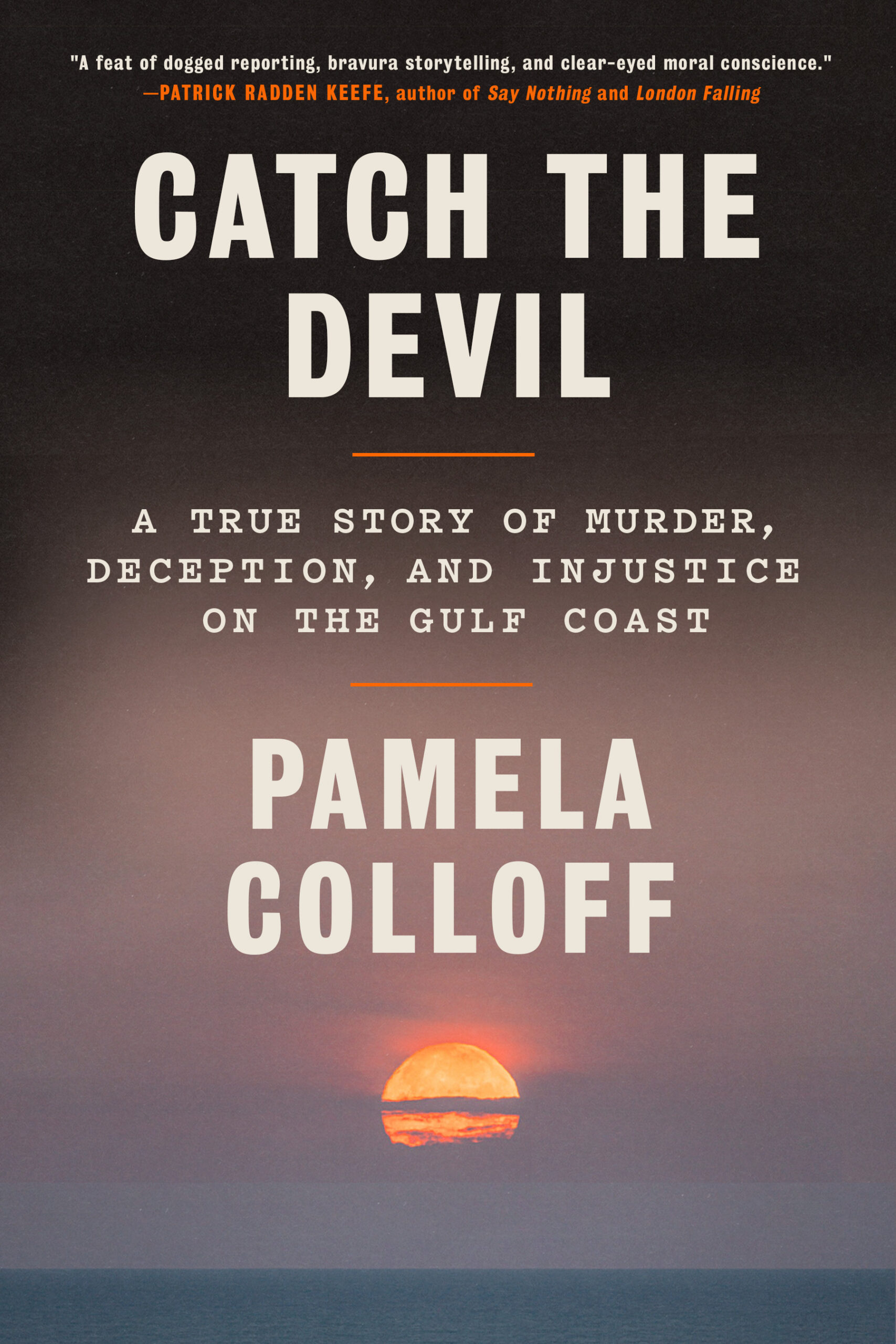
Pamela Colloff, a legend of Texas magazine journalism, uses Skalnik’s story to expose a perilous flaw in the criminal justice system in her long-awaited debut book, Catch the Devil: A True Story of Murder, Deception, and Injustice on the Gulf Coast, out from Knopf this July.
Colloff, who spent two decades at Texas Monthly before assuming a double role as a reporter for ProPublica and a staff writer at the New York Times Magazine, has long covered some of the most consequential wrongful-conviction cases in the state.
In 2010, she published an article on Anthony Graves, who was on death row for more than a decade after being convicted of the 1992 murder of a Burleson County family. By the time Colloff wrote about Graves’ story, an appeals court had overturned his conviction, a rare and telling move that indicated something was seriously wrong with his case. His conviction had relied on the word of a co-defendant who used his dying words to recant the accusations. But for four years after his case fell apart, Graves remained in jail, awaiting a new trial, where the state would, once again, seek the death penalty. Just a month after Colloff’s article outlining the weakness of the case was published, attorneys abandoned the prosecution, and he was released.
She built on that coverage in 2012, when she published a two-part story about Michael Morton, a Williamson County man who had been exonerated by DNA evidence in 2011 after spending almost 25 years in prison for the murder of his wife. Lawmakers later passed a law in his name mandating that prosecutors turn over evidence to the defense.
Wrongful convictions and prosecutorial misconduct have loomed large in Colloff’s reporting throughout her career, and all the stakes are there in her new book, which takes aim at another troublesome aspect of America’s criminal justice system: the so-called jailhouse snitch.
Catch the Devil: A True Story of Murder, Deception, and Injustice on the Gulf Coast (Courtesy)
For years, Skalnik—whose story begins and ends in Texas—attempted to dodge accountability for his own past by acting as a crucial witness for the State of Florida, delivering testimony of supposed confessions his neighbors at the Pinellas County Jail had let slip to him. In Catch the Devil, readers get a dual narrative: Colloff writes about Skalnik’s life and how prosecutors and judges enabled his doubtful testimony, and she also tells the equally compelling story of one man Skalnik helped send to death row.
In 1985, James Dailey was implicated in the murder of 14-year-old Shelly Boggio by his roommate and co-defendant, Jack Pearcy. Investigators in Pinellas County lacked forensic evidence, corroboration, or even a clear motive as to why Dailey, a Vietnam veteran, would have suddenly participated in such a crime. Pearcy, with a record of violence against women, was a much better fit, but officers pressed forward with the case against Dailey anyway.
Awaiting trial, Dailey ended up in the same jail as Skalnik. It was a twist of fate that would allow Skalnik to insert himself into the case and hold Dailey’s fate in his hands.
While Skalnik’s work with Florida prosecutors made him one of the most prolific jailhouse snitches in the country, he was hardly the only person offering up stories about other people in jail. Testimony given by jailhouse informants has played a role in sending at least 266 innocent people to prison in the United States since 1968, according to the National Registry of Exonerations. The Innocence Project reports that in about 20 percent of cases where DNA ultimately exonerated someone, the person had initially been sent to prison with the help of jailhouse testimony. In Texas, at least 17 people have been exonerated after being convicted based on false jailhouse testimony—four of whom were sentenced to death and 10 to life in prison.
In cases like these, prosecutors allow people who were in jail with the defendant pretrial to testify about what they allegedly heard the person discuss—or confess to—in the halls or through the bars of the county lockup. These witnesses are all facing their own criminal charges, and prosecutors are often willing to offer leniency in exchange for their help in gaining a conviction. In some cases, the jury doesn’t hear about these deals. As Colloff writes, Skalnik swore on several occasions that he was testifying only out of the goodness of his heart—only to get a deal shortly after.
Whether propelled by curiosity, anger, or incredulity, readers will charge through Colloff’s new book.
I cover the flaws of the criminal justice system for the Texas Observer, but even I was shocked by the apparent bad faith of state actors and the near-admirable heel-digging of prosecutors in the face of clear injustice.
The facts are sometimes stranger than fiction, but Colloff’s literary ability turns an inherently interesting story into a deeply impactful one. Her characters’ arcs take them across genres—love stories, wartime accounts, legal thrillers—and she navigates each one adeptly with evocative and descriptive prose.
Her deep reporting also allows her to jump between perspectives, to put readers into different people’s heads. What if you were the unwitting wife of a con man? A prosecutor hopelessly stuck on a high-profile case? A guy willing to do anything to stay out of jail?
Her ability to craft these characters is what stands out, and she’s able to extend empathy and fairness to even the most frustrating actors. No one in the book is one-dimensional. She contends with the consequences of squandered potential, of destructive alcoholism, of panic in the face of losing your freedom. Underpinning the book’s nuance and complicated narrative, though, is something in too short supply among Skalnik and his state-employed enablers: a commitment to the truth.
The post A Jailhouse Snitch and the System that Made Him appeared first on The Texas Observer.
Leave a Reply