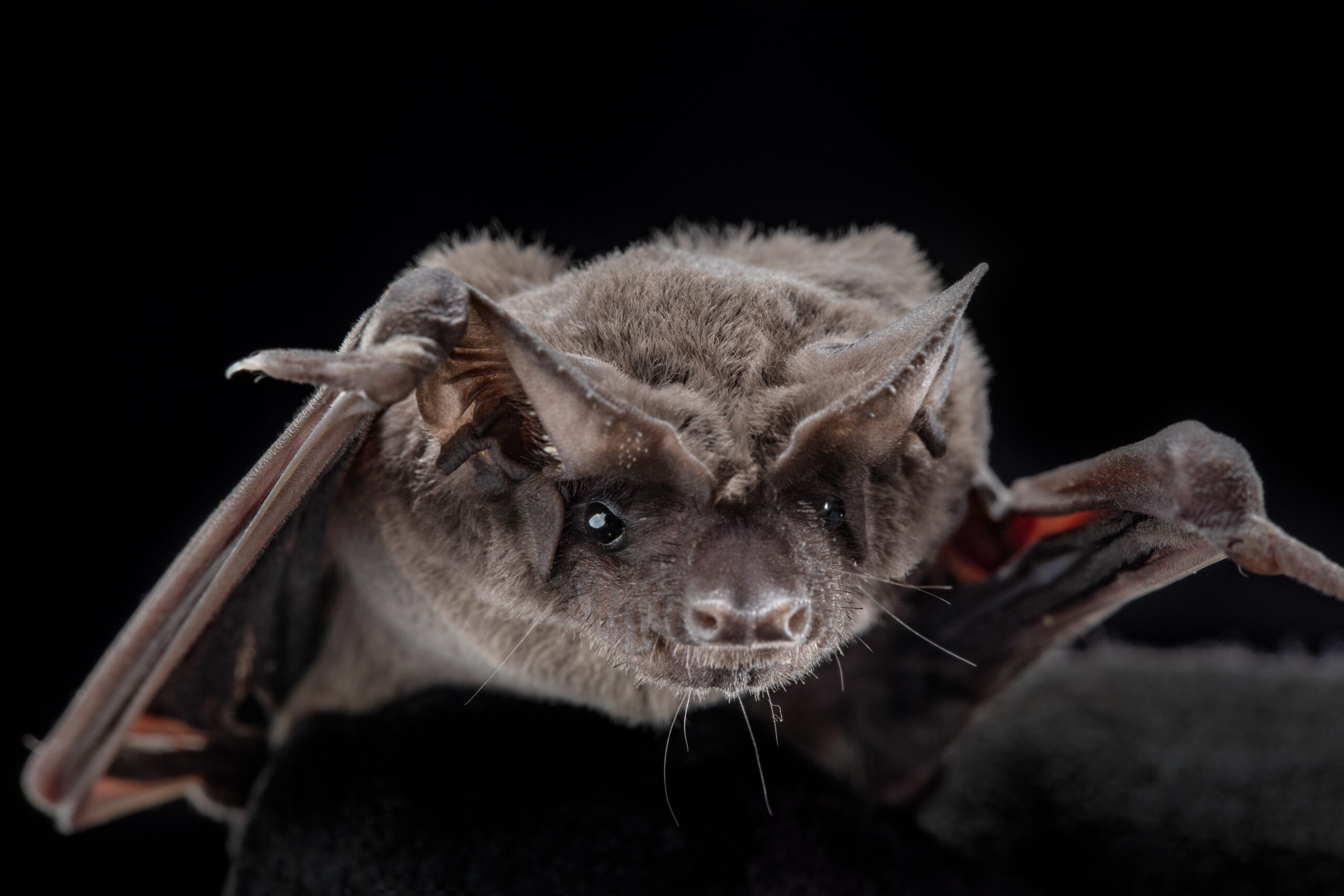
The gaping mouth of Bracken Cave, created when limestone collapsed into a sinkhole in this rocky patch of Hill Country millennia ago, reveals only darkness to the human eye. Yet the room inside is filled with the pulsing life of tiny, furry, pregnant Mexican free-tailed bats in April—a massive maternity ward that will, by summer, swell to 20 million after each mother gives birth.
This cave, a few miles north of San Antonio, is said to hold the world’s greatest concentration of mammals in such a compact space.
The sun is still painting streaks across the sky when a few scouts emerge, then suddenly many more follow, expertly forming funnel clouds—bat tornadoes—that allow them to rise quickly and elude waiting predators.
“Boom, they’re out!” says Fran Hutchins, the director of Bracken Cave Preserve, who has guided groups here for two decades as an employee of Bat Conservation International (BCI), an Austin nonprofit that is the cave’s owner and guardian. “You get that vortex when they surge out of the cave, and then when they reach the tree line, you get that river of bats in the sky.”
I watch with Hutchins and a small group of other rapt humans near the cave entrance, a rocky crevice surrounded by boulders, blooming lantana, and prickly pear. The departing creatures create their own wind, their wings beating out a collective nocturnal staccato.
WHAT IF NEXT YEAR, A MILLION FEWER ARRIVE AND HUMANS FAIL TO NOTICE?
Their speed is astonishing. These are the world’s fastest bats, able to fly up to 100 miles per hour.
Communities of thousands seem to select departure times and strategies based partly on wind direction, rain patterns, and the predators’ positions. Tonight, two pairs of speckled Swainson’s hawks repeatedly charge with war cries and bared talons. At times, the swifter bats, not blind despite the stereotypes, boldly strike back at these larger avian hunters with loud thumps.
This cavern’s internal temperatures hover around 104 degrees, providing a nurturing space for bat babies, yet any human who dares enter without a respirator could perish in only 30 minutes. Hutchins, a spelunker who has explored this cave with proper safety gear, says bats are somehow immune to the fumes from ammonia and other toxins generated by a 100-foot-deep guano pile that swarms with tiny beetles that consume both fallen bats and their excrement. “That’s housekeeping,” says Hutchins. Tonight, as a bat cave guide, he sports a gray shirt printed with Halloween-style bats.
For a few months each year, lucky humans can gain supervised access by donating to BCI. Though the show typically begins in May, many bats arrived in February this year. Statewide, as global temperatures rise, free-tailed bats have been arriving earlier and leaving later, sparking fear that their food supply and their survival could be affected—particularly given that vulnerable pregnant females migrate as far as 1,000 miles to give birth here and leave with babies mere months later.
Even the adult bats are small: One carefully netted by a BCI employee during my visit fit neatly inside a gloved hand. They’re about the same size as their blood-sucking vampire bat cousins, but they have longer wings. While vampire bats have long inspired fear—despite the rarity of attacks on humans—free-tailed bats have won friends by consuming insects. One study estimated that these bats save Texas cotton farmers alone around $800,000 per year on pesticides.
Bracken is the biggest, but other Texas maternal colonies, including in Devil’s Sinkhole and Old Tunnel state parks, also house millions. And some of these bats’ citified kin, mostly male or mixed colonies, roost below bridges: Austin’s Congress Avenue Bridge, Houston’s Waugh Bridge, and in San Antonio’s Pearl District.
When BCI moved to Texas in 1984, the urgent mission of its founder, Merlin Tuttle, was to persuade Austinites not to eradicate their bat colony. These days, Texans tend to appreciate the show. They know bats “are not blind; they’re not likely to fly into your hair,” Hutchins tells me.
The land around Bracken Cave—more than 4,000 acres—has been preserved at great cost and sustained effort by both BCI and the Nature Conservancy. Each organization owns side-by-side preserves, and they comanage a third tract that was acquired to fend off a 3,500-home development proposed in 2013.
Tuttle retired years ago. Since then, the nonprofit has grown under other directors. These days, BCI funds bat research and conservation worldwide. But BCI’s public face revolves around this one incredible spectacle.
In April, the Bracken Cave emergence continues until long after sunset. As Jupiter winks overhead, late-departing bats face off with a family of great horned owls.
Most bats easily evade the trio. Their beating wings paint paths on the night sky before they zoom up to 10,000 feet in forays for food that can extend 60 or more miles. Passing planes, reminding us of the nearness of civilization and of San Antonio International Airport, regularly alter altitude or divert flight paths to avoid them.
Tree frogs chirp and crickets trill and, at one point, a chuck-will’s-widow emits its mournful call as the hours-long spectacle unfolds and the scene fades to black.
No one knows for exactly how many millennia bats have roosted here; the guano pile inside nearby Natural Bridge Caverns has been carbon-dated at 8,000 to 10,000 years old. Despite conservation efforts, even Bracken Cave Preserve is no longer a true wilderness: A mere 5 miles away, the suburban sprawl along Interstate 35 has encroached as San Antonio and Austin slowly merge.
As closely as this cave has been watched, an unsolved mystery remains: Where do these bats go when they leave?
To determine the answer, Kristin Dyer, an Orange, Texas, native who’s now earning her Ph.D. at the University of Oklahoma, has begun to catch and equip a few Bracken bats with tiny transmitters and antennae. She’s erected a small tower near the entrance of the preserve, and with that, alongside other towers erected in state parks, in Big Bend National Park, and in Mexico, she hopes to track them.
Her aim is to map their journeys—and to help devise strategies to better protect them while they roam.
(Courtesy of Josh Hydeman/Bat Conservation International)
Because of their wandering ways, Mexican free-tailed bats, which don’t hibernate, have evaded mass die-offs linked to an incurable fungal infection, dubbed “white nose syndrome” after its most distinctive symptom, that has killed millions among the seven other North American bat species.
Thanks to their enormous colonies, free-tailed bats are labeled a species of “least concern,” although they, like other bats and birds, have been adversely affected by wind farms. Each year, massive turbines strike down 600,000 to 900,000 bats—as many as 100,000 in Texas alone, according to estimates provided by BCI and by Tuttle. (Texas does not require tracking of these kills.)
Right now, few seem to worry about the free-tailed bats’ future. But what if next year, a million fewer arrive and humans fail to notice? To answer that question, Dyer also hopes to find better ways to count them, a task that’s difficult even with sophisticated weather radar, given this colony’s enormous size and concentration.
“How are we going to know if they are decreasing in population? How do you know the difference between 10 million and 8 million?” she asks. “We could be losing a lot, and it could be having a serious impact on their populations. But we don’t know.”
The post The Bats of Bracken appeared first on The Texas Observer.
Leave a Reply