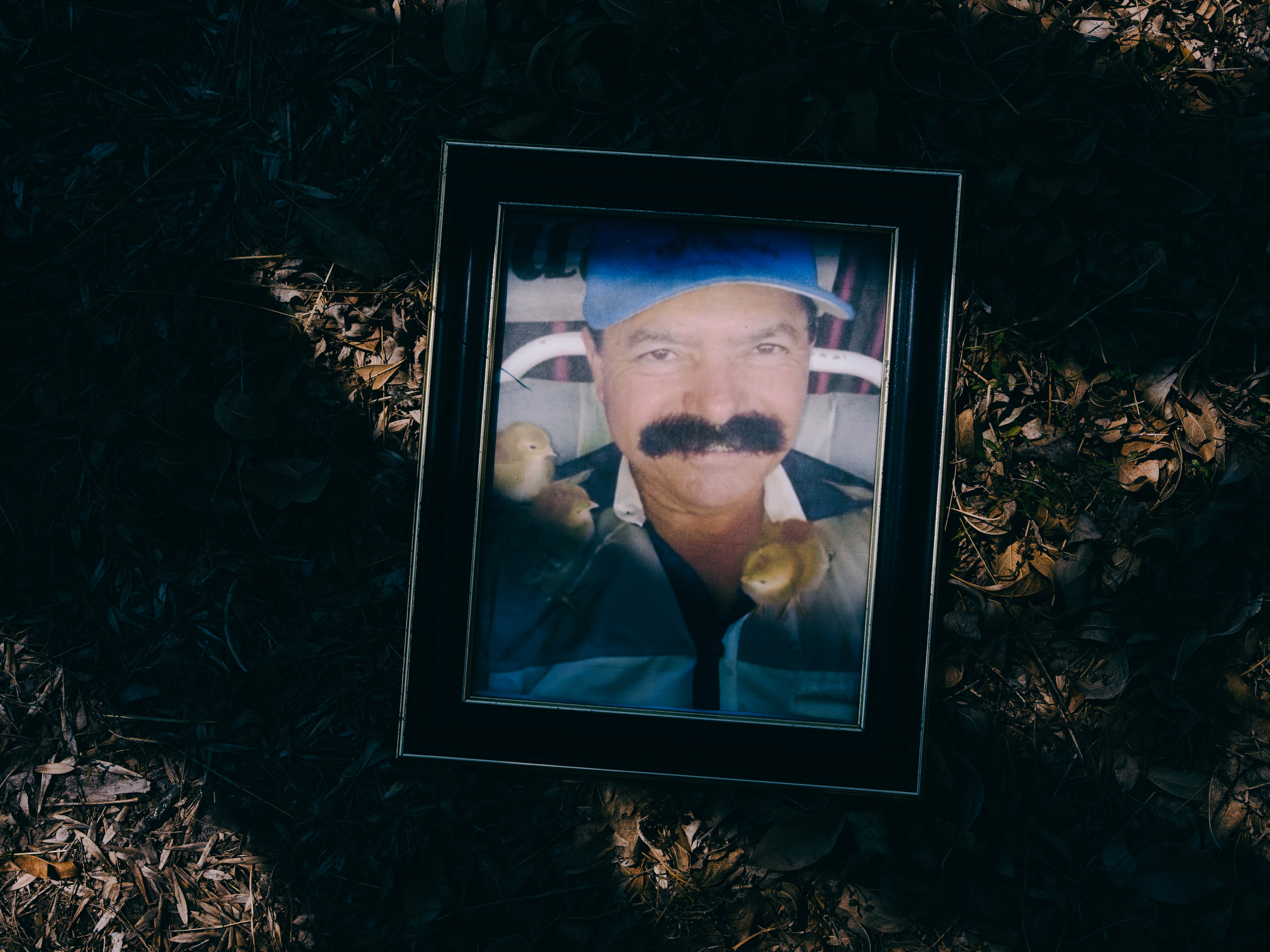
Ernesto Gonzales liked to hold court in the morning from a corner booth of El Rancho in Harlingen, a busy local eatery festooned with multicolored papel picado party banners—one of several spots he frequented after rising at dawn and reading the Bible. Between slurps of coffee—he drank it like water—and bites of breakfast taco, he would pause to finger his brushy, ample mustache and call out greetings. No one could predict from his deadpan expression whether the 62-year-old attorney might glance up to deliver a skewering remark, a sly joke, or, more rarely, a compliment.
After decades of trail riding, running a solo law practice, and serving as mayor of the nearby town of Primera, Gonzales seemingly knew secrets about everyone, gleaned from his encyclopedic knowledge of the Rio Grande Valley and his voluminous divorce and criminal case files. He lived perpetually surrounded by friends—and by enemies.
His flamboyant style verged on cantankerous. As a young attorney, a judge noticed the flourishes of aggressive energy he deployed in court, earning him the moniker “El Gallito,” the Little Rooster. But in late middle age, the Rooster had strayed from his flock. He spoke infrequently to his only son, and never to his former wives, though he’d quietly made sure they’d benefit in the event of his death.
In June 2017, he began to fight with two of his seven siblings over their mother’s treatment and medications. He soon filed related formal complaints against the home healthcare business run by his sister, a nurse, accusing her of patient abuse, neglect, and Medicaid fraud. (She denied all allegations.)
A Primera patrolman was summoned to the family home on June 21 over an argument Gonzales began over whether his mother, Francisca, bedridden after suffering small strokes, needed emergency treatment. Over his loud objections, the ambulance was sent away. Gonzales later alleged his mother had been “unduly influenced by my siblings to say she did not want to go to the hospital though I have the power of attorney.” He blamed siblings, nieces, and their husbands when she died days later, executing a posthumous maneuver to exclude some from the list of pallbearers.
More conflicts erupted at the matriarch’s June 28 viewing at Trinity Funeral Home, where Gonzales arranged for his twin brother, Enrique, to be served with papers related to a new lawsuit Gonzales had filed. The suit claimed that Enrique had borrowed $42,000 that was still owed to the family trust. (Enrique claimed the debt had been repaid.) In the chapel lounge, the fight over his mother’s care escalated into a scuffle, and his younger sister, Alice, was scratched and bitten.
El Gallito avoided injury, only because he’d been warned that two younger male relatives had threatened to “kick the living daylights out of me,” he later said in an affidavit.
About two weeks later, on July 13, Gonzales filed that affidavit to seek a protective order against the estranged sister who owned a healthcare business and four younger relatives. The language he used seemed blunt even by El Gallito’s standards: “I have had to carry an unloaded pistol in my truck hidden because I fear for my life,” he wrote.
As an active attorney, he’d received other threats too. He told family and an employee that he’d been jumped, pistol-whipped, and left unconscious by men he said belonged to a drug cartel while camping in his RV on South Padre Island. On his phone, he’d kept a copy of another ominous message he’d received via text: a photo of what looked like a dead man lying beside a rifle with a message that said only “Ernest.”
A framed photo of Ernesto “El Gallito” Gonzales
On July 18, Gonzales planned to meet at 8 a.m. with Alice to discuss her pending divorce. Alice knew her big brother—like his animal totem—rose before dawn and tended to be obsessively punctual. But he didn’t show. Inside the brick house on South F Street that he’d converted into the headquarters of his solo law practice, “Everything was in order,” she recalled in an interview. Inside, she found only his coat hung up neatly beside his desk, where the Bible was still open.
His battered white pickup remained outside, but the unloaded gun he’d carried for protection was missing. Alice immediately called 911.
Harlingen police officers were stumped. There was no sign of a struggle; a few drops of blood they later discovered and tested came from an animal. El Gallito was a hunter. With no body to examine or identify, the case remained that of an unsolved missing person for more than two years. Then, the Texas Rangers were summoned.
To this day, Alice says nobody ever fully investigated her brother’s 2017 disappearance. She knew there was no shortage of people who wanted her brother dead—including some of her siblings. “I wish somebody would really investigate. Because I want to know who took my brother’s life. Who had the nerve to take him,” she told the Texas Observer.
But the person Harlingen police and the Rangers arrested in 2020 was not among the people on Alice’s list; it was her own son, Solomon “Sonny” Campos Jr., a former police officer and a federal contractor for the Border Patrol with no criminal record.
Like others in his storied division of the Department of Public Safety (DPS), Texas Ranger Raul “Roy” Garza had a long list of duties—including assisting local police with crime scene investigations and unsolved murder cases. Garza initially refused to help with the El Gallito case, he said. He was already too busy reviewing another high-profile Harlingen missing person—Noemi Rodriguez, who vanished after finishing her shift around 2 a.m. at a McDonald’s almost exactly a year prior.
Garza worked on only a handful of murder cases during his seven years as a Ranger, a tenure that ended when he retired in 2023. That wasn’t atypical. DPS data obtained by the Observer through a records request shows that Texas Rangers opened 148 murder cases in 2024 and 2025—an average of one every two years per Ranger, based on the number of positions authorized by the Legislature.
Given their myriad assignments, few Rangers specialize in homicides. One exception was retired Ranger James Holland, who famously persuaded serial killers to crack—winning 93 confessions from an aging California inmate named Samuel Little and gleaning admissions from an Oklahoma killer that led to the discovery of two murdered teens’ clandestine graves near Houston.
Garza had neither Holland’s expertise in homicides nor his reputation as a “serial killer whisperer.” On a personal level, he thought Rangers were required to do too much. “If you want to do a good job, you can’t have too many cases on your plate,” Garza told the Observer in a March phone interview.
Alice Gonzales outside the law office of her brother, Ernesto
An Indiana native, Garza began his career as a police officer in San Juan, a town just west of Harlingen. After joining DPS in 1997, he made his way up as a trooper, a K-9 trainer, a drone operator, and a narcotics investigator before becoming a Ranger in 2016—the year before El Gallito disappeared. But his true passion was fishing: Since 2010, he’d been moonlighting as a fishing guide in Port Mansfield.
He considered his last two murder cases to be the most important—and “crazy”—of his career, though neither resulted in a murder conviction. “The Noemi Rodriguez case and the Gallito case will both make movies one day,” Garza said.
In the Rodriguez case, Garza and Harlingen police initially couldn’t locate the 19-year-old victim who disappeared after working at McDonald’s. Nor could they find the suspect, identified as the driver of a light-colored SUV spotted on the restaurant’s drive-through camera shortly before Rodriguez called her mother to say she’d gotten a ride home.
But the Rodriguez investigation heated up after her remains were discovered on the bank of a canal northeast of Harlingen in April 2017—not long before El Gallito vanished. A tipster, Garza said, led him to the suspect: A former co-worker at the restaurant whose family owned property where her body had been found. However, Cameron County prosecutors have never charged the man named as a “person of interest,” Miguel Angel Flores, who’s currently doing time for unrelated aggravated robberies.
Garza was still trying to gather evidence in the Rodriguez investigation when he got roped into helping Harlingen police with the unsolved El Gallito disappearance in July 2018. “I kind of got forced to take the case,” Garza said.
Within two years, Garza helped find the body and arrested a suspect—the nephew named Sonny Campos. But charges against Campos were still pending when Garza took early retirement in August 2023 to pursue his passion and become a full-time fishing guide.
A year later, his most high-profile Valley murder case would spectacularly fall apart.
The Texas Rangers’ cold case website still lists Gonzales’ murder as an example of matters solved through the Rangers’ prowess. But Campos was exonerated.
In a pending civil lawsuit, Campos alleges that Garza helped Harlingen police frame him for the crime and that officers destroyed, hid, or lost crucial evidence that could have proved his innocence.
In the March phone interview, Garza refused to comment on his investigation, given the pending civil suit. But the Ranger’s thick case file on the El Gallito murder—and his trial testimony—show that he began interviewing multiple relatives, including some who allegedly threatened Gonzales. But he quickly decided to focus on Campos.
It was an unusual choice: Other relatives questioned by Garza or by Harlingen police had criminal histories or had been named as posing threats by El Gallito in his request for a protective order. Campos, in contrast, got along well with his tío—and had passed frequent background checks during his career as a police officer in Washington, a rookie Border Patrol agent in Arizona, and, most recently, a federal contractor for immigration authorities in Texas.
Despite the delicate nature of the murder case, Garza used his personal cell phone to text some relatives whom he interviewed as potential witnesses, including some accused of making threats and Gonzales’ only son, according to testimony that Garza and others gave during the murder trial.
Garza told the Observer that he never considered the victim’s son to be a suspect—despite the fact that the son claimed more than $300,000 in assets including his father’s house, horses, and other property and life insurance money (along with his mother and stepmother). In testimony, Garza said he also ignored threats El Gallito had supposedly received from nonrelatives as irrelevant.
Garza obtained passwords and other valuable clues in 2019 about El Gallito’s last day from Gonzales’ son, who had access to his father’s house and computer. Various versions of El Gallito’s last day were soon leaked to the press and widely shared. Gonzales’ first few stops on the morning of his disappearance were predictable. He’d left his house near dawn, stopped at Whataburger (another favorite breakfast haunt), then went to his office. After leaving his pickup parked there, the data allegedly showed, the attorney—or his phone—pinged at several sites. Its electronic location was tracked near Campos’ home, near property that Campos leased for a goat ranch, and near the home of an older brother.
Based on the location data, Garza and Harlingen police officer Manuel Tovar zeroed in on Campos.
Campos sits at El Rancho in Harlingen, where his uncle used to sit.
Campos and his wife, Erika, worked long hours—she as an elementary school teacher and he ferrying immigrants stopped by Border Patrol to detention centers or to the border for voluntary removal. On the side, Campos leased pastureland from a great-uncle, where he kept both goats and chickens.
Campos denied seeing his uncle on the day of El Gallito’s disappearance, though he’d stopped at the goat ranch and fixed a trailer tire near there before driving 25 miles to work another extra job at Vinson Shooting Range in Los Fresnos.
Campos and his wife cooperated with police searches. In 2018, a team of police with cadaver dogs searched the ranch, finding no evidence. Officers returned other times to visit the property. Later, the couple’s home in town was eventually searched and Campos’ gun collection seized (none were ever used as evidence against him, but he told the Observer not all were returned).
Despite the previous searches, Garza still concluded that the ranch was “the perfect place to hide a body.”
Garza arrived at the acreage, about 10 miles southwest of Harlingen, on June 23, 2020. According to another witness, Garza had received information from an anonymous source, and one of his own reports referred to a “CI,” a common abbreviation for a confidential informant, though Garza later insisted there was no such informant. He also claimed in court—and in an interview with the Observer—that the reference to a “CI” he made in a government form to request a listening device (a rigged watch) referred to El Gallito’s son, who had at one point offered to secretly record conversations.
This time, Garza and a contingent of state and local officers, carrying ground-penetrating radar, found a skeleton at the ranch near a newly built barn that was later identified as belonging to Gonzales. The bones were buried several feet down, and some were missing. Based on reports and testimony later presented at trial, it was unclear how long the remains had been buried there, or whether they had been moved from elsewhere. But, as a forensic pathologist concluded, the cause of death was evident: Gonzales had been shot in the head execution-style.
The discovery of the grave was the primary evidence linking Campos to his uncle’s murder. But unlike other relatives, Campos lacked a motive.
After his uncle’s disappearance, his aunt’s healthcare business—the same one El Gallito had filed complaints against—had run into trouble with the feds. Yet Campos had steered clear of his uncle’s family feuds, trying to keep peace with both sides.
In fact, Campos claims he had maintained a close relationship with his uncle; they regularly breakfasted together at El Rancho. “I was never angry at my uncle. … It makes no sense,” Campos told the Observer in an interview.
At the time that his uncle accused other relatives of posing a threat, Campos said that El Gallito gave him “a tie that belonged to my grandpa so [Campos could] wear it as a pallbearer for my grandma’s funeral.” Nor did the nephew financially benefit from the crime.
A teetotaler, Campos often gave his uncle rides home after El Gallito had too much to drink—his uncle was on probation for DUI at the time he disappeared; he’d won a plea deal after suing DPS and a state trooper. In interviews, Campos said he, like other relatives, worried about his uncle’s addiction issues, and he once confronted a storekeeper he thought had sold his uncle drugs.
Prosecutors later used statements that other relatives provided about these conversations as evidence that Campos was tracking his uncle. Based on those statements, the cell phone pings, and the body-recovery site, they argued that Campos had kidnapped his uncle, shot him in the head, then buried him wrapped in a belly chain similar to those Campos used in his border job to restrain suspects.
Alice, who was in the process of divorcing Campos’ father, had argued with her eldest son at times. But she thinks Campos is the last person who would have wanted to kill her brother. “My son’s never been in jail. He’s never been in trouble. He is a clean kid. He has been wrongfully accused,” she told the Observer.
Two days after El Gallito’s body was found, Campos was arrested and charged with capital murder.
“We cannot as a society allow this kind of corruption and abuse.”
In an interview, Campos said he believed then, and now, that someone else planted the remains on the ranch—where there were no high fences, security cameras, or watchful residents—to frame him, likely with the help of someone in law enforcement.
As he awaited trial in jail—initially unable to post a more than $1 million bond and insisting on his innocence—Campos scribbled notes about mistakes he’d observed by police. He remained in jail for months, depleting his savings on attorney’s fees and losing his jobs. His wife gave up their car and reluctantly sold off their goats, chickens, and horses. Eventually, she sold the house she’d purchased prior to their marriage to provide collateral to a bondsman to ensure his release in April 2021.
Campos shared his observations with his Brownsville criminal defense attorneys, Ernesto Gamez and his daughter Erin Gamez (who is also a state legislator), who began to examine the evidence that they received through discovery. What they quickly found was that a lot of paperwork, videos, and photos seemed to be missing—and that some statements police had given under oath to obtain search warrants contained irregularities and information they considered false.
In January 2023, while out on bond, Campos filed an internal affairs complaint with Harlingen police alleging that Tovar committed perjury when he testified in district court to secure one of the warrants to search Campos’ property.
He filed a similar complaint with DPS against Garza. DPS did open an internal affairs investigation, but the agency took no action against the Ranger, according to a letter. Garza later said in court and in an interview that his 2023 retirement had nothing to do with the internal probe. After 26 years with DPS, he simply preferred to dedicate his life to catching fish rather than suspects. A records request by the Observer turned up no disciplinary actions.
Before his trial, Campos made a cell phone video of the day Garza arrived at his home to collect his DNA, supposedly to compare it against genetic material found near his uncle’s remains. Campos considered the video evidence of how the Ranger had failed to follow DPS standard procedures to avoid cross contamination. No DNA was used against him.
A dense crowd of journalists, many of whom set up TV cameras for daily updates, gathered at the Cameron County Courthouse when Campos’ trial finally began in October 2024. County prosecutors took more than two weeks to present their case. At every turn, his defense attorneys counterattacked, with points scored by both.
Some stories that aired on Valley TV stations focused on mistakes and missing evidence: Harlingen police admitted to losing early witness statements and multiple videos that they had collected after El Gallito’s disappearance. In his two days of testimony, Garza admitted that he’d never collected the victim’s computer, which the victim’s son allegedly used to access an online account and to help track El Gallito’s final cell phone locations. It had been destroyed, according to testimony.
Ernesto and Erin Gamez pressed Garza about why, even after being required by a court order to turn over all communications, he’d failed to provide texts and emails that he’d sent witnesses—including alternative suspects—during the homicide investigation. Garza conceded these were likely erased when he turned in his computer and cell phone upon his retirement in August 2023.
Garza was proud of his role in the dramatic discovery of remains in 2020; the Ranger claimed that, while other officers and trained canines had missed the grave, he’d been able to see a clear “disturbance” of the ground years later.
However, he and other DPS officials could not explain why body cam video, which should have been collected by various officers who participated in the search for the grave, was missing. They’d turned over only photos.
At one point, Erin Gamez accused the prosecutors of simply looking for ways to distract the jury from “the lack of evidence” against Campos. “There is no motive, no witnesses to testify that he did it,” she said in court.
At trial, the defense zeroed in on references Garza had made to an informant they argued had steered him to the grave site in 2020—after prior searches of the same area had found nothing. Pressed repeatedly for a name, the Ranger insisted on the stand that he didn’t have one.
Given that Garza’s testimony about having no informant appeared to contradict references in his own reports, Erin Gamez declared that she believed that the now-retired Ranger had deliberately committed perjury. During trial, she argued that he and other officers involved in the case should be investigated.
The case concluded after nearly three weeks. The jury reached a verdict in less than three hours: not guilty.
In a posttrial press conference, the younger Gamez declared that an innocent man had just gotten justice. But she told local journalists she feared there might never be any for El Gallito.
Cameron County District Attorney Luis Saenz did not respond to the Observer’s requests for comment. He is among the officials whom Campos has sued over the mishandled prosecution and alleged civil rights violations, though Saenz and other officials have asked the court to dismiss the suit, in part because police and prosecutors generally enjoy qualified immunity in such cases.
Meanwhile, other records show that Saenz had already criticized flaws in a different murder investigation involving a collaboration between Harlingen police and Garza. In an unusual statement, Saenz had declared that key evidence had been mishandled, forcing him to drop capital murder charges.
In July 2022, the Cameron County DA’s office attempted to try a man who’d been arrested and charged with the stabbing death of 63-year-old Eric Eugene Armstrong. Records show that Garza assisted Harlingen police with the collection of evidence in that probe too.
Armstrong, a welder and pipe fitter described in an obituary as someone who “never met a stranger and was willing to lend a helping hand to friends and neighbors,” was stabbed to death on March 1, 2021, in what police described as a botched robbery inside a home in Harlingen.
The suspect left his cap behind at the bloody murder scene. On March 2, a Harlingen officer asked Garza to assist with processing the hat, which had been sealed in a “brown paper evidence bag,” according to Garza’s report. The Ranger took 36 photographs with his state-issued Nikon camera and gave a DVD with the images to the Harlingen detective.
Next, using latex gloves, he helped collect hairs from the hat that had been taped to “a clean sheet of white paper.” Then Garza used a light and filtered goggles to look inside, concluding there was no other biological material. After that, he terminated his involvement, saying the city police were taking charge. His report does not indicate whether the hat or hairs were sent to a DNA laboratory for further testing.
Within days, Harlingen police arrested Jose Isaias Soto Martinez, who had recently been released from prison after serving part of a 30-year sentence for five prior aggravated robberies in Cameron County. He was later charged with capital murder.
Then, in a highly unusual move, Saenz halted Soto Martinez’s trial before all witnesses had testified, claiming that investigators had lost evidence and failed to complete necessary lab work. In an unusual diatribe about the poor quality of the investigation, Saenz blamed Harlingen police—never mentioning Garza or the Rangers, whose duties include helping smaller departments collect and analyze evidence.
“It is unfortunate that we were unable to try the case of Jose Isaias Soto Martinez to verdict,” Saenz stated, according to news accounts. “The investigation by the Harlingen police was mishandled. … Relevant videos and photographs that we were not advised existed until in the middle of trial were lost. Supplemental reports were not completed and forensic lab testing was never completed or followed up on.”
Soto Martinez, who faced a potential life sentence, was convicted in 2022 only of evading arrest, sentenced to two years, and had his probation revoked, prison records show.
In an interview, Garza told the Observer he had little to do with the Armstrong investigation, though he recalled the DA’s criticisms.
Saenz’s 2022 statement about officers failing to properly retain and test evidence in the Armstrong murder resembled criticisms that defense attorneys would make during Campos’ trial.
In 2022, the Texas Rangers faced turmoil and turnover that spilled beyond Garza’s border region. Seventeen Rangers were investigated for failing to act to prevent the deaths of schoolchildren in Uvalde—and Assistant Chief Brian Burzynski, one of Garza’s supervisors, retired along with the agency’s chief. In 2023, Garza joined more retirements in the Rangers’ bicentennial year, leaving the agency shorthanded.
Rangers, these days, are overburdened, including with in-custody death investigations and with border security deployments, Garza told the Observer. He said he wished the Rangers had no “additional assignments other than helping out small agencies with technically difficult cases.” He added, “I don’t think we need to be doing border ops helping out with drone operations and all this other crazy stuff.”
He still thinks Campos is guilty. And no one else appears to be investigating El Gallito’s murder—the Rangers’ cold case list still classifies the case as “solved.” DPS did not respond to questions emailed for this article.
But Campos’ lawsuit, pending in federal court, characterizes his prosecution as a massive miscarriage of justice that harmed the life of an innocent man. Campos is seeking compensation for what he has described as a flawed investigation that led to his wrongful arrest, the premature end of his federal career, the loss of his property, and nearly irreparable harm to his reputation and his life—and to his wife’s.
In this, he has an unusual advocate: C.J. Grisham, a veteran and the outspoken founder of the gun rights group Open Carry Texas, who gained a provisional law license in 2023 after attending the Appalachian School of Law. Grisham has promised to fight for Campos—even if those who really carried out the murder try to come after him.
In an interview, Grisham said government officials in this case violated their duty by manipulating, manufacturing, hiding, and destroying evidence. “We cannot as a society allow this kind of corruption and abuse of the justice system that happened in this case,” he said.
The post The Troubling Disappearance of ‘El Gallito’ appeared first on The Texas Observer.
Leave a Reply