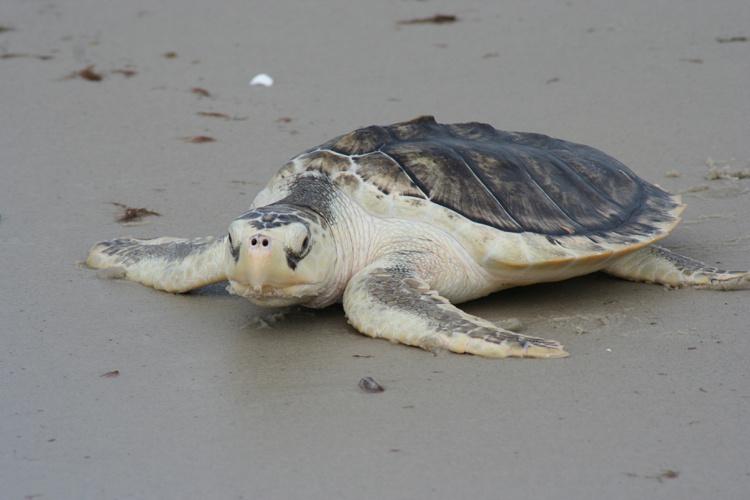
Nestled about a foot deep in a makeshift well of sand on the no-man’s-land of shoreline between dunes and waves, about 75 eggs laid bare, vulnerable to the dangers of the Texas coast. But not for long. Within hours of the nest’s arrival, members of the Nueces County Coastal Parks Turtle Patrol cordoned the area off, protecting dozens of Kemp’s ridley sea turtle eggs on North Padre Island.
That nest, the first of the 2026 season, was recovered April 2—one of the earliest starts on record. Kemp’s ridley are the most endangered species of sea turtle on the planet and the only one native to Texas. Padre Island National Seashore is one of their only consistent nesting sites. They’re not alone: the Gulf of Mexico is home to more than two dozen species on the endangered list, each of which endured rigorous scrutiny and scientific analysis to determine if they met the high standards to qualify for protection under the Endangered Species Act.
Now, under a new decision rendered by the Trump administration, every one of those species’ protections have been made largely optional. The Endangered Species Committee, made up of six cabinet level officials, convened at the request of U.S. Defense Secretary Pete Hegseth, who asked that oil and gas drilling companies operating in the Gulf be exempted from mandates under the law requiring them to take steps to protect species vulnerable to extinction. Hegseth claimed the exemption was necessary for “national security.”
Often referred to as “The God Squad” because of its power to alter the fate of entire species and ecosystems, the group is led by Interior Secretary Doug Burgum, a Trump appointee with strong ties to the oil and natural gas industry. The meeting was only the third time that an exemption has been granted since the endangered species law was enacted in 1973; the decision was rendered in just 17 minutes behind closed doors.
A Kemp’s ridley sea turtle on the beach.
“In each instance prior to this, [the committee] either voted to deny an exemption for an activity, or it voted to limit or at least come up with alternatives and ways to save the species that would allow the activity to go forward,” Steve Mashuda, the lead attorney for the environmental nonprofit Earthjustice’s oceans division, told the Texas Observer. “I’ve never seen anything like this, and the National Security justification has never been invoked until last week.”
Previous deliberations have lasted days, welcoming spectators and public comment from scientists and ecological experts. When those exemptions were issued, they were narrowly tailored to minimize the impact on vulnerable ecosystems. This time, drilling in the Gulf was given a blanket pass in the name of national security.
“Energy security is national security, directly enhancing our operational readiness and ability to project power globally,” Pentagon Press Secretary Kingsley Wilson said in an emailed statement to the Observer. “A resilient, domestic energy supply of oil is essential to safeguarding our nation’s interests and maintaining our strategic advantage.”
Environmental advocates, however, say this exemption won’t help that cause because the Endangered Species Act has never been used to prevent drilling operations in the Gulf. Instead, they say it just reduces costs for companies that would otherwise have to employ protocols to protect vulnerable species.
“The decision … is not going to result in any more oil production, it’s not going to result in lower gas prices. It will result in real harm and the potential extinction of one or more species in the Gulf,” Mashuda said. “There is no indication that the Endangered Species Act is currently, or even will in the future, be responsible for halting oil and gas development in the Gulf of Mexico.”
The U.S. is the world’s leading producer of both oil and natural gas. Of American oil production, 15 percent comes from the Gulf with Endangered Species Act protections in place.
The Environmental Protection Agency and Interior Department did not comment on the decision, and the National Oceanic and Atmospheric Administration referred the Texas Observer to the Department of Defense.
On April 2, Earthjustice sued the “God Squad” in federal court on behalf of four environmental nonprofits, alleging the national security reasoning was “arbitrary” and unfounded.
Without the legal mandate to take measures to protect endangered species, like slowing vessel speeds in habitats where animals sleep close to the surface or strategically permitting drilling in line with habitat protection, advocates worry the companies won’t opt-in to those practices.
There are only 51 Rice’s whales—another endangered species in the Gulf—left on Earth. With such limited numbers, each loss is detrimental to the species’ long-term survival, disrupting the genetic diversity of an already limited group, according to Doug DeMaster, a Marine Mammal scientist and expert who worked with the National Marine Fisheries Service for roughly three decades. After the Deepwater Horizon oil spill, 22 percent of the whales’ population at the time are estimated to have been killed. Activists fear a Gulf free of restrictions could lead to more damage toward the fragile species.
“Any vessel strikes, any oil spills that can potentially happen, the seismic activity that is necessary when they begin exploring leases for setup, drilling and platforming—it disrupts everything,” said Joanie Steinhaus, the Ocean Program Director for the Turtle Island Restoration Network, which is one of the plaintiffs Earthjustice is representing. “It disrupts [Rice’s whales’] communication. It disrupts their feeding habits, their breeding habits. This is a species that dives deep, but at night, it rests close to the surface, so the impact for vessel strikes is very high. … Without any ESA protections, we can potentially see them extinct in our lifetime.”
BP, Chevron and Shell—which have major operations in the Gulf—all declined to comment on the decision’s potential benefits for domestic oil production and referred the Texas Observer to the American Petroleum Institute (API). While API says they did not advocate for this decision, they reiterated that industry operators will continue to employ conservation practices, though they did not specify further.
“Our industry has a long track record of protecting wildlife while developing offshore energy responsibly,” API Spokesperson Andrea Woods said in an email statement. “Over the long term, American energy leadership depends on getting that balance right through reasonable, science-based protections while meeting growing energy demand.”
One of the most pressing concerns activists have raised are the long-term implications of the exemption beyond the end of the Trump administration. Joseph Manning, a staff attorney at Defenders of Wildlife, said while the exemption is only active through 2029, any new drilling platforms that start operating within that window will be protected even after the exemption expires. Manning says those platforms’ 40-to-50-year lifespan would be allowed to continue with minimal oversight, even in vulnerable habitats, if they act fast and drill while the exemption is in place.
“That means that for a lease that sold in 2029, the oil company will have to go out, they’ll have to do exploration—that might be seismic exploration, things like that—and once they determine, the best places to put wells, they’ll actually go out and they’ll do the initial drilling, the construction of the rig,” Manning said. “That rig will operate for a certain period of time, generally about 40 years at least, and then they’ll be decommissioned. So that entire lifespan is what is exempted here.”
Commercial fishing could also be impacted if the ecosystems fishermen rely on suffer a disruption to the food chain. The Galveston Bay Estuary is one of the highest producing estuaries in the nation, a status that requires a delicate balance between industry and environment. For the animals, the impact could be just as permanent.
“One of the scary things about an exemption from the Endangered Species Act is that the decisions that we make today can be irreversible,” said Beth Lowell, vice president of Oceana, an international ocean conservation group. “The Endangered Species Act is the safety net for wildlife that’s on the brink of extinction. Once they’re gone, they’re gone forever. … Extinction is forever.”
The post How Trump’s ‘God Squad’ Could Devastate Endangered Species Along Texas’ Gulf Coast appeared first on The Texas Observer.
Leave a Reply