The town of Castroville lies west of San Antonio, beyond rolling farmland, bounded on three sides by a cypress-shaded horseshoe of the Medina River—dry now from long drought—and on the fourth by a brushy escarpment. A single hill advances into the city, crowned with a cross, sheltering the regional park on one side and the church cemetery on the other.
If you mention Castroville to someone who’s driven through, they’ll likely bring up Haby’s Alsatian Bakery, founded in 1940 by Stanley Haby. It stands on the highway opposite Sammy’s Restaurant, named for its first owner, Sammy Tschirhart, who also purchased the bakery in the ’70s. They’re local landmarks.
My parents knew little more than that when they moved us to Castroville from San Antonio in 1989. My mother had a memory of looking down on it from the hills and thinking, What a lovely place to live. They built our house on a lot that had once held horses. A rusty shoe we found still hangs over the front door.
Castroville, “the Little Alsace of Texas,” was founded in 1844 by colonists from that region of France. It still bears their stamp. Even as a fourth grader, I learned quickly that those of this descent, the “native sons” as I’ve heard them called, occupied a caste to which I, a Puerto Rican and Greek autistic boy from the city, would never belong.
The streets are laid out in a simple grid, cut by the slash of U.S. Highway 90 and named for the cities of Europe. I took to exploring them on my bicycle. The westernmost blocks, away from the river, were yet unpaved and home to the Mexican population. I rode through them and wandered the segregated cemetery.
The spire of Saint Louis Catholic Church, built in 1870, can be seen for miles ’round. We went to Mass there, sitting before Our Lady of Guadalupe, where, someone later told us, the Mexican folk had sat for generations. Perhaps we found it natural to sit among those who looked most like us.
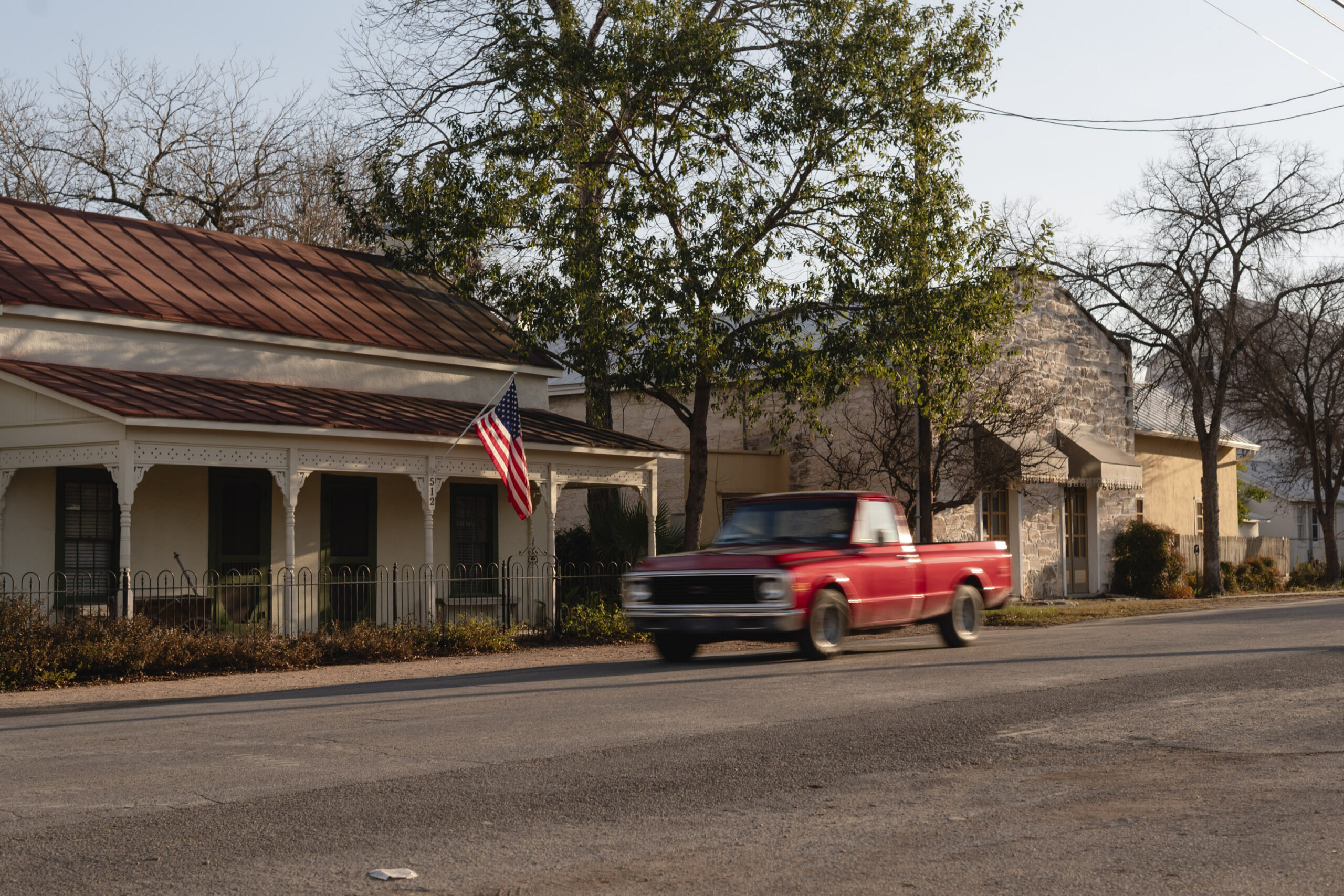
A cherry-red pickup drives along Paris Street as the sun sets.
Internal segregation made the school almost two within one. I got remarks like, “We forget you’re Hispanic because you’re smart,” and heard anti-Latino jokes and slurs. Friends on ranches outside town showed me the shacks where the “wetbacks” used to live.
Still, I did find companions. Two boys, “native sons” both, quickly became my best friends. One, who lived on a ranch west of town, could point to the graves of ancestors buried on a knoll in the park. His grandmother lived on our block, and once, we went into a dark back room where old photos stared down at us; we saw the shirt an ancestor had died in, perforated by arrows.
Despite my difficulty fitting in, I threw myself into volunteer work and Scouting. For my Eagle Scout project, I planned and oversaw the construction of a trail at that park, the first of its kind. It climbed from the river over a wild shoulder of land and back down again across a bridge. Within a year, park management changed hands, and the trail, though approved by the city council, had been demolished.
When chamber of commerce President Estella Kierce encouraged me to apply for Junior Citizen of the Year, I wrote an indictment of the town that had rejected both me as a person and my work on its behalf. Reflecting on how this would make her look, however, I tore it up and instead submitted something more positive. The chamber named me Male Junior Citizen of the Year. Given that I’m trans, perhaps I should apologize for having used my biological advantage to steal the title from some deserving cisgender boy.
Despite this small triumph, terrified of a future in which I could not see myself, I left Castroville, vowing never to live there again. I kept that promise until last year, when I moved back after almost three decades.
I left as a boy and returned a woman. My old trail has been rebuilt alongside many more, with an interpretive sign about my project. True, vandals have defaced my photo, but perhaps that’s fitting. My father, a former city councilman and American Legion commander, and my mother, an indefatigable volunteer, are well known, and when people ask who I am by asking who my parents are, I see recognition and then puzzlement. I’ve been taken for both my own sister and my own daughter.
At Halloween, my family went trick-or-treating with friends. Afterward, we had an impromptu party at our house, and my two old friends came over. In such moments, I forget ever having been a boy, and I seem to slip into an alternate, somehow truer reality where I have always been outwardly as I am now. I find myself wishing well for this place, my home.
In 2022, as I researched Texas civil rights history to write about Uvalde, where I lived at the time, I came across a startling reference to a 1970s “sawed-off shotgun killing of Richard Morales by Frank Hayes, the police chief in Castroville.” This appears in a chapter by Joel Zapata in Civil Rights in Black and Brown: Histories of Resistance and Struggle in Texas.
In a town so committed to reciting its history, I found it strange that I’d never heard of this event, which people must surely have remembered. They did remember, I later discovered. They just didn’t talk about it.
In 1994, I participated in Castroville’s sesquicentennial celebration. A commemorative play starred my friend’s father as the founder, Henri Castro, under the six flags on the town’s Houston Square. It’s what sparked my own interest in Castroville’s history.
Unlike the colonists, Castro was not Alsatian but born in Landes, France, in 1786 of a Portuguese-Jewish family who had fled the Inquisition. After serving under Napoleon, he immigrated to the United States, where he became a citizen, in 1827. He later returned to France for a time and worked for Jacques Laffitte and Company, a banking house.
The depression that afflicted the United States following the Panic of 1837 also stalled the prosperity expected in the newly formed Republic of Texas. Its congress authorized the president to negotiate a loan for $5 million. Europe proved more favorable than the destabilized United States, and a loan commissioner representing the Texas government contracted with Laffitte in 1841, with Castro appointed to handle the deal.
The French Minister of Finance opposed the loan, leading to the contract’s cancellation, but Castro traveled to Texas in 1842, still hoping to see it through. Sam Houston had just become president for the second time. A bill authorized him to make empresario contracts in another bid for financial solvency and as a buffer against aggressors. Castro managed to become consul general to France, and he received tracts of land both along the Rio Grande and just west of San Antonio.
He returned to Paris to recruit. Finding his character impugned by political enemies, he sought colonists far from the capital. He found them in Alsace.
Castro’s contracts granted him half the hundreds of acres promised to the colonists. The Alsatians set sail for Texas. After a miserable sojourn in San Antonio while they waited for him to make arrangements, they received their due, or something approaching that. Many traded their wild estates for lots in the new city of Castroville and nearby acreage suitable for farming.
Castro’s motivations have been interpreted variously. A 1978 state historical marker for his homestead on Fiorella Street claims that, “Using his own personal wealth, he cared for the colonists as though they were his children.” Bobby Weaver’s 1985 book, Castro’s Colony: Empresario Development in Texas, 1842-1865, is more objective: “[Castro] envisioned a sort of personal kingdom in Texas where he would be the great landholder and all the colonists would be beholden to him for bringing them to their new landholder position. To accomplish his ends the man relied upon an easy conscience and a glib tongue to carry him to success.” By all accounts, the venture ended in a disastrous lawsuit and impoverished Castro. He died in Monterrey, Mexico, in 1865.
The colonists occupied land that others considered home. Tejanos and Freedmen lived along the Medina River. A mill had existed there, destroyed in the flood of 1843. Lipan Apache and Comanche traveled throughout the region. The former used the land where the park now lies for a permanent encampment. Hostilities increased as the colonists settled in. Raids took place at Quihi, a Castro colony northwest of Castroville, leaving settlers dead. Texas Rangers enforced order.
One story, reported by Julia Nott Waugh in her 1934 book, Castro-ville and Henry Castro, Empresario, and told to her by Ralph Tschirhart, recounts how, in 1870, Nicolas Haby—a common Alsatian surname—laid in wait for Comanche come to steal his hogs at night. He shot one man in the face, killing him. A crowd assembled to look at the man the next day, and a boy named Frank Haby scalped the corpse. “Nic” Haby fed the body to his hogs but refrained from eating the animals for several years.
Over the next century and a half, the colonists and their heirs built their community, preserving the Alsatian dialect and traditional folk dancing. In 2025, I enjoyed watching my own friends dance at the annual Saint Louis Day celebration. My house lies around the corner from the Living History Center, and as I write this, I hear them building their new museum.
Truly, there’s something timeless about Castroville—though time comes for every town. It is a storied place, too, though not all stories are equally remembered.
At twilight, the road where Castroville Police Chief Frank Hayes shot and killed Richard Morales
In 1975, Castroville Police Chief Frank Hayes directed an officer to serve misdemeanor arrest warrants on Richard Morales, a 28-year-old construction worker, whom he suspected of having stolen a television and stereo, although they had been acquired from a rental agency. Hayes arrived on the scene and, after calling Morales “a thieving son of a bitch,” drove him to a lonely country road, made him exit the vehicle, and shot him. Claiming the killing to have been an accident, Hayes obtained his family’s help in burying the body in a shallow grave in East Texas.
After Hayes was initially found guilty only of aggravated assault, civil rights leaders protested in nearby Hondo and San Antonio. Governor Dolph Briscoe of Uvalde called for an investigation. The New York Times reported on the story, and Los Huracanes del Norte recorded a corrido about it. In 1977, Hayes was convicted of having deprived Morales of liberty without due process and was sentenced to life in prison.
Helped by a 1976 NBC newscast about the story, which includes an interview in front of the city hall building in which I once attended Scout meetings, I located where the killing occurred, between Quihi Road and Highway 90. It’s a lonely place. Nothing marks the spot.
In 1844, San Antonio must have seemed a long way from Castroville. Now, it’s all too near. Housing developments seem to spring up along Highway 90 overnight. Medina Valley ISD enrollment has exploded. A shopping center called Alsatian Oaks being built just east of town is slated to host chains like Ulta Beauty and TJ Maxx.
The west side remains mostly undeveloped. But not long ago, I was surprised to find a large tract cleared and flattened. It neighbors the ranch where I went on my first Scout campout. The creek I swam in growing up runs alongside it. A vast, level foundation has taken shape on it, obliterating the land. Soon, I discovered the cause: Microsoft is constructing a new data center there, one of many to be built in Medina County. An August 30 MySA article even refers to Castroville as a new Silicon Valley of Texas.
The city of Castroville itself still has quiet streets with no sidewalks, and even a few empty lots remain among its settler homes built of limestone and cypress. Residents want to keep it that way. A 2021 Texas Public Radio article quotes Bradford Boehme, “a seventh generation Alsatian descendent who still farms the same land his ancestors tilled” (and a former classmate of mine); meat market owner, Marvin Dziuk; and the mayor at the time, Darrin Schroeder, about attempts to negotiate with developers and keep the town’s character intact. Indeed, under Schroeder’s leadership, the city contracted with Simplecity to create a downtown master plan, a separate comprehensive plan, and a unified development ordinance (UDO) to guide future growth, a project that cost half a million dollars by the end.
Panicked by the proliferation of developments that lie outside city limits but that use the same resources, as well as proposals for high-density housing within the city itself, many citizens turned their ire anyway on Schroeder, who works for Microsoft, accusing him of selling the city out. As Schroeder campaigned for reelection in spring 2024, signs appeared all over town for a challenging candidate, Bruce Alexander, soon outnumbering Schroeder’s. Schroeder proposed a public debate moderated by the high school debate club at the American Legion hall. I attended, but Alexander didn’t show, citing a conflict, and Schroeder “debated” alone. As it turned out, Alexander won by a landslide, with 74 percent of the vote.
After Alexander took office, I attended the July 22 city council meeting for a friend who was out of town but wanted me to read her statement in support of the UDO. Residents in favor of the UDO spoke of wanting to preserve the town’s character, but they expressed a desire for downtown revitalization; improved residential options, including multifamily housing; and a path into the future. Those against spoke also of preservation while voicing fear of unbridled change and anger at the loss of control, claiming that the UDO meant the destruction of Castroville’s unique character, an inexcusable compromise with modern development. Palpable in all was the tense question of whether to meet the future head-on and treat with it, or draw up the bridges to prepare for a siege.
In his defense of the UDO, Councilman David Merz invoked the vision of Henri Castro, but to no avail. The council voted against adopting the plans developed under Schroeder—leaving the future uncertain.
April Maria Ortiz, with the Scout Trail she designed behind her, is pictured at Castroville Regional Park on Saturday, Jan. 31, 2026 in Castroville, Texas.
I later met with Merz at a coffee shop in an old gas station on Fiorella Street. He spoke of how, like me, he wasn’t a “native son.” He grew up in Illinois and moved to Castroville upon marrying a Tschirhart, living in an apartment before buying a house. We compared Scouting stories, though I had to correct him when he congratulated me for having belonged to such an excellent organization as the Girl Scouts.
In discussing the mayoral election and its impact on city planning, Merz pointed to low voter turnout. He bristled at the attitude I’d encountered: that some community members are of less value than others. But he wasn’t surprised by the stories I told. Toward the end of our conversation, he joked about forming a political party called Fremde, after an Alsatian term that means “outsider,” used by some for newcomers who supposedly should prove themselves before participating fully in public life—in this colony that was formed as a financial venture displacing others.
As we prepared to part ways, Merz told me that, in English, the pronoun “we” can be used exclusively or inclusively and that he included me in the “we” of Castroville. He encouraged me to play my own active role, and I’m still thinking about that.
In November, I went for a walk to read the historic markers in my neighborhood. The streets hummed with activity for a citywide yard sale. A boy rode by on a bicycle as I crossed Houston Square. The church bells pealed for All Saints’ Day, while the boy had a speaker in his backpack, playing the Judds’ song “Grandpa (Tell Me ’Bout the Good Old Days).”
Whatever its leaders and residents may wish, time is coming for Castroville. The drive for capital that brought Alsatian colonists in 1844 is bringing another kind of colonist down on their heirs. Castroville embodies both heritage and exclusion—what town doesn’t?—but unless it finds a way to preserve its soul, Texas will lose something irreplaceable.
The post Time Comes for Castroville appeared first on The Texas Observer.
Leave a Reply