The function of foundational myths is to fence off the present from ideas, counter-histories, and traditions from below that could cut through the barbed wire and reopen a sense of political possibility. As a great bard—Zack De La Rocha of Rage Against the Machine—once put it: “Who controls the present now controls the past, who controls the past controls the future.”
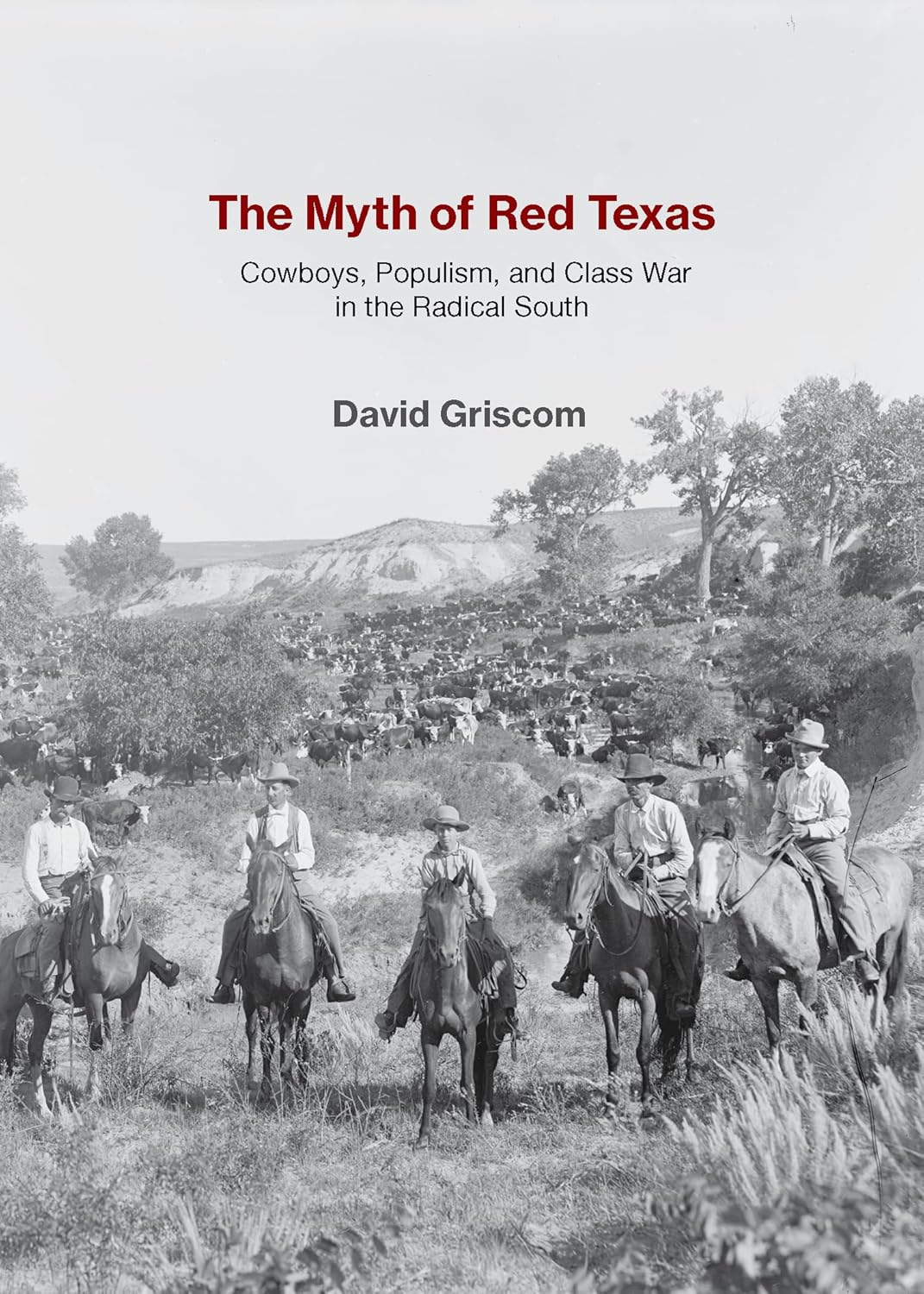
In his new book of revisionist history titled The Myth of Red Texas: Cowboys, Populism, and Class War in the Radical South, out April 14 from OR Books, David Griscom places a ten-gallon hat atop De La Rocha. “Republicans in Texas have been skillful at crafting a version of Texas history that is favorable to their current goals,” writes Griscom, a first-time author who hosts a podcast for the socialist magazine Jacobin and a streaming show called Left Reckoning.
Our state is home to the highest number of on-the-job construction deaths and to an epidemic of hospital closures, to name just two of many shameful designations. But how can we shift course? Must we recover an alternative story about this place with a different theme other than rugged individualism at its heart? Forge a connection between the hardhat and the maverick cowboy hat, the pecan-sheller and the Ascension hospital nurse on strike? Griscom’s book furnishes us with a strong “yes,” and it makes clear that the stick beating the drum of our potential counter-story is a left-wing old reliable: solidarity.
It’s important to say that the Myth of Red Texas is not a comprehensive revision of our state’s passage through dispossession, colonization, annexation, independence, and national and global integration. Griscom clears this up early in the book, with an apparent understanding of the cactus-like prickliness of Texas historiography. In his words, “I will not tell the entire history of Texas, or give an exhaustive history of the Texan left; instead, this book introduces radical moments in Texas’ history with important lessons for the left today.”
The book’s intention is clear: to sketch a distinct throughline connecting the left organizers of the Texas present to the radicals of the Texas past. Think of it like laying down an ideological I-35 for us to follow.
The Myth of Red Texas (Courtesy/publisher)
For those who may be left hungry for more—perhaps upset at omission or wanting a bigger telling—the most comradely thing I can do is to suggest expanding your Texas history bookshelf with: David Montejano’s Anglos and Mexicans in the Making of Texas, 1836–1986; Gerald Horne’s The Counter Revolution of 1836: Texas Slavery & Jim Crow and the Roots of American Fascism; Gary Clayton Anderson’s The Conquest of Texas Ethnic Cleansing in the Promised Land, 1820–1875; Bruce Glasrud’s Texas Labor History; David Dorado Romo’s Ringside Seat to a Revolution: An Underground Cultural History of El Paso and Juarez 1893-1923; Kathy Sosa, Ellen Riojas Clark, and Jennifer Speed’s edited volume Revolutionary Women of Texas and Mexico; and Wesley G. Phelps’ Before Lawrence V. Texas: The Making of a Queer Social Movement.
Of course, you may not have time to work through the many worthy academic histories of our state, and that’s exactly where the success of Griscom’s work lies: in its intentionally narrowed case for Texas solidarity.
In the book’s brisk pages, you’ll read of fence-cutting fights against the enclosure of the open range that may call to mind fights against federal border wall expansion on local ranch land, or you may feel a sense of kinship between fence-cutter communalism and how neighbors came together during Hurricane Harvey and Winter Storm Uri. Or you might see connection between the populism of the Farmer’s Alliance and the Knights of Labor, formalized in the People’s Party, and the growing number of union candidates and Democratic Socialists of America electeds who are either running for the state legislature or governing in Texas cities. You might grin about how Texas union membership is rising, reminded that, as Griscom asserts: “Texas once was home to one of the largest Socialist Party chapters in the United States.”
These facts are not inherently connected, but Griscom’s frame of solidarity in a state as repressive as ours prods us to ask whether the stakes necessitate us putting them on the same side of one bigger story.
The Myth of Red Texas finds grist for its argument even in monuments to conservatism like our state Capitol. The construction of the famous pink dome—the place where policies ensuring water breaks for construction workers were banned, where the achievements of the civil rights movement are regularly trampled, where cities are locked into bankruptcy risk over challenges to police power, and where trans Texans get treated like a bigger threat than the oil lobbyists who are dumping fuel on the climate crisis—was also birthed in a labor fight against exploitative convict leasing and the scab laborers brought in to quell that fight who themselves wound up choosing the right side of history. When unionized teachers pack the building today to resist the billionaire-backed demolition job on public education, they’re walking in a tradition that dates back to when the limestone was still being laid.
This inversion, of seeing the site not as a monument to the inevitability of right-wing dominance but as a sedimented record of struggle, is one of the book’s most useful political maneuvers. It reminds us that institutions we are told to experience as static were in fact forged through conflict and remain vulnerable to the same. As Griscom suggests, “What if we looked not to the Texas Capitol as a beacon of what it means to be Texan, but to the many workers who built it instead?” The task of organizers today, then, is not to manufacture a tradition out of thin air but to recognize themselves as inheritors of one that has been deliberately obscured.
Once you start looking for that tradition across the arc of Texas time, it gets harder to unsee it.
In more recent history, it should be better known that the Texas AFL-CIO was the first statewide labor federation to call for a ceasefire in Gaza, and that’s a truth I’m glad this book cements in print. It’s one of those moments that doesn’t quite fit the story the rest of the country gets told about this place, but it fits in the lineage Griscom is sketching. It reflects the same instinct that animated earlier Texas radicals: that solidarity is not supposed to stay small or comfortable, and it can blossom anywhere.
The connective tissue Griscom offers is not nostalgia for the Texana enthusiast but a kind of historical permission structure for strategists and insurgents. The fence-cutters, the populists, the socialists, the pecan-shellers, and the organizers of today are not linked by identical demands or conditions. They’re joined by the stubborn insistence that Texans are capable of collective action in defiance of concentrated wealth and state repression. Reading the book in the shadow of growing mutual aid networks, rising strike activity in healthcare and education, and a steady drip of headlines about the Texas union movement being out ahead and unafraid makes its central claim feel less like mere recovery and more like a recognition of the present.
But, just as sales of The Communist Manifesto don’t automatically translate into a just utopia, this book will not dislodge the myth of red Texas by itself. I believe Griscom knows this and means for his writing to be a clarion call to the Texas left and the movements which comprise it.
He puts it plainly: “Solidarity, and fighting for what you were due, were present from the very beginning of Texas’ shift from the frontier to the industrial and agrarian empire it would soon become. ” With a flourish, he adds, “Like the bluebonnets, which can lie dormant for years waiting for favorable conditions to grow, the Texas radical tradition can—and must—blossom again.”
This perspective doesn’t leave us with yet another romanticized past, or an artificially resolved present, but it does leave us less historically alone. We may not have a finished map, but we have proof of what can happen when we fight like hell against all odds here. And we have ancestors. What might change if more of us started acting like we knew it? How far might such a left reckoning take us?
The post Mythbusting Texas’ Reactionary Past appeared first on The Texas Observer.
Leave a Reply