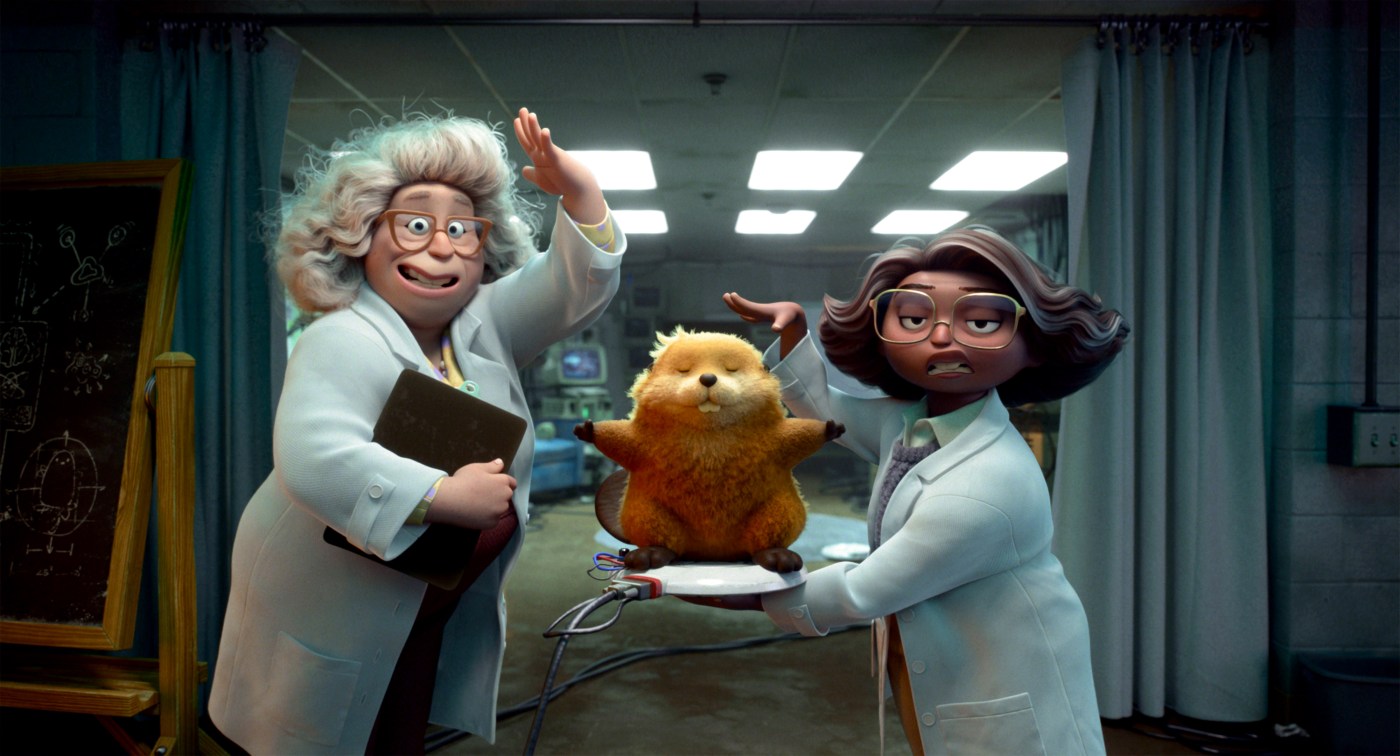
Beavers do not have white teeth.
That the mammals are often portrayed with gleaming white front teeth is one of beaver scientist Emily Fairfax’s pet peeves.
Emily Fairfax, a beaver scientist, ecohydrologist and assistant professor of geography at the University of Minnesota. (Adam Dunne / University of Minnesota)
Beaver incisors are actually orange, said Fairfax, an ecohydrologist and assistant professor of geography at the University of Minnesota. They get their color from an iron-rich protective enamel coating that makes them extra strong, allowing them to gnaw through tree trunks.
Because the orange enamel on the front of their teeth wears away more slowly than the white dentin on the back, a beaver’s two front teeth “are like a self-sharpening chisel that gets sharper and sharper and sharper” the longer they chew, according to Fairfax.
More beaver-teeth trivia: They grow continuously throughout their life, but daily use helps keep them short. “In a beaver’s life, they will go through about six feet of teeth on average,” she said.
In 2020, Fairfax’s research on beaver-created ecosystems caught the attention of producers from Pixar, the animation studio known for “Inside Out,” “Toy Story” and “The Incredibles.” Fairfax, then with California State University Channel Islands, presented a webinar on the subject and later found out that two people from Pixar were on the list of attendees.
A few months later, an email appeared in her inbox.
“It said, ‘Hey, we’re from Pixar. Can you give us a talk?’” said Fairfax, 33, of Minneapolis. “I thought it was spam at first, because why would that happen? But it was real.”
Fairfax ended up talking several times with folks from Pixar, who were fans of a stop-motion animation movie she made in 2019 called “Beavers and Wildfire.”
“They felt like I had enough understanding of art to be able to work really effectively with them,” she said. “If they had a question about beavers, I had the answer.”
That knowledge was crucial to Pixar producers who were working on “Hoppers,” a body-swap story featuring the voices of Jon Hamm, Bobby Moynihan and Piper Curda that opens Friday, March 6.
The story follows a young girl, Mabel, who can transfer her mind into a robot beaver with the goal of going undercover in the animal kingdom. She winds up befriending a beaver, King George, and uniting the animals to fight off the plans of a real estate developer.
Fairfax, who was a paid consultant on the movie, is listed as a “science expert” in the film’s closing credits. Another nod from the filmmakers: The professor in the movie is named Dr. Samantha E. Fairfax.
“If you look up her full name, it is Dr. Samantha Emily Fairfax,” Fairfax said. “That was very nice of them.”
From Carleton to Los Alamos to ‘beaver spiral’
Fairfax grew up in West Lafayette, Ind., East Lansing, Mich., and Mesa, Ariz. She graduated from Carleton College in Northfield in 2014 with degrees in physics and chemistry and got a job at the Los Alamos National Laboratory in New Mexico as a nuclear weapons engineer.
After a year, Fairfax’s self-described “beaver spiral” began, and she decided to pursue a doctorate in geological sciences with a certificate in hydrologic sciences from the University of Colorado in Boulder.
“They aren’t known to be a beaver school, but I didn’t have ecology in my background,” she said. “I wanted to figure out how I could study this phenomenon of beavers making drought-proof patches, and the easy tie-in with physics and chemistry was water, so I looked at programs where I could really focus on water.”
While at the University of Colorado, Fairfax received a National Defense Science and Engineering Graduate fellowship from the Department of Defense for her beaver research.
Related Articles
Glenn Whipp: The case for ‘Sinners’ to win best picture
How Elvis Presley roars back to life in Baz Luhrmann’s ‘EPiC’ concert film
Robert Carradine, ‘Revenge of the Nerds’ and ‘Lizzie McGuire’ star, dies at 71
KARE 11 chief meteorologist Belinda Jensen is retiring in May
Netflix releases a posthumous interview with Eric Dane after his death from ALS
“They are not weaponizing beavers, to be clear,” she said. “I wrote about wanting to study wetlands as places where there’s really interesting dynamics of sediment and water and vegetation all working together. They were like, ‘Great,’ and I was like, ‘Great.’ And then I was like, ‘It’s beavers.’ And they were like, ‘Sure.’ There was no expectation that I’d ever work for the DOD or anything like that.”
Prior to joining the faculty at the University of Minnesota in 2023, Fairfax worked as an assistant professor in California State University Channel Islands’ Department of Environmental Science and Resource Management and as an adjunct assistant professor at Utah State University.
She and her husband, Andrew Peterson, live in Minneapolis’ Linden Hills neighborhood. They have two cats, Cheetoh and Pepper.
Fairfax recently sat down with the Pioneer Press at her office at the U of M’s St. Anthony Falls Laboratory to talk about the world’s second-largest living rodents (the capybara of South America is the largest). The transcript is edited for clarity and conciseness.
Emily Fairfax Q&A
Emily Fairfax, facing camera, guides students on a 2025 class field trip to the University of Minnesota’s Cloquet (Minn.) Forestry Center. (Courtesy of University of Minnesota)
Q: When did your obsession with beavers start?
A: I went to work as an engineer right after college, and I did not particularly find that was a good fit for me. I was feeling a little bit sad about it, and I was watching TV, and a documentary called “Leave It to Beavers” came on. I watched it, and I was just hooked. They were featuring beavers in the deserts, which was something I hadn’t really thought about before. They showed these big aerial views of bright green beaver wetlands, with tons of plants and everything. They were super-healthy, just surrounded by absolutely dry, desiccated land in Nevada and in other places. And they kept saying, “You know, it was the worst drought we’ve had. It lasted years. The only place with water was the beaver ponds. The only place where there were still animals was the beaver wetlands.” I couldn’t stop thinking about it, so I told my boss I wanted to go to grad school and study beavers.
Q: What’s your favorite thing about beavers?
A: How stubborn they are. You can do anything you want to try to make them go away or stop doing what they’re doing, but once they’ve set their mind to building a wetland somewhere, they are going to do anything to do it. You take apart their dam; they’re going to rebuild the dam. You wrap all your trees in fencing; they will go find trees from a mile away and bring them back to that spot. They’re very stubborn and persistent, which is great because they need to be. They have a lot of really important things to offer us, and we’re not always super-receptive to that at first.
Q: I am curious about their decision to pick one spot and never leave. How does that work?
A: They just decide they love a spot. There should be flowing water or relatively deep water, so they like lakes, but they also like streams and rivers. There should be some of their food nearby. They only eat plants like cattails and reeds. They also love tree bark. So they will eat the bark off of willows, cottonwoods, aspen, birch, maple. They hate conifers. So they do not want to chew on pine trees. They do not want to chew on spruce or fir or anything like that. Just the leafy green trees.
Q: No fish?
A: Absolutely no fish. They can’t. They are obligate herbivores.
Q: Where do you do most of your field research?
A: I do a combination of field work and remote sensing for my research. A lot of it is with satellites. I can pull down satellite data and look at any spot in the world right now, and I can look at any spot in the world back in 1990 or in 2000. That is how I find these sites. I look at them before and after big-disturbance events — usually that’s a drought, a flood, a wildfire, something like that. Once I find them with satellite, then I go visit them on the ground. I have sites in Minnesota, Wisconsin, California, Colorado, Wyoming, Oregon and Alaska. Pretty much everywhere there are beavers, we are working.
Q: There aren’t many beaver scientists in the world. Did anyone ever try to dissuade you from focusing on just beavers?
A: There were a lot of people who thought it was a little ridiculous, like, “You should study something else that has to do with rivers or water. You know, where there are going to be jobs. Studying beavers is too niche. Cool documentary, but move on.” I pushed back on that quite a bit because I was seeing my own data. I was seeing how green these beaver wetlands were during the most wicked droughts that we’ve had. I was seeing then how these beaver wetlands were not burning during wildfires, and everything else was burning. And I believe my data, because I’m a scientist, and I’m seeing this happen over and over again. And as the years are passing, climate change is getting worse, and the droughts are getting worse, and the fires are getting worse, and the ability for beaver wetlands to resist that was not changing. It was around 2020 when I first published my research on beavers and wildfires. At that point, the conversation changed entirely. No one was like, “This is ridiculous.”
Q: How does a beaver wetland stay green in the middle of a desert?
A: If you have a beaver dam, it’s going to hold back water and slow it down, but the water is still moving through. It’s not like a still-water system. You have water going over the dam, under it, around it, through it. The beavers also dig canals. All of these little circuitous bits of water are the canals, and those are the beavers’ highway systems. That spreads out the water over the whole valley bottom, versus just in a pond. It increases the beavers’ area of influence from pond size to landscape size. A single beaver family doesn’t build one dam. They usually build between eight and 10 dams, sometimes even more, and that’s when you get a whole watershed just full of them.
Q: How do you know they’re all related?
A: We’re looking for active lodges. Are they actually spending time here? Beavers like to have a territory of about 1 to 2 kilometers of stream length. If other beavers come into their territory, they will fight them. They don’t want to share space.
Q: How many beavers are in a lodge?
A: You would have one family, which is going to be somewhere between four and 10 beavers, usually. We’ve got mom and dad, who will be partnered for life. They can live up to 20 years in the wild, although 10 to 15 years is average. You’ll have some teenage beavers that are between the ages of 1 and 3. Beavers stay home with mom and dad for the first bit of their life, and then you have little babies, and they have babies — called kits — once per year. They usually have between one and six kits, and about half of those make it to adulthood.
Q: Who else lives in the lodge with the beaver?
A: So in the winter, especially here in Minnesota, it’s very cold. Beavers are not super-bothered by the cold, but they also don’t want to feel minus-40, so their lodges have these really, really thick walls that are super-insulating, and then there will be a big snuggle pile of beavers in the middle. Every beaver weighs between 40 and 110 pounds as an adult, so it’s a huge warm snuggle pile.
Q: Wait, 110 pounds?
A: Yeah. They get that big. The record breaker was 110. He came out of Wisconsin, so he’s our neighbor beaver. I just saw a picture of a 105-pounder.
Q: Back to the lodge. Who else lives in there?
A: Everyone wants to be in there. You will have mice, muskrats, snakes, frogs, bugs. But the beavers do not want to snuggle all of these outsiders, so instead of welcoming them into their pile, what they do is they make separate spaces in their lodge, and they just kind of, like, push the muskrats over there, push the mice over there, push the snakes over there. As long as they’re not bothering the beavers, the beavers just leave them be.
Q: But other beavers aren’t allowed in?
A: They don’t let other families come in. You have to be related. They can tell. Mostly, we think by scent. And they don’t like outside beavers. They’re fine with blood relatives. The further away you are, the less likely they are to want to share resources. But ultimately, as long as the work is getting done and there’s enough food, they can be fairly tolerant.
Q: Were you happy about how beavers are portrayed in “Hoppers”?
Dr. Emily Fairfax attends the world premiere of Disney and Pixar’s “Hoppers” at El Capitan Theatre in Los Angeles on Monday, Feb. 23, 2026. (Rodin Eckenroth / Getty Images for Disney)
A: Yes. There’s a lot of implicit messaging around the value that beavers are bringing to this landscape, and that if we co-exist with them, we can benefit from the beavers. It’s not just, “Let’s let the beavers be there because it’s nice to the beavers.” It’s, “Let’s let the beavers be there because it removes pollution from the water. It protects us from floods and droughts and fires. It provides habitat for 80 percent of terrestrial species. Like, they’re really important.” It does a great job. It really hits the right notes.
Q: What I love about Pixar movies is how much you learn. I can just see little kids going home after seeing “Hoppers,” and the next time they see or read about a beaver, they’ll be spouting little facts.
A: I think there’s a lot of things people won’t realize they learned, especially the really niche beaver facts that everyone who studies beavers or works with them is going to be so jazzed to see.
Q: Like what?
A: Beavers don’t use their tails to pack mud; they use their hands. They will dig up mud, and they’ll press it on and do this little paw dance. They have the paw dance in the movie! And beavers can be really strong. They often start their dam with a line of stones. There’s this sequence where you see these, like, ultra-buff beavers lifting up the stones with their hands and moving them. And then my favorite: So beavers, their spine goes all the way to the tip of their tail. When you sit, your tailbone tucks. When beavers sit, they like to sit like people do – on their butts. Their tailbone tucks, so they’ll pull their tail between their legs and sit on it. And that’s real. And they show the beavers, the real beavers doing that. And then very cleverly, they show the person who’s pretending to be a beaver not doing it because she’s a fake, and she has her tail out behind her.
Q: Are beavers smart?
A: Beavers are extremely smart. They build their dam to create habitat, and that’s an example of tool use. They have very strong social relationships with themselves, with their families, with other animals in the ecosystem. They are able to be strategic about how much food they’re using. After wildfires, which I study a lot, we will see beavers start cutting and using burned trees, burned pine trees that they absolutely hate, to build their dam, so that they can prioritize the leafy stuff for their food. Whereas before the fire, they would be using leafy stuff for both.
Q: I’ve heard beavers referred to as “nature’s best architects.”
A: A beaver wetland is the ultimate 15-minute city. They have their lodge, which is their house, and then it’s surrounded by the pond, and that’s sort of like their yard or their property, but then they also have all these other dams that are there to help control the water flow and to make sure everything stays really green and really lush the whole growing season. So they’re managing a much larger space, and to get around that, they dig all these canals. The big ones are like their highways. The little offshoots are like their city streets. It can get them to every dam. It can get them to all their favorite foods. They’re not the only ones that use it. The fish use it. The turtles use it. Everyone’s using the beavers’ water network.
Q: What can we learn from their urban-planning and home-design skills?
A: Plan to have highly connected, easy-to-use paths in your city or your town. Make it easy for everyone to get around. That’s very important. In your own home, I think it’s important to have communal spaces. Beavers will eat and groom together. They will sleep in a big pile together, but they also go off and have their own personal time, similar to people. We will see siblings squabbling. We will see parents taking one kid out at a time and trying to, like, give them a little bit of space, a breather. We see the older teens hang with the little ones, but they don’t always have to be together. There are really good spaces and times for the whole family to be in one spot, and also spaces and times for everyone to get their space.
Q: Are beavers waterproof?
A: Yes. Their fur is so thick and well-groomed that the water droplets don’t get down to their skin. They also have extra eyelids, ear flaps, nose flaps, and a second pair of lips behind their teeth, so that they can completely waterproof everything when they’re underwater. It’s like they’re in a scuba suit.
Q: Back to those teeth. Did they make them orange in the movie?
Related Articles
Large-scale fire and small explosion at UMN steam plant late Friday night
U of M Regents back three-way deal with Fairview, physicians
U, Fairview and M Physicians reach 10-year agreement after mediation
Charges: UMN equine hospital vet tech took morphine from vials, which she then diluted with saline
Evie electric carshare seeks to expand, despite loss of federal grant
A: They went with off-white. There were so many discussions about it. At one of the very first meetings, when I knew it was going to be a movie about beavers, they said, “What are your top beaver myths that we will not propagate?” I talked about how beavers eating fish is a myth. I was like, “If you make them eat fish, I’m out. I’m not supporting that.” We talked about their teeth and how they’re not gleaming white teeth. We talked about how beavers don’t use their tail to pack down mud. It is never used for that purpose, although people always like to show that in drawings and cartoons. Over the course of film development, they were like, “Great news! There is absolutely no fish-eating. We have not even come close. They are herbivores. That’s clear.” And I was like, “Amazing.” “Also great news: Their tails are being used for accurate things. They sit on their tails. They will use their tail to steer when they’re swimming. They’ll slap to make noises for each other, but they’re not going to be using it to pack mud on the dam, but on the teeth, we’re not going to make them orange.” They tried rendering it, and it looked really rough. I mean, the beavers already have orangish fur, right? And then you add in orange teeth, and it’s just not a good look.
Q: Were you OK with that?
A: That was fine. They compromised. They went with an off-white color. It was not bright white. If that makes the beaver more palatable to a general audience, then I think that’s going to do more good than accurately showing those orange teeth.
Leave a Reply