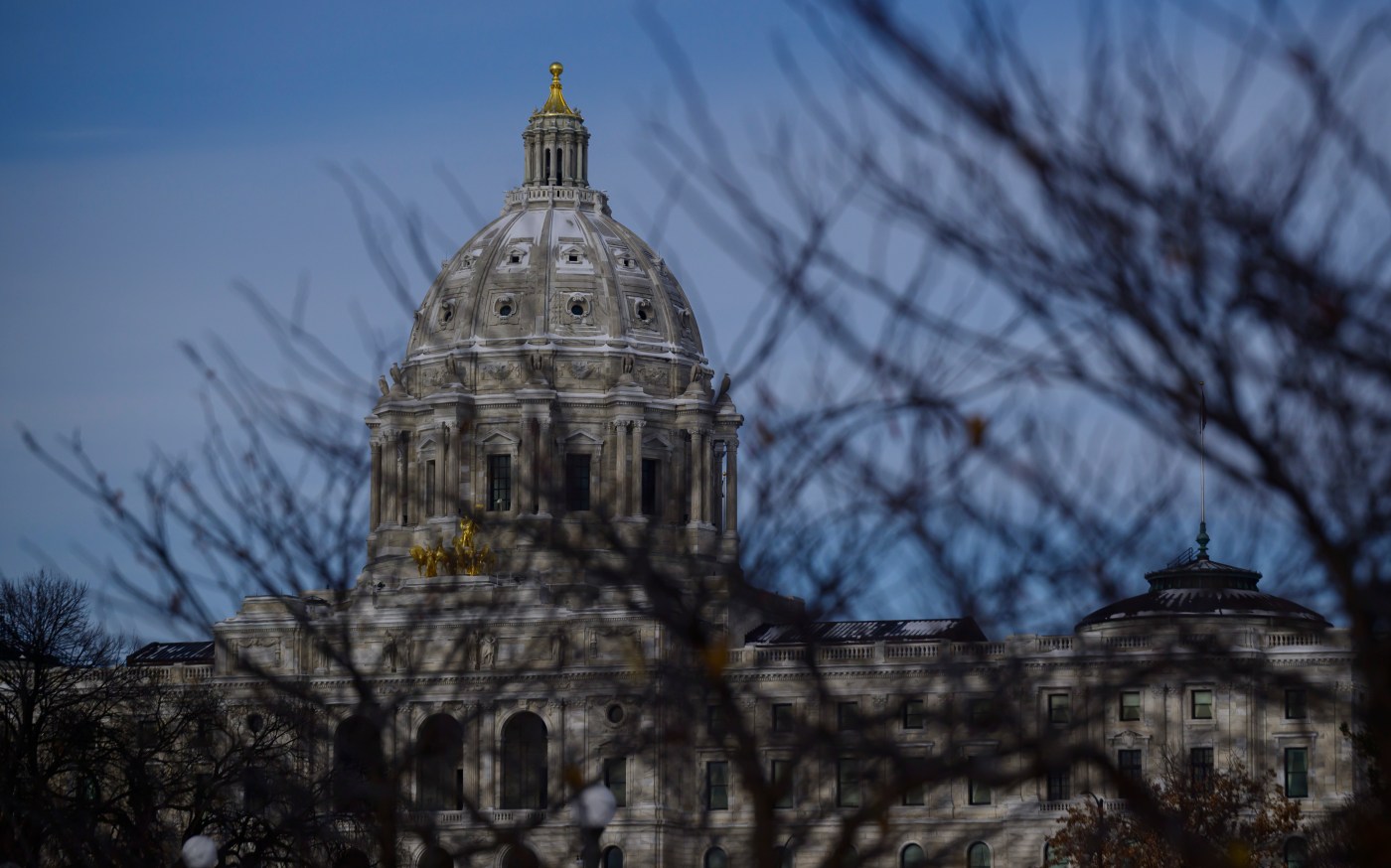
Addressing widespread fraud in state government is a central issue this year at the Minnesota Legislature. But while both parties have said they’re committed to fighting the problem, disagreement over the particulars continues to threaten progress in the state House.
Democratic-Farmer-Labor House members on Wednesday unveiled a package of fraud proposals for the 2026 legislative session that includes measures to boost Medicaid fraud enforcement at the attorney general’s office, modernize state computer systems and increase the number of provider audits and in-person site visits.
DFLers also say they want to reverse a decades-long trend of privatizing government services, which they blame for greater vulnerability to fraud in state programs. House DFL Leader Zack Stephenson said the universal free school meals program created by his party in 2023 has had no fraud scandal because its structure doesn’t allow for it.
“That program does not have fraud, because lunch ladies don’t commit fraud, right?” he told reporters at the Capitol on Wednesday. “When you have that public program with direct accountability, you close the opportunity for fraud that exists, as we are finding when you have a privatization model that allows for other layers to be in there.”
Debate over how to protect programs
Lawmakers continue to debate how to strengthen protections in government programs amid allegations of hundreds of millions of dollars of fraud at the Department of Human Services and Department of Education, and speculation that fraud could reach the billions. Federal prosecutors have charged dozens in schemes exploiting programs like housing support for people with addiction and disabilities, autism support programs and a pandemic-era meal program for children.
One of the major changes DFLers are proposing is a significant boost in staffing at the Medicaid Fraud Control Unit in the Attorney General’s Office. Federal prosecutions by the U.S. Attorney’s Office had been the primary engine for accountability in recent fraud scandals, but many staff there resigned last month — reportedly in protest of the Trump administration’s actions during last month’s immigration crackdown in Minnesota.
Rep. Matt Norris, DFL-Blaine and Sen. Ann Johnson Stewart, DFL-Minnetonka, are backing a bill to add 18 people at the state level to handle Medicaid fraud, boosting staff at the office to 50. It would cost around $1.2 million a year.
The House DFL’s fraud plan has a dozen or so bills and superficially bears similarity to Republican proposals. Though key disagreements have stalled progress in the tied House, where both parties have 67 members.
Republican proposals
Republicans have a slate of proposals aimed at fighting fraud, including creating criminal penalties for state employees who falsify paperwork during audits. However, a bill to create a statewide independent watchdog office — the office of inspector general — continues to fail committee votes as House DFLers continue attempting to modify the bill to remove the office’s enforcement capacity or allow the governor to directly appoint its head.
Republicans have continually rejected those changes, and noted that DFLers in the Senate had backed the inspector general bill last year. In 2025, the original bill, sponsored by Sen. Heather Gustafson, DFL-Vadnais Heights, passed 60-7 in the Senate with overwhelming bipartisan support, but never got a vote in the House.
House DFLers are now saying an enforcement division at the inspector general would be “redundant” since there’s already an anti-fraud enforcement at the state Bureau of Criminal Apprehension.
A version of the bill carried by Norris also allows the governor to directly appoint the inspector general rather than pick one from a field of candidates selected by a bipartisan commission of state lawmakers.
Stephenson said he believes Republicans had placed too much emphasis that the inspector general bill, when addressing fraud, would require action on multiple fronts.
“One of the problems about this debate, particularly this year, though, to be honest with you, has been that it’s too focused on the idea that there’s one bill that’s going to solve this problem,” he said.
In a joint statement Wednesday afternoon, Republican House leadership accused DFLers of continued delaying action on fraud — pointing to the inspector general bill’s repeated failure to pass committee votes.
“The culture of fraud that has taken root in Minnesota didn’t happen overnight, and it didn’t happen by accident,” House Speaker Lisa Demuth and Republican Floor Leader Harry Niska, said. “It happened because of the lack of action from Minnesota Democrats. Period. Now that fraud has become a political liability, Democrats are talking tough and trying to rebrand themselves as reformers, but Minnesotans aren’t buying it.”
‘It’s stalled, but it’s not dead’
Meanwhile, some Republicans remain optimistic that there could be a compromise on fraud legislation.
Sen. Michael Kreun, R-Blaine, who carried the Senate version of the inspector general bill with Gustafson, said last week that “it’s stalled, but it’s not dead.”
As lawmakers continued to negotiate fraud proposals this week, a report released Monday described longstanding vulnerabilities dating back to the 1970s and repeated inaction by state leaders despite nearly a half-century of warnings.
Earlier this week, Gov. Tim Walz’s director of Program Integrity, Tim O’Malley, released what he described as a “roadmap” to address those vulnerabilities, which he said were driven in large part by a culture in state agencies “more based on compassion than compliance.”
Related Articles
DFLers, Annunciation families call for gun control, but prospects still dim
Gov. Tim Walz fraud czar: ‘Inadequate accountability’ fed problem for decades
Fraud, immigration enforcement bills face early snags at MN Capitol
Minnesota Capitol rally calls for state aid following immigration crackdown
Data center foes bring swelling opposition to Minnesota Capitol
Leave a Reply