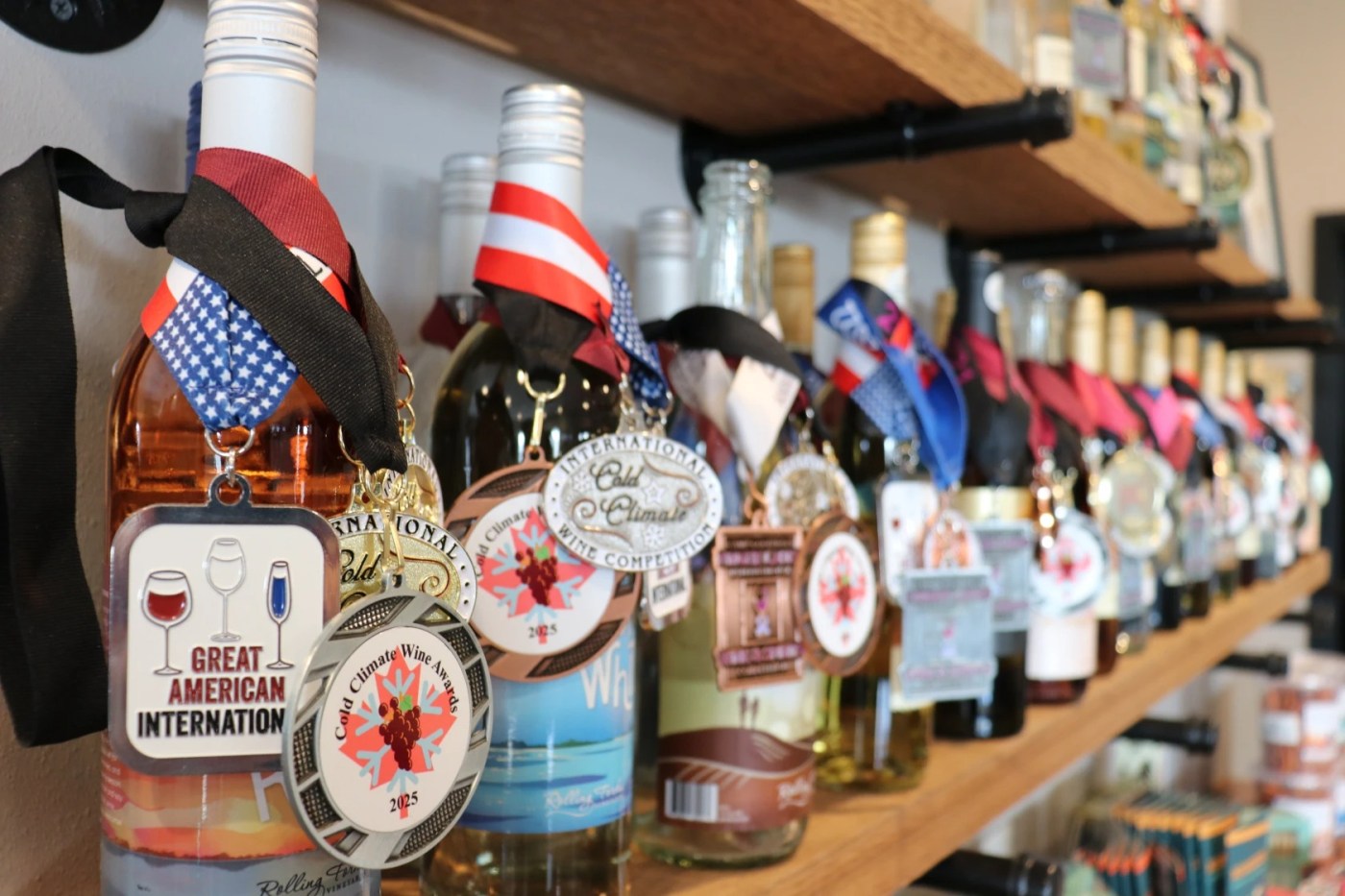
GLENWOOD, Minn. — The vision for Rolling Forks Vineyards was different from where this agribusiness has now landed among a long list of grape growers and wine makers around the world.
And that’s near the top in international competitions that they have entered using the cold-tolerant grapes that they press and process in-house at their vineyard overlooking Lake Minnewaska, in west central Minnesota.
Melanie Cihlar, general manager at Rolling Forks Vineyards, recalls breaking ground on their winery in 2019. They opened for business in July 2020 — during a global pandemic.
“A curse and a blessing that COVID was, it just really made the business look different,” Melanie Cihlar said.
The indoor-focused business owners quickly realized that in order to welcome guests, they needed an outdoor venue. A patio with room for 200, space for outdoor weddings, sledding in the winter, a corn maze and breathtaking views surrounding the winery have helped widen their space for customers at the vineyard. Outside of their winery space, it’s their work in finessing their wines that is helping them reach more stores and serve other vineyards throughout Minnesota and into North Dakota.
Cihlar said they are selling about half of what they anticipated they would be selling five years into business. That’s largely because of changed habits that have fewer people consuming alcohol. But their work to expand their offerings is being helped by their wines earning international recognition at various judged events around the world.
Grape vines at Rolling Forks Vineyards near Glenwood, Minn., in February 2026. (Michael Johnson / Agweek / Forum News Service)
“I feel like we’ve passed year five, so I feel like we’ve made it,” Melanie Cihlar said. “And now it’s just making sure we keep our reputation and we do the things that we say we’re going to do; continue to enter the competitions and keep our quality standard high.”
While they have shelves full of awards, the Wine Enthusiast awards they received last year hold a lot of weight in helping them get noticed. A score of 96 for one of their white wines at a San Francisco, California, competition, where their wine was judged against others from around the world, was particularly impressive. A 96 score is considered a “superb” rating out of 100. Only a “classic” rating of 98 to 100 is higher in this blind taste testing platform.
“If we’re pulling scores like that from our little winery here in Minnesota, that speaks a lot of volumes too for the quality that we’re producing,” Melanie Cihlar said.
They also took home two gold medals and two silver medals at the 30th Catad’Or World Wine Awards in Monticello, Chile, one of the most respected wine competitions in the Southern Hemisphere, according to Melanie Cihlar. At their latest competition, their wines scored near the top alongside the best from 18 countries.
“It’s a reminder that Minnesota’s unique climate and soils can create world-class wines, and we hope this honor encourages more people to share in our passion — whether at local restaurants, shops, or around their own tables,” Melanie Cihlar said.
Barrels of wine are resting in the production area of the Rolling Forks Vineyards on Wednesday, Feb. 11, 2026. (Michael Johnson / Agweek / Forum News Service)
Her husband Joe is the farm manager and started making wine and growing grapes years before they took the plunge into their own winery. They couple planted their first vines in 2011. Joe farms about 700 acres of mostly corn and soybeans, some surrounding the vineyard and others within 4 miles of the vineyard. He also works as a machinist to continue to keep money flowing in, even during slower times in crops and specialty crops.
Joe Cihlar said what the rolling hills surrounding Lake Minnewaska provide is a unique climate with cold air draining to the lake below them. The vineyards benefit from the moderating influence of the lake, which reduces frost pressure and lengthens the growing season — an advantage in northern viticulture. The soils, shaped by glacial activity, consist of sandy loam and glacial till, offering excellent drainage and contributing natural minerality. These factors create wines with vibrant acidity, intense aromatics and exceptional varietal purity, according to the Cihlars. Those features are helping their wine achieve recognition on the global stage.
“We try to manage every vine out of the 18 acres independently,” Joe Cihlar said. “So that’s part of the challenge, which I enjoy the challenge of that.”
While growing grapes in Minnesota has some similarities to growing them in California, there are a great number of differences. The history of grape growing in Minnesota, being not nearly as long as on the West Coast, means those taking on the challenge are learning a lot as they go. Joe said those who are in the state’s industry are very good about helping each other out.
“But there is not a single one person that knows everything,” he said. ”And that’s what I love about our industry in Minnesota. We have a lot of wineries and vineyards that we work with, and we speak literally on a weekly basis about how things are going.”
Even with all that information sharing, it still takes grit and determination to turn a crop and make a great product out of it every year.
Even though Minnesota grapes and the wine they produce have a lot of potential, the wine industry remains young and has been slow to grow here. During a recent visit to the vineyard, the owners were busy putting together the finishing pieces on a grant application with the Minnesota Department of Agriculture that could be used to help promote and build the wine industry in the state. Joe Cihlar recognizes the importance of getting some lobbying work going in order to get specialty crop growers, like grape growers, more state and national attention and representation.
Even if the grant dollars don’t come through, their work continues to help get more Minnesota wines in the hands of Midwest shoppers. He mentioned that this can be hard without recognition and without work to avoid other regions from dumping cheaper wines into the market.
Outside help
The 2024 vintage was special for the group because Joe started the growing season off handling the grape growing and harvest and the couple brought on Patricio Aravena, a wine maker and agriculture engineer with roots in Chile, as well as JoLee Boysen, as their tasting room and wholesale manager. These two are making strides at getting these wines in more glasses.
Aravena has been hard at work to help give that wine some added finesse.
“I’ve been working in the wine industry for more than 20 years,” Aravena said. While there is little to be done in the dormant vineyard until March pruning starts, he spends his time testing and tasting the wine and helping set the business up for success this winter. He expanded their wine-making abilities right off the bat.
The Minnesota grapes and wines are quite different from those in warmer climates to which he was well acquainted.
“This wine needs more care and knowledge,” Aravena said. The higher acid levels take time to understand. He said that where they are at now is just the beginning concerning where this operation is headed.
The operation includes 18 acres of grapes that they have been building since they moved to the farm in 2010. There was plenty of energy around grape growing at that time because the University of Minnesota was coming out with new varieties of cold-tolerant grapes. Joe said they plan to stick close to the current acreage until markets expand for the wine-making. They are also pursuing options to get into the fresh juice and syrup markets.
“That will further diversify what he have going on,” Joe Cihlar said. “We are set up for doing it. We have the equipment in place. So we’re looking forward to that. If that takes off then we’ll be adding a few more acres of grapes.”
They grow seven varieties of grapes. Those include University of Minnesota breeds along with private breeds. The vineyard’s prime time is from about the Fourth of July and up to freeze up. During that time they are hosting hundreds in their large patio overlooking the rolling hills, vines and waters below. They also host events year-round in their boutique-style winery.
The couple said their employee force grows to around 40 during the peak of the season. All those staff have a passion about seeing the business do well.
Related Articles
MN food producers, vendors invited to Monday lunch-and-learn event amid ICE impacts
ICE crackdown is disrupting Minnesota’s agriculture industry, leaders say
A study is retracted, renewing concerns about the weedkiller Roundup
How to store potatoes and other fresh produce
Minnesota’s European trade mission addresses tariffs, relationships
Leave a Reply