When a military coup toppled the democratically elected government of Myanmar in 2021, Burmese dissident S.M. was forced into hiding with his wife and child.
The family spent months cooped up in an apartment in the city of Yangon, afraid to go outside and risk discovery by the authorities.
After finally escaping the country as refugees, they resettled in St. Paul, where S.M. and his wife bought a small business, which they live above. They recently became legal permanent residents in the U.S.
But when SUVs full of federal agents started parking in front of their store during Operation Metro Surge, the family found themselves in an all-too-familiar situation: cooped up in their apartment, afraid to go outside and risk discovery by the authorities.
“I never imagined I would have to go through that again,” said S.M., who agreed to be identified by only his initials. “I felt like those days are over. … We didn’t do anything wrong. We have all the documents.”
S.M. and his family were able to remain safely indoors for nearly a month with help from a small army of strangers.
When the carloads of masked men showed up outside, these strangers chased them away with whistles. They dropped off groceries and other necessities. They even made deliveries for the family’s business.
“Me and my wife, we talk about how we really chose the right place to settle,” S.M. said of St. Paul. “We’re speechless.”
The strangers who came to the aid of S.M. and his family are part of a sprawling, decentralized network comprising thousands of Minnesotans who organized with their neighbors to oppose what U.S. Department of Homeland Security officials called the largest immigration crackdown in its history.
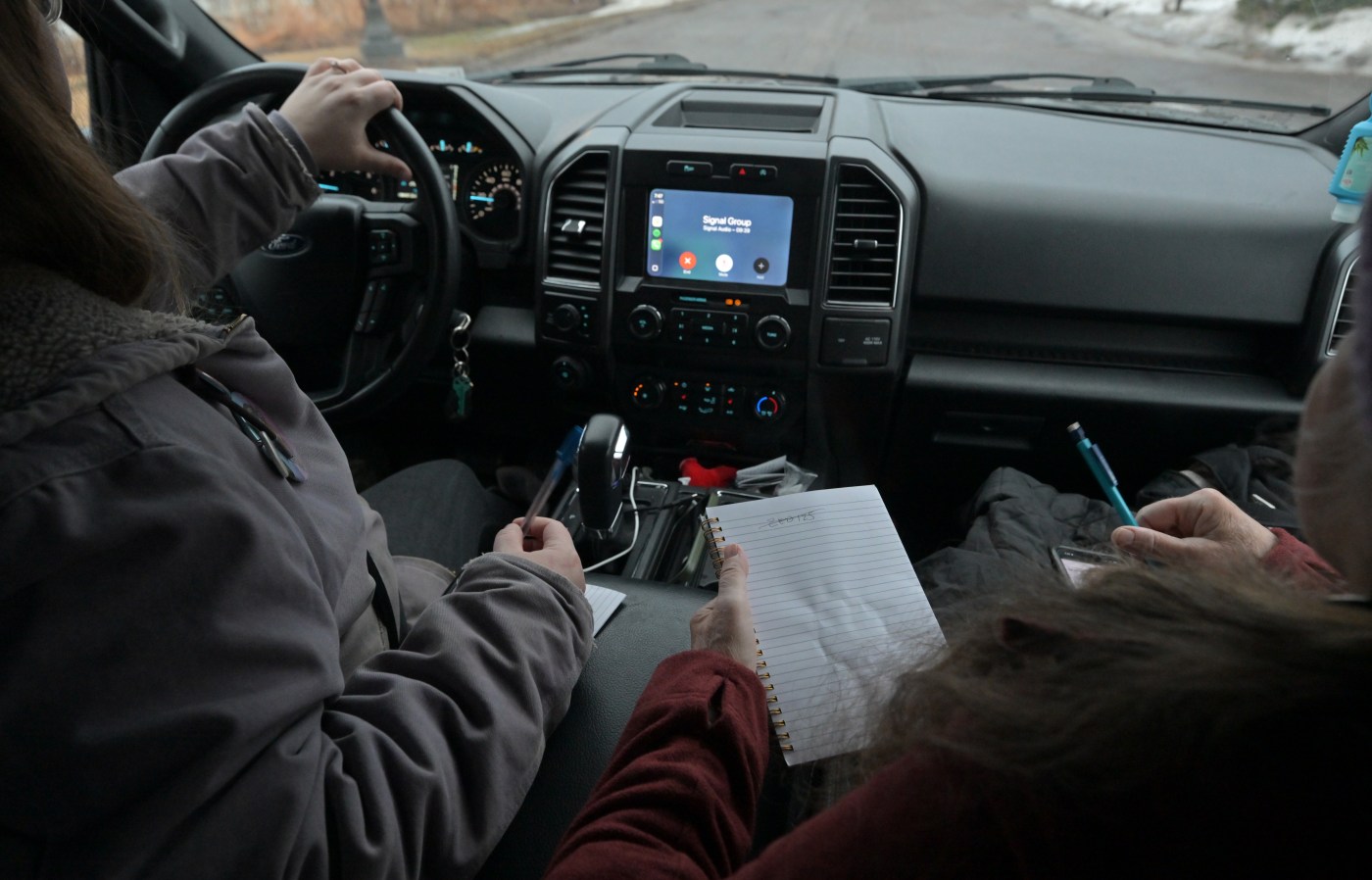
Communicating via encrypted messaging apps, they patrol their communities looking for Immigration and Customs Enforcement agents, make deliveries to families in hiding, and serve as lookouts at schools, churches and other institutions.
“I feel incredibly proud of the way St. Paulites have shown up for each other,” said HwaJeong Kim, who represents Ward 5 on the St. Paul City Council. “I think we should all feel really good about the way Minnesotans across the board cared for our neighbors who are under attack by the Trump administration.”
Caroline, an IT professional who volunteers as an ICE lookout at a school in her North End neighborhood and asked to be identified only by her first name, said the carloads of heavily armed federal agents in masks and tactical gear mimicked an occupying military force.
“Nothing makes people band together like a foreign invader, and that’s what it felt like,” Caroline said. “It felt like a foreign invasion.”
DHS officials did not respond to multiple requests for comment.
Federal law enforcement agents confront demonstrators outside an immigration processing center in Broadview, Illinois, on Sept. 26, 2025. The demonstrators, who were protesting a recent surge in ICE activity in the Chicago area, were pushed back from the facility with a barrage of less-lethal munitions, including stinger ball grenades, pepper balls, tear gas and baton rounds. (Photo by Scott Olson/Getty Images)

‘This could happen anywhere’
The Twin Cities were not the first target of the Trump administration’s unprecedented immigration enforcement campaign.
Many Minnesotans watched with worry as federal agents and National Guard troops hit the streets of Los Angeles last summer and Chicago in the fall.
Among them was Jose Alvillar Hinojosa, lead immigration organizer for the Minneapolis-based nonprofit Unidos MN, which has trained more than 40,000 Minnesotans to serve as legal observers of ICE activity since last February through its Monarca program.
“As we were seeing all of that unfold, we tried to reflect in our trainings what was happening in the country,” Alvillar Hinojosa said. “We said it was inevitable that this would come to Minnesota.”
Unidos and the handful of other local groups training observers last year adopted tactics that proved effective elsewhere, including the use of whistles to alert neighborhood residents to the presence of ICE agents.
“We train them to not interfere, to not escalate things,” Alvillar Hinojosa said of the observers, adding that nonviolence is at the core of the Monarca curriculum.
While the primary purpose of legal observers is to document ICE activity and record arrests, their presence sometimes drives agents away from a scene, which is “to some degree part of the intention,” Alvillar Hinojosa said.
“ICE likes to operate in the shadows,” he said. “They like to come in, kidnap someone and leave without anyone seeing what happened.”
After attending a legal observer seminar herself in August, Kim teamed up with Democratic-Farmer-Labor state Rep. Athena Hollins to organize a training by the Immigrant Defense Network in the North End that fall.
“We recognized this could happen anywhere and we needed to be prepared,” Kim said. “It was packed — every seat filled.”
In one of those seats was N., a union organizer and North End resident, who — like several others interviewed for this article — asked to be identified only by her first initial.
A roofing crew in her neighborhood had recently been arrested at a job site by immigration agents, and N. wanted to get involved, she said.
“I came away with a better understanding of what was happening to people,” N. recalled of the training. “It was something I was pretty much not informed about at all. … It was a place of privilege.”
Like many other newly minted observers, N. signed up to receive text message alerts from Monarca about ICE activity in the Twin Cities. She didn’t have to wait long.
St. Paul City Council member HwaJeong Kim tries to calm a crowd that had gathered during a federal immigration raid at a house in the 600 block of Rose Avenue in St. Paul on Nov. 25, 2025. (John Autey / Pioneer Press)

‘No core leadership’
A pair of high-profile immigration raids in November drew dozens of observers and protesters in St. Paul — the first at the Bro-Tex plant in St. Anthony Park, and the second at a house on Rose Avenue in the Payne-Phalen neighborhood.
“Those two instances made people more aware” of ICE’s presence in the city, Kim said. “Earlier on, you could go about your day as if you didn’t notice. There was an awareness gap.”
The next month, observers and activists gathered at Highland Park Community Center, where they used the encrypted messaging app Signal to create chat groups for each St. Paul neighborhood to coordinate activities block by block.
They also set up a citywide “rapid response” chat, where volunteer “dispatchers” direct mobile observers — called “commuters” — to areas where ICE has been spotted or is likely to be.
“The entire system truly is decentralized,” said Ben Damberg, a St. Paulite who works in manufacturing and has been involved with the rapid response Signal chat since its inception. “There really is no core leadership.”
A similar system was already in place in Minneapolis, with roots stretching back to mutual aid networks that sprung up during the aftermath of George Floyd’s murder in 2020, Damberg said.
As Operation Metro Surge flooded Minnesota with ICE and U.S. Border Patrol personnel, volunteers created a searchable statewide license plate database to help commuters keep tabs on vehicles used by federal agents.
The increased attention caused ICE to modify its tactics, N. said. Instead of the hours-long operations seen at Bro-Tex and Rose Avenue, convoys of agents would swoop in, make an arrest and often be gone in minutes.
T., a St. Paul union organizer who attended a Monarca training after the Bro-Tex raid, said observing ICE activity often comes with an uneasy feeling.
“It still hits me every single time when I see agents,” he said. “Even though that’s what you’re looking for, it’s jarring. You turn a street corner and there are four masked men in military gear with guns.”
Dispatchers like B., who splits her time volunteering in several rapid response chats, also feel the weight of the work they’re doing, she said.
“The first time someone was abducted on my watch, I was devastated,” B. said. “I had just had an observer in the area five minutes ago. There was a lot of guilt.”
A man prays before the memorial for Renee Nicole Good on Portland Ave. near 34th St. in Minneapolis on Thursday, Jan. 8 2026. Renee Nicole Good, a 37 year-old mother, was killed by ICE agents in a confrontation on Wednesday. (John Autey / Pioneer Press)

Turning point
Everything changed when Renee Macklin Good was shot to death by an ICE agent in Minneapolis on Jan. 7.
Outraged Twin Cities residents flocked to legal observer trainings hosted by organizations like Monarca and the IDN.
The St. Paul rapid response Signal thread quickly hit the app’s 1,000-person cap for a single chat. The influx of new observers allowed organizers to spin up neighborhood-specific rapid response groups and reduce response times.
While most ICE arrests now last only 7 minutes, Alvillar Hinojosa said, the response time for citywide alerts is often closer to 10.
“What we’ve noticed is that in the hyperlocal groups, the average response time is 3 minutes,” he said. “These are people already in the neighborhood. They respond fairly quickly.”
Baskets of whistles began popping up at checkout counters of local restaurants and coffee shops, next to wallet-sized “know your rights” cards in English, Spanish, Hmong and Somali.
As arrests continued to ramp up — often seemingly prompted by little more than a person’s accent or skin color — fear grew among Twin Cities immigrant communities.
A volunteer with the St. Paul Parents Solidarity Network adds packs of tortilla shells to grocery bags, for families of students who don’t leave their homes in fear of being detained by federal immigration authorities, at an undisclosed location Friday, Feb. 6, 2026. (John Autey / Pioneer Press)

Educators at St. Paul Public Schools noticed that students from immigrant families had not returned from winter break, said Montana Borth, an SPPS social worker. Twenty-five percent of pupils elected to attend classes remotely when the district began offering online learning for students sheltering at home.
People of color employed at local businesses — especially restaurants — stopped coming to work for fear of arrest during their commute, forcing many to reduce their hours or close their doors altogether.
With thousands of families afraid to leave their homes and with no source of income, mutual aid networks, large and small, ramped up to offer everything from food delivery to rent assistance to laundry service.
Borth and her co-workers quickly identified 11 families at their school alone who were in need of groceries the first week in January. They ran to Trader Joe’s that Friday afternoon for some staple items — chicken, milk, eggs — and dropped them off at the students’ homes.
Their list of families is now up to 30, and they employ a team of community volunteers who buy and bag culturally appropriate groceries for delivery by parents from the district.
“We have more people willing to help than we have a need for,” Borth said. “It’s wonderful.”
Stephanie Anderson, the mother of two SPPS students, helped set up a food pantry at her son’s school, where kids can fill their backpacks with groceries on their way home.
Grocery bags are ready to be filled volunteers with the St. Paul Parents Solidarity Network pack food, for families of students who don’t leave their homes in fear of being detained by federal immigration authorities, at an undisclosed location Friday, Feb. 6, 2026. (John Autey / Pioneer Press)

She also manages a nonprofit — created with help from a lawyer friend who serves with her on the PTA — to raise money for rent and mortgage assistance distributed to SPPS families district-wide. So far, more than $280,000 has been donated.
“I feel like it’s my duty as a member of the St. Paul community,” Anderson said, adding that she has dealt with pangs of guilt over the time she has spent away from her own children.
“They’re struggling, but they’re trying to understand,” she said, her voice breaking. “And they’re trying to be flexible with their mom, and I really appreciate that.”
A person is detained by federal immigration agents near the site where federal agents shot and killed a 37-year-old Minneapolis resident, Alex Pretti, at Nicollet Ave. and 26th St. in Minneapolis on Saturday, Jan. 24, 2026. (John Autey / Pioneer Press)

‘Gone too far’
With Metro Surge dominating headlines nationwide and around the world, photos and video captured by observers were shaping public opinion of the operation.
In addition to footage of Macklin Good’s killing, images of Hmong elder ChongLy Scott Thao being pulled from his house in his underwear on St. Paul’s East Side and detained 5-year-old Liam Conejo Ramos facing an ICE vehicle were inescapable.
On Jan. 24 — the day after anti-ICE protests drew tens of thousands of Minnesotans to downtown Minneapolis in sub-zero temperatures — intensive care nurse Alex Pretti was shot and killed by Border Patrol agents on Nicollet Avenue.
Again, legal observers and ordinary citizens captured his violent death from several angles.
A Marist poll conducted in the days following Pretti’s killing found that two-thirds of Americans believed the Trump administration’s immigration enforcement actions had “gone too far.”
In late January, Border Patrol Commander-at-Large Gregory Bovino was replaced at the head of Operation Metro Surge by White House border czar Tom Homan. Two weeks later, Homan announced the federal law enforcement presence in Minnesota would be scaled back.
Tom Homan, the White House border czar, speaks at the Whipple Federal Building at Fort Snelling on on Feb. 4, 2026. The Trump administration’s pullback of federal immigration agents from Minneapolis was a political retreat that showed there are limits to what Americans will accept as the president pursues his deportation agenda. (Jamie Kelter Davis/The New York Times)

Beyond ‘Metro Surge’
Despite the apparent end of Metro Surge, many activists in St. Paul and across the Twin Cities are not ready to declare victory.
Caroline said she won’t consider the crackdown over until deportation flights out of Minneapolis-St. Paul International Airport are halted and families feel safe sending their kids to school again.
“They say they drew down,” she said. “Did they really? How many cars are still coming out of (the Bishop Henry Whipple Federal Building) every day? How many people are still disappearing?”
And even if ICE leaves Minnesota, Kim said, the underlying policies that brought them here remain in place.
“We still have a broken immigration system that we’re enforcing with violence,” she said. “We need to have policies that dignify and humanize folks who come here for refuge, asylum and opportunity.”
Caroline agreed, saying, “there’s an enormous part of the population that thinks legal immigration is still just signing your name at Ellis Island.”
“It takes thousands of dollars, and years and years, to do it the ‘right way,’ ” she said. “And even the people doing it the right way are being swept up” by ICE.
“I’m not necessarily an open borders person,” she added. “But the whole process should never take more than two years, maximum.”
Several St. Paul activists expressed cautious optimism that the relationships forged over the past few months will serve as the foundation for a more interconnected city.
Related Articles
Communities fight ICE detention centers, but have few tools to stop them
Made in St. Paul: Community-made solidarity posters, at Morgan Hiscocks’ Lunalux letterpress studio
Texas man was fatally shot by a federal immigration agent last year during a stop, new records show
Cherished teacher mourned following deadly crash with driver who was being pursued by ICE
Fraud, immigration enforcement bills face early snags at MN Capitol
“There’s so much more weight now to what being a neighbor really means,” said Bobby, a St. Paul nonprofit worker and rapid response volunteer.
He drew a comparison between the current moment and the aftermath of Floyd’s murder in 2020.
“I think a lot of people felt like they could return to some kind of a normal life after that,” Bobby said. “I think there’s a kind of wrongness about that, which people are wrestling with now. How can we return to normalcy after this?”
Leave a Reply