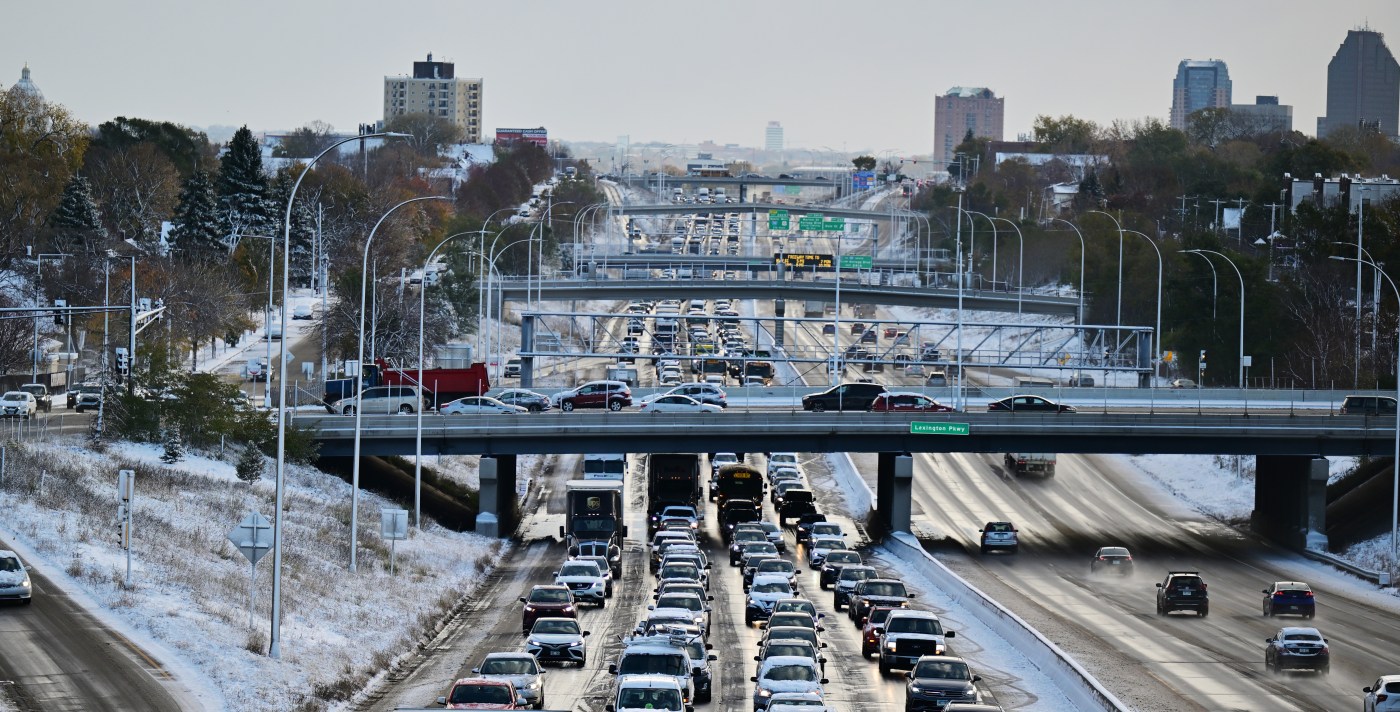
For the past 10 years, the Minnesota Department of Transportation has been weighing how best to reconfigure a 7.5-mile segment of Interstate 94 stretching from Minnesota 55/Hiawatha Avenue in Minneapolis to Marion Street in St. Paul. Three options are now on the table and ready for public comment through early March, with in-person discussions with the public scheduled for Thursday evening in St. Paul.
Transit and pedestrian advocates have called for filling in the deep trench of the highway in St. Paul, bringing it to grade level and creating a neighborhood-friendly boulevard that slows traffic speeds and potentially reduces vehicle emissions. Pointing to costs, congestion and traffic spillover into surrounding neighborhoods, MnDOT has chosen not to include the boulevard concept in a short list of potential projects, while offering simpler alternatives that could include removing travel lanes, adding managed lanes or consistent bus shoulders and improving frontage roads.
The goal is for MnDOT to make a final decision on interstate improvements by late 2028, while seeking environmental approvals around the same time.
Estimated construction costs have ranged from about $500 million to retain the status quo, on the one end, up to $3.2 billion to fill in the interstate and create a boulevard. A reduced freeway, reconfigured freeway or expanded freeway with new lane configurations and transit options could cost $1.5 billion to $2.6 billion for construction, on top of $62 million to $139 million for maintenance.
Related Articles
St. Paul City Council rejects grant extension for Lockheed Martin subsidiary
St. Paul man charged in hit-and-run death of man on mobility scooter
Local journalist and activist plead not guilty in St. Paul church protest
Woman critically injured in St. Paul hit-and-run, 2nd in the city in a week
Pickles, Como Zoo’s only remaining ostrich, dead at 14
Three options
After weighing 22 criteria ranging from impacts upon water pollution, noise and air quality to opportunities for economic growth, MnDOT has whittled 10 potential project approaches down to three options. A fourth option, “No Build,” is included in discussions to provide a baseline for comparing each project to the costs and drawbacks associated with doing nothing.
Option 1: “Maintenance B”
The first option is to maintain I-94 and its four travel lanes in each direction generally as they are, while reconstructing pavement and bridges and providing some relatively limited opportunities for bicycle and pedestrian improvements. Bus shoulders would be upgraded for consistency between downtown St. Paul and downtown Minneapolis, which could improve transit travel times. On the other hand, “wider shoulders may offer limited safety improvements but would not fix many of the other safety issues on I-94,” reads the MnDOT website.
Option 2: “Reduced Freeway-A”
With an eye toward reducing vehicular crashes and the seriousness of those crashes, the second option would be to remove travel lanes, add managed lanes and make other key changes designed “to improve the safety and comfort of people walking, bicycling or rolling.” That includes offering higher-speed bus rapid transit access and improved transit access for residents living near the highway at up to three new BRT stations whose locations have yet to be decided. Some frontage roads could be heavily improved.
The existing freeway would be rebuilt to host three lanes in both directions instead of four. During rush hours, two lanes in each direction would be dedicated to general travel, and a managed lane in each direction would be open to buses, carpoolers and those willing to pay with an E-Z Pass. At other times of day, everyone would be able to use all three lanes, including bus rapid transit services.
MnDOT has expressed concern that removing travel lanes will lead to more traffic congestion, especially during morning and evening rush hours, and possible traffic spillover into neighborhoods surrounding the interstate. On the other hand, a reduced freeway would make it easier to install locally-planned pedestrian and bicycle improvements across I-94, as well as new green space and other community-oriented improvements.
Option 3: “Reconfigured Freeway-A”
A third option would reconfigure the freeway, keeping the four existing travel lanes along I-94 today but converting one lane in each direction into a managed lane during morning and evening rush hours. The goal is to minimize traffic spillover onto surrounding streets while providing more reliable travel times for people in cars and freight trucks and decreasing travel times for buses. As in Option 2, planners would study up to three bus rapid transit locations.
Public comment closes March 9
The discussion resumes Thursday evening with an in-person meeting from 5:30 to 8:30 p.m. at the Wilder Foundation’s Amherst H. Wilder Auditorium, 451 Lexington Parkway N. in St. Paul. MnDOT will showcase project boards, make project representatives available for questions and offer the opportunity for visitors to submit official comment on the scoping document and draft scoping decision, as well as its state Environmental Assessment Worksheet, which were released in early January.
The public comment period on both documents closes March 9. Visitors on Thursday can fill out index cards or share their thoughts with a court reporter. Translated materials and interpretation services will be provided in Spanish, Hmong, Somali, Karen, Oromo, Amharic and American Sign Language.
MnDOT has acknowledged that the state’s approach toward highway construction 60 years ago was little short of devastating for the neighborhoods that I-94 bisected and displaced, including but not limited to the historically-Black Rondo neighborhood in St. Paul. In addition to safety improvements and necessary repairs to bridges, walls and pavement, state transportation officials see an opportunity to enhance broader community goals, such as reconnecting neighborhoods using MnDOT’s “livability framework,” which was developed following public workshops in 2021.
The framework calls for identifying key opportunities to establish a “sense of place,” as well as “community connections, economic opportunities, equity, safety and a healthy environment for the communities that live, work, and play there.”
Jointly conducted by MnDOT and the Federal Highway Administration, the Rethinking I-94 project is the first comprehensive review of this segment of the interstate since its construction in the 1960s.
More information is online at tinyurl.com/Rethinking9426.
Related Articles
In a West St. Paul front yard, an oversized whistle sculpture calls for ‘ICE out’
Pickles, Como Zoo’s only remaining ostrich, dead at 14
Waiting for a mentor: Abby
Waiting for a mentor: Penny
Trump’s border czar says ‘small’ security force will remain in Minnesota after enforcement drawdown
Leave a Reply