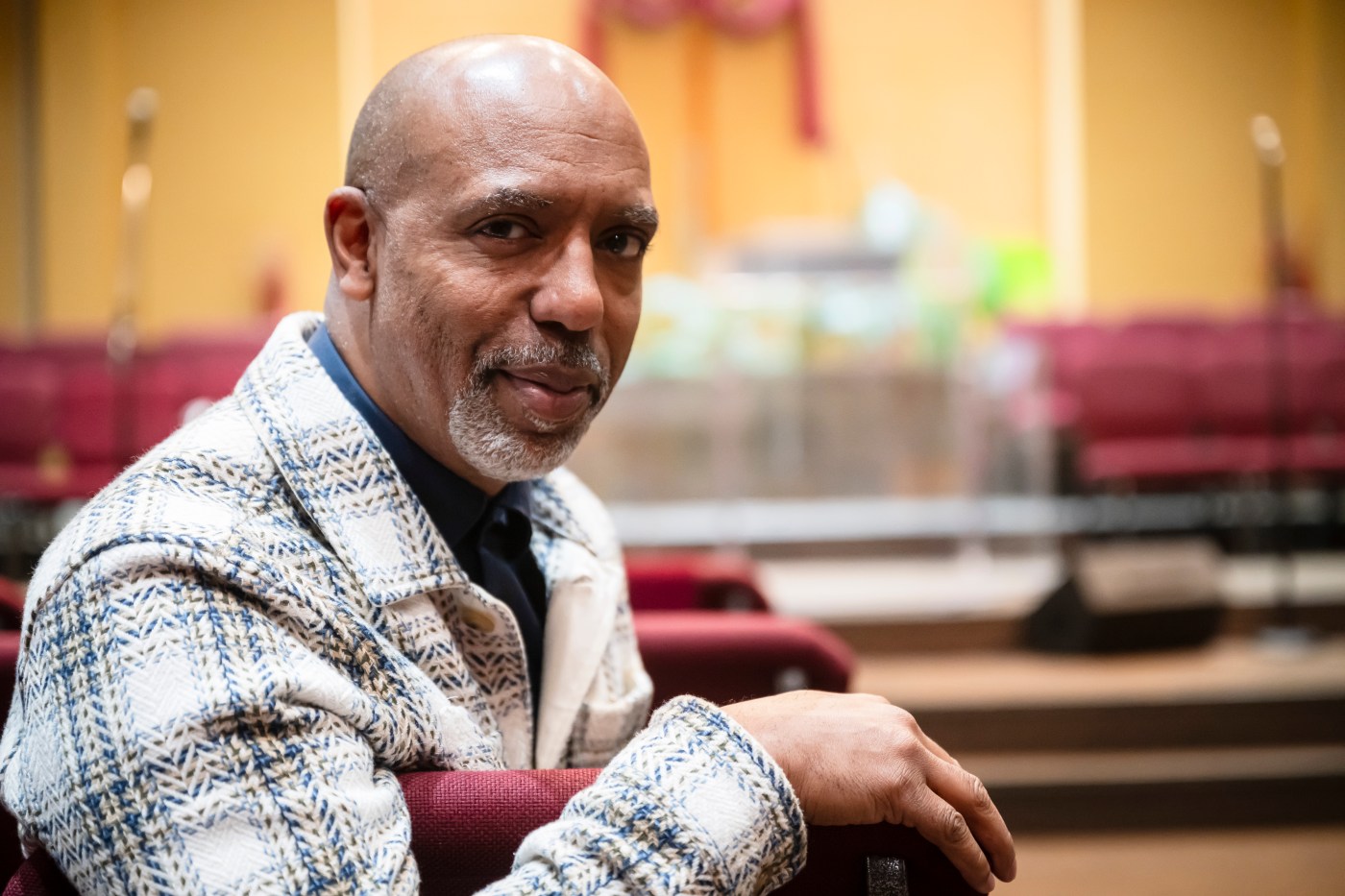
Born in 1950, Readus Fletcher experienced his share of racial discrimination as a young man, but he also saw the dismantling of Jim Crow laws that kept Black families from white schools, southern lunch counters, voting booths and the front of the bus.
He witnessed the Civil Rights era up close, and was proud to see his own father, a World War II veteran, recognized as the first Black man licensed to drive a streetcar through the streets of Minnesota’s capital city following desegregation of certain federal jobs by U.S. President Harry Truman. Riding with his dad at the helm remains one of his most treasured memories.
Wherever there was race-based segregation and cruelty, there also was a commitment to progress, from civil rights advocates on the ground to champions for equality in the halls of state, local and federal government.
Today, at the age of 76, for the first time, Fletcher isn’t feeling so optimistic. He said he never expected a societal step backward into the use of excessive force and intimidation against peaceful protesters, warrantless-detentions and state-driven character assassinations that have characterized Operation Metro Surge, the federal immigration action under President Donald Trump.
“I was really taken aback by where we’re at today, where you have this violent suppression of expressions of concern for people who need it,” said Fletcher, a retired City Hall employee and one of the subjects of a recent documentary about elders of St. Paul’s historically-Black Rondo community. “It’s against average Americans. That’s significantly different than the Civil Rights campaigns or the women’s rights campaigns.”
‘I feels like we’re back in 1950’
The same sentiment is shared by a number of Black leaders in the Twin Cities. On the one hand, descendants of chattel slavery are natural born citizens, which would make the mission of U.S. Immigration and Customs Enforcement during Operation Metro Surge seemingly irrelevant to their day-to-day well-being. But many of St. Paul’s Black leaders see things differently.
Advocates who remember similar tactics used against them and their peers during the Civil Rights movement of the 1950s and ’60s say they’re witnessing a resurgence of state-sanctioned racial hostility that has never really gone away but now plays out large, even more widespread, in front of cameras, backed by near-military force. For families who have lost loved ones following past police encounters or dispute the official record of events in crime reports, there’s deja vu writ large in the Department of Homeland Security’s decision to paint witnesses and victims of heavy-handed ICE actions as perpetrators.
“We’re missing whole human beings out of our lives, and it’s not a joke, and it’s not a game,” said Toshira Garraway Allen, founder of Families Supporting Families, during a January press conference following the killing of Renee Good by a federal agent in Minneapolis. “It’s not a game to watch people lie and twist up a story on your loved one. It’s not a game for people to call your loved one a terrorist after they get their life stolen.”
For some Black-led organizations, the current atmosphere in the Twin Cities harkens back to their origin stories.
“It feels like we’re back in 1950,” said Benny Roberts, executive director of the Hallie Q. Brown Community Center in St. Paul, which opened to serve Black residents in 1929. “It feels like we’re back in 1920. It feels like we’re back in the 1800s. … This is where we were founded.”
“Unless you’re Black or indigenous, you are an immigrant in America,” Roberts added. “Nobody is safe in these conditions.”
Black Ministerial Alliance speaks
On Feb. 2, more than 20 members of the African American Leadership Council and the St. Paul Black Interdenominational Ministerial Alliance, a coalition of more than 10 churches, stood side by side in a room at the Hallie Q. Brown Center to pray together and deliver remarks condemning the weekslong mobilization of federal agents throughout the state.
In no uncertain terms, they called for ICE to back out of Minnesota.
The Rev. Melvin Miller. (John Autey / Pioneer Press)
Melvin Miller, president of the Black Interdenominational Ministerial Alliance and senior pastor of the Progressive Baptist Church on St. Paul’s East Side, called out “the blatant violation of our Constitutional right to peacefully protest” and “the intimidation of civilians with firearms, and the tragic deaths and senseless deaths of Renee Good and Alex Pretti. … We condemn the racial profiling of Black and brown communities that’s going on, and the unjust detention of individuals … without a cause.”
Miller further condemned the targeting of sensitive locations like schools, hospitals and courthouses.
“We’re appalled at the malicious mischaracterization of immigrants as the worst of the worst, disregarding the fact that the majority — the vast majority — are law-abiding citizens and contributing residents of our community,” he said.
In an interview later, he said Black leaders are not calling for open borders or turning a blind eye to the complexities of immigration enforcement. President Barack Obama, he noted, deported a record number of immigrants across his two terms in office, but not with militarized force.
“It’s the methodology,” Miller said. “We want people to be treated as human beings.”
‘A sense of lawlessness’
Miller’s own parents moved from Jackson, Miss. north to Richmond, Va. in the late 1960s, part of the “Great Migration” of Black southerners seeking greater opportunity and freedom from Jim Crow restrictions. On paper, the 13th, 14th and 15th amendments had ended slavery, guaranteed the rights of citizenship and due process, and protected voting rights for Black Americans, but the reality on the ground in the deep south was far different, with segregation and disenfranchisement backed by lynchings, voter intimidation and selective, race-based legal enforcement.
“This has an eerie resemblance to what they came out of — a sense of lawlessness, where the laws are on the books but they’re not honored, where the administration can do what it wants,” Miller said. “It all begins with a mischaracterization of our neighbor as the ‘worst of the worst.’ That’s how it was for us — ‘Blacks are inferior, they’re lazy’ — that led to the imprisonment of our people.”
In St. Paul, groups of Black Americans, African immigrants, Latinos and Southeast Asians have sometimes butted heads in school yards or political races, and at other times found common ground to advocate together for rights and opportunities. Proximity — sharing public housing, a street, a school, a workplace — can lead to tensions and alliances, Miller acknowledged.
On the East Side, he’s seen schools where attendance has dropped by 20% or more during Operation Metro Surge, with families too scared to leave their homes to buy groceries, which has an economic impact that transcends race. More members of his congregation have stepped up to help with food shelf collection or volunteered to tutor students than have grumbled about not wanting to support immigrants.
“We have a little bit of that — ‘this is not our fight’ — but for the most part, there’s a deep sense of solidarity,” Miller said. “If they’re willing to shoot white people, what do you think they’ll do with Black people?”
Great Replacement Theory
In the minds of many Black leaders, demographic changes loom large as a backdrop to the current political climate.
Fletcher, in an interview, said many of the same sentiments used against immigrants in the current climate have been used against Black Americans over the years. In some white circles, there’s a palpable fear of the “browning of the voter pool” and demographic shifts — namely, fewer white births — that are leading to proportionally fewer white Americans against an uptick in Black and brown residents.
“That is critical for some,” Fletcher said. “The voting pool’s demographics are going to change, and many believe that will change the status quo in the near future. The voting majority may become brown, and how could the current majority deal with that? One way is to limit the brown children and future generations of voters. Deportation is a tool.”
Some racial antagonists have gone so far as to argue that the replacement of white voters by Black and brown voters — or by Muslims and Jews — is being orchestrated by a secret elite. Once a conspiracy theory, the “Great Replacement Theory” gained steam following the 2011 writings of French author Renaud Camus, who objected to an influx of Muslim immigrants in France.
Along a similar vein, the chant “Jews will not replace us” became a rallying cry during the 2017 “Unite the Right” white supremacist rally in Charlottesville, Va.
In the U.S., the theory has taken on partisan overtones, with fears that growing numbers of Black and brown residents — including legal and illegal immigrants — will bolster the ranks of Democrats over Republicans, even though Trump actually enjoyed an uptick in support in the 2024 election from communities of color.
Whatever party they actually align with, “immigrants, and the children of immigrants, who are citizens or will become citizens will become tomorrow’s eligible voters,” Fletcher said.
Related Articles
Gov. Tim Walz provides $1.2M to help with St. Paul’s cyber attack recovery
St. Paul City Council: Hotels should tell ICE they’re not welcome
Girl Scouts moving cookie sales online in response to ICE actions
Man pursued by federal officers crashes in St. Paul, sustains non-life threatening injuries
Don Lemon hires federal prosecutor who quit over immigration crackdown
For any party, that could, in theory, be less cause for alarm than for courtship and cooperation of growing members of the electorate. But fear, he noted, too often wins out. For Fletcher, a guiding principle rooted in both Black history and his religious faith remains his ethical North Star. “At the end of the day,” he said, “we are our brother’s keeper.”
Talia McWright contributed to this report.
Leave a Reply