By itself, the NCAA eligibility of Canadian major junior hockey players would have caused a seismic change in the world of American college hockey. Same goes for the advent of the transfer portal and the growth of Name, Image and Likeness payments to college athletes.
To have all three of those changes hit within the past four years or so has shaken the game to its core, and the results are being seen on campus rinks from Fairbanks, Alaska, to Fairfield, Connecticut.
St. Louis Blues’ Jimmy Snuggerud (21) clebrates after scoring againt the Dallas Stars in the third period of an NHL hockey game Wednesday, Feb. 4, 2026, in Dallas. (AP Photo/Tony Gutierrez)
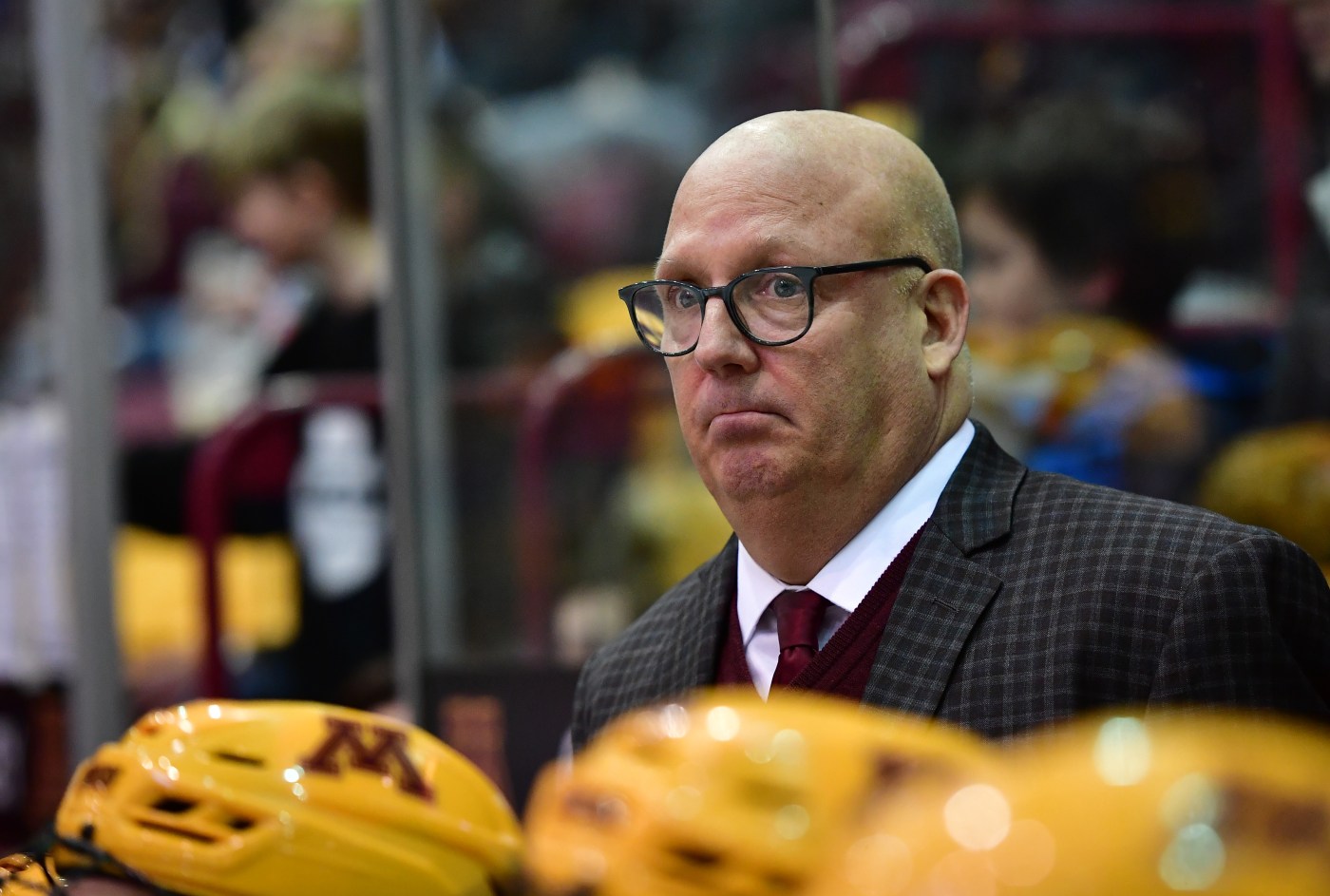
In the Twin Cities, while the relative newbies at St. Thomas make a serious push for the program’s first NCAA tournament invite, a few miles away on the U of M campus, this will almost certainly be the worst season Gophers coach Bob Motzko has logged since arriving from St. Cloud State in 2018.
Even after closing January with a much-needed sweep of neighborhood rival Wisconsin, the Gophers began the final full month of the regular season needing to run the table in February just to get back to .500 — and started by getting swept at home by Big Ten also-rank Ohio State.
Now sitting 35th in the latest Pairwise rankings that help determine the 16-team NCAA field, one numbers-crunching website recently gave Minnesota just a 2% chance of making a sixth consecutive trip to the national tournament.
So, what has gone wrong at a program that has not finished with a losing record since 2010, and that has hung a Big Ten title banner in four of the previous five seasons? Much of the trouble can be chalked up to two factors: premature departures, and Minnesota’s decision — at least for this season — not to get in on the major junior recruiting spree.
Minnesota goodbye
College hockey coaches generally don’t like to see their players leave school early for the professional ranks. And still, they understand that for the high-end player, college is a place to develop for a few years on the way to earning a pro hockey paycheck.
A common refrain heard from college coaches is if a player is leaving school to go directly to the NHL, “I’ll drive them to the airport.” If they’re leaving school early to go to the minor leagues, that raises more questions.
Six members of last season’s Gophers opted to leave early. By those “straight to the NHL” standards, Motzko would have had to offer three of them a lift to MSP.
Jimmy Snuggerud (St. Louis Blues), Matthew Wood (Nashville Predators) and Oliver Moore (Chicago Blackhawks) were all first-round draft picks and have all settled into every-night roles for their respective NHL teams. For three others, the decision to leave Dinkytown with college eligibility remaining is looking premature — and costly for the Gophers.
Chicago Blackhawks’ Oliver Moore (11) celebrates after his winning shootout goal against the Carolina Hurricanes in an NHL hockey game in Raleigh, N.C., Thursday, Jan. 22, 2026. (AP Photo/Karl DeBlaker)
Defenseman Sam Rinzel, a first-round pick of the Blackhawks, has gotten on the ice for more than two dozen NHL games this season but has lately been doing much of his work for their AHL affiliate in Rockford, Ill. Defenseman Ryan Chesley, a second-round Capitals pick, has spent all season with their AHL affiliate in Hershey, Pa.
Forward Connor Kurth, who was second for the Gophers offensively last season, was a sixth-round pick of Tampa Bay and has spent this season with the Lightning’s ECHL team, one step below the AHL, in Orlando.
New talent pool
The departures of all of Minnesota’s top five scorers from a year ago came at a time of great transition in college hockey recruiting. In November of 2024, the NCAA changed its rules to make players from Canada’s three major junior hockey leagues — widely known for their development of NHL-quality talent — eligible to play college hockey.
While Big Ten teams like Penn State, Michigan State and Michigan brought in some sure-fire NHL prospects who previously played in Canada for a small stipend, the Gophers skipped this season’s major junior recruiting train, sticking with the players they already had committed for the 2025-26 campaign.
“All I can tell you is, I like what’s in that locker room, and I like what’s coming,” Motzko said in a meeting with the media during the Gophers’ training camp in September. “And we’ll continue to bring in guys we like. It’s worked so far.”
Then the regular season started. With a brutally challenging October schedule for Minnesota, it was clear from the start that plan might not be work in this brave new college hockey world.
The Gophers were 2-7-1 on Nov. 1 after getting swept at Wisconsin. They righted the ship somewhat in November and December, but lost to lightly regarded Long Island at home — which when viewed through the eyes of the computer rankings might be enough to keep them out of the NCAA tournament by itself.
Of course, winning the conference tournament comes with an automatic berth. So, some hope remains.
In the wake of the two recent wins over Wisconsin, played before the huge crowds that have returned since he took over the program, Motzko said the attitude was good inside the home locker room at 3M Arena at Mariucci. But, the coach clarified, that’s been the case all season, even with the on-ice challenges.
“That’s one thing I can tell you. We have been very steady through this, as a group of young men, young athletes,” Motzko said before his team hosted Ohio State in a two-gamer to open February. “All I can tell you is we’re all hoping it’s a sign that we’re going to continue to grow.”
Last weekend’s pair of losses to the Buckeyes, at home, made for an inauspicious start to the stretch run for the Gophers (8-14-1), although next opponent Notre Dame — this weekend in South Bend, Ind. — is last in the Big Ten with a 4-17-1 record,
Nashville Predators right wing Matthew Wood (71) plays during the second period of an NHL hockey game Tuesday, Jan. 13, 2026, in Nashville, Tenn. (AP Photo/George Walker IV)
Coming attractions
With the recruiting class that will arrive on campus in the fall of 2026, the Gophers will dive into the major junior world for the first time.
Former Wayzata High School standout Jacob Kvasnicka is currently with the Penticton (B.C.) Vees in Canada’s highly-regarded Western Hockey League, where he was named the player of the month for January. Major junior defenseman Levi Harper and goalie Carter Casey are expected to arrive in Minneapolis from the Canadian leagues in 2027.
Much like they have with the transfer portal, through which some teams have completely revamped their rosters, the Gophers dabbling, not diving, into the major junior talent pool.
“We’re one year into it and we’ve got a handful of guys up there that are coming in, in the near future,” Motzko said. “So, it’s like, everyone’s talking and evaluating how it’s all working. But a good hockey player is a good hockey player, no matter where they come from.”
Motzko will turn 65 in late March and has made it clear that he’s not going to coach well into senior citizenship, as some of his peers have done. But with some social media chatter about whether or not he will be around next season, Motzko was asked if he had any thoughts of retirement at season’s end. His answer was unequivocal.
“No,” he said.
Instead, as college hockey evolves, Motzko sees the Gophers program evolving with it, for the better.
“Is it changing? For sure it is,” he said. “It just broadens where you’re looking and what you’re paying attention to. … Are we ever going to go heavy into all of it? No. We’re going to navigate the waters the way we need to navigate the waters.”
Leave a Reply