Tenants who get affordable housing through the city’s lottery or a rental assistance voucher often can’t afford amenity fees in new mixed-income luxury buildings, creating what one described as a “two-tiered system” within New York City rentals.
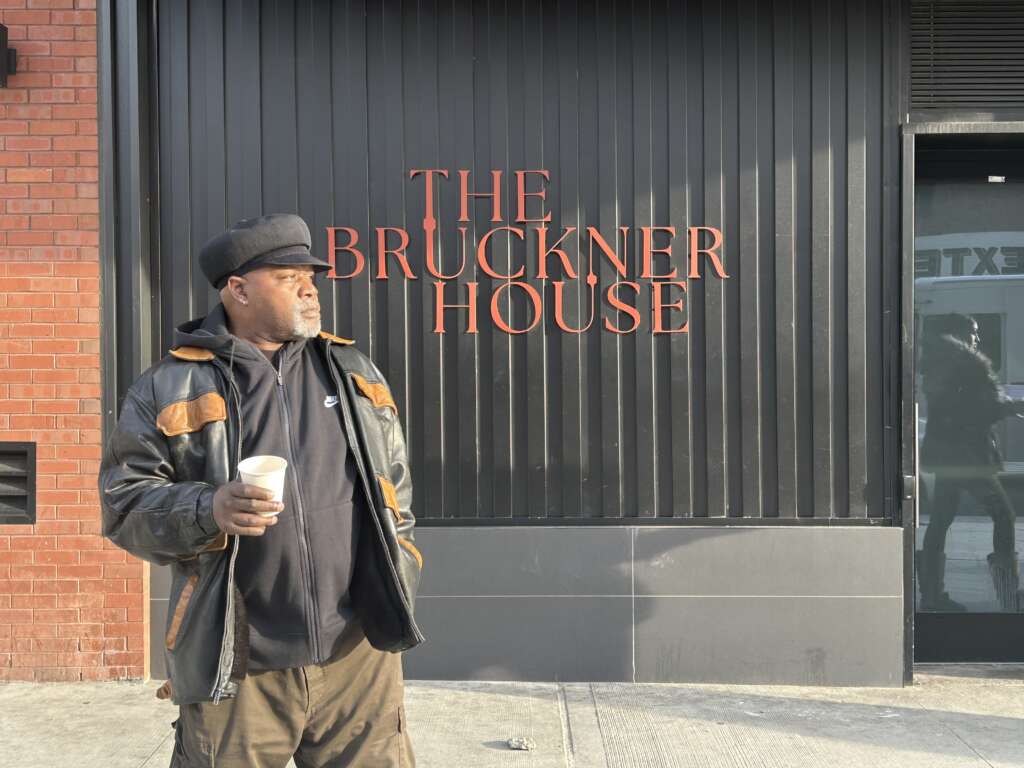
Joseph Jones, 61, outside his rental building in the South Bronx. He uses a rental voucher, and says the $250 monthly fee to use the building’s amenity spaces means he and other affordable tenants are locked out. (Patrick Spauster/City LImits)
“How can I be loitering in my own home?”
Joseph Jones, 61, is standing in the well-furnished lobby of his apartment building on Bruckner Boulevard. the South Bronx.
The clock is ticking.
According to a building policy, tenants can only spend 15 minutes at a time hanging out in the building’s lobby. Just downstairs in the basement is a lounge, game room, and gym where tenants are welcome to stay as long as they like.
It just costs $250 a month.
Jones, an affordable housing tenant who lives on disability and uses a city-issued housing voucher, can’t afford an extra couple thousand dollars a year to pay for access to his building’s numerous amenities.
He’s one of several low-income tenants in the building who say that lack of access creates tension between affordable tenants, market rate tenants, and management.
Affordable housing in New York City is increasingly found in mixed-income buildings. In exchange for a tax break, subsidy, or more square footage, developers set aside a percentage of units in new buildings for affordable housing available through the city’s affordable housing lottery.
Tenants who win lottery apartments or use a voucher in new luxury apartment buildings in the five boroughs told City Limits that the high cost of amenity fees creates income-segregated spaces within their buildings.
“We’re really talking about fairness and equity. [The Department of Housing Preservation and Development (HPD)] believes that all tenants, affordable and market-rate, should have equal access to amenities, regardless of income, rent, or unit type,” said Natasha Kersey, a spokesperson for HPD, in a statement to City Limits.
But with few hard rules about amenity pricing for the city’s housing agency to enforce, tenants say that many buildings have fee structures that make it impossible for lower-income tenants to afford.
Those tenants say pay-to-play amenities sharpen class lines in their communities, and harken back to times when developers would sometimes create separate entrances for affordable and market rate tenants: a practice called the “poor door.” New York State barred buildings from using separate entrances for affordable tenants in 2015.
“My first thought was that it was making a two-tiered system,” said Amber Jensen, who won the housing lottery for a residential-to-office conversion in downtown Manhattan but is worried about paying amenity fees out of pocket.
A tale of two buildings
Walk four blocks west from 40 Bruckner, where Jones lives, and you hit the Maven, a towering 27-story new luxury building built in 2021.
At the Maven, a gym, pool room, screening room, and coworking space are included in the cost of rent. Voucher holders—who typically pay 30 percent of their income in rent each month, with the city paying the rest directly to the landlord—get access to all of it.
A sign in the lobby of The Bruckner House about time limits.
(Patrick Spauster/City Limits)
Jones says that he comes over to the Maven every week to shoot pool with a friend who lives there and also has a voucher. But when he goes back home, he can’t sit in his own lobby for 20 minutes or use any of the communal spaces.
Staff for JCS Realty, which operates Bruckner House, did not respond to detailed questions from City Limits about their amenity pricing and lobby rules.
Amenity fees in new buildings can range from $45 to several hundred, according to affordable housing lottery tenants and owners who shared the information with City Limits.
The range in pricing means that at some buildings, tenants get access to amenities that can help them stay healthy, socialize, and relax. At other buildings, affordable and market rate tenants scarcely interact, despite sometimes sharing walls.
At Bruckner House, residents say the divider between the rich and poor is not a doorperson, but a key fob.
One day last summer, voucher holder Fred McKay and another affordable housing tenant, Byron Brown, wanted to play dominoes. If you have the amenity fob, you can swipe into a game room in the building’s basement.
But they couldn’t afford the amenities, so they started up in the building’s lobby, they said, but were asked to leave because of the 15 minute time limit.
So Brown went up to his room and got a folding table and chairs and brought it outside to the corner.
Byron Brown, a tenant at the Bruckner House, said he and a friend were told they couldn’t play dominoes in the building’s lobby. (Patrick Spauster/City Limits)
“We played like two or three games out there for maybe 45 minutes,” said Brown. Then the police pulled up in response to a complaint and gave them a ticket.
“This building is too much, man,” said Brown. “They’re a piece of work.”
Another tenant at Bruckner House—a woman who asked to remain anonymous out of fear of retaliation from the landlord—said that having access to the gym would have made a big difference for recovering from injuries she sustained in a car accident.
Without access to equipment at home, she could only do some of her physical therapy exercises when she paid for a visit at her physical therapist’s office.
The city and state impose a few rules on property owners when it comes to building perks. They can’t charge affordable tenants more than market rate tenants, or use amenity fees as a hidden rent increase for rent-stabilized tenants, and they must be optional.
HPD said it also has “guidelines” that encourage discounted amenities for low-income households to keep costs proportional. They also suggest developers break amenity packages into individual services so tenants can pay for what they need.
The Bruckner House at 40 Bruckner Blvd. (Patrick Spauster/City Limits)
“Our guidelines help ensure fees are transparent, optional, and proportional, applied equally across affordable and market-rate units, and clearly disclosed in leases. Every tenant needs to be able to fully enjoy the shared spaces in their community,” a spokesperson said.
Those guidelines, according to the agency, apply to all mixed-income projects that don’t require developers applying for a zoning change.
The problem, tenants say, is that guidelines are just that: guidelines, not hard rules.
Landlords have a great deal of discretion on how much to charge, and for what. That discretion has led to unequal outcomes, some tenants say.
“That feels very discriminatory to me,” said Jensen. “It’s not passing the smell test.”
Tenants speculate that having poor tenants in the building use the amenities is bad for marketing.
“Our comfortability bothers them,” said McKay.
‘At that price, it’s impossible’
At The Set, a sparkling 44-story tower in Hudson Yards, tenants must pay $1,000 a month to use the city’s rooftop club, complete with a swimming pool.Survey
“At that price, it’s impossible,” said Genesis Martinez, an affordable housing lottery winner who lives in a small one-bedroom apartment in the building with her two daughters, 1 and 4.
A one-bedroom in the building goes for over $7,500 a month. Martinez pays $1,400 for a low-income lottery unit.
“They want to keep a certain atmosphere on the roof and maybe they feel like the middle class tenants will mess that up so they purposely price it prohibitively,” said Brian, another affordable housing tenant at The Set. Brian asked City Limits to withhold his full name out of fear of retaliation.
Sometimes exorbitant fees at these buildings create two different cultures—those who can afford to pay and those who cannot. At The Set, multiple affordable housing tenants told City Limits that they inquired about a discounted program for tenants that occupy affordable units, but there was no such subsidy available.
“There’s no community area for us,” Brian said.
The Set, a mixed-income luxury building at 455 10th Ave. in Hudson Yards, where access to amenities costs $1,000 a month. (Adi Talwar/City Limits)
The Related Companies, which owns and manages The Set, said that it was an outlier case that supplies premium services like housekeeping, and food and beverage services.
“The vast majority of our mixed-income rental buildings in the City offer a heavily discounted amenity fee, either tiered by [income level] or a fixed-rate, to ensure all residents have the option of accessing those amenities. Each property is unique in terms of the offering,” said a spokesperson for the company.
At one of their buildings, Riverwalk Park, Related said they offer subsidized amenity pricing depending on the income level of the household, ranging from $7 a month for formerly homeless units to $30 a month for middle income units.
City Limits inquired about amenity pricing with leasing agents at a half dozen other affordable housing lottery buildings. All but one said amenity fees are non-negotiable and they do not provide discounts to affordable housing tenants.
At Brookfield’s Two Blue Slip, another new building in Greenpoint, management agents say they increase amenity fee rates at a lower rate in affordable apartments compared to market rates.
The problem, tenants say, is that there is little consistency between buildings. Even affordable housing tenants with far more reasonable fees say they cannot afford the extra bill each month.
At Brookfield’s Two Blue Slip in Greenpoint, management agents say they increase amenity fee rates at a lower rate in affordable apartments. (Patrick Spauster/City Limits)
Jensen, a 64 year old domestic violence survivor who has been living in a shelter for 18 months, applied to the lottery at 25 Water St., voucher in hand, expecting to pay $50 or $75 for amenities in the new building. But at $150 a month, it gave her second thoughts, especially since she’d have to commit for a full 12-month lease term.
“It was kind of a surprise to me,” she said.
She signed a lease including the amenities but will have to scrounge together an extra $1,800 a year to pay for them. “Other than the location, the amenities were the other reason I wanted to live in that postage stamp apartment,” Jensen said.
Her City Fighting Homelessness and Eviction Prevention Supplement (CityFHEPS) voucher would pay up to $2,600 for a studio, but the base rent is only $2,200.
“Why didn’t they just charge more and include [amenities]?” asked Jensen. If amenities were free—or priced into rent—her voucher would help pay for them.
“It would completely take the stress off of me,” she said. “The only thing I could think of is because they’re planning on raising the prices later.”
The City Council has made several changes to the CityFHEPS program in recent years to help low income tenants. Passed in 2023, Local Law 99 prohibits the Department of Social Services from deducting a utility allowance from the voucher amount, an effort to make more apartments available regardless of whether utilities were included in the rent or a separate charge.
But the city has also been trying to rein in the costs of the program—by cutting incentives for landlords, trying to increase payment amounts for longtime residents, and upgrading data systems to reduce processing time. Comptroller Mark Levine says CityFHEPS will cost $2 billion by the time the fiscal year ends in June, a big reason for the city’s larger than expected budget deficit.
Mayor Zohran Mamdani has pledged to build 200,000 affordable apartments in the city over the next 10 years. A significant portion will likely be in mixed income buildings, enabled by state tax incentives and recent “City of Yes” zoning changes designed to incentivize denser and affordable development.
Whether those future tenants will be able to enjoy everything new buildings have to offer remains to be seen.
To reach the reporter behind this story, contact Patrick@citylimits.org. To reach the editor, contact Jeanmarie@citylimits.org
Want to republish this story? Find City Limits’ reprint policy here.
The post The New ‘Poor Door’: Amenity Fees Are Too High for Affordable Housing Tenants appeared first on City Limits.
Leave a Reply