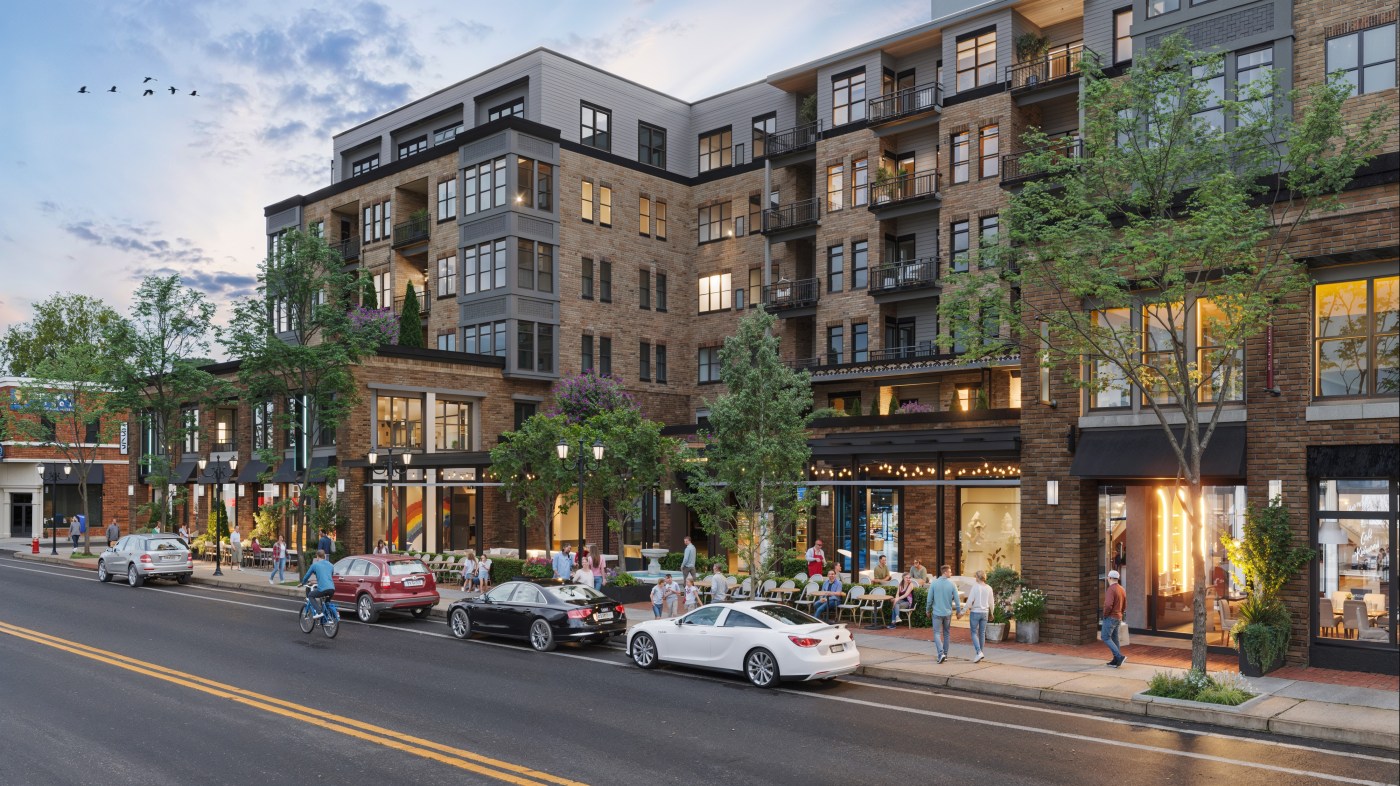
Shortly before the Christmas holiday, officials with St. Paul Planning and Economic Development made the case that a developer should receive nearly $3 million in tax incentives to demolish the three buildings at the northeast corner of Grand Avenue and Victoria Street and replace them with a six-story, mixed-use apartment building.
The St. Paul City Council agreed, voting 5-1 to greenlight Afton Park Development’s plans to tear down the Victoria Crossing East Mall, the former home of the Billy’s on Grand restaurant and a neighboring rental house. In their place will rise a 90-unit market-rate apartment building with more than 12,800 square feet of ground-level restaurants and retail, as well as a level of underground parking.
It’s the type of development some housing and small-business advocates have longed for to expand the city’s tax base and bring more foot traffic to Grand.
“We have the option to not grow or we have the option to grow,” said St. Paul City Council President Rebecca Noecker at the time. “We haven’t seen a completely unsubsidized housing development in St. Paul in a long time. A third-party review found there was a (financial) gap, and the amount of the gap is what we’re allowing.”
Grand Avenue blighted?
Still, even some fans of the project were left scratching their heads.
To grant the developer $2.96 million from a new $9.4 million, 26-year tax increment financing district, state statute required city officials to prove the site was blighted, and that the $44.6 million project would be unlikely to move forward but for public assistance.
Grand Avenue? Blighted? Long celebrated as arguably the city’s toniest small-business district, the avenue has suffered its share of vacant commercial buildings. However, they remain surrounded by bustling boutique shops, restaurants, cafes and apartment buildings, as well as high-end homes on adjoining streets.
Events such as Grand Old Day and the St. Paul Winter Carnival Grande Day Parade draw fans and vendors to Grand from miles away, and a cigar store, a children’s bookshop, multiple bakeries and the Golden Fig Fine Foods gourmet grocer are among the independently owned destinations that add to its appeal.
The Victoria Crossing building on the corner of Grand Ave. and Victoria St. in St. Paul on Thursday, Dec, 19, 2025. (John Autey / Pioneer Press)
58 TIF districts citywide
The city currently captures 7% of its annual tax capacity for TIF spending, or about $37 million last year, in 58 TIF districts.
That’s raised concerns that financial incentives intended to lure developers to blighted areas are being overused to the point they’re almost an automatic giveaway, even when a property and its surrounding area are not in especially bad condition.
“It’s a seductive tool that a lot of constituencies are going to say, ‘It’s going to increase the tax base,’ which it does not for 25 years,” said Summit Avenue resident Robert Muschewske, a retired management consultant and member of the fiscal watchdog group Insight St. Paul, which opposed the TIF award. “To what degree does a development meet a clear public purpose that it merits a subsidy? Given the location, why does it need a public subsidy at all?”
Developer Ari Parritz has said the new building will increase the site’s $6.5 million value by $20 million. Existing property taxes, which equal roughly $200,000, will continue to flow into the city, county and school district general fund. Over the course of 26 years, the tax increment above that amount will fund the $9.4 million TIF district, including the developer’s $2.96 million pay-as-you-go financial note and $3 million for off-site affordable housing.
The city, in effect, loses nothing financially compared to the status quo, he said, and gains new housing and refreshed storefronts, as well as off-site affordable units, instead of an aging mall. Within Paper Source, the last retail tenant to leave the mall on Jan. 15, tarps were set out in multiple areas to capture falling water during recent snow melt. Even from the exterior, the house neighboring the property shows obvious deterioration, from rotted wood to a sloping front porch.
“This isn’t about Grand Avenue being blighted, or even the intersection being a blighted corner,” explained Parritz, who lives in St. Paul. “It’s literally about the physical infrastructure of the particular buildings. Anyone who doesn’t believe me is welcome to go in and take a look.”
Related Articles
Your Money: Markets were up in 2025, will it continue?
Working Strategies: Hiring bonuses can come with caveats
Job titles are out and skills are in, Wharton expert says. Here’s what employers want to see
US producer prices rose 0.5% in December, more than expected, on uptick in services inflation
Warsh’s challenge: Navigating Fed independence and Trump’s demands
Three ‘structurally substandard’ buildings
City staff have justified the creation of the $9 million TIF district based on two reports commissioned by the Housing and Redevelopment Authority — a financial analysis from Ehlers Public Finance Advisors and a building inspection and repair-or-replacement analysis from LHB, a Minneapolis-based architectural, engineering and planning firm.
Muschewske, who said he was a regular customer at the Victoria Crossing East Mall, noted he attended a Planning Commission meeting in November to review whether the proposed TIF district was in keeping with the city’s Comprehensive Plan, where it was supported by a close vote of 6-5, and neither report was made publicly available at the time.
In fact, city Planning and Economic Development released both reports to him at the end of December, weeks after the city council had already approved the new TIF district.
“This process needs to be improved,” he said. “There’s no public opportunity to weigh in with any substantive input.”
In a Dec. 10 presentation to the city council, city staff noted that the Housing and Redevelopment Authority had retained LHB “to complete an assessment of the property to determine if the statutory blight test has been met.”
The LHB report, which was published for the city in October, did not specifically use the term “blight.” It did use the criteria allowed by state statute to greenlight new TIF districts — that the buildings were “structurally substandard.” The state defines substandard buildings as those where repair costs to bring a site up to building codes would exceed 15% of the cost of a full structure replacement, not counting energy improvements.
The report estimated that replacing the three buildings with comparable construction would cost about $4.7 million, compared to needed improvements totaling $1.36 million, much of it related to roofing, lighting, HVAC and windows. In other words, code repairs would equal 29% of replacement costs, which is well above the state’s 15% threshold.
The LHB report runs to 56 pages with appendixes, photos and a line-item by line-item description of repair and replacement costs for each building. By statute, at least 50% of the structures would have to be deemed substandard “to a degree requiring substantial renovation or clearance,” and LHB’s Aug. 13 inspection found that 100% of the buildings fit the description.
The Ehlers report and ‘but for’ test
To justify new TIF districts, Minnesota also requires a “but for” test, which means the project would not occur but for a TIF subsidy.
Based on current market conditions, the $44.6 million project would bring a return on investment of 6.02% without TIF assistance, or 6.8% with TIF financing attached, according to the Ehlers report. “In the current market, developers typically need a … yield on cost of at least 7% for financial feasibility,” reads their report. “Based on this, we conclude TIF assistance is warranted for the project.”
The three-page financial analysis from Minneapolis-based Ehlers found that a mortgage loan would cover $28.5 million of the $44.6 million project cost. Equity, or cash and investor stakes, would cover another $12.8 million, and a state grant would cover $350,000.
The project’s total development cost works out to be about $495,000 per housing unit, which “is not uncommon for small projects located on core city infill sites,” reads the report. Even with housing rents of $3.83 per square foot, “which is at the upper end of the market, but appropriate for the location,” the $2.96 million gap remains, unless it’s filled by additional assistance, according to Ehlers.
Muschewske said he and other members of an Insight St. Paul subcommittee focused on TIF spending met with the developer, Parritz, who had previously helped another firm develop the Kenton House, which also added luxury apartments above restaurants to a nearby site on Grand Avenue.
“The developer seems to be a reasonable guy,” Muschewske said. “He developed something down the street successfully without the use of TIF. He claims he was able to do that because interest rates were lower during COVID. But it’s not clear why taxpayers should be on the hook to provide him his investment return.”
‘A sweet opportunity’
Parritz said St. Paul has used TIF sparingly for market-rate housing, which has largely stalled throughout the city. Without an infusion of both public and private dollars, the Grand-Victoria site would remain underutilized.
The Gather Eatery and Bar, the restaurant that came after Billy’s on Grand, closed in January 2025, leaving a large vacant commercial space.
“I wish the public could focus more on creating better tools, instead of blasting the only ones we have that can make an actual difference,” Parritz said.
“The only market-rate housing TIF has been applied to in our city is (downtown) Landmark Tower and, depending upon how you spin it, Highland Bridge, where market-rate housing is supporting affordable housing,” he added. “I continue to talk to investors who are ruling out St. Paul for anything because it’s St. Paul — regulation, politics, rent control, you name it. But things are definitely getting better. … We have a sweet opportunity to get some things going, but we’re still dealing with investor sentiment that has accumulated over decades.”
Construction of the new building is anticipated to start in February and run to the summer of 2027.
Related Articles
St. Paul police investigating fatal Saturday shooting
Joe Soucheray: Even the country’s best water needs to breathe sometimes
Here’s what a federal indictment alleges about 9 people charged in St. Paul church protest
Mary Ellen Klas: Republican governors are starting to understand the assignment
St. Paul: Customs and Border Protection employee charged with DWI
Leave a Reply