When St. Paul Public Works hired Jericho Huggar away from the city of Minneapolis two years ago to return to work in the neighborhoods where he was raised, no one was counting on him campaigning for a Bagela to follow.
The bright red Bagela — a portable asphalt recycler that whirs, smokes and smells like a contraption out of a Dr. Seuss children’s book — feeds on the kind of bottom-of-the-cereal-box construction debris that usually gives contractors heartache over where to store it. Instead of being carted off to a landfill, that potential hazardous waste is converted into hot pothole fill in a matter of minutes, saving costs on transport and disposal.
It would take some time for Huggar — a superintendent of street maintenance — to reassure others in St. Paul Public Works that buying a used machine from the city of Minneapolis would be a steal at $15,000, about one-tenth or so of its full retail price, and save taxpayer dollars by providing longer-term pothole relief for city streets than the common “cold mix.”
Huggar made the case anyway, and convinced higher-ups to make the purchase, which went through last year. The Bagela was put to work this month for the first time in the capital city. “I’m a taxpayer,” explained Huggar, who grew up in Frogtown.
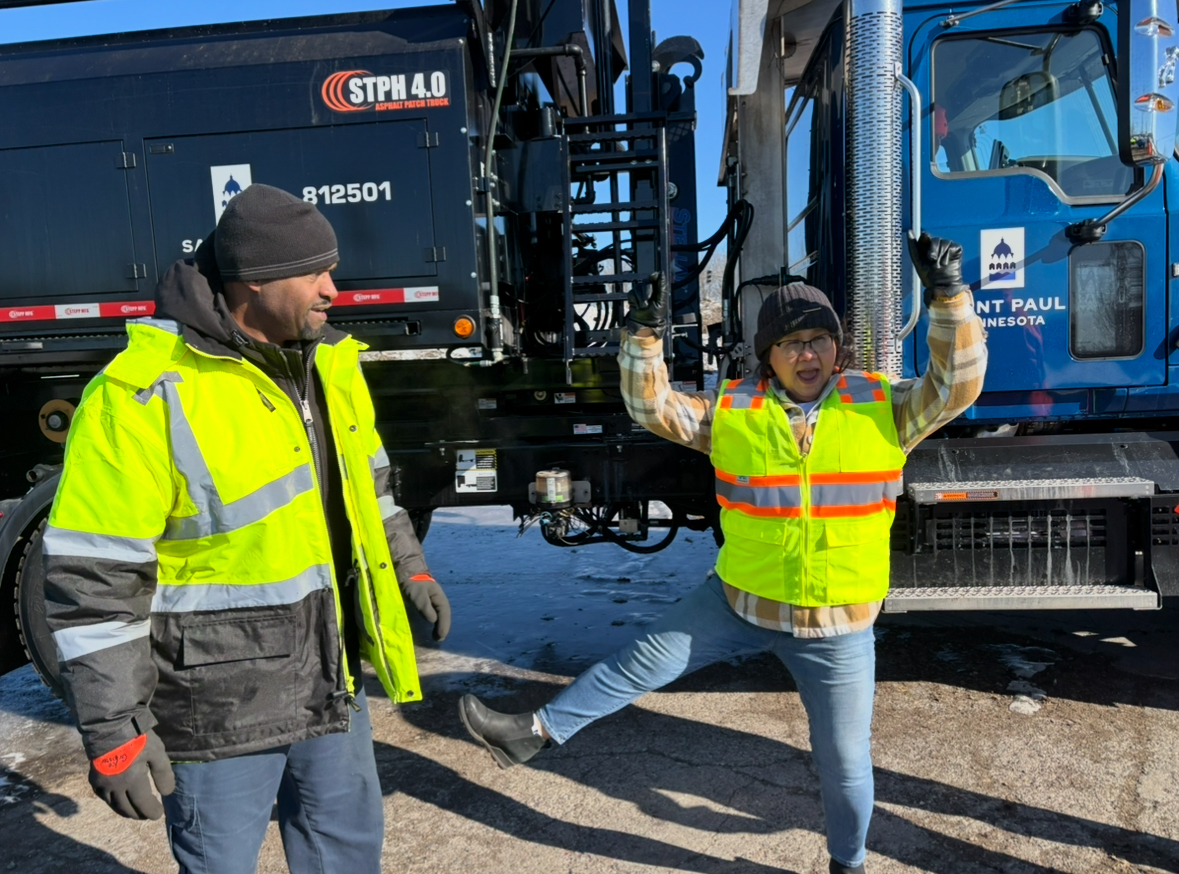
Joined by St. Paul Mayor Kaohly Her and St. Paul Public Works Director Sean Kershaw on Wednesday, Huggar and other Public Works officials showcased their “new-to-us” Bagela in action during a media event at a Public Works facility near Como and Western avenues.
Asphalt “rocks” dropped into the mouth of the Bagela like coffee beans in a grinder, churning into a relatively fine silt of steaming black fill, as a worker in a mini-skid steer loader scooped up the fallen grounds and deposited them into a heated truck bed.
Within minutes, the Public Works truck was parked just off Rice Street, on a residential street that had been rendered bumpier than corduroy by a series of winter potholes. Her received an impromptu tutorial in how to shovel out fill, drop it into place, tamp it down and then sweep it smooth.
For Her, whose first month in office has been dominated by thousands of federal agents swarming the Twin Cities, taking a moment to sweep pothole fill came almost as welcome relief.
“We can do both,” Her said. “We can address crises as they’re happening, but we have the staff in place so that we can continue to move forward on core city services, so that our residents do not see disruption.”
Given freezing temperatures, the city’s “hot mix” plant hasn’t opened for the season yet, and Public Works is still filling most potholes with “cold mix,” a type of asphalt mixture that has a shorter life expectancy.
Still, the Bagela is expected to make a sizable dent in demand this season by converting at least 13,000 tons of cast-off asphalt debris into hot pothole mix, which can be quickly transported to rutted streets needing a quick makeover.
“This is more durable and more efficient, so we can cover more potholes and get the work done so that it lasts longer,” said Kershaw, called the Bagela a promising addition to the city’s winter toolbox. “We have so many potholes that it’s never enough, but if this is successful, I imagine that we’ll want to get another one.”
Most of the asphalt source material will come from clean-outs of the city’s trucks and asphalt plant, or the dregs of street projects. “We try to find stuff that doesn’t have concrete in it, as clean as possible,” Huggar said.
Given temperatures that have risen and fallen in quick succession, leading to daytime melt and icy freezing overnight, Kershaw said there are plenty of pothole-riddled streets this season, though perhaps not quite as many as during winter 2022-2023, which ranked as one of the five snowiest seasons on record.
“They’re higher this year because the potholes are worse, but I don’t think we’re at ’23 levels yet,” Kershaw said.
While pothole filling isn’t entirely provided on a complaint or “first come, first served” basis, there’s some truth to the idea that the squeaky wheel — those who call in potholes — gets the grease, so to speak.
Public Works crews are doing the best they can to fill potholes citywide based on a grid map, working methodically from quadrant to quadrant, said Kershaw, while also prioritizing streets where especially challenging potholes may represent a danger to drivers.
“We will put those dangerous potholes first,” Kershaw said.
Related Articles
Bells will ring in unity across the Twin Cities on Saturday
No school. No work. No shopping. A second, national ‘day of action’ planned for Friday.
Niche alt-country acts and Trampled by Turtles to play the new Minnesota Country Club Festival
Meet St. Paul Winter Carnival’s 2026 doggie royalty: King Bruno and Queen Pumpkin
St. Paul’s Camp Bar cancels sold-out shows from Canadian comic after he went viral with Renee Good rant
Leave a Reply