“The ultra wealthy and the most profitable corporations are going to fight any revenue raiser,” said Brahvan Ranga, campaign manager of Invest in Our New York, a coalition of organizations pushing for progressive tax reforms. “But the political winds are at our back in a way that hasn’t been the case in years.”
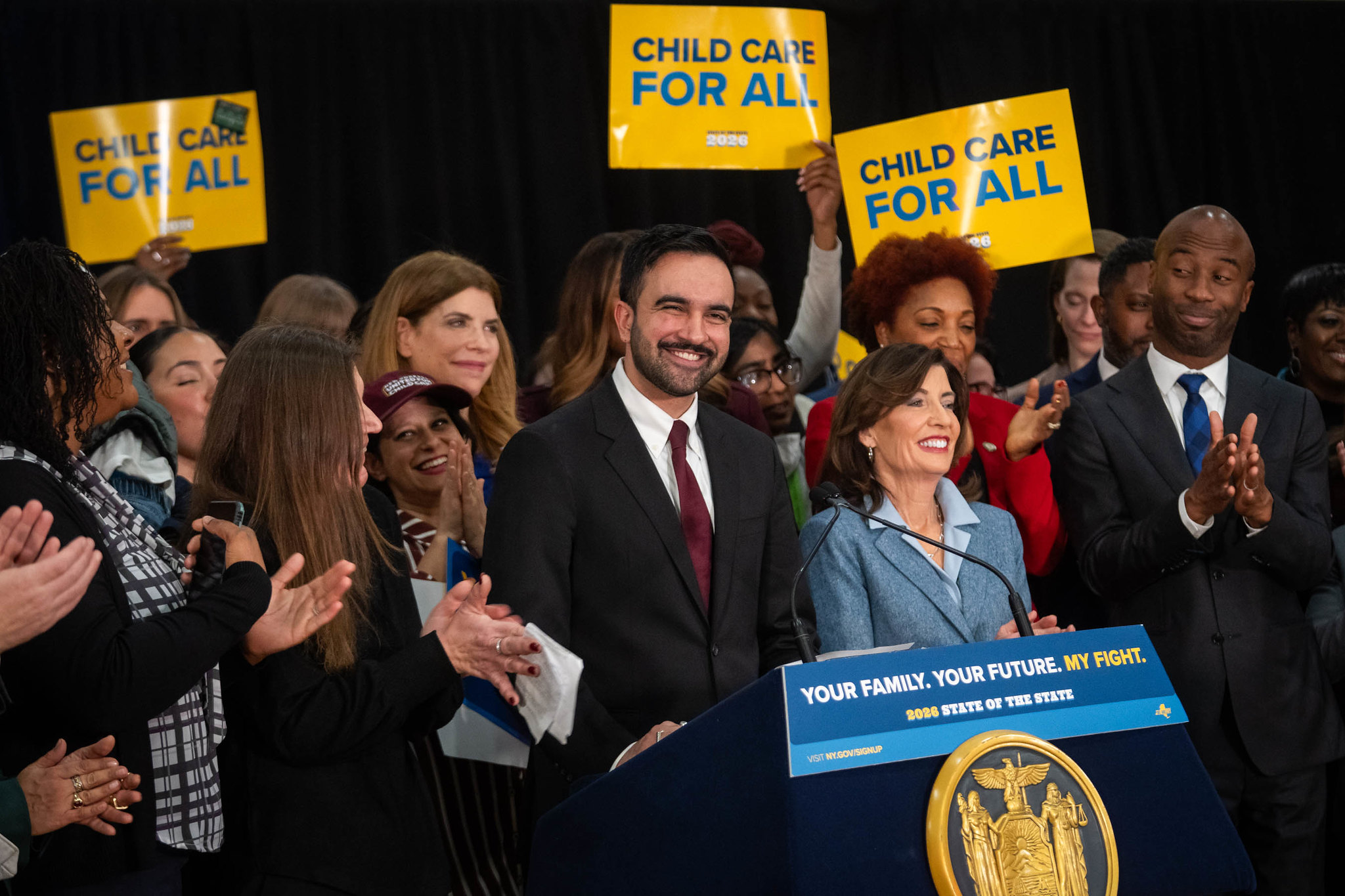
Mayor Zohran Mamdani and Gov. Kathy Hochul announcing an expanded child care initiative earlier this month. (Ed Reed/Mayoral Photography Office)
Zohran Mamdani won the mayoral election resoundingly by running on reshaping New York to be affordable and manageable for working people. But many of his audacious plans require money—lots of it.
With the exception of property taxes, the city can’t raise taxes on its own and must always go to Albany seeking votes. The mayor is asking for dollars right as the federal government is slashing funding (and cutting health insurance) and while Gov. Kathy Hochul—who has largely opposed raising taxes—and the legislature, who clutch the state’s purse strings, are preparing to run for re-election.
Much of Mayor Mamdani’s success may rest on figuring out what taxes they’ll find politically palatable. He faces a larger-than-expected city budget deficient this year—what officials blamed on under-budgeting by the Adams administration—as he gets ready to negotiate his first spending plan due in July.
On the state level, the governor’s budget office has in recent months said revenue streams looked rosy and that taxes are “a last resort.” Hochul’s $260 billion state budget proposal, unveiled last week, avoided any such hikes. “You can make historic investments without raising income taxes,” the governor said.
That’s not the attitude progressives are looking for, said Jasmine Gripper, co-director of the New York Working Families Party. Gov. Hochul “has made bold promises and under-delivered. We’ve been underwhelmed by the investment.”
She hopes that Mamdani’s win showed that the way to energize voters is with bold ideas. “We don’t want to be underwhelmed anymore,” she said. “The pressure from Zohran’s campaign means the demands of what New Yorkers are expecting are high.”
Brahvan Ranga, campaign manager of Invest in Our New York—a coalition of organizations pushing for tax reforms—points to a new poll that shows super majorities of New Yorkers supporting legislation that would raise revenue through progressive taxes.
That’s what Mamdani wants, too. His campaign plans called for raising an estimated $9 billion annually by hiking the corporate tax rate to 11.5 percent (to match neighboring New Jersey), and by adding a 2 percent income tax on anyone earning more than $1 million a year.
In a statement last week, Mamdani praised Hochul’s budget plan for making “meaningful investments” but reiterated his call to tax the rich. “It is time to ask New York City’s wealthiest and large corporations to pay their fair share,” he said. (Efforts to reach the new mayor for this story were unsuccessful.)
“The ultra wealthy and the most profitable corporations are going to fight any revenue raiser,” Ranga said. “But the political winds are at our back in a way that hasn’t been the case in years.”
The question becomes what tax plans to push forward with that wind.
One idea that has circulated in recent years is a pied-à-terre tax. The tax would target multimillion dollar second homes in the city owned by the ultra wealthy.
“We need money to run the city so a tax on the wealth of the people that own multimillion dollar homes and are not living in them makes sense,” said Morris Pearl, the chair of the group Patriotic Millionaires, which advocates for higher taxes for people in their own bracket.
The pied-à-terre tax became popular with the public and some officials a decade ago, when faceless oligarchs from other countries and American billionaires snapped up exorbitantly-priced apartments that they didn’t even live in.
Luxury towers along Manhattan’s “Billionaires’ Row” overlooking Central Park. (Felix Lipov/Shutterstock)
It seems like an easy target, given the minuscule, elite constituency. But lobbyists killed the legislation in 2019. In 2023, then-Comptroller Brad Lander again pushed the idea, but it has yet to gain serious traction and its opponents remain implacable. “The real estate lobby has lots of powerful friends in state government and so I would imagine that could be an obstacle,” Ranga said.
James Whelan, President of the Real Estate Board of New York (REBNY) said in an emailed statement that the tax is “a fundamentally flawed idea” that would cost jobs and discourage investment.
Ironically, the bigger issue for the pied-à-terre tax is that the people who support the idea rank it low on their priority list. If Gov. Hochul threw her weight behind it, progressives would welcome it, Gripper said. But she and her allies are not pushing for it.
“Progressive groups have agreed on a set of revenue raisers that we’re committed to fighting for and a few years ago we actually set aside the pied-à-terre tax,” Gripper said. “We’re not against it. It’s simply that it doesn’t raise enough revenue. It doesn’t get us to closing the affordability crisis.”
“It doesn’t change the macro budget outlook of the state or the city,” adds Nathan Gusdorf, executive director of the Fiscal Policy Institute.
(This is also true of the commuter tax, which was foolishly relinquished decades ago by Assembly Speaker Sheldon Silver. While there’s some disagreement—Gripper calls it regressive for working people commuting from the suburbs—from the city’s perspective, it’s “a travesty that it was repealed,” Gusdorf said. “You’re earning your income here and the city has a right to tax people on that income earned here.” But it’s not politically palatable and doesn’t bring in enough revenue to make it worth fighting for, he added.)
Ranga likes the idea that the pied-à-terre tax reflects the city’s shift in priorities and has widespread public support, so he believes it could be part of the puzzle. But he doesn’t think it should be a focal point in the coming legislative cycle. The pied-à-terre tax would reap hundreds of millions of dollars, which is “pretty minimal” compared to “both the scale of the federal cuts and the the scale of the new programs we’re proposing,” he said.
And while it may disincentivize some of the worst practices on the housing front, he’d rather see a fight to “pass legislation to strengthen tenants rights and rent stabilization or for legislation to enact social housing to massively construct beautiful mixed income, affordable housing for all New Yorkers.”
Ultimately, he said, the pied-à-terre tax falls short because “it can’t replace bolder proposals either on the housing front or the revenue front.”
Instead, Gripper, Ranga and Gusdorf are all thinking big. “We want to target revenue that puts us in the billions of dollars in order to actually fund things like universal childcare,” Gripper said, referring to one of the new mayor’s goals (Gov. Hochul recently announced that the state will fund the first two years of an expanded free child care program, but funding beyond that is still to be determined).
Gripper said raising the personal income tax on just the absolute wealthiest could generate $20 billion, a state capital gains tax could raise about $12 billion, boosting the corporate tax yields $7 billion and an heirs tax reaps $4 billion.
There’s also the idea of a wealth tax—applied to a person’s total assets, rather than their annual earnings—like the national one promoted by Elizabeth Warren. “We have to get beyond the personal income tax,” Gripper said.
Pearl, of the Patriotic Millionaires, notes that he has virtually no income, so he is barely taxed. “I think these things should be on the table,” he said. “We need the school teachers, doormen, bus drivers and others who work here to be able to afford to live here. The governor should think about them, not the small number of people from whom she’s chosen to get support.”
But Gusdorf said there are potential constitutional limitations on a wealth tax in New York (although Gripper believes they could win on challenges in court). He adds that while it’s a good policy, it also introduces unknowns, from potential court battles to details of how to fully capture the value of the wealthy’s assets.
He cites an adage that “an old tax is a good tax because any tax is complex and it takes so long to work out the kinks and there’s so much to fight over.” This argument applies to the pied-à-terre tax, too. “People think the income tax is toxic, so we need a new tax but that’s thinking backwards,” he said.
“Everything that seems appealing about doing a new tax is going to be a nightmare. The income tax works. People pay it. We have regulations and legal and accounting expertise to deal with it,” Gusdorf added. “It’s the one thing where you raise it a little bit and you’re going to get a lot more money.”
Gripper said raising the personal income tax on people making more than $25 million would have plenty of public support. “That feels really easy and tangible,” she said.
Gusdorf adds that The Fiscal Policy Institute has plenty of research showing that, despite fear-mongering by the right, rich New Yorkers really don’t move out in response to the income tax. (The Institute’s studies show that working class people leave at a much higher rate than the wealthy, driven out by the cost of living.)
“The millionaires and billionaires are not going anywhere,” adds Gripper. “It is their playground. They love the museums. They love the parties. They love New York. We’re just asking them to pay their fair share.”
New York Stock Exchange building in Manhattan’s Financial District. “The millionaires and billionaires are not going anywhere,” Gripper says. (JJFarq/Shutterstock)
Gusdorf also disputes the notion that raising the corporate tax rate would harm businesses. Sixteen states have a higher corporate tax rate than New York’s, he said, and Mamdani’s goal is simply to match New Jersey’s rates. The tax is not based on where a company is headquartered, but on how much business a company does in New York, and it’s only paid by the approximately 1,000 most profitable corporations. “It hits a small number of businesses and is structured so there’s no economic disincentive effect,” he said.
Gripper said progressive policy groups have also tinkered with their proposal on the heirs tax to make sure it only hits those “who are about to have the biggest wealth transfer in history”—raising the threshold and creating safeguards to protect people who inherit valuable property that they want to live on or use for farming.
Ranga hopes that Mamdani’s election is a game changer for all those legislators looking for voters’ support this year.
“Voters are saying the government should make our lives better and they should do so by making the ultra-rich and the most powerful corporations pay their fair share,” he said, adding that legislators and the governor should realize this extends beyond the five boroughs to the state’s smaller cities and even rural areas. “If you’re running for re-election, you’ve got to be responsive to that.”
Gripper notes that the governor has “outsized power in the budget process” but she believes that if the legislature “holds firm we can get good things done.”
“I am confident that one or more of these revenue raisers will get passed this year,” she said.
To reach the editor, contact Jeanmarie@citylimits.org
Want to republish this story? Find City Limits’ reprint policy here.
The post Tax Talk: Mamdani’s Ambitious Agenda Requires New Revenue. What Could That Look Like? appeared first on City Limits.
Leave a Reply