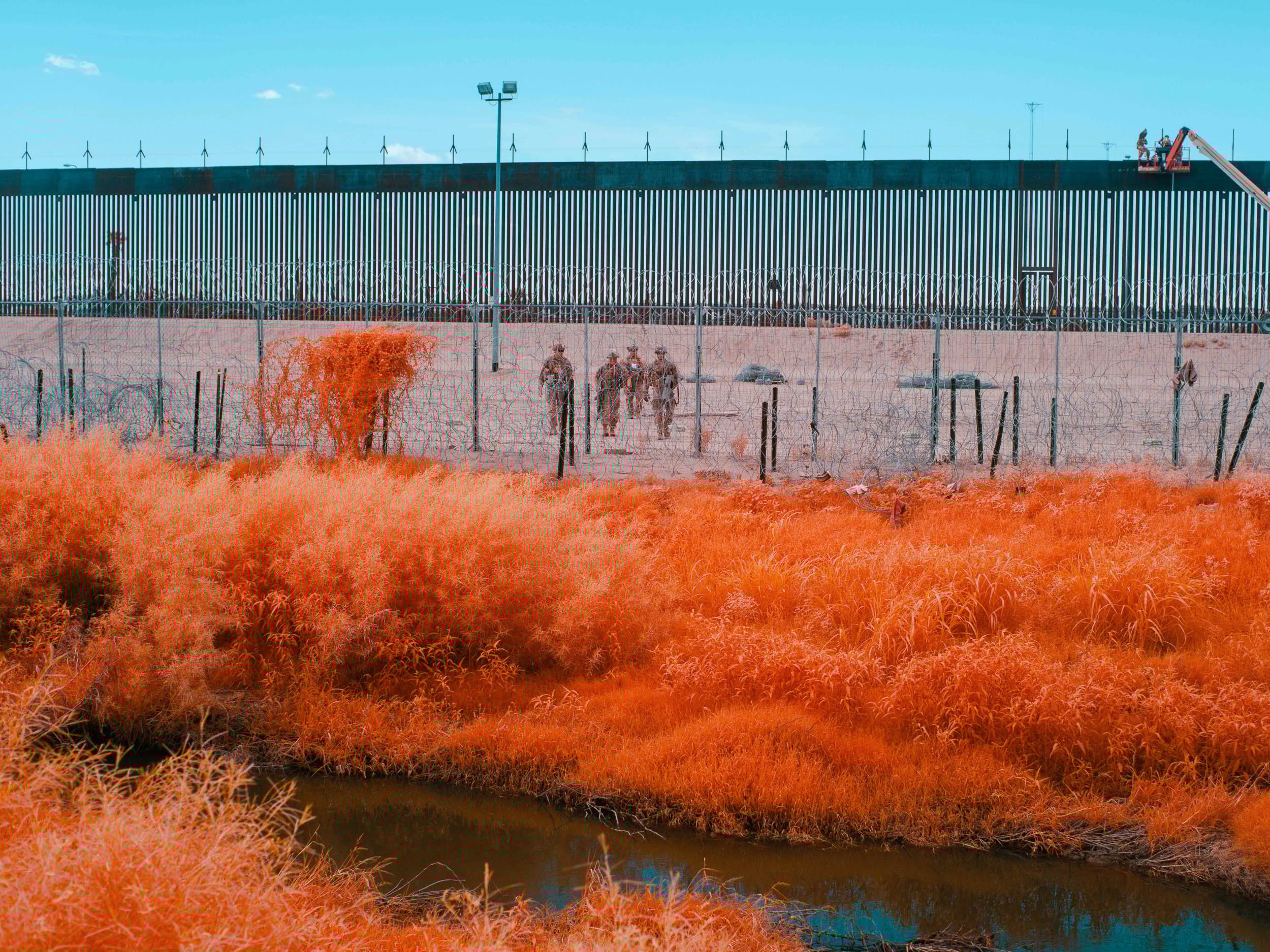
On a hilltop overlooking the Rio Grande, just below a picnic area along Highway 83 in San Ygnacio, there’s an unmarked grave. The river—as well as its new razor-sharp decorations—stretches as far as the eye can see in either direction. Occasionally a car passes, but mostly there’s a quiet stillness.
The riverine border between Texas and Mexico is 1,254 miles long, a distance too great to be understood by those who’ve never seen it. This leaves room for interpretation, so the river becomes many things to many people. Lately, according to Texas Governor Greg Abbott, the border has been the front lines of an “invasion.” Most recently, the Trump administration has established “national defense areas” along sections of the Rio Grande, apparently restricting Texans’ access to U.S. soil.
This river that was once a squiggly line on a map is now the front line of an intense militarization. Where white-tailed deer and largemouth bass used to live in relative peace, now there are Stryker armored vehicles and dangerous floating barriers.
It’s surreal to think of the river’s ancient history, with the Rio Grande reaching the Gulf more than half a million years ago. Today, the surreal nature of the Rio Grande has taken on a different character.
This photo essay aims to see the border in a new light. Inspired by a decades-old method, I’ve examined this region through infrared imagery—recasting the militarization of the area using the military’s own technology.
In the 1940s, the U.S. military enlisted Kodak to help it with aerial reconnaissance. Kodak, in turn, developed infrared-sensitive film that allowed aerial photographers to detect enemy camouflage. The film was called Aerochrome. Live vegetation reflects infrared light, and Aerochrome was engineered to render this reflected light in false-color hues of red or pink.
Using this specialized infrared-sensitive film in their reconnaissance missions, American troops were able to spot enemy positions, which did not reflect the same wavelength as living foliage and appeared as brown spots in a sea of pink and red.
Later, Kodak made a modified version of the film stock available to the public.
This is a relatively harmless example of a larger, more devastating phenomenon whereby military technology is first deployed abroad, then later finds applications at home.
As military violence escalates around the country, and scholars say American democracy is sliding toward authoritarianism, I decided to use once-military technology to examine the current political moment in Texas.
Unfortunately, Kodak discontinued Aerochrome film stocks in 2009—but modern digital cameras can be converted to record images in the same way. The spectrum of light visible to the human eye is roughly 400 to 700 nanometers in wavelength; however, a converted modern digital camera can see wavelengths in the ultraviolet and infrared spectrums, below and above the visible range respectively. This conversion is achieved by removing a filter that normally sits on top of the sensor in a digital camera. By removing it, the sensor sees well beyond what the human eye can see.
Different filters can then be used to isolate specific ranges of light. The Aerochrome look is recreated using a converted camera and an IR Chrome filter made by Korali Vision, which records only visible light and light at the lower end of the infrared spectrum.
This technology allows the viewer to see anew the intense militarization along Texas’ border with Mexico, showing how an already surreal landscape has been pushed further beyond reality.
Editor’s Note: This photo essay is published in partnership with the Economic Hardship Reporting Project.
The post The River and the Fever Dream appeared first on The Texas Observer.
Leave a Reply