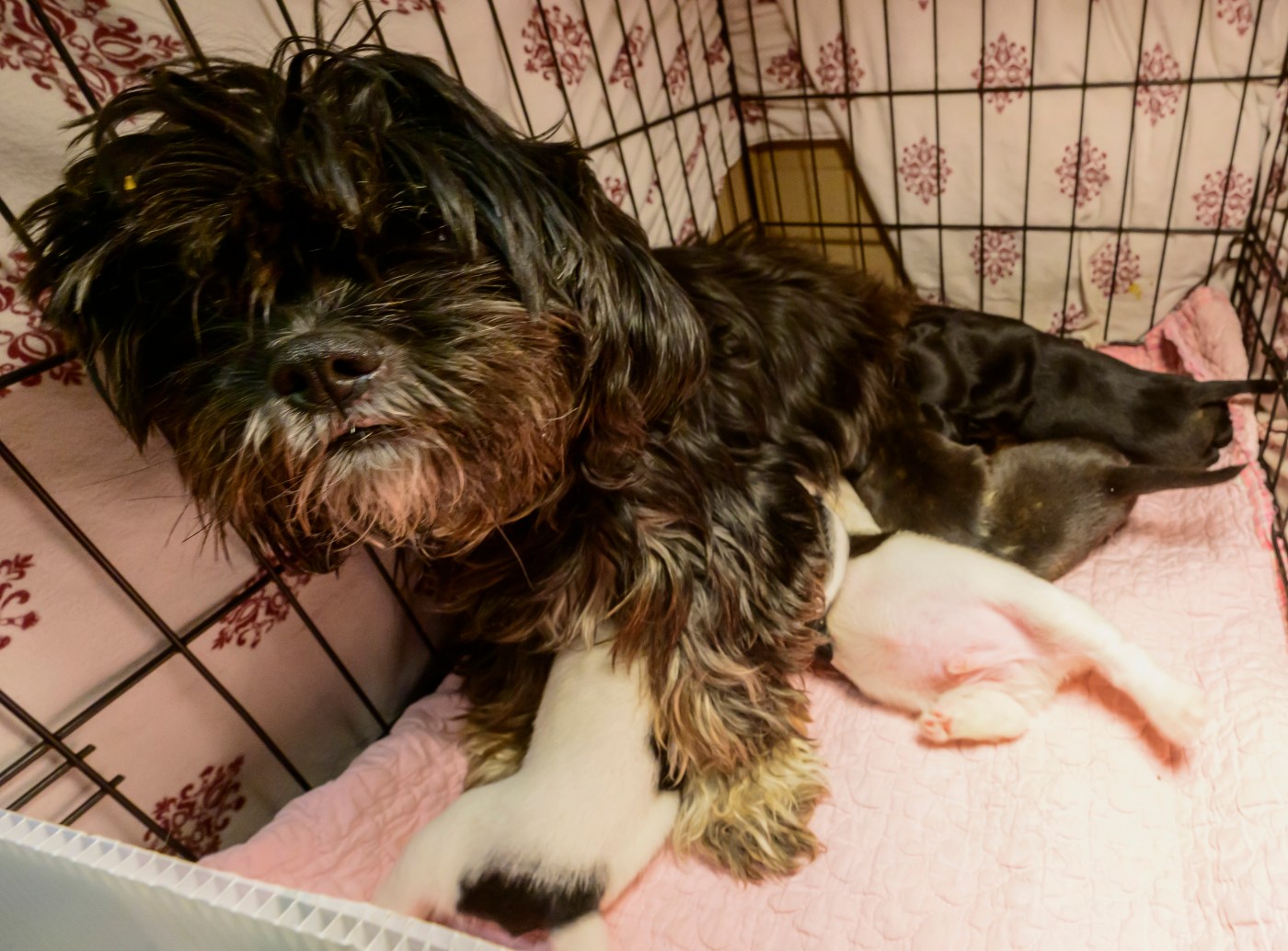
A North Minneapolis woman taking in a sudden influx of stray animals in crisis needed help, especially after a rescued dog in her care unexpectedly gave birth to a litter of puppies.
A small rescue already at capacity referred the case to Jeanne Weigum of Pooches United with People (PUP), who called the woman to get more information.
“The first words out of her mouth were, ‘I’m Hispanic,’” said Weigum of the St. Paul-based nonprofit. “She basically indicated that she had taken in all these dogs and cats of people who were being ‘disappeared’ from the ICE activity. She said people are going away and they’re just putting their dogs and cats outdoors, hoping somebody will take care of them. She said she was working with a young man who was helping catch these dogs and cats and bringing them to her. She told me she’d already rehomed seven dogs.”
Even though Weigum was aware of the heavy presence of Immigration and Customs Enforcement officers in the Twin Cities for Operation Metro Surge, it was still startling to hear about these particular ripple effects.
“Even though I work with dogs, this was brand new to me and I’m embarrassed to say I had never even thought of it,” Weigum said.
Snowball, front, and Cinnamon after coming into care in January 2026 at Pet Haven in St. Paul. The rescue says the dogs’ owners were detained as part of Immigrations and Customs Enforcement’s Operation Metro Surge. (Kerry D’Amato / Pet Haven)
This crisis is different from past pet crises, Weigum says.
“Because of Katrina, when there was such a catastrophe with animals, the whole animal rescue community figured out how to deal with these big crises,” said Weigum of the 2005 hurricane. “So if it’s a hurricane or if there’s something like that, like floods, the big rescue organizations are set up now to deal with those issues, but this is a rolling crisis. It’s clearly a rolling crisis in our community.”
For pets and their people, it’s also a quieter kind of crisis, one that some organizations and rescuers are still realizing.
“The fact that nobody had talked to me about it, that I hadn’t thought about it, suggests to me that this is a crisis that we haven’t even defined yet as a crisis,” Weigum said recently. “Once you define something as a crisis, you start figuring out what to do about it. I’m not sure anybody’s even doing that yet.”
A dog in a car
In an interview with Michael Barbaro of “The Daily,” a New York Times podcast, Minneapolis Police Chief Brian O’Hara was asked about how ICE operations were impacting policing in the city.
That impact included the story of a dog in a car.
“So we’ve just gotten a pretty dramatic increase in 911 calls from people in the community related to a lot of the street enforcement that’s happening,” O’Hara said in the interview that aired on Jan. 12. “And it’s things like: People are being arrested, and their cars are left — sometimes left in the roadway, sometimes blocking the street, and in one case left when it wasn’t even placed in park and was rolling down the road. We had another time where there was a dog in the car, and they left the dog in the car.”
But, in terms of the numbers of dogs and cats in the animal control system, it doesn’t appear to be a significant issue yet.
“MACC (Minneapolis Animal Care & Control) hasn’t seen a real uptick,” said a spokesperson for the city of Minneapolis. “Just a few animals.”
It’s the same in St. Paul.
“We have the same year-to-date number of impounded animals as we did this time last year,” said a spokesperson with the city of St. Paul.
The Animal Humane Society, the largest animal welfare organization in the Upper Midwest, concurs.
“We have had less than a handful of calls that we know of over the last couple of weeks related to ICE,” said a spokesperson last week. “We take about 1,000-plus calls a month, so three calls in two weeks isn’t huge. These folks were surrendering because they were either leaving the country or state, or in one instance the owner was deported and a co-worker had their dog and was surrendering to us.”
Related Articles
Videos show deadly Minneapolis shooting and political leaders reach different conclusions
From frigid quiet to outraged sorrow, a few hours on Minneapolis street where agents killed man
Immigrant families protest at Texas facility housing 5-year-old boy, father detained in Minnesota
The man killed by a US Border Patrol officer in Minneapolis was an ICU nurse, family says
Thousands rally against immigration enforcement in subzero Minnesota temperatures
But if this situation is impacting pets, some local rescue groups say, in addition to potential language barriers, people might not feel comfortable saying why they are surrendering their animals — and, anecdotally, they are turning for help within their own circle, if they have time to turn to anyone at all.
(At press time, the Pioneer Press was waiting to hear back from U.S. Department of Homeland Security representatives on how they handle pets if detaining people locally.)
But, across all rescues interviewed, it’s clear that pet owners currently in fear of being detained or deported are needing places or people to take their pets in an emergency and they need help now getting supplies like pet food and cat litter while they hunker down at home during this surge.
Feline Rescue
Across St. Paul at Feline Rescue, the kennels are full and the inquiries are incoming.
“We have seen an uptick of cats left at our door,” said Traia Thiel, cat support services manager of the St. Paul-based nonprofit. “I can’t say it’s ICE-related, but it feels correlated. They are usually in carriers. I commend them for leaving them in a place that all but guarantees cats end up safe, but it’s cold.”
Sometimes, the rescue does know more about the pets’ stories due to the inquiries they receive.
“One type is folks who are reaching out on behalf of their neighbors who have had to go into hiding, and so they’ve left their cats with their neighbors who are then trying to rehome the cats for them,” Thiel said.
Another recent call came in for help from people also in hiding while dealing with a deported family member’s two litters of kittens.
“They’re suddenly trying to feed all these kittens and they haven’t been able to leave the house to get food and supplies,” Thiel said.
Feline Rescue is doing what it can to help, despite a full house from taking in cats from an unrelated hoarding situation as well as the current atmosphere of fear and uncertainty.
“Our adoption rates have dropped over the last two weeks,” Thiel said. “It’s cold, people are scared to come in and maybe it feels like not a good time to make a permanent decision for your family … but we are trying to reserve intake slots for anyone directly affected by Immigration and Customs Enforcement.”
The nonprofit also partners with Keystone Community Services, bringing pet supplies to Keystone for its food programs, which include a mobile food shelf service.
For more info or to donate to Feline Rescue’s Community Outreach & Services, visit felinerescue.org/community-outreach-and-services/. The rescue is also in need of foster homes for senior cats and behavioral/under-socialized cats, apply at felinerescue.volunteerportal.org/?nd=opportunities.
Pet Haven
The staff at Pet Haven — a foster-based animal rescue with a facility on Minnehaha Avenue in St. Paul — are also seeing people and pets in crisis right now.
Cruise after he came into care in January 2026 at Pet Haven in St. Paul. Cruise was surrendered along with his sibling, Crash. The rescue says their owners were returning to Brazil over fears of Immigrations and Customs Enforcement’s Operation Metro Surge, even though they have legal status to live and work in the United States. (Kerry D’Amato / Pet Haven)
“We’ve taken in about 18 animals that have been directly affected by ICE operations,” said Kerry D’Amato, executive director. “I cry more often these days than I ever have. Our facility is in the heart of one of Minnesota’s oldest historical immigrant neighborhoods, Frogtown. We are under attack. Our neighbors are scared. Fosters afraid to leave their house to come get supplies. We are all suffering.”
In some cases, it’s not clear why the pets were separated from their owner — like Otto. The dog was found in an abandoned vehicle that was towed to an impound lot. It took a long time, possibly a month, before anyone discovered the dog and brought him to Pet Haven.
“We have him,” D’Amato said. “He somehow survived.”
There are other cases where the pets’ stories are definitely related to Operation Metro Surge.
“On Friday, we took in six dogs from three different families, all affected by ICE,” D’Amato said. “The immigrant community is very tight and they support each other. There is a community member, in the Latin community, this person became the drop-off point for people who were taken or fearing being taken or leaving, so this person took all these animals and contacted someone who knew us.
“Three days before, we also took in two cats from a mobile home park that belonged to a husband and wife taken by ICE,” she said.
People are coming to Pet Haven, D’Amato says, because they know it really is a haven.
“We have whistles at our front door, we have a sign that says ICE is not welcome; people know it’s a safe space,” she said.
That said, the costs are significant: In Otto’s case, for example, he is currently in foster care and his dental work alone could cost $3,000 or more.
The public can drop off pet food and supplies at Pet Haven, 505 W. Minnehaha Ave., from 11 a.m. to 5:30 p.m. on Wednesdays and Fridays, 3 to 7 p.m. on Thursdays and 10 a.m. to 2 p.m. on Saturdays. More info/donate at pethavenmn.org.
The Bond Between
The ordinary tasks of going to the store to purchase food for your pet or taking them on a walk are not something everyone feels comfortable doing right now in the Twin Cities.
This is something that Rachel Mairose, executive director of the Bond Between, is learning.
“Somebody that I ran into yesterday was crying because she hadn’t walked her dog in a month because she was too scared to go outside,” Mairose said. “She said, ‘What kind of world is this where I can’t even walk my dog?’ That’s just heartbreaking to hear.”
The Bond Between wants to help.
“We’re hoping to be a resource for people who are potentially going to be displaced,” Mairose said.
The nonprofit encourages pet owners to have a plan in place for their pets as Operation Metro Surge continues.
“Everybody’s talking about the human side of it, but pets are also impacted by all of this,” Mairose said.
The nonprofit, which has locations in Minneapolis and Minnetonka, is letting the community know they are open to both surrenders and respite care for pets in this crisis. The organization also has a food shelf.
The help is needed.
“Right now, it’s friends or family members of people who have been detained or are deported and they have custody of the animal, so they’re the ones reaching out to us,” Mairose said.
This is how the organization came to know a Mastiff-Cane Corso mix named Chapo who is in need of a foster home.
“His dad was taken,” Mairose said. “A friend is taking care of him, but can’t long term, and this is not something he expected to happen — that’s his family member and it’s horrible to feel helpless after you have been detained.”
It’s not the organization’s only pet in crisis.
“We have another family where the father is getting deported to Venezuela and his wife and daughter are going to follow him because they want to stay together, but they have a little dog they can’t take,” she said. “These are the situations that are heartbreaking right now — the animal is confused and it’s just another layer of stress for that family that is already going through a hard time. And so, we’re just doing what we can to get resources to families.”
To learn about those resources as well as fostering/donating, go to thebondbetween.org.
Good Samaritans
The Minneapolis woman who is taking in displaced animals spoke to the Pioneer Press recently about the situation from her home in Minneapolis, on the phone and with a rescued cat sitting on her chest while she talked.
The Pioneer Press is not naming the woman at her request; she has security concerns.
While she lives in Minneapolis now, the displaced animals in her care come from a suburban mobile home community where she says she used to live; she still is in contact with some neighbors, including a young good Samaritan rescuing animals there as people scramble in the face of ICE’s presence.
“He was asking me to take this animal or that animal, and I asked, ‘What is going on?’” she said. “That’s when he said that people are just opening doors and letting pets out.”
While she says she has not witnessed the situation herself, the young man paints a picture of a tense neighborhood: “He told me about one guy coming back from getting groceries on his bike and they arrested him,” she said.
Helping the pets of her former neighborhood feels natural; some of her first memories in Mexico involve trying to save chickens, she says.
“I was born that way,” she said. “I have been protecting animals all my life.”
That includes a young dog named Lafond and her six puppies.
Lafond’s spa day
Cassie Eiynck, a pet groomer at Pet Evolution St. Paul, holds the leash of Lafond, a rescue dog, as Sarah Watson, a volunteer with Pooches United with People (PUP), tells Lafond she’ll back after the dog’s haircut and bath on Thursday, Jan. 15, 2026. (John Autey / Pioneer Press)
As some dogs around her got a bit feisty for their time in “The Groom Room” on Jan. 15, Lafond quietly enjoyed her comped grooming session at Pet Evolution St. Paul at 1074 Grand Ave.
“The whole spa day, she got it,” said Angie Reeves, owner of the St. Paul location.
The former stray, possibly a Shih Tzu mix, definitely needed tidying up after running loose and giving birth: She had some matted hair and other hygiene issues, but one thing was clear to groomer Cassie Eiynck: This dog was socialized, this dog was loved. A lap dog, probably. And now, after apparently losing her home for unknown reasons and in unknown circumstances, a dog with a fresh start.
“You did such a good job,” said PUP volunteer Sarah Watson when the grooming session was finished and dog treats were in hand.
Rescue dog Lafond after being groomed. (Brittney Pryce / Pet Evolution St. Paul)
“I loved helping her out,” Eiynck said.
The pet store does what it can, with the owner covering the cost of grooming and tip for Lafond’s session but also regularly hosting adoption events for PUP.
“We’re not taking political stances or anything,” Reeves said. “We’re just really wanting to support folks being impacted.”
After Lafond’s puppies are weaned, they will be available for adoption before their mom, who will be available later, after she is out of the postpartum period and has been spayed. Check/donate at pupmn.org.
Advice for pet owners
The Minneapolis woman with the dog and puppies had initially reached out to a different animal rescue organization in the metro. This small but established rescue asked PUP to help because they already had their hands full. They still do.
When contacted by the Pioneer Press earlier this month, the rescue had just taken in several dogs from someone who told them they had ICE knocking on their door. After initially giving an interview to the Pioneer Press, the organization’s president later asked not to be named as they are busy with current requests for help from the community, including helping those with cats in need.
She did share some advice for all of us, though, citizens as well as people without legal status.
“The biggest thing is to let people know: Don’t take animals in your car if you are going for an errand,” she said. “Because you don’t know if ICE is going to stop you, detain you and leave the animal in a running car. Only take the pets out if you are bringing them to a vet appointment.”
Also, she said, if you believe you are at risk of detainment, leave a piece of paper somewhere prominently in your home with emergency contacts for people or organizations who can help your pets.
“Because, like this mom with puppies,” she said, “it’s typically your neighbors watching out for you.”
Saying goodbye to Master Shifu
Master Shifu settles into his three-level kennel at Feline Rescue in St. Paul on Jan. 16, 2026. His owner surrendered him as she’s returning to her home country and can’t bring him along. (Traia Thiel / Feline Rescue)
The young woman arrived at Feline Rescue with red eyes, her cat in a carrier.
It was time to say goodbye to Master Shifu.
“I’m originally from Canada and I have the privilege of being white in this country right now, but I just feel sick that my tax dollars are going toward what they are right now … it’s just so scary,” said the woman, a dual citizen who asked not to be identified out of security concerns. “And so me and my family talked about it and we were like, ‘We have to go back.’”
Master Shifu, however, is staying here.
“My partner’s in Canada and they’re very allergic to cats,” she said.
Related Articles
Videos show deadly Minneapolis shooting and political leaders reach different conclusions
Paul Allen, radio voice of the Vikings, mocks Minnesota protestors
Immigrant families protest at Texas facility housing 5-year-old boy, father detained in Minnesota
The man killed by a US Border Patrol officer in Minneapolis was an ICU nurse, family says
Man fatally shot by federal officers in Minneapolis identified
Because no one she knew here could take in her cat, she was surrendering Master Shifu to Feline Rescue, who will find a new home for the young tuxedo.
“I looked into this rescue and I’m very hopeful because it seems like there are a lot of great people who work here,” she said.
Thiel is one of those people. On Friday, she walked the woman through the paperwork, handed her a box of tissues and gave her time to privately say goodbye to Master Shifu as he settled into the kennel where he would be temporarily housed.
“I’m sorry,” the woman said to her cat. “I love you.”
Master Shifu is now available for adoption. View his profile at felinerescue.org.
Leave a Reply