By JOSH BOAK, AAMER MADHANI and WILL WEISSERT, Associated Press
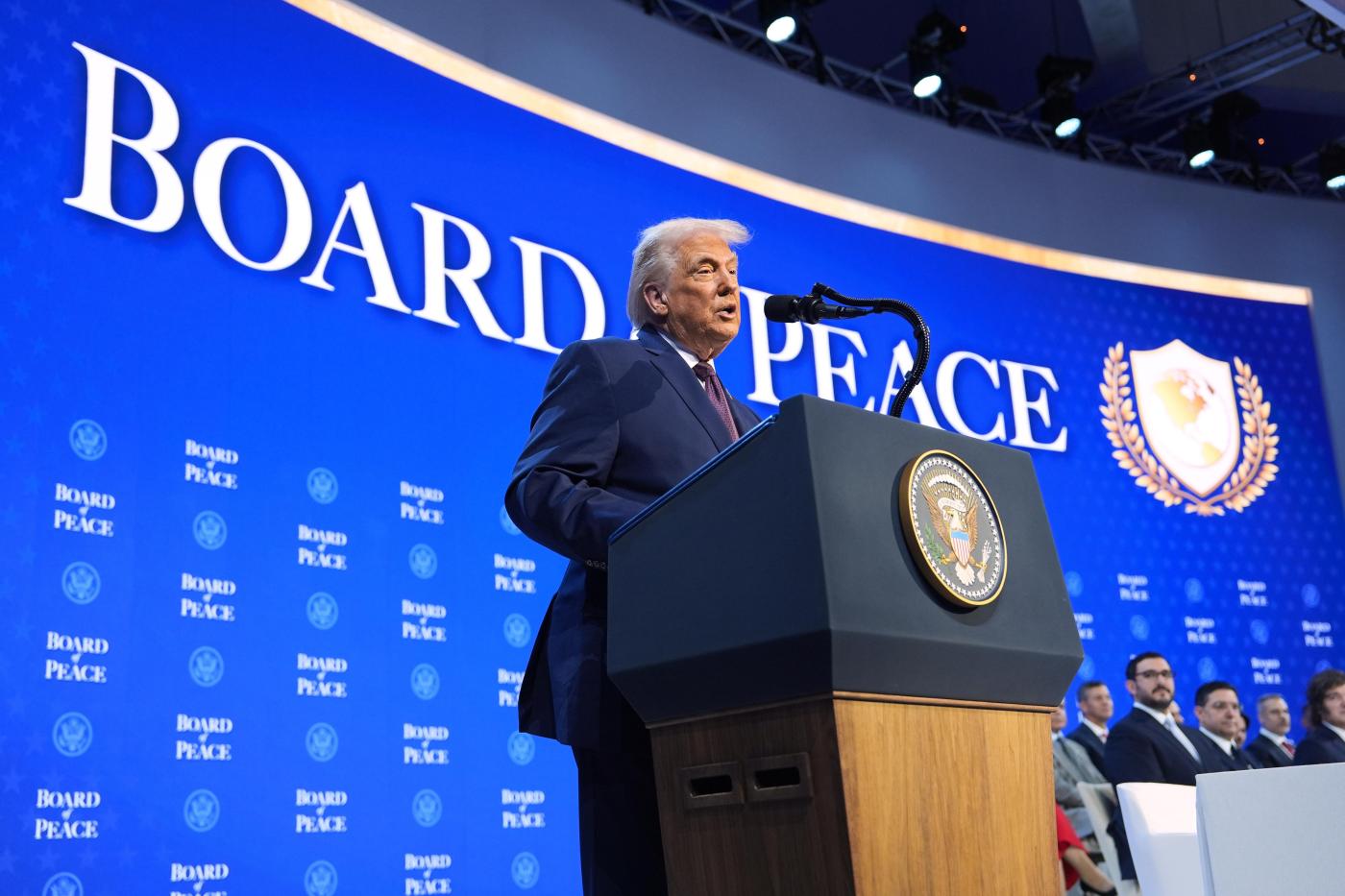
DAVOS, Switzerland (AP) — President Donald Trump on Thursday inaugurated his “ Board of Peace ” to lead efforts at maintaining a ceasefire in Israel’s war with Hamas, insisting that “everyone wants to be a part” of the body that could eventually rival the United Nations — despite many U.S. allies opting not to participate.
President Donald Trump arrives for a Board of Peace charter announcement during the Annual Meeting of the World Economic Forum in Davos, Switzerland, Thursday, Jan. 22, 2026. (AP Photo/Evan Vucci)
In a speech at the World Economic Forum, Trump sought to create momentum for a project to map out a future of the war-torn Gaza Strip that has been overshadowed this week, first by his threats to seize Greenland, and then by a dramatic retreat from that push.
“This isn’t the United States, this is for the world,” Trump said, adding, “I think we can spread it out to other things as we succeed in Gaza.”
The event came as Ali Shaath, head of new technocratic government in Gaza, said the Rafah border crossing will open in both directions next week. That’s after Israel said in early December it would open the crossing, which runs between Gaza and Egypt, but has yet to do so.
The new board was initially envisioned as a small group of world leaders overseeing the ceasefire, but has morphed into something far more ambitious — and skepticism about its membership and mandate has led some countries usually closest to Washington take a pass.
Trump tried not to let who wasn’t there ruin his unveiling party, saying 59 countries had signed on. He told a group of participating world leaders and top diplomats from Azerbaijan to Paraguay to Hungary, “You’re the most powerful people in the world.”
Trump said of those assembled “every one of them is a friend of mine” and noted that in “most cases” they were “very popular leaders. Some cases — not so popular. That’s the way it goes.”
President Trump stands on the podium at the beginning a session on the Board of Peace initiative of US President Donald Trump at the Annual Meeting of the World Economic Forum in Davos, Switzerland, Thursday, Jan. 22, 2026. (AP Photo/Markus Schreiber)
Attending were Secretary of State Marco Rubio, U.S. special envoy Steve Witkoff and Jared Kushner, the president’ son-in-law and a key overseas negotiator for his administration on several fronts.
Among those also on-hand were Saudi Arabia’s Foreign Minister, Prince Faisal bin Farhan; Azerbaijan’s President Ilham Aliyev; Armenian Prime Minister Nikol Pashinyan, and President Kassym-Jomart Tokayev of Kazakhstan. Many are Trump allies, including Argentina President Javier Milei and Indonesia President Prabowo Subianto.
Trump has spoken about the board replacing some UN functions and perhaps even making that entire body obsolete one day.
But he was more conciliatory in his remarks on the sidelines of the forum in the Swiss alps, saying “We’ll do it in conjunction with the United Nations,” even has he denigrated the UN for doing what he said wasn’t enough to calm some conflicts around the globe.
Rubio noted during the event that some countries’ leaders have indicated that they plan to join but still require approval from their parliaments, and the Trump administration says it has also gotten queries about membership from countries that hadn’t been invited to participate yet.
Why some countries aren’t participating
Big questions remain, however, about what the eventual board will look like.
Related Articles
Denmark says its sovereignty is not negotiable after Trump’s Greenland about-turn
Jack Smith is set to testify at a public hearing about his Trump investigations
Conservative group says Los Angeles school policy hurts white students in federal lawsuit
Autopsy finds Cuban immigrant in ICE custody died of homicide due to asphyxia
Trump pushes for lower rates and ban on investor home purchases in bid to make homes more affordable
Russian President Vladimir Putin said his country is still consulting with Moscow’s “strategic partners” before deciding to commit. The Russian president on Thursday is due to host Palestinian President Mahmoud Abbas for talks in Moscow.
Others are asking why Putin and other authoritarian leaders had even been invited to join. Britain’s foreign secretary, Yvette Cooper, said her country wasn’t signing on “because this is about a legal treaty that raises much broader issues.”
“And we do also have concerns about President Putin being part of something which is talking about peace, when we have still not seen any signs from Putin that there will be a commitment to peace in Ukraine,” she told the BBC.
Norway and Sweden have indicated that they won’t participate, after France also said no. French officials stressed that while they support the Gaza peace plan, they were concerned the board could seek to replace the U.N. as the main venue for resolving conflicts.
Slovenian Prime Minister Robert Golob said “the time has not yet come to accept the invitation,” according to the STA news agency, with the main concern being the board’s mandate may be too broad and could undermine international order based on the U.N. Charter.
Canada, Russia, Ukraine, China and the executive arm of the European Union also have not yet indicated their response to Trump’s invitations. Trump calling off the steep tariffs he threatened over Greenland could ease some allies’ reluctance — but the issue is still far from settled.
The Kremlin said Thursday that Putin plans to discuss his proposal to send $1 billion to the Board of Peace and use it for humanitarian purposes during his talks with Abbas. But he noted that the use of those assets will require the U.S. action to unblock them.
Board grew out of ceasefire proposal
The idea for the Board of Peace was first laid out in Trump’s 20-point Gaza ceasefire plan and even was endorsed by the U.N. Security Council.
Invitation letters to world leaders ahead of Davos indicated that the panel may not confine their work to Gaza. Israeli Prime Minister Benjamin Netanyahu announced he’s agreed to join, after his office has earlier criticized the makeup of the board’s committee tasked with overseeing Gaza.
Months into the ceasefire, Gaza’s more than 2 million Palestinians continue to suffer the humanitarian crisis unleashed by over two years of war. And violence in Gaza, while not at the same level as before the October ceasefire and hostage deal was agreed on, continues.
Key to the truce continuing to hold is the disarming of Hamas, something the militant group that has controlled the Palestinian territory since 2007 has refused to do and that Israel sees as non-negotiable.
Trump said Thursday that the war in Gaza “is really coming to an end” while conceding, “We have little fires that we’ll put out. But they’re little” and that they had been “giant, giant, massive fires.”
Iran protests loom in background
Trump’s push for peace also comes after he threatened military action this month against Iran as it carried out a violent crackdown against some of the largest street protests in years, killing thousands.
Trump, for the time being, has signaled he won’t carry out any new strikes on Iran after he said he received assurances that the Islamic government would not carry out the planned hangings of more than 800 protesters.
But even as he prepared to unveil his Board of Peace, Trump also made the case that his tough approach to Tehran — including strikes on Iran’s nuclear facilities in June last year — was critical to the Israel-Hamas ceasefire deal coalescing. Iran was Hamas’ most important patron, providing the group hundreds of millions of dollars in military aid, weapons, training and financial support over the years.
Meeting with Zelenskyy
Trump also expects to speak with Ukrainian President Volodymyr Zelenskyy, who arrived in Davos on Thursday morning for a meeting expected after the morning’s Board of Peace announcement.
But Trump, who continues to struggle to get Zelenskyy and Putin to agree to terms to end their nearly four-year old war, again expressed frustration with both on Wednesday.
“I believe they’re at a point now where they can come together and get a deal done,” Trump said. “And if they don’t, they’re stupid — that goes for both of them.”
Madhani and Weissert reported from Washington.
Leave a Reply