“From a sustainability and environmental justice perspective, the question is not whether redevelopment should occur, but under what conditions and for whose benefit.”
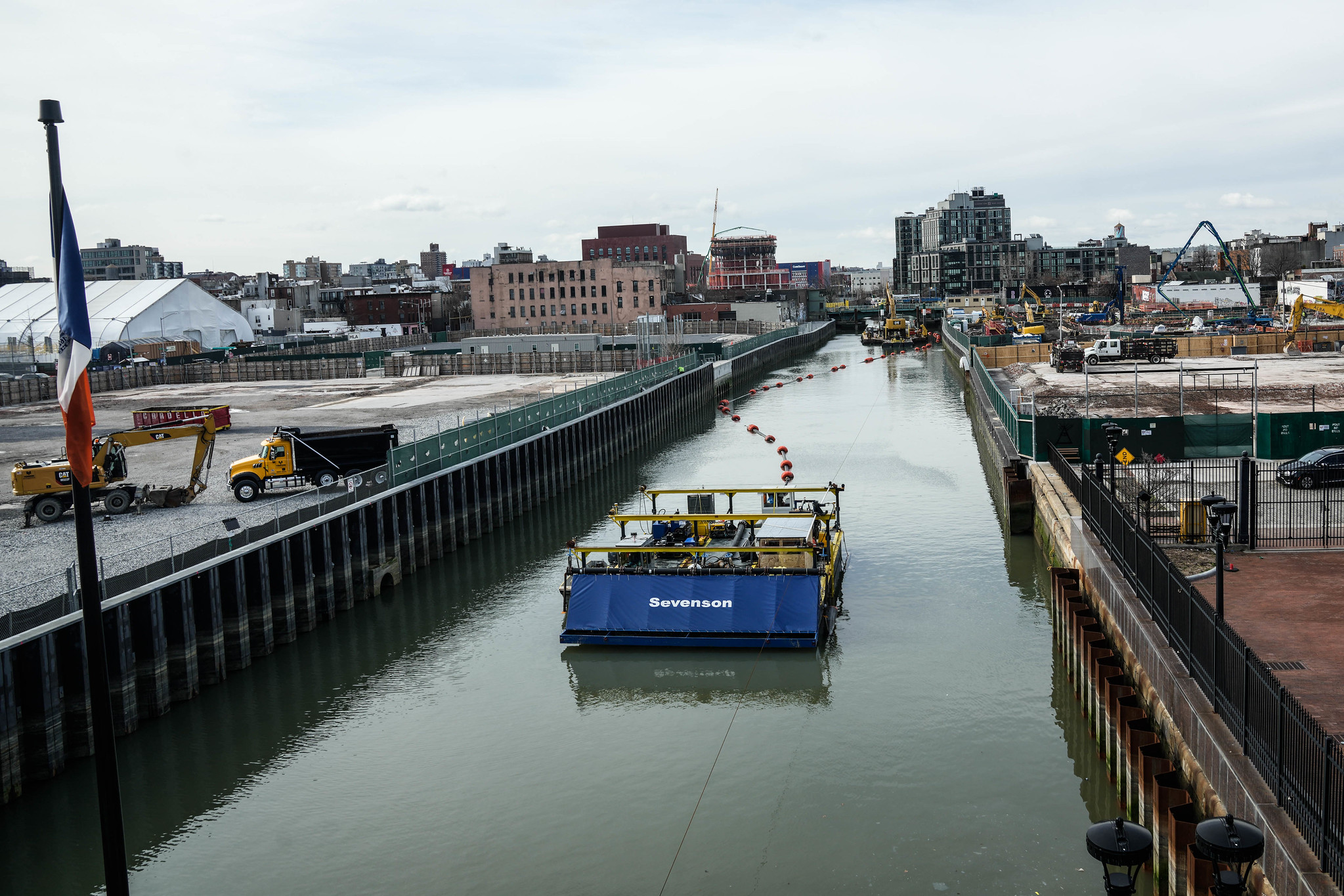
The Gowanus Canal in 2023. (Michael Appleton/Mayoral Photography Office)
For years, the Gowanus Canal has been presented as a success story in progress: a federal Superfund cleanup, new sewer tanks, and a rezoning that promises thousands of new apartments along a “revitalized” waterfront. But at 459 Smith St., a former manufactured gas plant parcel on the canal’s western edge, the story looks less straightforward.
Known in state records as the 459 Smith Street Brownfield site (Site No. C224012B), part of the K-Citizens MGP—Carroll Gardens complex, it’s classified as posing a “significant threat to public health or the environment,” according to New York’s Department of Environmental Conservation. Decades of gas production left coal tar and associated contaminants in soil, groundwater, and soil vapor, and helped create the toxic canal sediments often described as “black mayonnaise.”
Yet the site is being handled under New York’s voluntary Brownfield Cleanup Program (BCP), rather than the State Superfund framework generally used when the state seeks stronger enforcement leverage and long-term accountability at highly contaminated sites. That choice of program, and the development planned on top of it, raises fundamental questions about who is protected, who pays, and what we mean by “sustainability” in practice.
The 3.81-acre parcel once hosted fertilizer operations and later served as key infrastructure for the Citizens Manufactured Gas Plant. Investigations by NYSDEC and National Grid have documented coal tar at substantial depths, along with elevated contaminants in groundwater and vapor. Since entering the Brownfield program in 2019, remedial work has included excavation and removal of impacted material and canal-edge controls. NYSDEC materials also note that the canal remains hydraulically connected to the site, and that an impermeable bulkhead is intended to address that connection.
Those are significant steps. But NYSDEC’s own documents, including the Draft Remedial Action Work Plan and a recent Pre-Design Investigation work plan, make clear that the site is not “clean” in any ordinary sense. Contaminated historic fill remains in place, contaminants of concern persist in soil, groundwater, and vapor, and the future use of the parcel will rely on long-term engineering and institutional controls. The proposed remedy is designed to contain and monitor contamination, not remove it entirely.
Seen through an environmental governance lens, the decision to keep 459 Smith in the Brownfield program rather than treat it as a State Superfund site matters. Brownfield is a voluntary, incentive-driven program designed to spur redevelopment through negotiated remedies and tax credits. State Superfund was created for the most serious hazardous waste sites, with a stronger presumption that responsible parties will pay for robust, enforceable cleanups.
The two programs also differ in how cleanup costs are structured and recovered. Under the State Superfund program, the state can draw on a dedicated fund to investigate and remediate a site and then seek cost recovery from identified responsible parties. Under the Brownfield Cleanup Program, a private party enters as a “volunteer,” finances investigation and remedial work up front, and may receive substantial state tax credits in return. In the case of regulated utilities such as National Grid, many of those costs can ultimately be recovered through rates charged to customers, subject to approval by utility regulators. Program choice, therefore, has material implications for how the financial burden of remediation is distributed among polluters, ratepayers, taxpayers, and private developers.
Here, NYSDEC’s own registry acknowledges that 459 Smith is heavily contaminated and a significant threat, and that there is a clear, viable responsible party: National Grid. Yet the parcel has been carved out of the broader Citizens MGP complex and placed in BCP, with a developer entity serving as the Brownfield “Volunteer” and National Grid and the site owner listed as project applicants for the remaining work. That classification shapes who ultimately pays (ratepayers, taxpayers, shareholders), what level of cleanup is pursued, and what happens if long-term monitoring reveals new problems.
Community advocates and local elected officials have treated this as more than a bureaucratic detail. In July 2025, the coalition Voice of Gowanus filed a complaint with the State Inspector General and NYSDEC’s internal investigations office, arguing that using BCP for such a heavily contaminated “significant threat” parcel misuses the Brownfield statute and sets a troubling precedent for other former gas plant sites. Assemblymember Jo Anne Simon echoed those concerns in a comment letter, arguing that the Brownfield classification is a serious legal misfit for a “significant threat” parcel and that Track 4 remedies—often reliant on caps, vapor systems, and deed restrictions—do not provide the same enforcement leverage and long-term accountability as a Superfund pathway.
All of this sits beneath an ambitious development proposal. NYSDEC describes the concept as three multi-story buildings—two mixed-use commercial/residential buildings and one separate multi-story commercial building—along with canal-edge public realm improvements, including a new pedestrian walkway, a mapped Nelson Street segment, and roughly 90,000 square feet of open-air space. Immediately north, on land that was once part of the same industrial complex, Gowanus Green is planned as a 100-percent affordable housing campus with a new public school and public open space. The affordability and public access embedded in Gowanus Green are essential wins in a city facing overlapping housing and climate crises. The point is not to halt those projects, but to ensure they rest on the most protective and enforceable cleanup possible.
From a sustainability and environmental justice perspective, the question is not whether redevelopment should occur, but under what conditions and for whose benefit. Coal tar and volatile contaminants do not distinguish between market-rate and affordable units, or between rooftop pool users and schoolchildren. If residual contamination or future plume migration undermines indoor air, groundwater, or even the canal’s Superfund remedy itself, those impacts will be shared—though not equally.
The planned school at Gowanus Green is a good example of how risk and opportunity intersect. Placing an educational facility so close to a restored but still vulnerable canal demands the highest cleanup standards and the most reliable long-term monitoring. It also creates an opportunity to design a truly “green” school: a building and curriculum that acknowledge the site’s history and equip students for the green and blue careers that New York will increasingly depend on. A school staffed with educators knowledgeable in environmental science, public health, and local history would be a significant asset to the neighborhood, helping interpret monitoring data and collaborating with agencies and community groups to track the lingering effects of legacy pollution over time.
Rather than treating the school as an ordinary neighborhood facility on an ordinary site, the city could commit to a specialized focus on climate, ecology, and environmental technology—from water-quality monitoring and green infrastructure to coastal resilience and environmental justice. Partnerships with local groups, conservancies, and community scientists could give students hands-on experience with real data from the canal and the surrounding watershed. Career and technical education tracks could prepare young people for jobs in stormwater management, environmental monitoring, urban forestry, and sustainable design—fields directly linked to the long-term health of Gowanus and other waterfront neighborhoods.
In this model, the school is not simply next to the canal; it is in relationship with it. Transparency about environmental conditions, real-time data displays, and classroom projects tied to ongoing monitoring would help ensure that both risks and progress are visible to students, families, and residents. That kind of integration—strong cleanup, robust oversight, a knowledgeable school staff, and meaningful educational engagement—would move the project closer to the promise of “sustainability” that Gowanus has been asked to embody.
What happens at 459 Smith St. will resonate far beyond one block of Gowanus. Across New York City, communities are grappling with how to clean up old industrial sites, build housing, and prepare for climate-driven flooding at the same time. Program classification—Brownfield versus Superfund—is one of the quiet levers that determines who bears the risks and costs. New York’s new Mayor Zohran Mamdani ran and won on an affordability-and-justice agenda that treated housing, enforcement, and everyday cost pressures as inseparable from broader structural reform. For City Hall, the governance of sites such as 459 Smith belongs squarely on that sustainability-and-affordability agenda—where climate risk, land-use policy, and environmental health meet questions of accountability and who ultimately pays.
Early signals from the new administration suggest an effort to move quickly on housing and tenant protection, with an emphasis on speeding the delivery of affordable units and strengthening enforcement against negligent landlords. The mayor has also framed schools and other public facilities as part of the city’s climate-resilience toolkit—places that can cool neighborhoods, absorb stormwater, and serve communities during heat events and emergencies.
Whether this administration chooses to apply that same climate-and-affordability lens in Gowanus—by pressing for stronger oversight at 459 Smith, supporting more protective remedies there and at Gowanus Green, and aligning program choices with the realities of toxic plumes and climate change—will send an important signal. It will tell New Yorkers whether “sustainability” is branding or a genuine commitment to aligning land use, infrastructure, schools, and justice across the entire city.
Mark Yarish is a Brooklyn-based sustainability researcher completing his doctorate in sustainability at Capitol Technical University. He serves on the Gowanus Canal Community Advisory Group and the Gowanus Oversight Task Force. The views expressed are his own.
The post Opinion: How 459 Smith St. Could Set a New Standard for Gowanus Redevelopment appeared first on City Limits.
Leave a Reply