
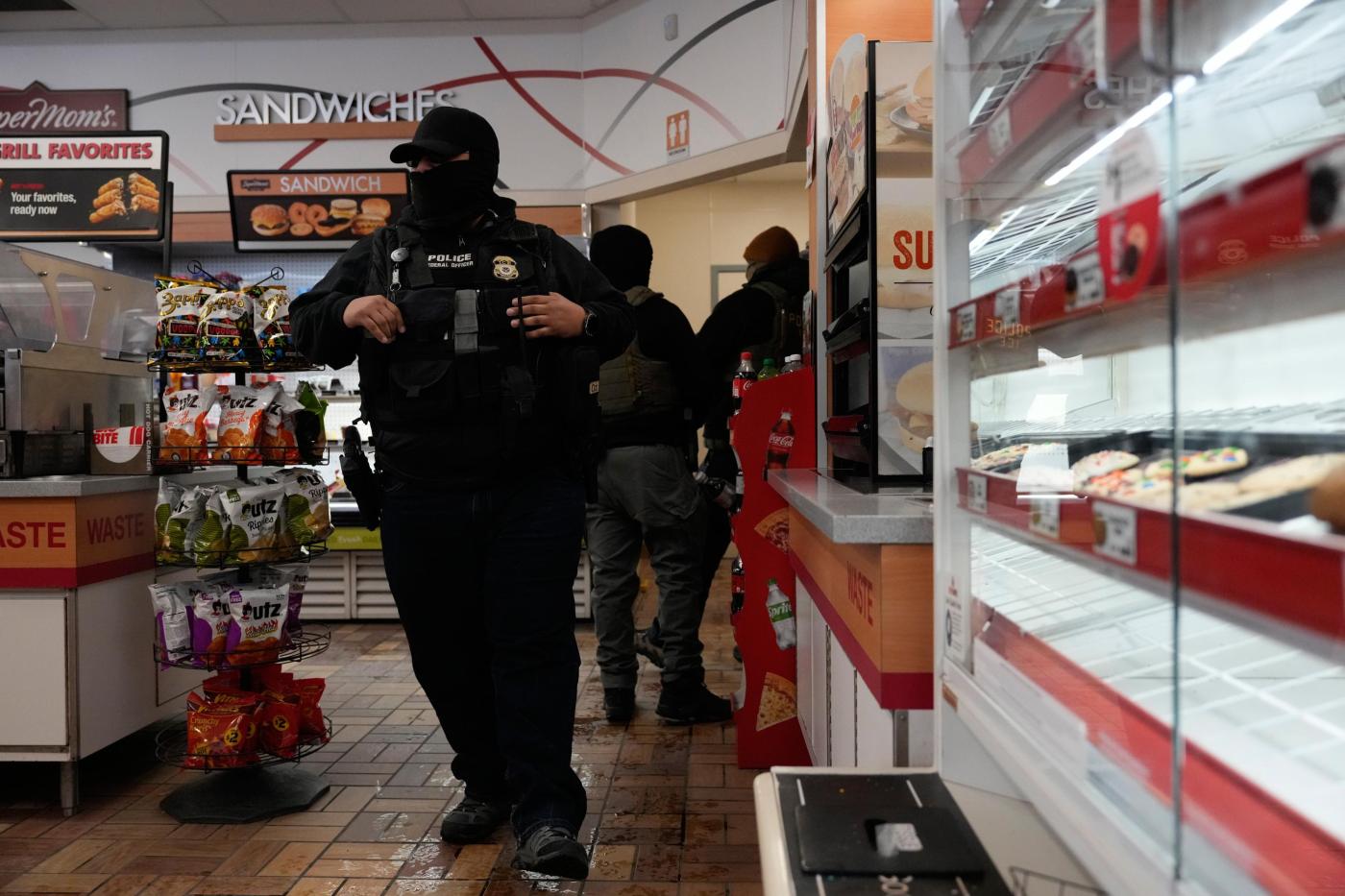
The St. Paul City Council plans to introduce an ordinance today that would prohibit law enforcement from staging on city-owned property for federal immigration enforcement and would limit access to non-public spaces.
The move comes as the city council announced today they intend to introduce a series of ordinances and policy changes over the coming weeks in response to immigration enforcement actions.
The discussion began after an Immigration and Customs Enforcement operation on Nov. 25 on Rose Avenue near Payne Avenue. St. Paul police said they were called to assist as protesters gathered. They used chemical irritants and less-lethal munitions.
Since then, ICE has ramped up its presence and work in Minnesota.
“The City must move urgently and therefore will not wait for one comprehensive update to the City’s existing separation ordinance,” the city council said in today’s statement.
The separation ordinance says city of St. Paul employees are not authorized to enforce federal immigration policies. The ordinance was established in 2004.
The ordinance updates being planned “do not change federal law, do not interfere with lawful federal enforcement actions, and do not prevent compliance with valid warrants or court orders,” the statement said. “Instead, they clarify the scope of the City’s authority and responsibilities under local law.”
Proposed ordinance also discusses ‘non-public city spaces’
All seven city council members are sponsoring the ordinance being introduced at today’s council meeting, which begins at 3:30 p.m. It says city-owned or city-controlled parking lots, ramps, vacant lots and garages are not open to the general public without restrictions.
And “no federal, state, or local government entity or personnel is authorized to use” those spaces “as a staging area, processing location, operations base, or any other similar use for enforcing federal immigration laws.”
City officials cannot authorize access “except when required by a signed judicial warrant or when access is otherwise required by law,” the ordinance says. “Such spaces are not available to the general public for similar activities, and federal, state, or local government entities or personnel will not receive special or enhanced access to city property for operations enforcing federal immigration laws.”
The ordinance also discusses “non-public city spaces” that are not accessible to the general public, such as those requiring badge access, breakrooms, workstations, storage closets and employee-only areas.
“Non-public city spaces are not open for the purposes of enforcement of federal immigration laws except with a signed judicial warrant or when access is otherwise required by law,” the proposed ordinance says. “City employees do not have the legal authority to consent to permit access to non-public city spaces in situations where a signed judicial warrant or other legal obligation would otherwise be necessary to gain access.”
An ordinance is a city law enacted by the city council. It is read at three separate council meetings, a public hearing is usually held at the second reading, and it becomes effective after passage by the council and 30 days after publication.
City council members also plan to discuss “subsequent immediate and near-term actions” today, according to their statement.
Related Articles
Minnesota: Amtrak cancels some services ahead of brutal winter weather
Legal referee tosses petition for restraining order against St. Paul mayor
Food producers, vendors invited to St. Paul lunch-and-learn event amid ICE impacts
Founders of St. Paul addiction recovery nonprofit charged with drug trafficking
Minnesota statewide strike, economic blackout to protest ICE on Friday
Leave a Reply