“By centering broader, more accessible forms of participation and tying engagement to real outcomes, the city has an opportunity to align civic conversation with civic reality.”
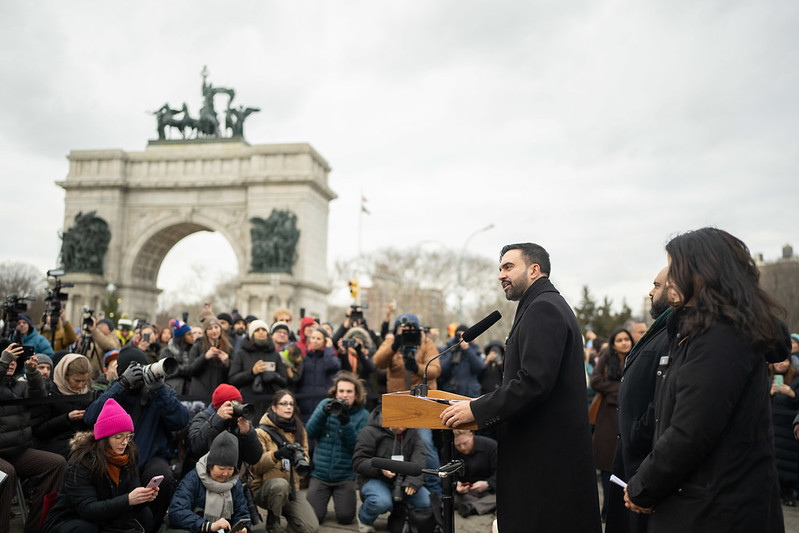
Mayor Zohran Mamdani announcing the Mayor’s Office of Mass Engagement (OME) on Friday, January 2, 2026. (Michael Appleton/Mayoral Photography Office)
On his second day in office, Mayor Mamdani signed an executive order establishing an Office of Mass Engagement. It is both a policy shift and the creation of a new agency for a new mayor.
The order names a problem that anyone who has spent time in civic life recognizes. Too often, “community” is defined by the few who repeatedly show up or happen to be in the room. That is not because they care more, but because they have the time, flexibility, and familiarity with civic processes that many New Yorkers do not. When those voices are treated as synonymous with an entire district, our understanding of the public and consensus becomes distorted.
The Office of Mass Engagement is designed to build consensus and inform policy decisions through mass engagement, not just by listening to whoever shows up to meetings. There are degrees of consensus. One rare area of broad agreement in New York City is the need to make the city more affordable, with housing being the biggest driver of cost. How to fix that problem has less consensus, but the 2025 election gave us real insight and a real opportunity for this new mayor.
After millions were poured into campaigns both supporting and opposing the pro-housing ballot measures, voters approved them decisively. These measures removed a councilmember’s ability to veto housing in their district, a power that has been used repeatedly to block housing. The evidence is overwhelming that building housing at the right scale makes a city more affordable, and New Yorkers demonstrated they understand this. Had the ballot measures been defeated, I would have been disappointed, but I would have had to acknowledge that voters do not want to build housing faster. That is not what happened. Voters chose affordability through housing.
If you rely on the old methods, listening to the same folks at the same meetings, you will not achieve this. New York City has over 8 million people. Brooklyn Community Board 6, my district, has over 120,000 residents. Even if 200 people pack a meeting room, that represents a decimal point, not a majority.
The last few months in my neck of the woods have illustrated this dynamic with unusual clarity. I offer this example not because it is unique, but because it is familiar, a micro version of a broader and recurring pattern in civic life.
As is often the case after elections, attendance at community board meetings increased. The most consistent and unifying theme among many of the new attendees was opposition to the Court Street bike lane. Alongside that opposition came a recurring claim: that the community board does not represent the district, and that “the people” oppose bike lanes, new housing, and the broader policy direction reflected in the most recent election.
Showing up matters. But it does not confer ownership over the word “community.” As Roger Ebert famously reminded movie critics inclined to universalize their reactions, you saw this movie. The same applies here. Attendance and volume reflect a point of view and a style, not a consensus.
In an election-district-level analysis I completed last November, I examined how residents in the district actually voted, not just for candidates, but on the ballot itself. During the campaign, several social media accounts that explicitly claimed to speak for entire neighborhoods, some literally named after the neighborhoods they purported to represent, dedicated multiple posts and local media appearances to opposing the charter changes intended to speed housing development. Coverage often treated these voices as representative of neighborhood sentiment.
Guess what happened? The entities that claimed to speak for a neighborhood did not even win their own blocks, and every single election district in Brooklyn Community Board 6 approved the pro-housing ballot measures. And before the assumption creeps in that voters checked “yes” across the board, it is worth noting that there were six ballot questions, and they were not treated equally. Questions 1 and 6 failed. Questions 2, 3, and 4, the housing measures, passed overwhelmingly. Voters were discerning, not disengaged.
I will admit I was surprised by the margins. Sitting in community board meetings and other civic spaces, the loudest voices were often opposed to both the bike lane and the housing measures. But elections have a way of clarifying reality. When it comes time to count votes, decibels do not count twice.
What the last few months have shown, in my neck of the woods, is how easily the loudest or most organized voices can come to be treated as the neighborhood’s definitive voice, even when the data tells a different story. The specifics may vary by neighborhood, but the structure of the disconnect is consistent.
That divide between rhetoric and results mirrors other civic fights. In the Court Street bike lane dispute, opponents sued to stop the project. The case was dismissed. Check out crashcountnyc.com to get a sense of why we need protected bike lanes.
As reported by Streetsblog, Brooklyn Supreme Court Justice Inga O’Neale ruled that the New York City Department of Transportation acted on a rational basis, with the goal of safety, under state law, and made clear that decisions about how city streets are used are policy questions for elected and accountable officials, not the courts. If opponents want different outcomes, the remedy is not litigation; it is electoral change. Street safety and housing are connected. Building more housing increases density, which in turn requires better, more environmentally sound forms of transportation. This is why pro-housing and safe streets coalitions usually align.
The judge’s reasoning echoes the same principle that underlies the Office of Mass Engagement: decisions about our shared infrastructure belong to those accountable to the electorate, not to whoever can dominate a meeting room or a courtroom. Brooklyn Community Board 6 approved the Court Street bike lane unanimously. At some point, the question answers itself.
Mamdani received more votes than any mayoral candidate in decades, in part because his campaign reached new and different voters. The Office of Mass Engagement reflects that same understanding: governing requires meeting people where they are, not just engaging those already in the room.
This disconnect is not abstract to me. In my position, as is clear in the executive order itself, I regularly work with the offices it consolidates and oversees. The challenges it describes are the same ones I encounter in practice: fragmented engagement, feedback that is passionate but not representative, and systems that reward persistence and availability rather than broad participation.
The executive order acknowledges that our current civic structures privilege those with the most time and resources, and that engagement is too often disconnected and ad hoc. It also recognizes an essential truth: participation only builds trust when people can see how their involvement shapes outcomes. When election results are ignored or minimized in favor of whoever shows up most often, that trust erodes.
None of this is an argument against community board meetings or public testimony. Those forums matter. They surface concerns, refine policy, and provide accountability. But they are not, on their own, a representative sample of a community, especially when ballot-box turnout exceeds meeting attendance by several orders of magnitude.
This is precisely why the Office of Mass Engagement matters. By centering broader, more accessible forms of participation and tying engagement to real outcomes, the city has an opportunity to align civic conversation with civic reality.
The Mamdani administration has demonstrated in its first two weeks that it is serious about this approach. Earlier this month, the administration announced Rental Ripoff hearings in every borough, combined with tools to protect tenants and a call for residents to share their experiences with abusive landlords. Beyond City Hall, Gov. Kathy Hochul’s move to modernize the State Environmental Quality Review Act (SEQRA) signals that the political environment is shifting toward actually building the housing New Yorkers need. Even Jacobin has acknowledged the urgency, a recognition that now spans the political spectrum.
The goal is clear: make the city more affordable. Mamdani has committed to building 200,000 affordable housing units. You cannot achieve that with neighborhood vetoes, which is precisely why voters removed them. You also cannot achieve it by treating the preferences of whoever dominates a meeting room as representative of an entire community.
The Office of Mass Engagement is essential to this effort. Engagement should support governing, not paralyze it.
Mike Racioppo is the district manager of Brooklyn Community Board 6 and a commissioner on the Charter Revision Commission.
The post Opinion: Why Mamdani’s New ‘Office of Mass Engagement’ Matters appeared first on City Limits.
Leave a Reply