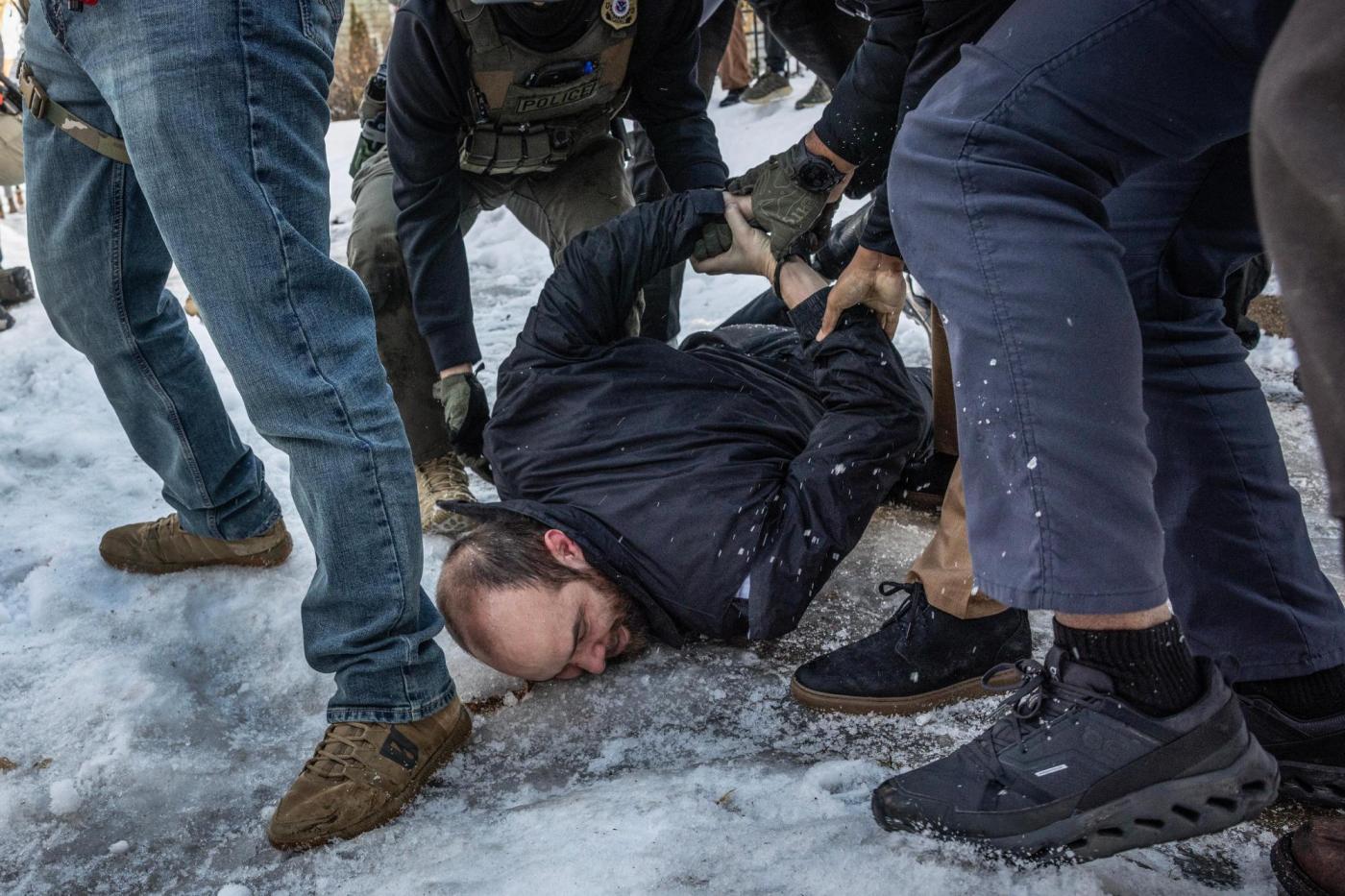
MINNEAPOLIS — The video shows a young employee in a reflective vest being hauled away by federal agents from the entrance of a Target store in a Minneapolis suburb.
“I’m a U.S. citizen!” the worker shouted as the armed agents shoved him into an SUV on Monday, after he had directed expletives at one. “U.S. citizen! U.S. citizen!”
In and around Minneapolis in recent days — in quiet residential neighborhoods and busy shopping districts, at gas station and big box store parking lots — similar chaotic scenes are unfolding, an escalation of tensions between residents and federal agents as the Trump administration intensifies its immigration crackdown in Minnesota following the killing of Renee Good by an immigration officer last week.
“It feels like our community is under siege by our own federal government,” said state Rep. Michael Howard, a Democrat whose district includes Richfield, where the Target employee and another colleague were seized Monday.
Howard said both workers were U.S. citizens and were later released. The Department of Homeland Security said the Target worker seen in the video was arrested in connection with “assaulting, resisting or impeding federal officers.” It was unclear Tuesday if the employee was charged.
Federal officers are descending on streets in what they say is an effort to find immigrants lacking legal status with criminal and dangerous backgrounds. They are displaying a show of force they argue is necessary in cities and states where local governments and law enforcement agencies have refused to help them. But many residents, business owners and immigrant workers have denounced the tactics, saying the agents are indiscriminately sweeping up hardworking friends and neighbors based on racial and ethnic profiling, and are increasingly organizing to push back.
The skirmishes between residents and the heavily armed federal agents have been especially nerve-wracking for residents of Minneapolis, where the memories of the 2020 murder of George Floyd — and the protests and rioting that followed — are still raw. This time, residents and elected officials say, the fear is not abuses by law enforcement but an encroaching federal government.
Department of Homeland Security officials have made roughly 2,400 immigration-related arrests in Minnesota since Nov. 29, said Tricia McLaughlin, a spokesperson for the department. Some of those immigrants have been convicted of sex crimes, armed robbery, drug crimes and other offenses, federal officials said. But it was not clear how many people immigration agents had arrested had criminal records. The number of arrests does not include protesters.
As the surge has intensified, so have the efforts among activists, community volunteers and livestreamers to document federal agents’ aggressive tactics. Federal officials and local residents both say the presence of the other on the street is making the situation worse.
Local concerns over the federal government grew on Tuesday when six federal prosecutors in Minnesota resigned over the Justice Department’s push to investigate the widow of Good and questions over whether the shooter would be investigated.
Images circulating on social media over the past two days and verified by The New York Times show agents approaching a car at a gas station, seeking out the immigration status of the driver and demanding that he open the door. When he doesn’t, they break the window of the car and remove him. Gregory Bovino, a Border Patrol official, yells at bystanders to back up.
In another video, Elliott Payne, president of the Minneapolis City Council, is seen being shoved by an agent.
Payne said in an interview Tuesday that federal agents with assault rifles and combat gear were patrolling the streets in convoys. At night they shine lights from the vehicles onto pedestrians, he said.
“This is a military occupation, and it feels like a military occupation,” Payne said.
According to Payne, federal agents scream obscenities at residents and repeatedly holster and unholster their weapons. “It’s like living in a war zone,” he said. The federal presence was not ubiquitous. Residents said the federal agents were concentrated in areas with large immigrant populations and were absent in others.
President Donald Trump said Tuesday that federal agents were in Minnesota to remove “convicted murderers, drug dealers and addicts, rapists, violent released and escaped prisoners, dangerous people from foreign mental institutions and insane asylums, and other deadly criminals.”
Trump wrote on social media that “THE DAY OF RECKONING AND RETRIBUTION” is coming for Minnesota, without elaborating.
On Monday, DHS said Minnesota was not cooperating with the federal government and said 1,360 illegal immigrants were in Minnesota prisons. The department demanded that they be handed over to the federal authorities when released.
Howard, the state representative, said federal agents for the most part did not have warrants and were staging in the parking lots of stores and apartment complexes and targeting people of color, asking for proof of citizenship.
“Nothing about that is making our communities more safe,” he said. “We have many people in our community that are undocumented, but they are valued members of our community.”
For many in Minneapolis, where 70% of people voted Democratic in the 2024 presidential election, the resistance from neighborhood groups and community volunteers has felt empowering in what has felt like a hopeless time, residents said in interviews.
But even some of those in favor of the community defense efforts were on edge that protesters could go too far. Residents said they were worried that with the number of agents patrolling the area and heightened tensions, weapons would be fired, deliberately or by accident.
“It’s just a matter of time before something else occurs. Another person shot. ICE agents injured,” said Maurice Ward, 54, who runs a social justice organization.
On Monday afternoon, a few blocks away from the site where Good was killed, witnesses recounted how a group of federal agents crashed their vehicle into a car that they had been trying to stop. As officers spoke to the driver, a crowd began to swell. Neighbors rushed out and groups of activists who have been following and filming the agents arrived, many whistling and shouting.
“Get out of our city!” they yelled.
Some threw snowballs at the officers and pelted their vehicles with water bottles. The agents deployed pepper spray and tear gas, sending residents scattering.
In an interview later, Christian Morales, 40, said he had been driving to his mechanic shop when he noticed what could be federal agents sitting in a vehicle in an alley. They began to follow him, he believed, solely for looking Hispanic.
He said he was grateful for the community volunteers and neighbors who came out, some in sweats and pajamas, to document the scene, and he believed their presence was why agents ultimately left him alone. But he also worried whether some of the volunteers shouting obscenities at agents emboldened them.
“It makes them act different, like they have more power,” he said.
Payne said he was encouraging residents to take video of federal agents, which he said could be used as evidence in legal action that state and local officials are pursuing against the federal government over the deployments.
A lawsuit filed Monday by the state of Minnesota and the cities of Minneapolis and St. Paul asked a judge to block the federal government from “implementing the unprecedented surge in Minnesota.”
The lawsuit said “thousands of armed and masked D.H.S. agents have stormed the Twin Cities to conduct militarized raids and carry out dangerous, illegal and unconstitutional stops and arrests.”
On Monday night near a fast-food restaurant in south Minneapolis, whistling began to fill the air, a warning by volunteers that federal agents were in the area. Two immigrant workers locked the doors of the restaurant. Muna Ahmed, 37, who had walked in to order a sandwich, was grateful for the signal. A former hospital interpreter of Somali heritage, Ahmed was in disbelief over the hostility of federal officers on the streets.
“This is not the America I know,” she said.
Leave a Reply