At NYCHA’s Surfside Gardens, slow repairs leave seniors and residents with disabilities waiting years as broken elevators, intercoms, playgrounds, and trash compactors disrupt daily life.
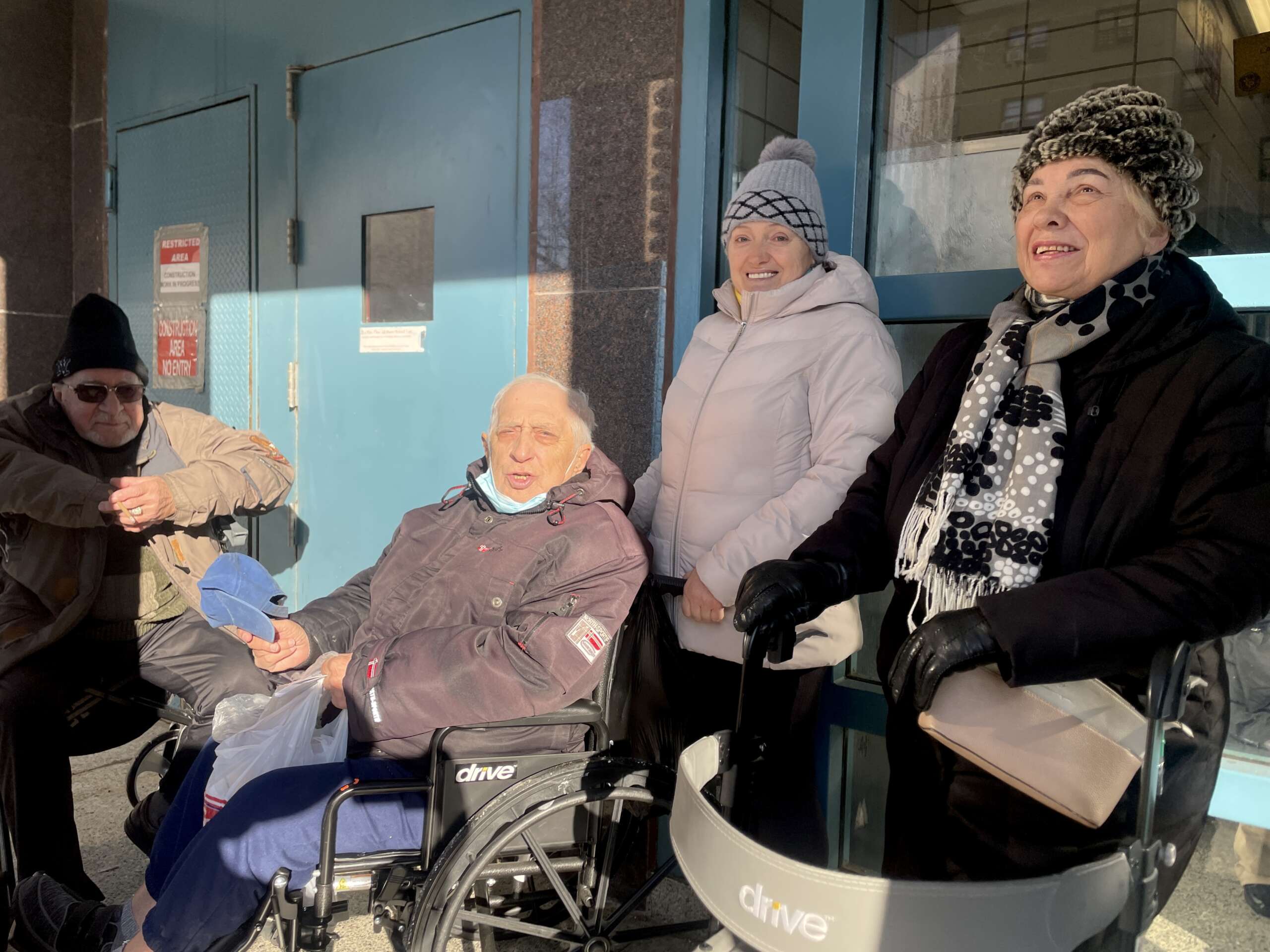
Right to left: Aleksandra, Svitlana Matyash, and Valeriy Feldman outside Surfside Gardens’ Building 1. Residents say frequent elevator outages in the senior-designated building leave them stuck upstairs. (Photo by Bella Week)
On a chilly afternoon in mid-December, four residents of Surfside Gardens’ Building 1, one of two senior-designated buildings in the Coney Island public housing complex, gathered in the last moments of sun outside the lobby, chatting in Russian. All live on upper floors of the 14-story building. When the elevators stop working, they say coming out here becomes impossible.
“When the elevator is broken, we need to stay home,” said Aleksandra, 79, who uses a walker and asked that her last name not be used for fear of causing trouble with the New York City Housing Authority (NYCHA), which runs the complex.
“I live five floors up, she lives third floor, he lives seven or eight floors,” she said, nodding toward Valeriy Feldman, 85, who uses a wheelchair. Translating Feldman’s words from Russian, Aleksandra added: “Every time, it’s a problem for him.”
Surfside Gardens, home to a large population of seniors and residents with disabilities, has long struggled with infrastructure failures that residents say NYCHA has been slow to fix.
Elevator breakdowns are the most disruptive, but they aren’t the only issue: in at least two buildings, the intercom system has been broken for years, and the trash compactor has been out of service, leaving garbage to pile up outside. A playground has been fenced off since June 2023 for repairs that have yet to begin, while another reopened in 2024, over a decade after Hurricane Sandy destroyed it.
Although NYCHA has committed capital funding to address many of these problems, residents say the agency allows conditions to deteriorate to a critical point before beginning multi-year repair projects, leaving them with limited access, daily disruptions, and ongoing health and safety risks.
Shakema Ashby, 32, and her 4-year-old daughter, Artist, at Surfside Gardens, where the playground is expected to remain fenced off for five years. (Photo by Bella Week)
Decades of federal, state, and city underfunding have left the system with major repair needs across its developments. To address these shortfalls, NYCHA has pursued alternative funding models at some sites, including transferring some properties to private management through the federal Rental Assistance Demonstration program (known locally as PACT) and creating the Public Housing Preservation Trust. Now, potential federal budget cuts threaten to strip resources from a repair process already failing to meet residents’ needs.
“It’s been like this for years,” said Silvana Merced, 48. “But you want to raise our rent or throw us out if we’re a dollar short. It’s terrible.”
Elevator outages are frequent across the complex. NYCHA service interruption data reviewed by City Limits show that Surfside Gardens experienced 140 elevator service disruptions across its five buildings in 2025. Building 3, home to the most residents, had 47 outages, including one that lasted 11 days.
Service logs also show 10 instances of full “no service” conditions in 2025, meaning a building had no functioning elevators at all. On the evening of July 11, over 300 residents in Building 3 were left without a working elevator for 24 hours.
For Deidre King, 58, who lives in Building 3 and uses a wheelchair, outages can mean being abruptly and indefinitely stuck inside.
“I can’t come down the stairs,” said King. “So when the elevators break, I have to stay upstairs.”
Not all residents are affected the same way. Rosa Bernitt, 70, who lives in Building 2, said she can usually manage the stairs, but it’s hard.
“I can still use the stairs to go down,” she said. “Going up is a little difficult, but I can make it.” She worries about her neighbors with less mobility. “Other people, they cannot. They need the elevator.”
Stacey Thomas (left) and Deidre King (right) outside Surfside Gardens’ Building 3. The building experienced 47 elevator outages in 2025, sometimes leaving King, who uses a wheelchair, unable to leave her apartment. (Photo by Bella Week)
NYCHA’s failure to provide reliable elevator service has long been the subject of scrutiny. In 2018, the agency settled a lawsuit after the U.S. Department of Justice accused it of systematically violating federal health and safety regulations, including failing to provide adequate elevator services. A federal monitor was appointed in 2019 to oversee NYCHA’s efforts to improve living conditions and capital projects.
Planning for Surfside Gardens’ elevator replacement project began in March 2022. The following year, Mayor Eric Adams and Gov. Kathy Hochul announced $300 million to fund that project and elevator replacements at 19 other NYCHA developments. By that point, Surfside’s elevators, installed in 1990, were already well beyond the manufacturer’s recommended 20-year lifespan.
The project to replace the complex’s 10 elevators has been in the procurement phase since January 2024. NYCHA Deputy Press Secretary Andrew Sklar said in a statement that the project has faced delays, in part due to the rejection of earlier non-responsive bids. Construction is now expected to begin in early 2027, with completion anticipated in May 2028—roughly six years from initial planning and 16 months behind schedule.
While NYCHA has made improvements under federal monitorship, the most recent monitors’ report, released in December, describes a modest backslide across several obligations last year.
Elevator outages in 2025 lasted an average of almost seven hours, which was 18 percent longer than the previous year. The agency met its requirement to replace 275 elevators by the end of 2025—a year behind schedule—though it remained out of compliance with nine of 18 outstanding elevator-related mandates.
Residents say a broken intercom at Surfside Gardens’ Building 3 has left the front door propped open for years, raising safety concerns and leading to stolen packages. (Photo by Bella Week)
The situation could soon worsen. The Trump administration has proposed cutting the U.S. Department of Housing and Urban Development’s budget by 44 percent. NYCHA receives about 70 percent of its funding through HUD, including half its capital budget. If approved, the cuts would further strain a capital process that already leaves residents waiting years for critical repairs.
In a statement, NYCHA Press Secretary Michael Horgan said the agency is monitoring the situation. “As more information becomes available from the federal government, the Authority will continue to assess our options in addressing any impacts related to funding,” Horgan said. “NYCHA remains fully focused on our work to ensure residents’ health and safety and improve their quality of life.”
For Merced, who has lived at Surfside since she was a kid, the delays have been hard. “There’s nothing being done here,” she said. “It’s like we just got left behind.”
To reach the editor, contact Jeanmarie@citylimits.org
Want to republish this story? Find City Limits’ reprint policy here.
The post When Elevators Break, These NYCHA Residents Are Stuck in Their Apartments appeared first on City Limits.
Leave a Reply