“As hard and unlikely as Mamdani’s victory may have been, turning from the promises of a campaign to the tasks of governing well and fairly will be harder still. He faces many hurdles and will be under a glaring spotlight.”
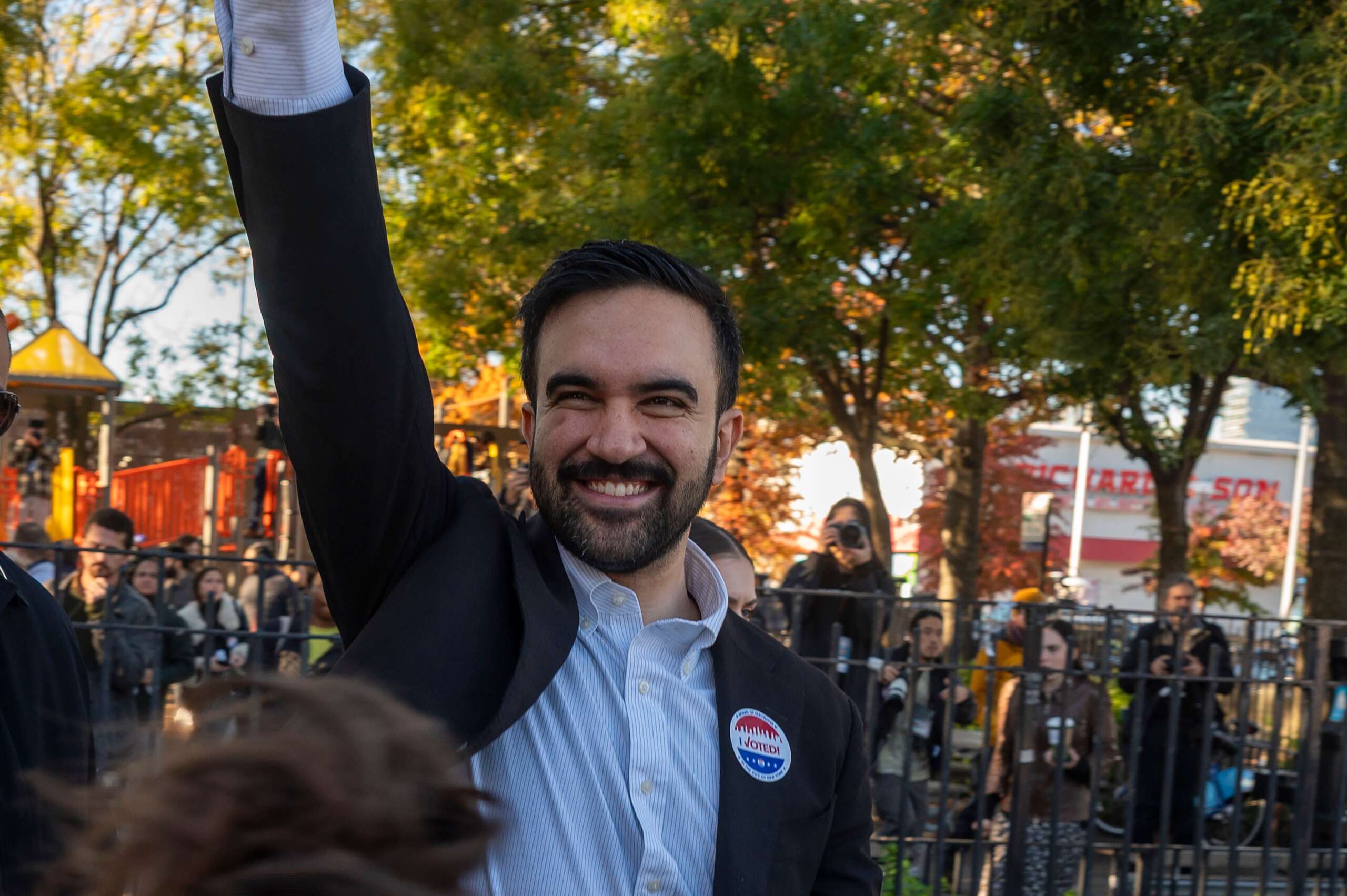
Zohran Mamdani speaks to media after casting his vote in the general election outside the Frank Sinatra High School on Nov. 4, 2025 in New York City. (Ron Adar / Shutterstock.com)
Zohran Mandami’s historic mayoral victory promises more than just a generational shift in leadership of New York City. As Jonathan Mahler wrote in The New York Times, his win is a “rebuke of the city’s identity for the past 40 years.” And Doug Turetsky, writing in the Daily News, said Mamdani’s rise “signal[s] a rupture in the influence of finance and real estate interests over the life of the city since the 1970s.”
As these observations reflect, Mamdani’s campaign opened a new direction for the city, a new beginning, offering a clear and masterful diagnosis of the growing inequality and key issues needing attention. He offered changes that have been thwarted for decades and set a high bar for a new governing agenda—a belief that municipal government can be an instrument to enable those who work hard to thrive.
Yet as hard and unlikely as Mamdani’s victory may have been, turning from the promises of a campaign to the tasks of governing well and fairly will be harder still. He faces many hurdles and will be under a glaring spotlight: from his supporters who saw his candidacy as representative of a new kind of leader ready to take on the wealthy and powerful, and from his detractors, these very same wealthy and powerful, who spent millions derailing him. And before the votes were counted, President Donald Trump threatened to withhold massive federal aid from the city if Mamdani won.
The overarching theme of Mamdani’s campaign was affordability, to move from the Bloomberg vision of New York as a luxury product to a city where all can live and thrive. Free buses, free childcare, and freeze the rent were the rhetorical bumper stickers—but none of that can happen quickly or easily.
While Mamdani’s supporters will be looking for early evidence that the kind of change he represents is taking place, his detractors—from the White House to Wall Street—will be looking to thwart him at every turn. They’ll highlight any misstep as evidence of failure, ready to pounce on him before he’s even sworn in as mayor. The recent White House meeting and follow-up press conference suggested at least a temporary détente. We’ll see how long it lasts.
The stakes for his mayoralty are high, and Mamdani’s success in navigating and managing the city under extraordinary circumstances will be tested. Winning the election was impressive. Governing well, and fairly, will be the true test of his leadership.
To prove that he can manage the city and make good on the kind of pragmatic and progressive agenda he was elected to deliver, Mamdani needs to identify some changes that he can implement locally, quickly and at a relatively low cost. Clear policy deliverables are an excellent benchmark for good governance.
As a veteran city manager and someone who has managed large, complex organizations, it is through this lens, from my “wheelhouse,” that I offer these thoughts, practices and proposals.
The team he builds: marshaling the talent needed to execute his vision
An early responsibility will be to attract a mix of seasoned government veterans and younger talent: competent managers in their respective areas of expertise who can chart innovative approaches to service delivery and problem-solving. A team overseeing the vast machinery of municipal government and delivering campaign promises, while offering a departure from past, stale and failed policy and management practices. A team that recognizes the daunting challenges they face, and that governing will be messy. The team Mamdani assembles will be a window into his leadership.
Another window is how he decides to structure the municipal government, including the assignment of agency clusters to each deputy mayor. Once assembled, Mamdani should allow his deputy mayors, commissioners and high-level staff to manage their agencies. And he should establish aggressive outcomes and timelines: key elements for achieving change in the complex organizations they lead. He needs to put micro-managing in the rear-view mirror.
As mayor, he controls who he appoints to key posts and has the ability and authority to recast and reshape agencies to break from their ossified past. And he can restructure the government to coincide with his governing agenda and platform. He should build a governing structure that parallels campaign promises and policy objectives, restructuring city government to meet the needs of city residents.
Transition hiring has already begun, with the appointment of the first deputy mayor and chief of staff. They come with diverse backgrounds and experiences. Their working relationship is key, as they will likely bring a vastly different approach to choices the mayor will need to make.
Another key appointment is the hiring of the Office of Management and Budget director, recently announced as former CUNY CFO Sherif Soliman. The mayor needs to rely on budgets that are honestly crafted, including revenue protections that are accurately projected. The crafting of budgets is more than an exercise in accounting: it is a statement of social and economic priorities. Budgets, if crafted well, tell a coherent story, and reinforce the mayor’s governing agenda and priorities. Mamdani must understand that the new OMB director is not about just cutting costs, but about resurrecting the silent M and incorporating MANAGEMENT into how budget choices are made.
Mamdani also recently picked Steve Banks, a former de Blasio administration official, as his corporation counsel. This role oversees the city’s Law Department and provides guidance to the mayor on emerging issues. It will need to be rebuilt, as it has been resourced-starved in recent years. And given the brutal immigration policies from The White House, much attention and added legal capacity will be needed.
Managing the municipal workforce
There is much that needs to change. City staffing shortages and timely staff replacements have plagued the Adams administration. As such, agency performance has lagged. Being vigilant in timely filling of core staff vacancies should be a high management deliverable. Managers should conduct a review of hard-to-fill jobs and determine where work schedules may need to be modified, and/or salaries increased to be competitive within municipal government and the private sector.
The mayor’s staff will require vigilance in identifying service inefficiencies and expeditiously addressing them. Agencies should seek innovations that yield productivity savings so resources can be applied to meet priority needs. Both tasks are essential as service demands are increasing, especially among the city’s most vulnerable populations.
Municipal labor negotiations are another aspect of governing that can potentially generate significant savings to support future wage and benefit increases, while stripping wasteful labor practices that have been squandered for decades.
Mamdani can budget “smartly,” by hiring more staff with collection responsibilities to secure millions in unpaid property taxes and from unpaid violations and fines. The additional staffing costs will be significantly offset by the revenues generated from these massive collections.
Smart budget crafting always looks for revenue generators. Leaving no money on the table should be a key lens the administration applies to meet the moment.
Burden sharing: a key leadership tool needing to be exercised
With his mandate to govern, Mamdani should exercise his power by asking key institutions in the city to step up, meet the moment and contribute to his new agenda.
This is what burden sharing looks like: Mamdani can call upon elite law firms who capitulated to Trump to redeem themselves by offering massive pro bono legal support in two vital areas: 1. to push back on Washington’s draconian deportation and harassment strategies, and 2. provide legal support to challenge predatory landlord practices and prevent evictions. We know that evictions contribute to homelessness, and the number of unhoused in the city has reached record numbers. For too long eviction service has been resourced-starved. It causes harm and instability in tenants’ lives. Demand for these services is climbing and requires the new administration’s attention.
Mamdani can also call upon our wealthy philanthropic community to increase grant giving levels, so millions of resources can be applied quickly to address the social needs in our city. Some of these foundations are sitting on endowments of $1 billion. Presidents and board members should expedite and advance millions in grants to maximize awards in a single year, for greater impact, instead of awarding the minimum legally required amounts.
Additionally, Mamdani should call on the billionaire owners of our sports venues, who pay no taxes, to unleash millions to support parts of his governing agenda. Each of these asks would be meaningful contributions to lessen the burden on the city’s treasury and enable Mamdani to realize his campaign promises.
Taking control of what can be controlled
Some much-needed change is out of the city’s direct control, and will require a different set of strategies to achieve. But there is so much to do at home here in the five boroughs. As Mamdani begins to oversee the workings of governance, he will be assessed on how he positions himself and the choices he makes through clearly articulated policy and service deliverables.
Another management theme he should adopt: Going “big on the basics” for a livable and thriving city. He should pick a few priorities, and deliver them. These should fit the moment and establish trust in his management chops. Mamdani should inform the media of his plans and commit to share his progress and achievements, as well as pitfalls and obstacles.
Below are some “quick hits” Mamdani can deploy without Albany, despite whatever the predator class intends to do to thwart his agenda, and whatever Trump threatens to throw at the city.
Poverty: Nearly half of the city’s population is living in poverty or teetering on its edges, struggling to afford necessities like food and housing. The city’s poverty rate is 25 percent. By way of comparison, it was 18 percent in 2021. Mamdani will be inheriting an unstable economy, and levels of poverty will likely climb. A cornerstone of Mamdani’s mayoralty will be to address and reverse this concerning reality.
The city’s soup kitchens and food pantries need to be fully resourced and monitored closely to meet increased demand, so that no cupboard is bare. Additional city and state funding should be provided to “stretch” food stamp spending to meet cost of living increases caused by inflation.
To meet the growing demand for food stamps, the city should hire more HRA staff to expedite the timely processing of this vital benefit. New targeted outcome goals should be established to correspond with added staff resources. Some 1.8 million city residents are receiving SNAP, which is essential to lessen economic insecurity.
Maximizing inventory at NYCHA: Mamdani must claw back the time it takes NYCHA to restore vacant apartments for new tenants. In Fiscal Year 2025, it took 371.1 days for apartments to be restored. By comparison, it took the Bloomberg administration 44 days, and the de Blasio administration 114 days. Given the urgent need for housing, the Mamdani administration will need to set a new and aggressive target to welcome new tenants.
Tackling white collar crime: This is a core government responsibility. Much of the city is running on exploitation, targeting the most vulnerable residents. Enforcement of white-collar crime should no longer take a back seat to street crime. Enforcement with certainty of consequences should become the governing imperative.
Mamdani should get serious about cracking down on predatory landlords that don’t maintain their properties, and be vigilant in prosecuting landlords when buildings are not maintained. Guaranteeing stiff financial penalties must be built into governing expectations.
He must also crack down on predatory employers that traffic in wage theft and impose unfair work schedules that wreak havoc on employees’ personal lives. It is estimated that $1 billion is lost to employees due to wage theft annually. The tyranny of work in the city must end. “Just Hours and Wages” should be the new dignity of work mantra.
Addressing transportation needs and priorities: Mamdani should complete the legislatively mandated requirement of 150 bus lane miles. He should outline plans to expand bus lanes in other areas of the city to reduce overcrowding and speed bus service. He should continue adding bike lanes throughout the five boroughs as another transportation option for city residents and a way to reduce vehicle traffic.
Quality of life improvements in underserved neighborhoods: The city should require owners of vacant properties and lots to maintain them by aggressively awarding summonses and collecting fines. The September 2025 Mayor’s Management Report records only 101 lots cleaned citywide, compared to 1652 in Fiscal Year 2022, a drop attributed to budget cuts.
Illegal dumping in selected neighborhoods must also be addressed through aggressive enforcement. Mamdani should also increase the weekly frequency of garbage collection in business districts, in underserved communities, and where Business Improvement Districts are not present.
Mamdani has already signaled a restructuring of the NYPD’s responsibilities, creating a new agency to be responsible for mental health and social maladies while dedicating policing work to fight crime. He should consider another restructuring, with a coherent vision and leadership team.
Immigration: The new mayor should appoint a deputy mayor for immigration services, building an organizational structure fully resourced to be responsive to multiple issues and needs. This includes protecting immigrants from intimidation and deportation, and from Trump administration overreach. Clearly this is a major challenge to the new administration and will require partnering with Gov. Kathy Hochul, and other governors experiencing this abusive federal policy.
In addition to securing immigrant safety, the city will need to bring stability and economic certainty through jobs with livable wages and affordable housing, along with other services, so immigrant New Yorkers can contribute fully to the economic landscape. In the 1970s, the city experienced a surge in the immigrant population. Their arrival resurrected the city and vastly improved its neighborhoods, and was vital to New York’s turnaround. The recent immigrant surge can signal another such opportunity.
Our city’s demographics indicate that one in three residents are immigrants. At his victory speech, Mamdani summed up in a very personal way his commitment to the immigrant community: “New York will remain a city of immigrants, a city built by immigrants, powered by immigrants, and as of tonight, led by an immigrant,” he said.
Even before being sworn in, Mamdani faces significant challenges:
From Washington: Cuts to federal subsidies are already being considered and more are being threatened, at a time when demand for services is high. Threats to deport thousands of immigrants, and a national economy that is facing a recession from Trump’s economic policies, will directly result in lost revenues from state and city treasuries, coupled with severe job loss. Here in the city, poverty levels already at 25 percent are likely to spike. In both the city and the state, preserving core services will be tested.
From Albany: For decades, wrong choices have hampered the city. In a risk-averse culture, expedient choices were made, when harder and necessary choices were required. The city and its residents have paid a steep price for these lapses in courage and leadership. The upcoming legislative and budget session will test the political courage of elected officials, and whether they will continue to capitulate and surrender to the “privileged few”—undermining Mamdani’s plan to tax corporations and wealthy individuals for the resources needed to carry out his signature policy initiatives. Mamdani will also need Albany’s help with gap-closing measures to address both lost federal revenues and a shrinking economy. He will need to exercise significant political capital to adopt his legislative and budget agenda.
From NYC’s privileged few: For decades, the moneyed class pursued a set of “values” that tightened their grip on preserving their wealth and institutional power, imploring tactics of exploitation, extraction and predatory schemes. As noted, Mamdani’s campaign agitated the affluent. They believed they could buy this election to protect their wealth and take care of themselves. Clearly unconcerned how barren and coarse the city has become, they set about with their checkbooks and hubris, underwriting the campaigns of Andrew Cuomo and Eric Adams and characterizing Mamdani as an existential threat to the city. With Mamdani’s election behind us, it’s certain the entrenched moneyed class will persist in their attempt to undermine his agenda. Their grip on the city’s institutions will be tested.
Mamdani’s election represents an opportunity to turn the page on the past 40 years of real estate and finance industry dominance, and the sectors’ priorities determining much of the city’s political life. His agenda reflects his understanding of ordinary New Yorkers and their struggles to pay their bills.
Rather than wallow in the struggles, his campaign was animated by a feeling of joy. A belief in the possibility that the city—and city government—can work for all New Yorkers. This resonated with many New Yorkers, especially the young, and as a result more people voted in November’s election than in any other mayoral contest in more than five decades.
Yet such positive feelings can turn to frustration if signs Mamdani is making good on his promises don’t appear in a timely manner. This makes achieving some quick programmatic or policy changes, ones that reflect the promise of a more affordable and equitable city, especially important.
Clearly, Mamdani faces many challenges, from Washington to Albany and even closer to home: reorienting the entrenched city bureaucracy is no easy feat. But falling short risks turning November’s win to little more than a Pyrrhic victory.
Harvey Robins has worked in various positions in city government, nonprofits and foundations for more than 40 years. This includes as first deputy administrator at the Human Resources Administration; deputy chancellor for finance and administration at the Board of Education; director of the Mayor’s Office of Operations; director of strategic planning at The Children’s Aid Society; and director of strategic planning and operations at the Edna McConnell Clark Foundation. Recently, he’s written articles in City Limits and City and State.
The post Opinion: How Zohran Mamdani Can Avoid A Pyrrhic Victory appeared first on City Limits.
Leave a Reply