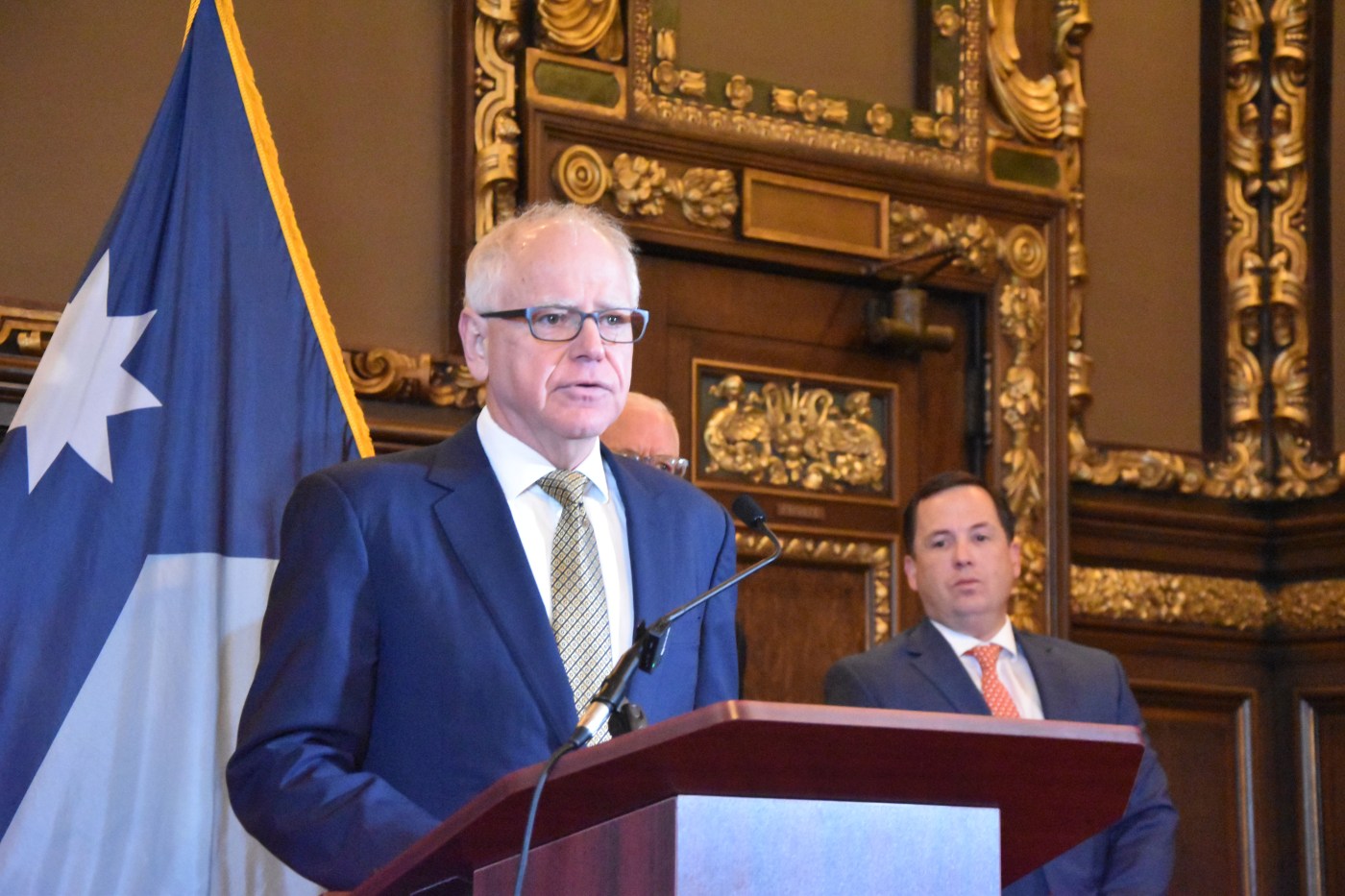
ST. PAUL — Gov. Tim Walz and Minnesota Department of Human Services officials on Friday, Dec. 19, said the administration and agency don’t have evidence to suggest fraud could reach $9 billion.
On Thursday, the U.S. Attorney’s Office announced six new defendants in the latest wave of charges for Medicaid fraud in the state, also providing an update on its estimate of the scope of the state’s fraud — about $9 billion.
RELATED: ‘Industrial-scale’ MN fraud may have cost billions, feds say in announcing new charges
First Assistant U.S. Attorney Joseph Thompson said that according to the federal Center for Medicaid and Medicare Services, an audit of 14 “high risk” state Medicaid programs found that the claims since 2018 of those 14 programs totaled out at $18 billion.
Thompson said based on what his office has investigated so far, he’d expect “about half or more” of the $18 billion in claims to be fraudulent. However, state officials said on Friday that they don’t have any information to suggest $9 billion, but they didn’t say it was incorrect.
“I wouldn’t say it’s wrong. I mean, we do the same thing at the Department of Human Services. We look at billing data, we look for red flags,” DHS Inspector General James Clark said Friday. “What I’m saying is I haven’t seen any evidence or information to suggest that there’s $9 billion worth of Medicaid fraud.”
Walz called the number “speculation,” and said they’re using that number without the proof behind it. He and DHS officials invited proof from the U.S. Attorney’s Office; Clark said he’s previously asked for proof of such figures and hasn’t received it.
“To extrapolate what that number is for sensationalism or to make statements about it, it doesn’t really help us,” Walz said Friday during an unrelated news conference at the Capitol. “It doesn’t get us to where we need. I just need their help to prosecute this. I need their help to help us get a realistic perception on this.”
John Connolly, deputy commissioner and Medicaid director at DHS, said the evidence he has indicates “tens of millions of dollars” in fraud. That estimate is specific to Medicaid fraud and does not include other state agencies, such as the Department of Education, which oversaw Feeding Our Future fraud estimated at $250 million.
“We don’t have evidence in hand to suggest that we have $9 billion in fraud and these benefits over the last seven years,” Connolly said. “And if there is evidence, we need it so that we can stop payment. That’s a very alarming number. And so if there is evidence, credible allegations of fraud. We need that information to take action now.”
Connolly also added a few pieces of context and noted that of the 18 billion, $6 billion ran through a managed care organization. $10 billion was subject to electronic visit verification.
“That basically means that a worker that goes to provide services in someone’s home is as basically indicating with a timestamp when they arrive, when they left, what service they provided who they are and who received the service,” Connolly said.
He added that $11 billion was authorized by a county case manager — which he said means care was authorized according to clinical need, “an assessment, a care plan,” with a dollar amount also being authorized by a case manager.
Walz said that while he is grateful for the U.S. attorney’s work in prosecuting, he called out the office for not mentioning on Thursday what the state has done.
“What they didn’t tell you yesterday is that June, I was given the authority to stop payments … The folks they were talking about on the housing stability stabilization grant, we stopped payment on them in July and turned the case over to law enforcement to prosecute,” Walz said. “They didn’t come in here and find that. They didn’t come in here and stop payments. They can’t do that. But what they didn’t tell you is, we’re partners in this.”
Throughout the fall and winter, the state has issued pauses on enrollees and licenses for new providers in some of the Medicaid programs on top of halting payments to programs with suspected fraudulent activity. Clark said yesterday he expects that effort from DHS to continue.
Walz also expressed concern about providers within the programs that are providing legitimate services.
“They just said the entire program. Well, that is not the case, and this becomes problematic because we’re already hearing it, and we’re very conscious to it, those programs that, the vast majority that provided incredible services, are now being put at a disadvantage because we’re not able to get them out,” he said.
The fight against fraud has taken a particularly partisan turn at the Capitol in recent weeks. During the session, lawmakers and Walz were previously able to find common ground on several proposals — including the bill that authorized the state to halt payments.
Related Articles
New law inspired by fallen St. Paul fire captain will expand first responder benefits nationwide
St. Paul: Swearing in for Mayor-Elect Kaohly Her on Jan. 2
Former Minnesota GOP chair joins U.S. Senate race
‘Industrial-scale’ MN fraud may have cost billions, feds say in announcing new charges
MN pauses licenses for adult day care amid suspicion of fraud, ‘kickbacks’
On Wednesday, DFL members of the House Fraud Prevention and State Agency Oversight Policy Committee questioned Chair Kristin Robbins, R-Maple Grove, about sharing fraud tips received through a tip line the Republican-led committee set up.
“We have not because there is no trust, as you might understand,” Robbins said. “This fraud has been perpetuated on your watch, and the whistleblowers who reach out to us within the department are terrified, and they feel that they’ve been retaliated against already.”
Robbins said she has been forwarding information from the tip line to the U.S. Attorney’s Office, the FBI and the Office of Legislative Auditor, but hasn’t shared information with DFL colleagues or DHS. She said she’ll “consider it.”
“Nobody in the legislature on the Republican side is interested in solving this,” Walz said. “My God, it would be the worst thing in the world for them if this is solved like we’re doing it here early this year, because then what are they going to run on?”
Leave a Reply