For labor organizing, Texas was long dismissed as a forlorn place.
“Right-to-work” laws restrict organizing here, most public-sector workers can’t collectively bargain or strike, and local governments are broadly banned from passing their own worker rights ordinances.
Yet total membership in Texas unions has been growing. According to data from the Bureau of Labor Statistics, 603,000 Texans belonged to unions in 2024, up from closer to half a million a decade ago (though the union density rate has remained steadier below five percent). For the past eight years, Rick Levy steered this growth as the president of the Texas AFL-CIO and as secretary-treasurer for the prior two. He retired in early December, concluding three decades of work with the state labor federation.
“My reasons for retirement are many, (including that I am old AF),” Levy, who’s 68, wrote in his announcement.
Levy often joked around and downplayed his role as he spoke with me about his long career in the Texas labor movement. Even though he’s been a lawyer for much of his life, he acts and talks more like an organizer, always using the word “we” when referring to the organization’s accomplishments. It was his vision to broaden the leadership of the organization that has helped shape how the state federation has developed. And it was the wave of movements from the 1960s to today that shaped Levy’s leadership at the Texas AFL-CIO.
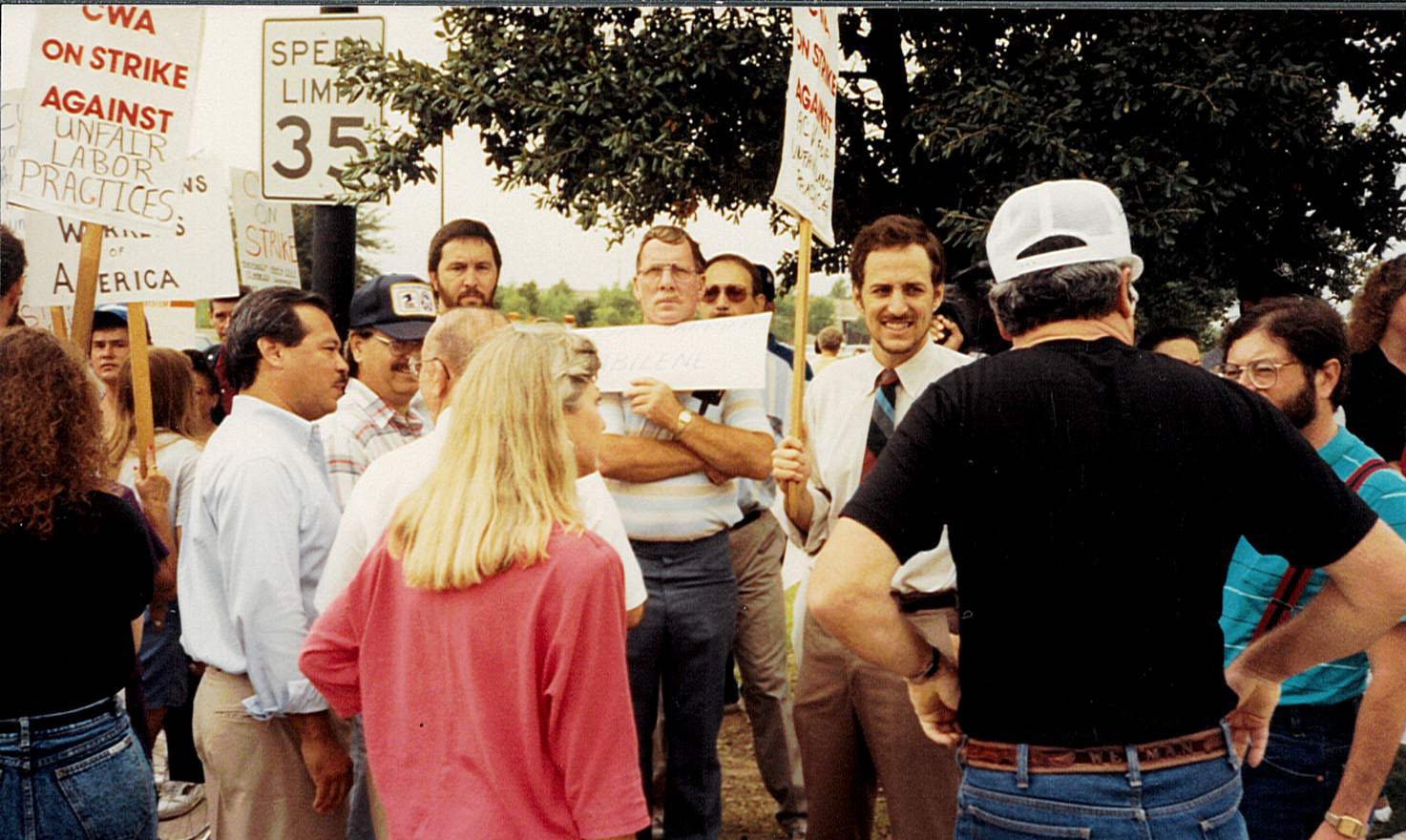
Levy on the picket line in the 1990s (Courtesy/Texas AFL-CIO)
As a child, Levy grew up in St. Louis, Missouri, when the city’s Black community was fighting to integrate the school district. “You can’t grow up in an environment like that and not have it touch you,” Levy said.
When student protests roiled college campuses in the 1970s, Levy participated in sit-ins at Stanford University to demand the school divest from its interests in apartheid South Africa and ensure equal employment and pay for Black workers on campus. Even as the police stormed onto the campus to remove protestors, Levy and other students refused to budge. This incident and successive protests landed him in jail several times. After graduating, he went through a series of jobs—as a school bus driver, delivery truck driver, and a bookstore cashier—to support what he calls his “main job”: organizing.
Inspired by the courtroom battles he witnessed, Levy graduated from law school and found his way to Tyler to work as a civil rights and labor attorney. The Piney Woods region has a long history of civil rights and labor struggles. The area was the site of the Texas Sick Chicken Strike in the 1950s, the women workers’ strike at the leather products Schoellkopf plant in 1979, and the Goodyear Tire plant strike in 2006. Daves, McCabe & Hahn, the law firm where Levy worked, was well known for its work in landmark civil rights cases, such as Plyler v. Doe, the 1982 Supreme Court case that forbade states from denying children a free public school education based on immigration status. The case’s presiding U.S. district judge, William Wayne Justice, who also ordered the Texas Education Agency to desegregate public schools and the Texas prison system to reform its conditions, was based in Tyler.
“There was a small group of progressive folks who were trying to change the world … and they took me under their wings,” Levy said.
Then Ronald Reagan became president. When Reagan launched his onslaught against workers’ rights, Levy decided it wasn’t enough to fight in the courts.
“We had been on the cutting edge, making changes, and then as kind of the political climate changed … the law wasn’t really making the kind of impact that I wanted,” Levy said. “When I came to the state [federation], it was because I could be part of the labor movement, which was trying to change the laws and trying to change the politics.”
In 1990, when Levy joined the Texas AFL-CIO as its legal and education director, union membership in the state was in a deep swoon. From 1964 to 1984, Texas union density fell from 14 percent to 8 percent and continued dropping after that. Levy recalled the state federation employed only ten staff members then, mostly men and mostly white. Much of its work revolved around politicking and lobbying members of the Democratic Party, then in its final years of ruling Texas.
“Rick saw early on that it was going to be a while before we started winning statewide elections again,” said the Texas AFL-CIO’s former communications director Ed Sills, who worked with Levy for three decades before retiring last year, added that Levy could always find “opportunity in crisis.”
Even as organized labor’s power at the state Capitol waned, Sills said Levy “believed we could do more” than engage in state politics and rejuvenated the state federation’s worker education and leadership training programs. “Rick understood that if you want to have a movement that lasts, you need to constantly be developing new leadership.”
Levy in 2011 (Courtesy/Alan Pogue via Texas AFL-CIO)
When Levy became president, he’d also recruited Montserrat Garibay, who was elected secretary-treasurer. It was the first time a Hispanic person served as an officer for the state federation.
“He saw something in me that I didn’t even realize,” Garibay said, calling Levy “a great mentor.” At the time, Garibay was the vice president of Education Austin, an affiliate of the Texas American Federation of Teachers and, before that, a bilingual kindergarten teacher. “I wasn’t the usual candidate. I was a leader with a funny name, with an accent, an immigrant, but he really embraced that,” she said. After more than three years in the role, Garibay was handpicked by the Biden administration for a role with the U.S. Department of Education. Today, she’s running in the Democratic primary for Texas House District 49, an open seat in Austin.
During his tenure, Levy expanded the federation’s executive board and staff and included more women and people of color. He formed the annual Women’s Summit for women organizers, which shaped the organization’s priorities on issues such as reproductive freedom. And he created a program to train young activists to become labor organizers. Levy said his “greatest day” was when these young organizers shooed him out of that group’s annual meeting so they could lead the discussion.
But his efforts to broaden union membership encountered opposition at times. Levy said that back when he joined, “A pretty broad section of the movement, if you asked them what their immigration stance was, would say to call the immigration authorities. It was an us versus them perspective.” Under Levy, the federation started conducting citizenship clinics across Texas, a project Garibay had started in Austin. Leaders educated members on why solidarity with immigrant workers was critical to building the labor movement. As a result, members started volunteering in the clinics. “Through some really difficult conversations, a number of unions took the lead saying, ‘All workers are part of the working class and all workers deserve representation.’ And we started to organize in a way that was much less exclusionary,” Levy said.
“He saw a different future for the Texas AFL-CIO,” Garibay said, “where all of us can be welcomed, and all of us can be part of the labor movement.”
Efforts to grow the leadership and membership from the bottom up helped bring about successful organizing campaigns for local affiliates in the past few years. In 2022, nurses at Ascension Seton Medical Center in Austin voted to join the National Nurses Union. Workers at major Texas news publications, including the Dallas Morning News, The Texas Tribune, and the Austin American-Statesman have successfully unionized in recent years. And in Houston, Hilton hotel workers with UNITE HERE Local 23 won a new contract on October 10, guaranteeing a $20 per hour minimum wage, stronger safety protections, and less workload after striking for 40 days.
Levy said that, unlike traditional labor struggles, these organizing campaigns were moving beyond economic demands to battles for the public good. Nurses organizing demanded less workload to protect patients’ safety; reporters exposed how media monopolies were “gutting their ability” to cover important stories; and teachers denounced the “underfunding and the hollowing out of our public education system for Greg Abbott’s voucher scam,” Levy said. He believes this unity between workers and the community is why public opinion of unions is so high now.
These recent unionizing victories in Texas are catching national attention. “Everyone has always known the power that Texas workers have, but it hasn’t been until recently, and especially with strong leadership, that we’ve been able to organize in some new and different ways to leverage power and strength using creative tactics. It’s taken some time, but the National has definitely taken notice,” said Liz Shuler, president of the national AFL-CIO. She added that the national organization has been investing more resources in Texas, especially with Levy’s efforts to strengthen regional labor federations within the state.
Austin Congressman Greg Casar worked together with Levy on various pro-labor policy fights at the local, state, and federal levels. “No one has done more than Rick Levy for the modern-day labor movement in Texas,” Casar said.
Levy at a Capitol rally this year (Courtesy/Texas AFL-CIO)
When I asked others what it is they will miss the most about working with Levy, Casar, Shuler, and other federation leaders mentioned how Levy opened each meeting with a snarky quip or welcomed new leaders by warning them, “Don’t screw it up!” Sills recalled how Levy turned some staff meetings into informational scavenger hunts. “He put people at ease through humor,” Sills said.
When I asked Levy what he’s most proud of from his tenure as president of the Texas AFL-CIO, he spoke again of the organization’s new leadership. The federation’s new president is Leonard Aguilar, a San Antonio union plumber, who became a leader in the trade unions, then secretary-treasurer of the state federation. Lorraine Montemayor, a state employee who, through the federation’s leadership training program, became an organizer with the Dallas American Federation of Teachers and then the political director for the Dallas AFL-CIO, is now the secretary-treasurer. It will be the first time that two Latino leaders will helm the Texas AFL-CIO.
“For any organizer, their number one job is to organize themselves out of a job. And I feel like I’ve done that,” Levy said. “They’re going to be able to take it to places that I could never even imagine.”
Levy is leaving the Texas AFL-CIO during another historical onslaught against workers. This time, Levy said, the federation is organized. He reminds Texas workers, “The cavalry is not riding in to save us. To the extent we’re going to get saved, it’s because we’re going to organize and we’re going to stand with each other.”
The post At the Texas AFL-CIO, a Changing of the Guard in a Time of Growth appeared first on The Texas Observer.
Leave a Reply