DULUTH — Two years after a company confirmed the presence of helium beneath the surface of Northeastern Minnesota, other companies are poking around the area for confirmation of a lightweight gas from the other end of the periodic table of elements: hydrogen.
At its remote site between Babbitt and Isabella, Pulsar Helium has drilled three additional wells since October, bringing its total to five as it seeks to better estimate the size of the helium reservoir and characterize its resource, which already ranks among the highest concentrations in the world.
Most notably, the company recently announced that some of the helium released by its original well includes helium-3, a rare isotope that can be used for nuclear fusion, scanning for nuclear weapons at ports of entry and supercomputing, among other uses.
“A cylinder the size of my forearm here would be 30 million bucks,” said Cliff Cain, CEO of Edelgas Group, which advises companies — including Pulsar — on rare gases.
Why is helium so valuable?
It’s incredibly rare on Earth, sourced primarily as a byproduct of decaying tritium from nuclear warheads. Its prevalence on the moon, however, has even prompted some to consider sourcing it from there.
Remote northern Minnesota would be a bit easier to reach, and Pulsar officials are still determining how much of the gas is standard helium versus helium-3.
The region’s subterranean cracks and fissures are believed to have trapped helium, a byproduct of the breakdown of radioactive elements, in pockets beneath the surface, and those characteristics are also attracting companies looking for hydrogen, sometimes found in the same places as helium.
Last month, Pulsar finalized a deal to buy a hydrogen exploration company and its private gas exploration rights across more than 59,000 acres in St. Louis and Itasca counties as it looks for more helium.
Thomas Abraham-James, president and CEO of Pulsar, said he’s aware of several other companies eyeing gas exploration in the region, and if they are after helium, he doesn’t see it as competition.
“It’s further validation of what we’ve done and the potential of this area,” Abraham-James said.
What’s fueling the hunt for hydrogen?
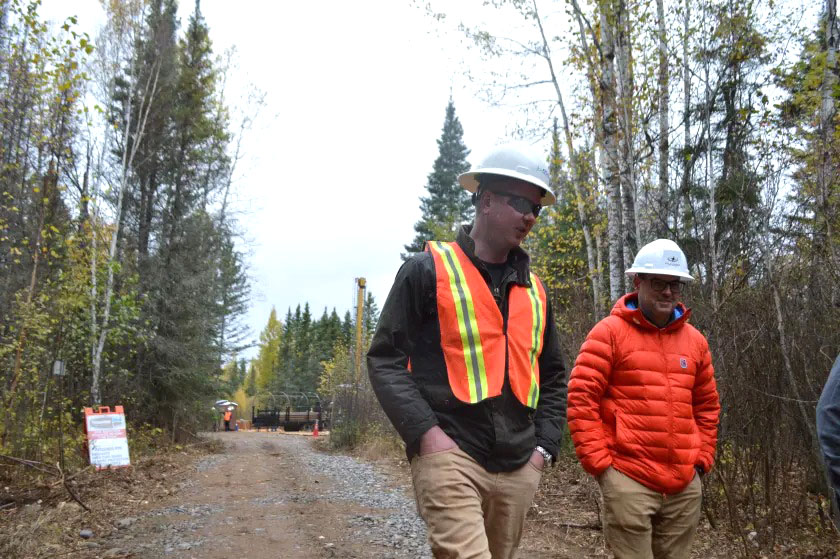
A drill rig is in place and about to start drilling Pulsar Helium’s third well near Babbitt, Minn. on Oct. 16, 2025. The company confirmed the presence of helium gas trapped beneath the surface in northeastern Minnesota two years ago. Companies hoping to find hydrogen in the area also want to conduct exploratory drilling. (Jimmy Lovrien / Duluth News Tribune)
While demand for helium stems from its uses in medical, aerospace and defense products, the search for so-called “natural hydrogen” or “geologic hydrogen” in the region is being driven by the desire to have a fuel that releases only water vapor when it’s burned.
Currently, most hydrogen comes from fossil fuels, and while water can be split into hydrogen and oxygen through electrolysis, that requires a significant amount of electricity. That’s why the prospect of naturally occurring hydrogen in Northeastern Minnesota has piqued the interest of several companies. The attention comes after the U.S. Geological Survey identified areas along the Midcontinent Rift, including Minnesota, as areas where the geology might allow for hydrogen to form as the water interacts with iron and is then trapped in underground reservoirs.
Quebec Innovative Materials Corp. last month announced it would explore the possibility of hydrogen in two St. Louis County townships on the Iron Range, and Koloma, which is backed by Bill Gates’ Breakthrough Energy Ventures and Amazon’s Climate Pledge Fund, said it has been conducting surveys as it gears up to possibly conduct exploratory drilling in the region.
Related Articles
More drops for AI stocks drag Wall Street toward a 4th straight loss
Warner Bros recommends investors reject Paramount’s offer in favor of Netflix’s
Expert tips to ease financial pressure and avoid holiday overspending
Own a Hyundai or Kia? Here’s what you need to know about anti-theft settlement
Hyundai and Kia will repair millions of vehicles under a deal to fix anti-theft technology
Kristen Delano, Koloma’s head of government affairs, told the News Tribune last month that the USGS data is often a starting point for companies hunting for hydrogen, but that Koloma is analyzing other existing geologic surveys, collecting its own data and using artificial intelligence to narrow where it wants to conduct exploratory drilling.
“We also have expert geologists and data that shows us in the Iron Range, you have the right type of iron-rich rock, and that the right type of geology and depths and opportunities for this to exist and be caught in these pockets or traps,” Delano said.
The confirmation of helium in Minnesota in early 2024 and the potential for hydrogen in the area prompted state officials to craft regulations for the industry. The Minnesota Department of Natural Resources said its rulemaking for permitting and the leasing of state lands for gas production must be completed by May 2026.
What makes Northeastern Minnesota a good option?
The Midcontinent Rift formed 1.1 billion years ago when North America tried to pull itself apart, sending magma up and leaving behind deposits of copper, nickel and other metals in areas like Minnesota’s Duluth Complex and Tamarack Intrusion. Iron-rich olivine is often found throughout the Duluth Complex, which itself intersects with the 2-billion-year-old Biwabik Iron Range, which, of course, contains iron. And a type of iron, called iron(II), or Fe(II), can form hydrogen when it reacts with water.
“These terrains are sutured together, and having them right next to each other, you have high potential for a lot of iron(II) that saw a lot of water driven through it from these geologic processes,” said Latisha Brengman, associate professor of earth and environmental sciences at the University of Minnesota Duluth.
Hydrogen can also form by radiolysis, when radiation released by old granite breaks water down into hydrogen over a long period of time.
While the reactions that create hydrogen “probably happen all the time,” Brengman said, there’s only one known reservoir in the world, in Mali. It has been tapped to power a nearby village.
Researchers suspect additional natural hydrogen sources have yet to be discovered, but Brengman said capturing natural hydrogen — reservoir or not — could include a technique combining natural and engineered processes.
That technique would involve using iron near the surface or tailings — waste rock leftover from the taconite pellet plants — to host these reactions and capture the hydrogen. Industries seeking to replace coal, oil and natural gas could then burn that hydrogen as a carbon-free energy source with water vapor as the only byproduct.
Delano said regionally sourced hydrogen could be a “game changer” across many industries, including the iron mining and steelmaking processes. “Natural hydrogen’s best use is being put to use for other energy needs and cleaning up those really hard to abate sectors,” Delano said.
But hydrogen is a small, light gas that can easily leak. Out in the atmosphere, it can react to other greenhouse gases.
“While hydrogen itself is not a greenhouse gas, leakage of hydrogen fuels causes indirect warming due to hydrogen’s influence on methane, tropospheric ozone, and stratospheric water vapor,” according to research published in Frontiers in Energy Research last year.
Related Articles
Minnesota county pays $3.25M to settle sisters’ civil rights suit
Duluth teen sentenced for randomly assaulting homeless man with rock
Woodbury school among many impacted by influenza outbreaks, will switch to online classes
Probation for MN man who made threats over political banter at a White Bear Lake church concert
Own a Hyundai or Kia? Here’s what you need to know about anti-theft settlement
Delano said Koloma expects to be “very, very active” in 2026 with seismic studies using earth-shaking “vibe trucks” to send energy waves into the ground and get a sense of what’s below.
“If that data leads to what we think it will, then we’re ready to keep our feet on the ground … and be part of the Minnesota infrastructure as we explore for hydrogen,” Delano said.
And as Brengman readies findings on whether magnetite, a common iron ore on the Iron Range, produces hydrogen — spoiler: “Yes, it’s a very common reaction,” she said — she’s gearing up for her next project. She’ll be partnering with the U.S. Department of Energy’s National Laboratory of the Rockies to build a system that can help predict where hydrogen was or is produced.
“The Midwest has a lot of great potential, because it’s a very old terrain, and so there’s lots of old-water rock interaction to map out,” Brengman said.
Leave a Reply