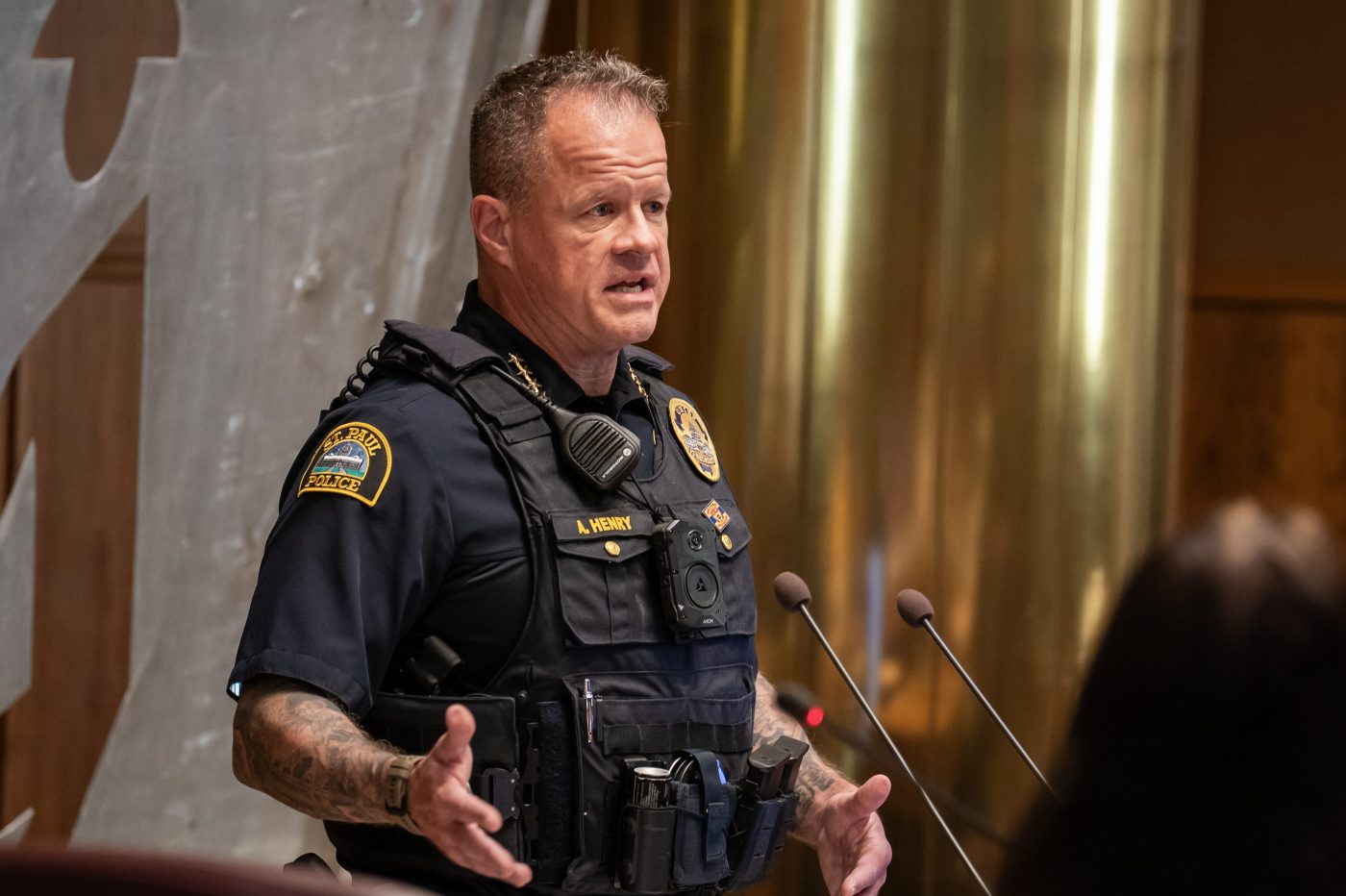
St. Paul’s police chief said Monday that claims of police officers starting at an “instantly escalated” response to protesters at a federal immigration operation last month are not true.
Officers who wore gas masks and were armed with batons weren’t “our second, third or fourth step of being there,” Axel Henry said.
The St. Paul City Council last week unanimously approved a resolution, in which they said they’ll work with the Board of Peace Officer Standards and Training “to conduct a thorough investigation into SPPD’s use of force during the Nov. 25, 2025 incident,” which Henry said he welcomes.
Henry said he’s already initiated internal affairs investigations. The department’s review of body camera footage is ongoing. They’ve gone through 60 to 70 percent of what Henry estimates to be a couple hundred hours of videos.
Criticism of police comes from all sides: There are people who say St. Paul police shouldn’t have been present in Payne-Phalen at all and some people who ask “why aren’t you being more aggressive” in immigrant enforcement, Henry said.
St. Paul adopted an ordinance in 2004 “that establishes a clear line of separation between the actions of local law enforcement and those of federal immigration authorities.” The council plans to review the ordinance, and act “to strengthen it, if and where necessary,” Council Member Molly Coleman said at last week’s meeting.
After an ICE raid at Bro-Tex Inc. in St. Paul on Nov. 18 and the federal operation in Payne-Phalen one week later, Henry met with federal law enforcement leaders, other local law enforcement and community groups who’ve been organizing protests.
“We need to be solution driven,” Henry said. “Part of my strategy has been to try to talk to all of the groups to figure out how we can round off some of these sharp edges so (federal officers) are less likely to need to be bailed out of anything … and people who want to protest and monitor it can do so in a way that won’t create a situation that’s unsafe for themselves or anybody else.”
What happened in the 600 block of Rose Avenue on Nov. 25 was unusual, Henry said. Last year, St. Paul police responded to or handled 210 marches, protests or big demonstrations and there have been 185 this year.
“We’re all talking about the one of Rose because that one didn’t go the way we wanted it to,” Henry said.
Other cities and suburbs are “feeling the same pinch and pressure,” he added. “… We’re kind of like the rope in the tug of war between the folks that don’t like this approach and the federal agents that are doing it.”
‘At a boiling point’
On the morning of Nov. 25, federal deportation officers were conducting an operation in the 600 block of East Rose Avenue to arrest an undocumented person who’d previously been removed from the U.S. and who had re-entered unlawfully, according to a probable cause statement signed by an Immigration and Customs Enforcement deportation officer and filed with a criminal complaint in federal court. It started about 7:45 a.m.
ICE arrested that man, but the incident continued until around 12:25 p.m. when they arrested another man.
The second man is charged in federal court with assaulting and impeding a federal officer, by allegedly striking the officer’s vehicle with his own, and improper entry to the U.S. He has entered a plea of not guilty.
Related Articles
‘Ringleader’ of vast real estate fraud scheme sentenced to prison
St. Paul man fatally shot his kids’ mother, took them to Michigan before fleeing to Canada, charges say
Shooter ID’d by authorities in Stewartville High School shooting
Search for the Brown University shooter continues as questions swirl about campus security
Rob Reiner’s son Nick arrested after the director and his wife were found dead at their home
St. Paul police were called to the scene to take an accident report regarding the man who allegedly struck the federal officer’s car. While the officer was writing the report, a crowd of people observing and protesting was growing, Henry said.
The officer called a supervisor, reporting essentially that people were “coming here, already at a boiling point,” Henry said. The supervisor arrived and saw people were in the street. Henry went there and made a decision to bring in two officers, each in squad cars at opposite ends of the block on Rose Avenue to keep vehicles off the street because he said he wanted to be sure no one was struck.
Federal officials were holding the address for a warrant, and had surrounded it, because the suspect had run back into the home. “They weren’t asking us for help with that,” Henry said. “But they told us, ‘We’re going to be here for a bit because we’re drafting a warrant.”
Call for help
Henry has heard estimates that the crowd grew to 250 to 300 people
“It finally got to the point where … people tried to push in on the federal agents and their crime scene, and they were calling for help, saying that people were arming themselves with sticks and rocks,” Henry said.
The group was comprised of people who were hostile and people who were not, Henry said.
“I think that mixture was more heavily weighted toward not hostile, but it only takes a small percentage” to cause problems, he added.
Police leadership on the scene were directing officers and making decisions in conjunction with department leaders. They decided to bring in Mobile Field Force officers, who are trained to respond to protests, and SWAT officers who had just finished an unrelated detail.
But St. Paul City Council Vice President HwaJeong Kim, who came to the neighborhood as the situation unfolded, said at last week’s council meeting that “there are times where their posturing is the escalation.”
Force escalated
St. Paul officers’ “uses of force happened when we were trying to leave,” Henry said. Federal agents departed after the man surrendered to them, St. Paul officers were backing away on foot and some people blocked police vehicles from leaving by standing in front of or behind them, Henry said.
Some instances have drawn outrage, such as video of a woman with a cane who was standing still in front of a vehicle when a St. Paul officer blasted her in the face with a chemical irritant “at point-blank range,” Mayor Melvin Carter has said. The video showed that another officer then shoved her.
Protestors run from tear gas canisters fired by St. Paul Police officers after a demonstration against a federal law enforcement action on the 600 block of Rose Avenue in St. Paul turned violent on Tuesday, Nov. 25, 2025. (John Autey / Pioneer Press)
In another situation, a St. Paul police vehicle was driving away on Payne Avenue and people walked after it. An officer or officers exited and began spraying a chemical irritant. Someone threw an object at the vehicle’s back window, breaking it. Police launched 40-mm projectiles and chemical munitions — spent canisters marked Triple-Chaser OC were visible on Payne Avenue afterward.
Henry said those cases and everything that happened is being reviewed by the department through body camera footage. The department is also investigating who thew objects at the police vehicle.
Badge numbers
Some people in the crowd asked officers for their badge numbers. Mobile Field Force personnel are supposed to have their badge numbers on their helmets.
While St. Paul police officers are required to hand out their business card — which has their name and badge number — when they respond to a call or are asked, officers acting as a Mobile Field Force are exempted under department policy, which says they are trained “not to individually interact with the public” during such a detail.
Another issue that arose: The department called officers in to work and some grabbed a jacket that didn’t have their name on it.
“We should be looking people up and down and making sure they’re in configuration,” Henry said. “Not because anybody was trying to conceal their identity, but because we don’t want to give any air to the argument that that’s what we would do.”
Public hearing Wednesday
Related Articles
A Brown University student survived being shot in high school. Then came the active shooter alerts
Wisconsin man detained in connection with deadly shooting at Brown University
Mahtomedi woman dies after being struck by vehicle on I-94
Jett once served St. Paul as a police horse; now he’s in need of help
St. Paul City Council to ask POST Board for ‘thorough investigation’ of officers’ use of force
What: The St. Paul City Council is hosting a public hearing “on federal immigration operations and St. Paul Police Department conduct.” People can speak for up to 2 minutes. Council Member Nelsie Yang said she’s sponsoring the hearing “because of the overwhelming number of people who have been asking us to share with us their grievances especially,” which will help them shape policy and make budget decisions.
When: City Council meeting starts at 3:30 p.m. Wednesday. There are several matters on the agenda before this public hearing and it’s not known what time it will be up.
Where: St. Paul City Hall, 15 W. Kellogg Blvd., council chambers on third floor.
Leave a Reply