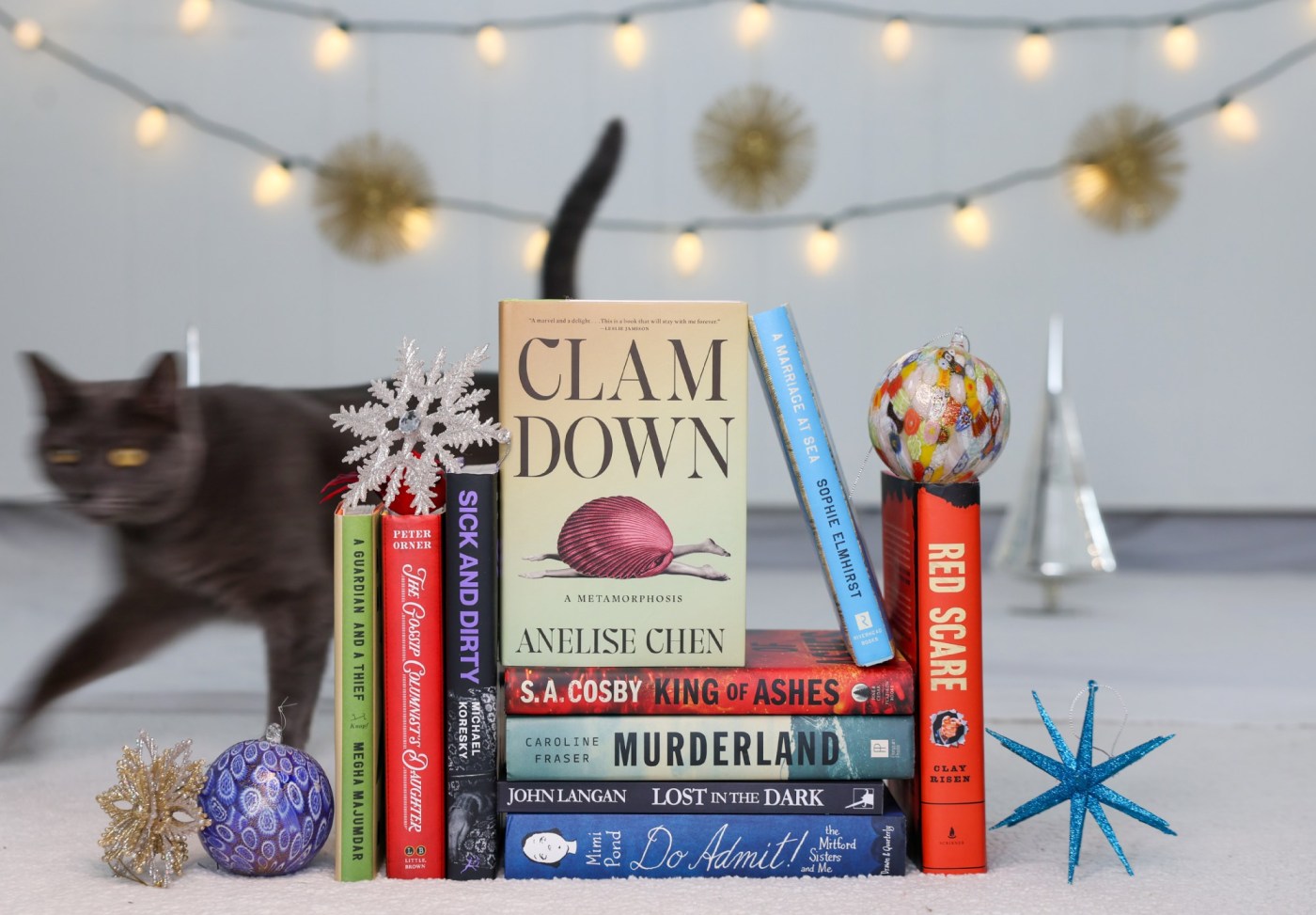
There are 49 books in front of me, stacked like colorful bricks in a wall. These are the 49 books I didn’t include in the Chicago Tribune’s 10 Best Books of 2025. If you’re curious about the recipe for this list, here’s how I do it: I read all year long, and when I finish a book and loved it — a comic book, a mystery, a history, essay collection, novel — I set it aside. As months roll on, the stack climbs, teeters. It lives inside a closet. Occasionally, I hear a collapse when the stack gets too tall.
By July, the rumbling begins.
Then, sometime in November, when I can no longer read another thing and the deadline for this list approaches, I drag it all out of the closet and intuitively separate out the books I haven’t been able to shake. When I have 10, I have a list. I wish it were more thoughtful. I do shift books in and out of the top 10 pile until I feel certain: My favorites. But basically, that’s the process.
Then, afterwards, I feel terrible.
The first week of January I recall thinking, of course Adam Ross’s “Playworld,” a disturbing novel about a child actor and a much older woman, will make the top 10 in December. Nope. Was there a lovelier physical book this year than “Syme’s Letter Writer,” an ode to correspondence by the New Yorker’s Rachel Syme? Not really, and yet, that didn’t make the final 10, either. Alexis Okeowo’s “Blessings and Disasters,” a portrait of Alabama, deserved more readers. Same goes for “The Autobiography of H. Lan Thao Lam,” Lana Lin’s communing with the spirit of Gertrude Stein, via Naperville. And same for Kevin Nguyen’s irreverent, prescient “My Documents,” which pictures the U.S. government putting Vietnamese-Americans in camps. And Virginia Feito’s delightfully cold “Victorian Psycho.” And Jeff Chang’s great Bruce Lee biography, “Water Mirror Echo.”
All of those and about 40 others should be in this top 10, too.
Still … what’s here? I’m jealous of anyone reading these for the first time. In no order:
“Clam Down: A Metamorphosis” by Anelise Chen. Technically a memoir, though so hilarious and original, it’s impossible to read as genre at all but rather, a novelistic tale of a writer weathering a divorce who opens a typo-ridden email from her mother, imploring her to “clam down.” Surrounded by social media, buried in research, Chen decides to embrace the metaphor: Should she retreat into a hard shell? Or open up and trudge on?
“Red Scare: Blacklists, McCarthyism and the Making of Modern America” by Clay Risen. I can’t quite put my finger on why, but the year was agog in echoing histories of hypocritical censorship and political bullying that eventually left the nation is a different place. A powerfully patient narrative account that goes beyond the familiar images of Congressional hearings and Joe McCarthy to the everyday fear-mongering that created a network of repression — and the everyday courage that, one day, toppled the hysteria.
“The Gossip Columnist’s Daughter” by Peter Orner. The best Chicago novel in ages. Rooted in Orner’s real background as a Highland Park native with family connections, a mesh of obsession, broken friendships and the nagging persistence of family legends, bundled into a true crime that was never solved: the murder of Karyn “Cookie” Kupcinet.
“A Guardian and a Thief” by Megha Majumdar. Two tales and a clock. A mother’s passport is stolen just before she gets her son and father escape to Ann Arbor. A pickpocket will do anything to feed his family. An instant classic, set against societal collapse and the wrenching calculations and contradictions families make to survive.
“Sick and Dirty: Hollywood’s Gay Golden Age and the Making of Modern Queerness” by Michael Koresky. An uncommonly fun and sophisticated dark cultural history that will drive you back to film. Did you know the Hollywood production codes (1934-1968) that buried gay life started with a meeting at Loyola University? Do you know how gay filmmakers carried on nevertheless, with clandestine cleverness? An absorbing landmark of film criticism at a moment when the practice itself is fading out.
“Lost in the Dark, and Other Excursions” by John Langan. Not a household name, but someday. Langan, the most bracingly classical of the new horror writers, is swinging for greatness here, with dense nail-biters that draw on the erudite, swirling language of Shelley and Lovecraft but lean back into the character-driven snap of Stephen King. An author tracks the extras on a horror DVD to a bleak history. Notes to a review of a Frankenstein novel lead to a vast darkness. An essay on horror lit grows very nasty. Langan, never far from the past, yet fond of experiments, reads like the future.
“Do Admit! The Mitford Sisters and Me” by Mimi Pond. A sprawling, virtuosic group-biography of the six infamous sisters who escaped their country estate, then tumbled through a 20th century of scandals, fascist friends and journalistic triumphs. Page after page, Pond, one of our great underrated cartoonists, finds original paths through history.
“A Marriage at Sea: A True Story of Love, Obsession and Shipwreck,” by Sophie Elmhirst. A word-of-mouth smash over the summer with good reason: What begins as survival tale — an economical, riveting account of a couple in 1972 whose boat is struck by a whale, then spend months alone in the open ocean, starving and despondent — heads to surprising depths once they are found, and are uncomfortable with dry land, the way their story gets told and their own feelings about what exactly survived the disaster.
“King of Ashes” by S.A. Cosby. Proof that crime fiction isn’t always a churn of brand-name antiheroes. And yet Cosby’s star continues upward, reminding us again that broad appeal and comfortable beats doesn’t mean empty writing. His latest may be inspired by “The Godfather” — a son returns to his family crematory business and ailing patriarch, only to face a power grab and the blowback of revenge — but it deposits you in seriously Shakespearean territory. Blissfully pulpy and mournfully tragic, all at once.
“Murderland: Crime and Bloodlust in the Time of Serial Killers,” by Caroline Fraser. You know the feeling you’d follow some writers anywhere? I felt it with Fraser in “Prairie Fires: The American Dreams of Laura Ingalls Wilder,” her 2018 Pulitzer winner. The grip only tightens here, dragging you into a scary, thrillingly reckless patchwork of correlation. The premise, that ecological pollution in the Pacific Northwest of the ‘60s and ‘70s bred a generation of neurologically-singed human monsters, likely is not airtight, and yet, a great writer can root you. Part true crime, part corporate screed, part coming-of-age memoir, part Rachel Carson, part victim memorial, Fraser constructs an enormous mood board dense with villains and propulsive detail, crossing, crisscrossing.
A masterpiece, and the best book I read all year.
cborrelli@chicagotribune.com
Leave a Reply