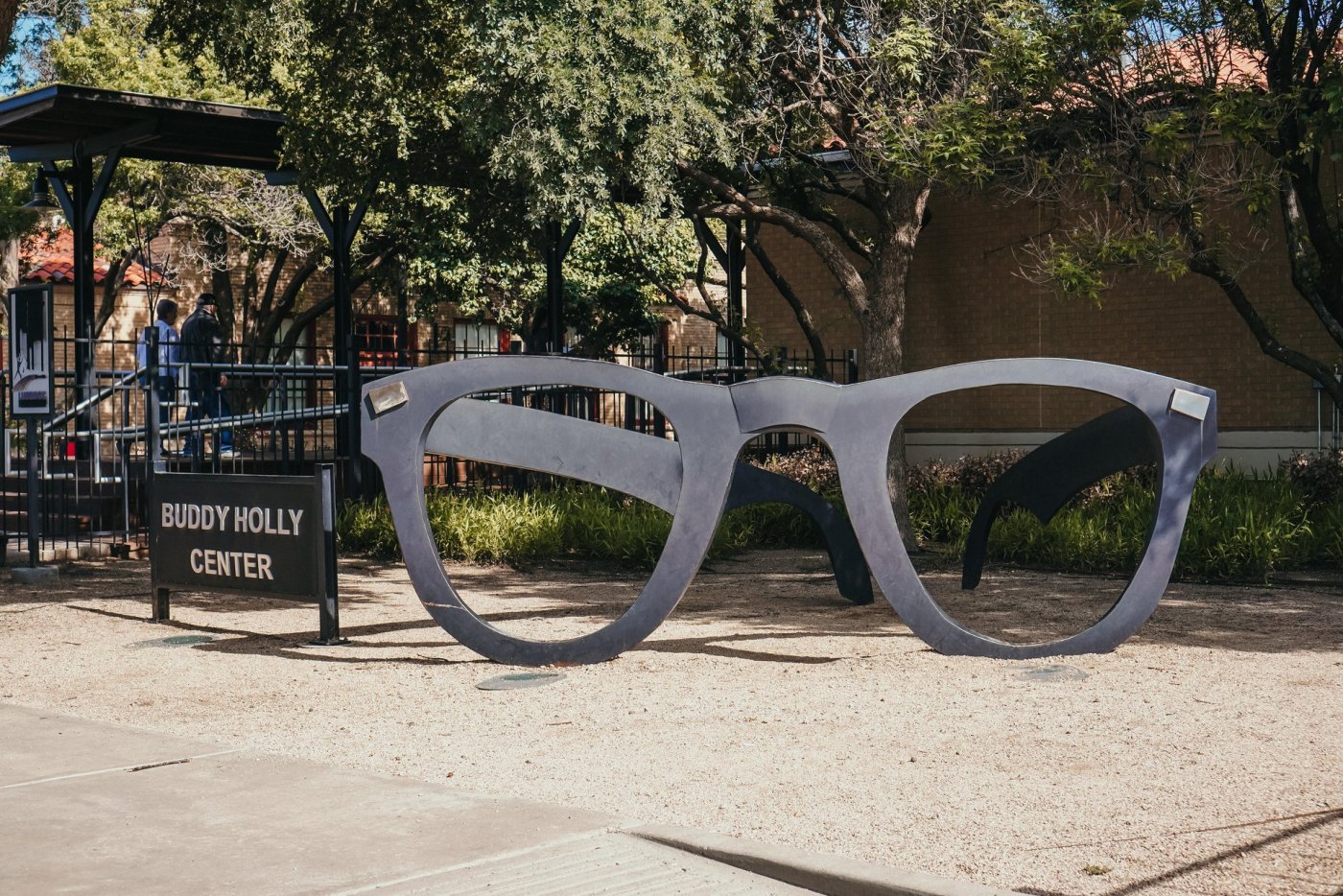
There are black-rimmed eyeglasses of various sizes all over Lubbock, Texas – some are large enough to climb into for a creative selfie, others are small symbols on magnets and postcards at breweries and gift shops around the city, and some are painted onto the asphalt to form a crosswalk border. The iconic symbol is a tribute to Lubbock’s favorite son, musician Buddy Holly.
Many Minnesotans can understand Lubbock’s obsession with all-things Holly. I mean, we have our own Prince memorabilia with painted murals, Paisley Park museum and purple paraphernalia throughout the Twin Cities. In Lubbock, the adoration is equally strong. I recently spent three days in the northwest Texas town of approximately 250,000 residents on an invitation from Visit Lubbock and saw firsthand how important Holly was to the area and to the music community in general. The man born Charles Hardin Holley in 1936 pioneered the popularity of rock ’n’ roll before his tragic death at age 22 in an airplane accident in Clear Lake, Iowa, in 1959 that also killed Ritchie Valens, and “The Big Bopper” J. P. Richardson. Lubbock’s love of Holly and his musical genius is just one pleasant surprise I discovered during my visit. Here’s a look at some of the highlights.
Back to the beginning
Signage at the Buddy Holly Center in Lubbock, Texas. (Photo courtesy of Amy Nelson)
Our group of travel writers saved a tour of the Buddy Holly Center until the final day of our trip, but I would suggest starting here to get an immediate sense of Lubbock’s vibe. Located on Crickets Avenue (named after his famous band), this museum is not to be confused with the new Buddy Holly Hall of Performing Arts and Sciences concert venue (more on that later). At the museum, we caught a 15-minute film documenting Holly’s life and influence for his songs, including “That’ll Be the Day” and “Peggy Sue.” I experienced a very meta moment while watching Paul McCartney discuss on film how Holly impacted him and everyone else in the Beatles (allegedly named after the Crickets) while reading a text from a friend who was inviting me to McCartney’s spectacular concert at U.S. Bank Stadium in Minneapolis the next night. Of course I went; it was karma.
After the film, I toured the compact but well-curated gallery of Holly’s personal items, including those famous eyeglasses and the 1958 Fender Stratocaster guitar, the last guitar he ever played. I chatted with very passionate docents about the memorabilia, and one led me to a display case that included the tour schedule for Holly’s final performance. I knew that my mother-in-law had seen Holly perform in Wisconsin a few days before his death, and there it was – proof that he had played Green Bay’s Riverside Ballroom just two days earlier. I got a bit of a chill realizing how fortunate she was to have seen that concert.
Symbolic guitar picks that represent investors in the Buddy Holly Hall of Performing Arts and Sciences in Lubbock, Texas. At the center is Sir Paul McCartney. (Photo courtesy of Amy Nelson)
And the day before that performance, a young Bob Dylan (then Bobby Zimmerman) attended Holly’s concert in Duluth, which he cites as “the dawning of it all.” After our time exploring the center, we walked next door for a guided tour of the Allison House, a remarkable re-creation of the house that Crickets drummer Jerry Allison grew up in and where he and Holly first formed a band.
On a different day, our group toured the Buddy Holly Hall of Performing Arts and Sciences, a $158 million performance venue that opened in 2021. With two theaters, a restaurant and a ballet school adjacent to the center, the gorgeous building attracts big names and events, from Broadway musicals to the Lubbock Symphony Orchestra to Joan Jett and the Blackhearts. Our guide showed us a hallway decorated with signatures and decals of the acts who have come through, sharing a bit of lore that Bob Dylan is one of only a few performers to decline signing the wall when he performed there in March 2022 (but he did sign a register). Paul McCartney’s name popped up again as a micro-investor who helped support the hall’s construction, and our guide pointed out the guitar pick inscribed with his name on the artistic wall of symbolic picks. Look closely, and you’ll see these picks are arranged to form a torso of Holly and his guitar. It’s a neat little trick once you spot it.
Beyond Buddy
Agave Dreams, a statue on the Texas Tech campus in Lubbock, Texas. (Courtesy of Amy Nelson)
Music and performing arts aren’t the only artistic expressions in Lubbock, however. One part of the tour took us to the Texas Tech campus, right in the heart of the city, where we spent the afternoon learning about the commissioned sculptures and public art across the sprawling grounds. I was surprised to learn Texas Tech’s Lubbock campus is 1,839 acres in size, compared with the University of Minnesota’s estimated 1,150 acres across both the Minneapolis and St. Paul areas.
As college students zipped around on scooters and scurried to their various classes, we boarded the program’s art bus to explore campus and learn more about the nearly 150 pieces of art by more than 140 artists across the system’s eight campuses. The Lubbock location is the largest, and we saw more than a dozen works, all site-specific to their location. For instance, outside the Experimental Sciences Building, a stainless steel and aluminum sculpture titled Astrolab by American artist Owen Morrell reflects the research students and professors are conducting inside. A striking and magnetic sculpture titled Agave Dreams by German artist Juilan Voss-Andreae sits in a cactus garden outside the Biology Building. It’s a point of pride that Texas Tech’s collection has been named one of the top 10 public art collections in the United States by the prestigious Public Art Review. I was thankful we had the bus to transport us around, because walking to the various pieces we saw would have been at least several miles on a hot Texas day.
Branding irons at the National Ranching Experience in Lubbock, Texas. (Photo courtesy of Amy Nelson)
Ranching also plays a big role in Lubbock and throughout Texas, which we learned about at the National Ranching Experience, a 27-acre museum and outdoor historical park. All but five of the 53 historic structures in the park are between 100 and 200 years old, showcasing the history of ranching. The day we visited, several school groups were touring the outdoor structures as well as the new Cash Family Ranch Life Learning Center, an interactive museum where we learned the difference between ranching and farming and the many types of prairie grasses.
And with ranching comes Lubbock’s other obsession: fantastic food, especially barbecue. We had it for lunch at Evie Mae’s BBQ, in exotic form at The Nicollet and with the famous fried chicken at Dirk’s. The only place I didn’t try some form of barbecue during the visit was at breakfast at Cast Iron Grill. But that’s because there, it’s pie for breakfast, which we certainly sampled. It’s the perfect place to start the day — for the pies, and because it’s located right next to the Buddy Holly Center and those oversized frames.
Related Articles
New holiday movie features the off-season charms of Door County, Wisconsin
The best U.S. airports for drinking alcohol, ranked
The best food cities in America for 2025
Consumers should do their research before giving in to Travel Tuesday temptation
US air travelers without REAL IDs will be charged a $45 fee
Leave a Reply