On November 13, surrounded by family and listening to Guy Clark songs in the capital of the state on which he left such an enormous mark, David Richards left us at the age of 92.
How to capture the life of such a man in such a small space?
The obituary his daughter, Ellen Richards, wrote follows David and Ann Richards from law school in Austin to Dallas, where David joined the Mullinax & Wells law firm, then back to Austin, leaving behind what David would later describe as a right-wing hysteria that made Dallas “a scary place.”
In Austin, he joined Sam Houston Clinton’s law practice—the office also housed the ACLU and the Texas Observer—and he and Ann quickly found their way to Scholz Garten, the gravitational center of a wildly eclectic universe of lawyers, legislators, writers, and agitators. There, Ellen writes, David would spend hours holding court.
Holding court. David Richards knew how to tell a story. A story that grabbed you and didn’t let you go.
A Rio Grande whitewater trip gone bad with overturned canoes washing downstream into the Santa Elena Canyon. Grabbing Molly Ivins by her lifejacket and hoisting her back onto the raft as she tumbled into a roaring rapid at the bottom of the Grand Canyon. An impulsive decision to throw in with Gary Cartwright, Jodie and Pete Gent, and Bud Shrake in a plan to buy the town of Sisterdale. His only meeting, as a young man in D.C., with LBJ, who ripped into him after he mentioned an article from this publication, forgetting that the author wasn’t sufficiently flattering to the great man.
Captivating, funny, profane, contemptuous of establishment figures who busted unions, shut minorities out of power, and claimed ownership of the state’s Legislature and executive mansion, David always left you wanting more. One more dinner gathering. One more night with the tab open at Shorty’s in Port Aransas. One more story.
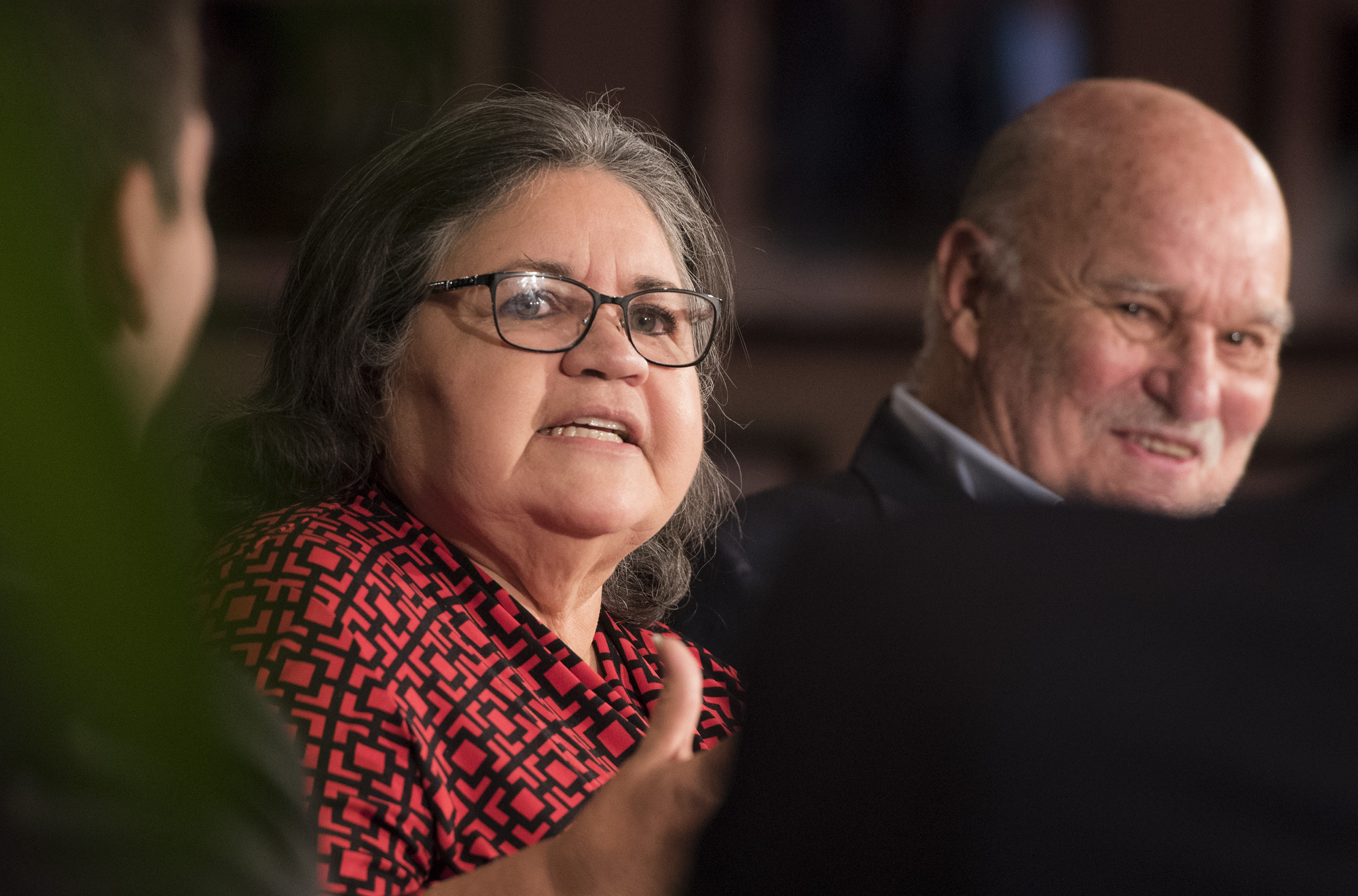
In November 2017, the LBJ Presidential Library held a discussion about gerrymandering and voter ID including Norma Cantú, professor of law and education at UT-Austin, and David Richards (right). (LBJ Library, Public domain, via Wikimedia Commons)
As a lawyer, David devoted a career to dragging those establishment figures into court, methodically putting together a string of judicial victories that dramatically changed the political and economic landscape of what his friend Molly Ivins referred to as the Great State.
“If there’s anything good in Texas—academic freedom, labor, voting rights, education, politics—his litigation facilitated it. He did all that,” said George Korbel, who tried numerous cases with David.
Overstated? Only slightly. David Richards filed and won lawsuits in every category Korbel mentions. And a few more.
Labor causes of action in Dallas. Mexican-American furniture workers getting their day in court in Austin. Farmworkers in the Rio Grande Valley (with David joining their weeks-long pilgrimage from the Valley after Governor John Connally and then-Speaker Ben Barnes confronted them to warn that they marched on to Austin at their own risk.) Voting rights cases in East Texas, where attorney Otto Mullinax carried a pistol for protection. What Korbel described as “drive-by lawsuits when West Texas got to be as dangerous as East Texas and we would only meet with clients when it was daylight.” And half a dozen cases before the U.S. Supreme Court (the only lawyer Korbel ever knew who could dictate a Supreme Court brief in one take).
“If he’d quit after Regester, he would have accomplished more than most lawyers do in a lifetime,” Guy Herman, a Travis County judge, observed at the gathering celebrating David’s ninety-second birthday.
Regester v. White, ultimately decided by the Supreme Court in 1973, was the most consequential and far-reaching lawsuit David filed. The political and business establishment had used multi-member districts to shut Black and Latino candidates out of the state Legislature. Dallas County was about fifteen-percent Black, yet it went decades without electing a Black state legislator because in county-wide elections white voters supported white candidates. In Bexar County, Mexican-American candidates in San Antonio faced the same demographic dead end. The lawsuit was such a big threat to the state’s business and political elite that Leon Jaworski, later of Watergate fame, signed on pro-bono to defend the status quo.
As lead counsel, working with Ed Idar of the The Mexican American Legal Defense and Educational Fund, David prevailed. When the top court ruled for the plaintiffs, the roadblock Black and Latino Texans faced in the state Legislature was dismantled. Racial barriers began to come down across Dixie and beyond, as Korbel explained: “Lawyers across the country went to court and used the basis David came up with in Regester v. White.”
St. Mary’s law professor Al Kaufman said of David, “He covered so much. Labor law, voting rights, education funding.” Kauffman worked alongside him on many cases, including the complicated and belabored Edgewood v. Kirby lawsuit that compelled the state to more equitably fund public education.
Kauffman credits Richards with devising the “efficiency argument” that persuaded the Texas Supreme Court. “He saw issues that others didn’t see, and he articulated them so well, and he had a good sense of how law relates to politics and movements and labor.”
David would later find delight when critics from rich districts bemoaned a “Robin Hood” lawsuit that would move their tax dollars to poor districts. Since he was a child, he’d considered Robin Hood his personal hero.
And David never quit.
“You know, David and I redistricted the City of Austin [after the 2020 census]. He did it over the phone, most of it. I attended the meetings and he would do the districts. And he was perfect,” Korbel said.
David’s life was long and varied, as his daughter’s remembrance lays out; he married Sandy Hauser after Ann and, in 2016, his last life partner, Nancy Novack. “On quiet evenings, David, cocktail in hand, would sit with Nancy on the patio watching as the last birds visited the feeder and the sun dipped beyond the horizon,” the obituary—which asks that memorial contributions be made to the Texas ACLU or Democracy Forward—reads.
How, then, to remember David Richards? Consider this for a moment.
East Texas in the 1970s was firmly in the grip of Jim Crow Democrats who owned their elected offices because no Black candidate could win an at-large election. Politically and culturally, the counties east of the Pine Curtain felt like a westward extension of the Mississippi Delta, where Black neighborhoods were known as “the colored quarters” and Klansmen openly gathered in their favorite coffee shops.
David was part of a suite of lawsuits and went to William Wayne Justice’s courtroom to break the white establishment’s lock on political power. His description of one initial hearing, if you were lucky enough to hear him tell it, was riveting and cinematic.
“The courtroom was divided. Blacks on one side, Whites on the other. Divided like a wedding party, bride’s family and groom’s family,” as he told the story once in 2000. “I sat with Arthur Weaver beside me, his Black supporters filling our side of the courtroom. On the other side, the defendants and their supporters, their Stetsons sitting on the bench behind them, their red necks bulging over shirts and ties they almost never wore. They sat listening to the ‘amens’ from our Black supporters every time we made a point. And you could sense they were beginning to understand that they were looking up at a judge named William Wayne Justice who was about to hand down a ruling that would change life as they knew it forever.”
After Judge Justice ruled for the plaintiffs, Pastor Amos Henderson became the state’s first Black candidate elected to county office in the twentieth century.
David would turn the Nacogdoches lawsuit into a litigation roadshow, working with other lawyers, finding plaintiffs, filing a string of lawsuits that knocked down Jim Crow barriers that stood against Black political representation in East Texas since Reconstruction.
Half a century ago in deep East Texas, David Richards was a beacon of light in a dark corner of a dark state at a dark moment in its history. Two months before he died, over lunch, he said that as dark as Texas is today, he saw a few glimmers of hope.
Glimmers. Go out and find one. Make one happen. Paint a sign and take it into the street to speak truth to power. Write a check to an organization fighting for your values. Stand between ICE agents and decent people facing deportation. Go to the polls. Take your neighbors with you.
An authentic American hero has departed.
The post Remembering David Richards, 1933-2025 appeared first on The Texas Observer.
Leave a Reply