“These cuts are being strongly felt among our community before they even hit them,” said Carlyn Cowen, chief policy and public affairs officer at the Chinese-American Planning Council.
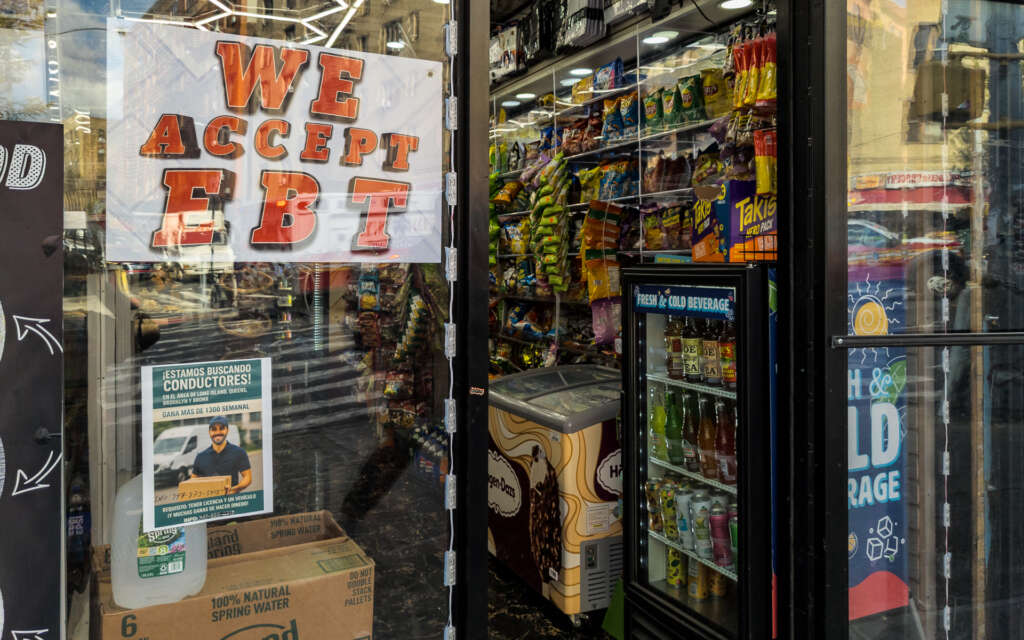
An EBT sign in a storefront on East Gun Hill Road in the Bronx. (Adi Talwar/City Limits)
New York Attorney General Letitia James and attorneys general from 21 other states are suing the U.S. Department of Agriculture over a new rule they say would permanently bar refugees and asylees from participating in the Supplemental Nutrition Assistance Program (SNAP).
The exclusion stems from the One Big Beautiful Bill passed by federal lawmakers this summer, which included substantial alterations to the nation’s social safety net programs.
That includes expanded work requirements for SNAP recipients—which are, for now, on hold locally until next year—and new eligibility parameters that exclude victims of trafficking and several legally present immigrant groups from the benefits.
The U.S. Department of Agriculture (USDA), the federal agency in charge of the SNAP program, issued a memo in late October stating that the government no longer considers refugees, people granted asylum, and parolees eligible for food assistance.
While undocumented immigrants have never been eligible for SNAP, the above groups and victims of trafficking were able to apply for food assistance benefits as soon as they obtained that protected status, and as long as they met the program’s other requirements. The One Big Beautiful Bill eliminated that eligibility.
The AGs’ lawsuit says that the USDA’s memo goes even further than what Congress laid out in the bill, claiming it would close all possibilities for these groups to qualify for SNAP, even if they become lawful permanent residents—one of the few non-citizen groups still eligible under the Trump administration’s changes (though after a five year waiting period).
“The federal government’s shameful quest to take food away from children and families continues,” Attorney General Letitia James said in a statement last week, announcing the lawsuit. “USDA has no authority to arbitrarily cut entire groups of people out of the SNAP program, and no one should go hungry because of the circumstances of their arrival to this country.”
Under the Big Beautiful Bill, the government will cut funding for the SNAP program—formerly known as food stamps—by $187 billion through 2034, representing a 20 percent cut, according to the Congressional Budget Office.
The timing couldn’t be worse: SNAP recipients already saw their benefits delayed for over a week in November because of the federal shutdown, while many states and localities aren’t sure how to implement the new eligibility measures.
The federal government says the changes haven’t taken effect yet.
“Due to the complex nature of non-citizen policy, USDA is in the process of developing further guidance based on questions from SNAP State Agencies and partners,” a USDA spokesperson said in a statement.
New York’s Office of Temporary and Disability Assistance (OTDA), which administers the program on the state level, said it has not yet issued implementation guidance to local districts following the USDA’s October memo.
In New York City, officials assured that people should not be losing their benefits yet. “We always work to protect all vulnerable New Yorkers, and no one has yet been impacted by any changes,” a spokesperson for the New York City Department of Social Services (DSS), which runs SNAP in the five boroughs, said in a statement to City Limits.
But should the new requirements move ahead, about 15,000 non-citizens in New York City alone could be impacted, according to DSS’ internal estimates. Officials say that any new guidelines for implementing the system depend on what the state stipulates. Even if these changes are put into place, affected SNAP beneficiaries will not see any changes until they are recertified, the spokesperson said.
According to the Congressional Budget Office, 90,000 people under the non-citizen category could lose benefits across the country. According to the Attorney General’s Office, as many as 35,000 New Yorkers across the state could lose benefits.
The Chinese-American Planning Council—which serves low-income and immigrant Asian American New Yorkers—estimates that 20 percent, or 2,000, of the roughly 10,000 SNAP recipients the organization works with could be impacted, according to Carlyn Cowen, chief policy and public affairs officer.
“Just to give you an idea of the level of fear and the scale of impact that these cuts are having in the weeks before we heard about [it]… we had multiple community members calling in asking about what would happen to their SNAP benefits,” Cowen said. “We had a community member experiencing a mental health crisis because they were worried. He was worried he wouldn’t be able to feed his family.”
“These cuts are being strongly felt among our community before they even hit them,” Cowen added.
Tina Lopez, the International Rescue Committee’s executive director in New York, said access to SNAP “was an integral part of the U.S. refugee and humanitarian programs under federal law.”
“[SNAP] really does become vitally important, particularly for survivors of human trafficking to have these essential food services when they are experiencing such instability,” Lopez said. “These essential food services create that stability that they need to gain back the mental health resources to survive and thrive.”
Chia Chia Wang, New York director for Church World Service, an organization working with vulnerable populations internationally, underlined that community members are uncertain about their futures.
“Their ability to access the benefits they do qualify for may be undermined by numerous efforts that make their lives harder,” Wang said.
In addition to the SNAP eligibility changes, the Trump administration announced new rules last month around the “public charge” policy—a way for immigration officers to see if immigrants use public benefits.
The increased scrutiny did not stop there: on Nov. 24, U.S. Citizenship and Immigration Services (USCIS) issued a memo calling for a “review and re-interview” of all refugees admitted in the country during the Biden administration: about 233,000 people.
According to the memo, first reported by Reuters, USCIS would continue to review refugees admitted in other periods afterwards.
“Federal eligibility rules and other policy changes have created a chaotic situation for immigrants, refugees, and advocates alike,” Wang said.
To reach the reporter behind this story, contact Daniel@citylimits.org. To reach the editor, contact Jeanmarie@citylimits.org
Want to republish this story? Find City Limits’ reprint policy here.
The post New York Sues Trump Administration Over SNAP Changes That Would Exclude Thousands of Legal Immigrants appeared first on City Limits.
Leave a Reply